
Offshore medical exams are required to ensure workers are physically and mentally prepared for the challenges of remote, high-risk environments. These evaluations focus on identifying health issues that could lead to emergencies where evacuation or medical care may be delayed. They also help companies comply with strict legal and safety regulations.
Key Points:
- Purpose: Assess physical and mental fitness for offshore work and survival training.
- Legal Compliance: Required under laws like the Health and Safety at Work Act 1974 and Marine Order 55.
- Health Risks Addressed: Cardiovascular health, mental resilience, exposure to hazards (e.g., noise, toxic substances).
- Certification Validity: Typically valid for 2-5 years, depending on the jurisdiction.
- Penalties for Non-Compliance: Fines, suspension of operations, or legal action.
Workers undergo tests for physical fitness, mental health, and drug/alcohol screening. Updated guidelines, such as the OEUK Issue 8.1, now include stricter requirements like weight thresholds and role-specific fitness tests. Digital platforms like ABLEMKR simplify tracking certifications and compliance, ensuring safer and more efficient workforce deployment.
Wind Turbine Medical Exam + Chester Step – Watch it being done!
sbb-itb-aa28329
Legal and Regulatory Requirements
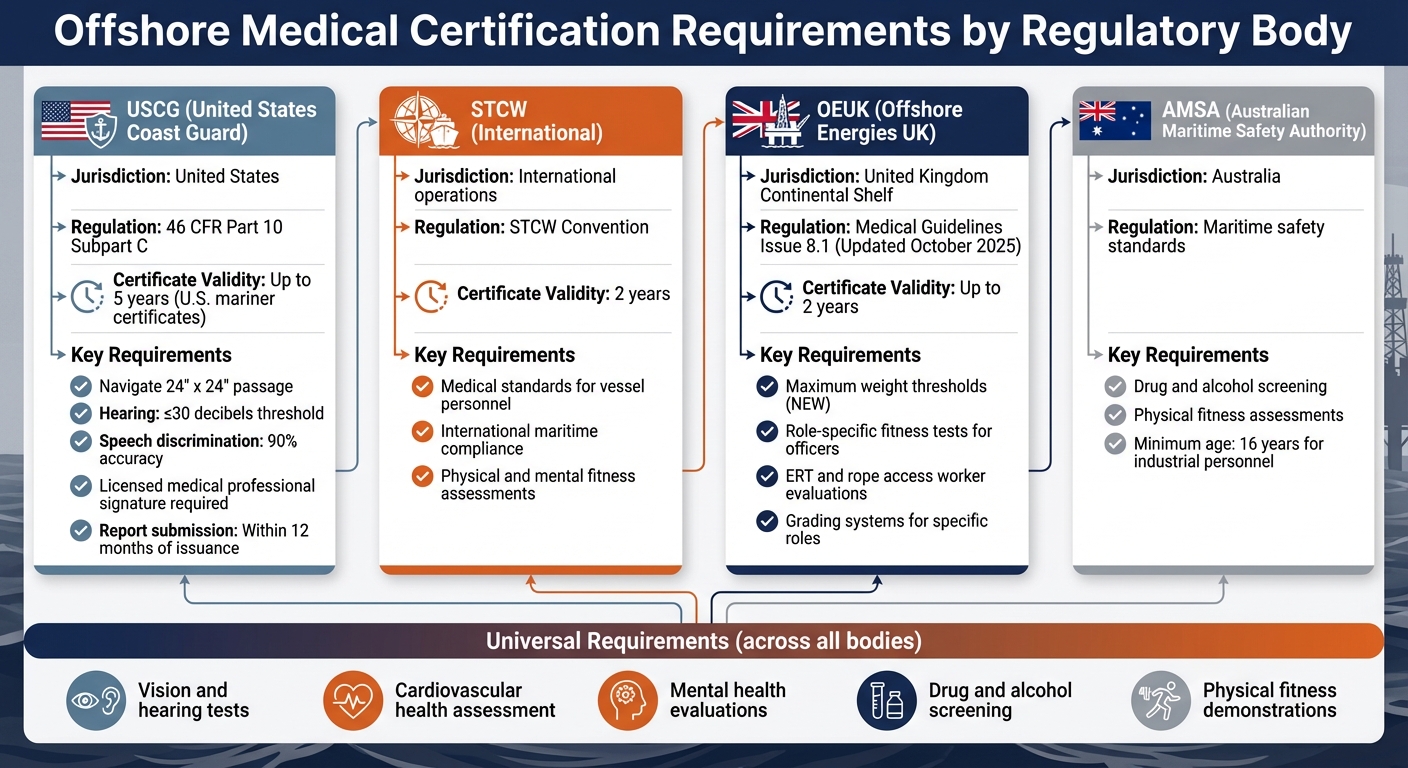
Offshore Medical Certification Requirements by Regulatory Body
Regulatory Bodies and Standards
Different jurisdictions enforce specific offshore medical exam standards, often overseen by regulatory bodies. In the United States, the United States Coast Guard (USCG) manages medical certification for merchant mariners and offshore workers under 46 CFR Part 10 Subpart C. These standards include rigorous physical requirements, such as the ability to navigate a 24-by-24 inch passage.
For international operations, the STCW (Standards of Training, Certification and Watchkeeping) Convention outlines medical standards for personnel on applicable vessels. STCW medical certificates are generally valid for 2 years, while other U.S. mariner certificates may extend to 5 years. The USCG also enforces specific hearing requirements, such as a threshold of 30 decibels or less and 90% speech discrimination accuracy.
In the United Kingdom, Offshore Energies UK (OEUK) provides a comprehensive medical fitness framework through its "Medical Guidelines – Issue 8.1" (updated October 2025). These guidelines are widely recognized across the UK continental shelf. Additionally, the COSHH (Control of Substances Hazardous to Health) Regulations require health surveillance and risk assessments for offshore workers exposed to hazardous materials.
These stringent standards demand full compliance, with heavy penalties for violations.
Compliance and Penalties
Adhering to these regulatory standards is just as important as the medical examinations themselves. Non-compliance can lead to severe consequences, including fines, suspension of operations, or other enforcement actions. Regulatory authorities conduct regular safety audits, offshore site inspections, and require mandatory incident reporting. Enforcement officers have the authority to issue orders, levy fines, suspend approvals, or initiate legal proceedings.
For example, in the Canada-Nova Scotia offshore area, operators are legally required to obtain authorization before starting any work or activity. This includes submitting detailed medical care and safety plans. Failing to address health risks, such as asbestos exposure, can result in enforcement actions and substantial financial penalties. To remain valid, medical exam reports must be signed by a licensed medical professional and submitted within 12 months of issuance.
These regulations not only ensure compliance but play a key role in reducing health risks in offshore environments.
What’s Included in Offshore Medical Exams
Offshore medical exams go far beyond a routine checkup. These evaluations are specifically designed to ensure workers can handle the physical, mental, and operational demands of offshore environments. Each component is tailored to address risks that could impact safety or performance in these challenging settings.
Physical Fitness Tests
Physical fitness is the cornerstone of offshore medical clearances. Vision and hearing tests are mandatory across international maritime and offshore industries to ensure workers maintain situational awareness in high-risk environments. Cardiovascular health is also assessed to confirm that workers can endure the physical demands of offshore tasks and respond effectively in emergencies.
The OEUK Issue 8.1 guidelines, updated in October 2025, have introduced a maximum weight threshold for offshore workers. For specialized roles like Deck Officers, Engineering Officers, and Offshore Installation Managers, practical demonstrations of physical capability are required. Additionally, workers must often complete assessments to confirm they can handle mandatory offshore survival training. Members of Emergency Response Teams (ERT) and rope access workers undergo even more rigorous fitness evaluations tailored to their high-intensity roles. These standards reflect updated regulations aimed at ensuring workers are prepared for emergency scenarios.
While physical fitness is crucial, mental resilience is equally vital in offshore environments.
Mental Health and Stress Evaluations
Mental health is just as important as physical fitness when working offshore. These evaluations focus on a worker’s ability to cope with isolation and high-pressure work conditions. They often include a review of the individual’s medical history alongside a physical exam to identify any issues that could affect safety or job performance.
The OEUK Medical Guidelines (Issue 8.1), updated in October 2025, set the standard for these evaluations in the UK energy sector. These assessments help reduce work-related illnesses, minimize absenteeism, and limit the need for costly emergency medical evacuations – an essential factor given the remote nature of offshore operations. By addressing mental health, these exams ensure compliance with occupational health standards designed to protect workers in high-risk, isolated environments.
After mental health evaluations, drug and alcohol screening adds another layer of safety compliance.
Drug and Alcohol Screening
Drug and alcohol screening is a mandatory part of offshore medical exams. These tests ensure workers are not impaired by substances that could compromise safety in critical situations. The screening is integrated into the overall medical fitness assessment and must adhere to standards set by regulatory bodies like the Australian Maritime Safety Authority (AMSA) and the U.S. Coast Guard (USCG).
For U.S.-based mariners, the Coast Guard has the final say on medical and physical qualifications. Roles such as Offshore Installation Manager (OIM), Barge Supervisor (BS), and Ballast Control Officer (BCO) require general medical exams performed or reviewed by licensed professionals, including Medical Doctors, Physician Assistants, or Nurse Practitioners. Additionally, industrial personnel must be at least 16 years old to meet the medical and physical fitness requirements. This screening process ensures compliance with both international and U.S. maritime safety regulations, maintaining operational standards across the board.
Safety Benefits of Medical Clearances
Medical clearances aren’t just about meeting requirements – they’re about preventing emergencies before they happen. In offshore environments, where hospitals are hours away, identifying health issues early can avoid the need for complex first aid or costly emergency evacuations. The Health and Safety Executive highlights this clearly: "The key priority is to prevent ill health arising out of conditions at work by identifying, assessing and controlling health risks". This proactive approach is especially critical in remote locations, where even minor health concerns can quickly escalate into serious problems.
Reducing Health Risks in Remote Locations
Offshore installations are often isolated, far from immediate medical care, making pre-deployment medical screening essential. These clearances help detect health irregularities before workers even set foot in these remote environments. By ensuring workers have the "initial and continued fitness" required for their roles, medical screenings reduce the risk of medical emergencies in areas where specialized treatment is unavailable.
Modern practices go beyond basic yes-or-no evaluations. Today, medical examiners use comprehensive risk assessments to evaluate not just an individual’s health but also their ability to meet the physical demands of specific offshore roles. This includes referencing detailed job task analyses to ensure a worker’s fitness aligns with their job responsibilities. Frameworks like the OEUK Medical Guidelines (Issue 8.1) set the standard for assessing fitness across the UK continental shelf, with specific grading systems for roles like Emergency Response Teams (ERT). In an offshore emergency, there’s no room for doubt – responders must be physically capable of meeting the challenges head-on.
Protecting Workers and Teams
Medical clearances do more than protect individuals – they safeguard entire teams. A single worker’s health issue can compromise crew safety and disrupt operations. The Energy Institute underscores this point: "Medical standards are an important part of the oil industry’s philosophy to maintain a safe working environment where individuals are able to function safely and effectively without risk to the plant, environment or others".
For high-demand roles like Emergency Response Teams and rope access positions, fitness evaluations are even more rigorous, ensuring workers are prepared for the physical challenges of offshore work. These clearances also confirm that workers can handle the intense offshore survival training required before deployment.
Ongoing health surveillance plays a critical role in preventing chronic conditions caused by workplace hazards like noise, vibration, and exposure to harmful substances. While fatal accidents often grab headlines, work-related illnesses are a more common issue for offshore workers. This makes medical clearances not just a regulatory formality but an essential layer of protection for both individuals and their teams in these high-risk environments.
Using Technology to Track Compliance
Offshore worker safety and regulatory compliance have come a long way, thanks to digital platforms that simplify the management of medical certifications. What used to involve juggling outdated and scattered records is now handled through centralized systems. These platforms securely store medical records, certifications, and training data in one place, giving employers real-time updates on every worker’s compliance status.
How Digital Platforms Support Compliance
Centralized, cloud-based platforms are game-changers for compliance tracking. They automatically flag certifications that are about to expire or are missing altogether. By syncing with HRIS and LMS systems, these platforms integrate compliance data directly into crew scheduling, ensuring seamless operations. For offshore projects, this automation helps avoid costly deployment delays.
One standout feature is compliance-driven scheduling. These systems prevent deploying personnel who don’t meet the required medical or safety standards. Every action is logged, creating an audit-ready record that aligns with international standards like ISO or OEUK. Workers also benefit from mobile apps that let them upload new certifications, complete health forms, and check results anytime, making administrative tasks much smoother.
The efficiency gains are undeniable. Even a 1% boost in crew scheduling efficiency can save hundreds of thousands of dollars per vessel annually. Digital platforms also allow employers to tailor medical and safety requirements by role, project, or region. This ensures workers are pre-screened for the exact criteria needed in high-risk environments.
By combining compliance with streamlined processes, these tools are reshaping workforce mobilization.
How ABLEMKR Manages Workforce Deployment

ABLEMKR takes digital compliance tools to the next level, redefining how workforce deployment is handled in energy and extractive industries. The platform maintains a database of pre-vetted workers, verifying offshore medical certifications, safety training (such as BOSIET, TWIC, and OPITO), and background checks before adding them to the talent pool.
When operators face urgent needs, like last-minute shutdowns or remote pipeline repairs, ABLEMKR’s scheduling dashboard provides real-time insights into worker availability and credentials. This ensures only workers with up-to-date certifications appear in search results. Its mobile-first design matches workers to job sites based on their certifications, training, location, and availability – cutting out manual checks and speeding up deployment.
Conclusion
Offshore medical exams play a critical role in safeguarding workers, teams, and operations in some of the most challenging and remote environments. These evaluations go far beyond routine checkups, ensuring that each individual is physically and mentally prepared to handle the unique demands of offshore work. As Sigma Health explains:
These in-depth assessments, beyond a basic checkup, identify any underlying health conditions that could impact an individual’s ability to perform their duties safely. This proactive approach reduces accidents and injuries, fostering a safer work environment.
Regulations further emphasize the importance of these exams. They help prevent costly medical emergencies, reduce operational downtime, and keep crews fully capable – even in isolated areas where advanced medical care is not readily available.
The advantages are undeniable. Identifying health issues early not only protects lives but also ensures that operations run smoothly without unexpected disruptions. With OEUK certificates typically valid for up to two years and costing between $150 and $310 (roughly £120 to £250), this modest expense is a small price to pay compared to the potential costs of emergency evacuations or halted projects.
Advances in digital solutions have simplified the management of these certifications. Platforms like ABLEMKR demonstrate how technology can streamline compliance tracking and improve workforce deployment, helping offshore operations maintain safety and readiness without compromise. By combining strict regulatory compliance with innovative digital tools, the industry achieves both safety and operational efficiency.
FAQs
What medical conditions can disqualify me from offshore work?
Certain health conditions can prevent individuals from working offshore due to safety risks. These include severe heart diseases, uncontrolled high blood pressure, serious lung conditions, and certain neurological or musculoskeletal disorders. Psychiatric conditions, infectious diseases, or a history of organ transplants might also disqualify someone if they increase safety or health risks. Medical evaluations typically assess factors like stability, physical functionality, and the likelihood of sudden incapacitation in remote, high-risk settings.
How do offshore medical requirements change by country and role?
Offshore medical requirements aren’t one-size-fits-all – they vary based on the country and the specific role. Countries like Norway, the UK, the U.S., and Australia have their own sets of medical exams designed to align with their regulatory standards. The type of job plays a big role too. Higher-risk positions often demand more detailed medical evaluations. All of this is aimed at ensuring workers are physically prepared to handle the challenges of offshore work while keeping safety a top priority.
What happens if my offshore medical certificate expires before deployment?
If your offshore medical certificate expires before your deployment, you’ll probably be considered unfit to work offshore until it’s renewed. Expired certificates typically don’t meet safety compliance standards, making it crucial to have a valid, up-to-date certificate to satisfy regulatory requirements and remain eligible for deployment.


