
When hiring in Ohio, deciding between a W-2 employee or a 1099 contractor directly impacts your business’s tax obligations, costs, and compliance risks. Here’s what you need to know:
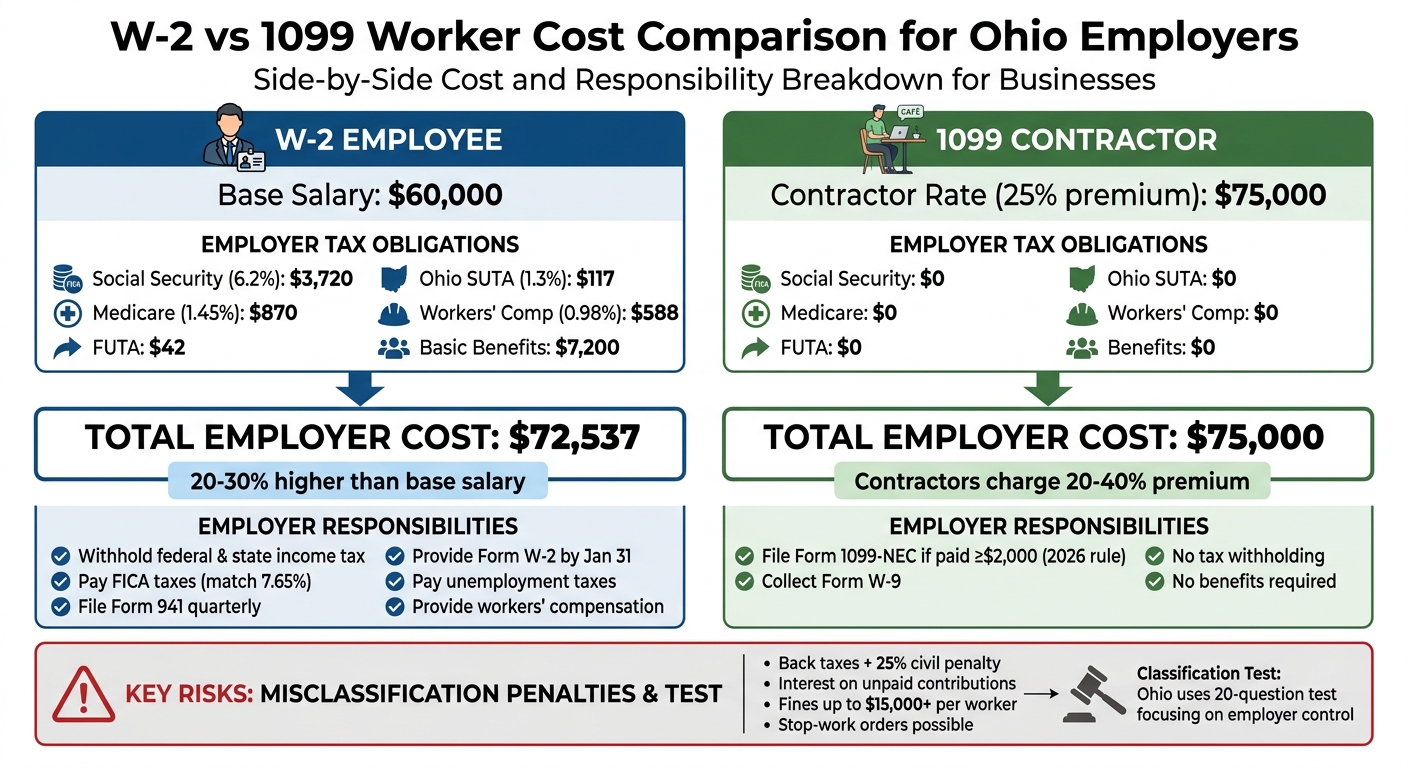
- W-2 employees: Employers withhold taxes, pay Social Security (6.2%), Medicare (1.45%), unemployment taxes, and workers’ compensation. Total costs are typically 20–30% higher than the employee’s salary.
- 1099 contractors: Employers avoid tax withholdings and additional payments but must issue Form 1099-NEC for payments over $2,000 annually (new 2026 rule). Contractors handle their own taxes, including a 15.3% self-employment tax.
Key Risks: Misclassifying workers can lead to Ohio and federal penalties, including back taxes, interest, and fines up to $15,000 per worker. Ohio uses a 20-question test to determine worker classification, focusing on control over work.
Cost Comparison:
- A $60,000 W-2 employee costs about $72,537 after taxes and benefits.
- A 1099 contractor charging a 25% premium costs $75,000.
Proper classification ensures compliance and prevents costly penalties. Employers should evaluate control, maintain documentation, and review worker relationships annually.
W-2 vs 1099 Worker Cost Comparison for Ohio Employers
Differences between W-2 and 1099 workers for small businesses
sbb-itb-aa28329
Federal Tax Obligations: W-2 vs 1099 Workers
Federal tax rules vary significantly depending on whether you’re dealing with W-2 employees or 1099 contractors. With W-2 employees, employers play an active role in withholding and matching taxes. On the other hand, independent contractors are responsible for managing their own tax payments. Let’s break it down further.
W-2 Employer Tax Requirements
When you hire a W-2 employee, you’re required to withhold federal income tax from their paycheck based on their Form W-4. Additionally, you must withhold 6.2% for Social Security and 1.45% for Medicare, then match those amounts dollar-for-dollar. This means you’re contributing an extra 7.65% in Federal Insurance Contributions Act (FICA) taxes. For Social Security, this 6.2% applies to earnings up to $184,500 in 2026. Medicare contributions, however, have no income cap, so the 1.45% applies to all wages. For employees earning over $200,000 (single filers) or $250,000 (married filing jointly), you’ll also withhold an additional 0.9% Medicare tax, but you don’t match this extra amount.
Employers also need to pay the Federal Unemployment Tax (FUTA), which costs 0.6% on the first $7,000 of each employee’s wages – amounting to $42 per employee annually. These taxes are reported quarterly on Form 941 and annually on Form 940. Additionally, you’re required to provide employees with a Form W-2 by January 31 each year.
1099 Contractor Tax Requirements
For independent contractors, your tax responsibilities are much simpler. You don’t withhold federal income tax, Social Security, or Medicare taxes, nor do you pay FUTA. Instead, contractors handle their own taxes, including the full 15.3% self-employment tax, which covers both the employer and employee portions of Social Security and Medicare.
Your primary responsibility is filing Form 1099-NEC for any contractor you pay $2,000 or more in a year. This threshold was raised from $600 in 2026 under the One Big Beautiful Bill Act. The form must be sent to both the contractor and the IRS by January 31. To ensure compliance, collect a completed Form W-9 from each contractor before making payments.
"The classification question is not elective. Neither the business nor the worker can designate classification by contract language alone." – National Payroll Authority
Federal Tax Comparison Table
Here’s a quick look at the differences in federal tax obligations:
| Tax Type | W-2 Employee | 1099 Contractor |
|---|---|---|
| Federal Income Tax | Employer withholds based on Form W-4 | Contractor pays quarterly estimated taxes |
| Social Security | Withholds 6.2% and matches 6.2% | Contractor pays full 12.4% through self-employment tax |
| Medicare | Withholds 1.45% and matches 1.45% | Contractor pays full 2.9% through self-employment tax |
| FUTA | Employer pays ($42 per employee) | Not applicable |
| Annual Reporting | Form W-2 (due January 31) | Form 1099-NEC if paid ≥ $2,000 (due January 31) |
| Quarterly Filing | Form 941 required | None |
W-2 employees generally cost employers 20–30% more than their base salary due to FICA, FUTA, and other federal requirements. Meanwhile, independent contractors earning $100,000 pay approximately $7,065 more in taxes compared to W-2 employees at the same income level, as they bear the entire self-employment tax burden. Navigating these federal tax obligations is vital to avoid penalties for misclassification and manage employment costs effectively. These distinctions serve as a foundation for understanding state-specific requirements, such as those in Ohio.
Ohio Tax Requirements for Employers
Ohio employers must navigate state-specific tax rules in addition to federal requirements, with notable differences between W-2 employees and 1099 contractors. Knowing these distinctions is crucial for accurate budgeting and staying compliant with agencies like the Ohio Department of Job and Family Services (ODJFS) and the Bureau of Workers’ Compensation (BWC). Let’s break down Ohio’s tax requirements for payroll and contractors before diving into a cost comparison.
Ohio Payroll Taxes for W-2 Employees
On top of federal taxes, Ohio mandates additional withholdings and contributions. For W-2 employees, employers must:
- Withhold state income tax based on the employee’s Form IT 4.
- Deduct school district income tax if the employee lives in a district that requires it, using Form SD 100.
These taxes must be sent to the Ohio Department of Taxation according to their schedule.
Employers also contribute to the State Unemployment Tax Act (SUTA) at a rate of 1.3% on the first $9,000 of an employee’s wages, which means a maximum annual payment of $117 per employee. Keep in mind that your SUTA rate may vary depending on your company’s unemployment claims history.
Additionally, Ohio employers are required to pay workers’ compensation premiums, averaging around 0.98% of payroll. Failure to comply with this requirement can result in enforcement actions.
Ohio Tax Treatment of 1099 Contractors
Tax obligations for 1099 contractors in Ohio are much lighter for employers. Here’s what you need to know:
- Employers do not withhold state income tax, school district tax, Social Security, or Medicare taxes from contractor payments.
- Contractors are responsible for their own tax payments, including quarterly estimated payments to the Ohio Department of Taxation if they expect to owe more than $400 in self-employment tax.
Employers are also exempt from paying SUTA or workers’ compensation premiums for contractors. However, if you pay a contractor $600 or more in a year, you must issue Form 1099-NEC, even though federal reporting thresholds may differ. Contractors themselves typically set aside 15–30% of their earnings for estimated income and self-employment taxes.
Ohio Tax Comparison Table
| Tax/Requirement | W-2 Employee | 1099 Contractor |
|---|---|---|
| State Income Tax | Employer withholds | Contractor pays via IT 1040 |
| SUTA (Unemployment) | Employer pays 1.3% on first $9,000 | Not applicable |
| Workers’ Compensation | Employer pays (~0.98%) | Not applicable |
| Annual Reporting | Form W-2 | Form 1099-NEC (if paid ≥ $600) |
For instance, employing a W-2 worker with a $60,000 annual salary in Ohio adds about $12,537 in employer-paid taxes and benefits, bringing the total cost to $72,537. By contrast, a 1099 contractor charging 25% more to account for self-employment taxes would cost $75,000, with no additional tax burden for the employer. These distinctions are key as we move into a deeper cost analysis and compliance overview later in this article.
Cost Analysis: W-2 vs 1099 Workers
Total W-2 Employee Costs
In Ohio, hiring a W-2 employee comes with costs that are about 20–30% higher than their base salary due to taxes, insurance, and benefits. For example, a worker earning $60,000 annually will cost their employer $72,537 after factoring in these additional expenses.
Here’s a breakdown of where that extra $12,537 goes:
- Social Security tax (6.2%): $3,720
- Medicare tax (1.45%): $870
- FUTA tax: $42
- Ohio SUTA (1.3% on the first $9,000): $117
- Workers’ compensation insurance (0.98% of payroll): $588
On top of these taxes, basic benefits add around $7,200 annually, while more comprehensive benefits could cost up to $16,800.
But the costs don’t stop there. Employers also face "soft costs" like equipment and software (ranging from $1,000 to $3,000), onboarding and training, and an 8 to 12-week ramp-up period (or hiring vetted office staff to reduce these overheads) before new hires reach peak productivity.
Now, let’s see how these numbers stack up against the costs of hiring 1099 contractors in Ohio.
1099 Contractor Costs
1099 contractors are simpler from a cost standpoint. Employers pay them only their agreed rate – there are no employer-side taxes or benefits. However, contractors generally charge a 20% to 40% premium over what they’d accept as a W-2 salary, since they’re responsible for covering their own 15.3% self-employment tax and benefits.
For instance, a contractor applying a 25% premium to a $60,000 base salary would charge $75,000, which is higher than the W-2 employee’s total cost of $72,537. The break-even point in Ohio is $72,537 – any contractor rate above this makes hiring a W-2 employee more cost-efficient.
It’s also worth noting the risks of misclassifying workers. As discussed earlier, penalties for misclassification can be severe, including back taxes, interest, and penalties from both federal and state agencies. However, the IRS offers a way to mitigate this risk through the Voluntary Classification Settlement Program (VCSP). By participating, employers can resolve misclassification issues by paying just 10% of one year’s employment tax liability, without additional interest or penalties – provided they act before an audit begins.
Annual Cost Comparison Table
| Cost Component | W-2 Employee | 1099 Contractor (25% Premium) |
|---|---|---|
| Base Pay | $60,000 | $75,000 |
| Social Security (6.2%) | $3,720 | $0 |
| Medicare (1.45%) | $870 | $0 |
| FUTA | $42 | $0 |
| Ohio SUTA (1.3%) | $117 | $0 |
| Workers’ Comp (0.98%) | $588 | $0 |
| Basic Benefits | $7,200 | $0 |
| Total Employer Cost | $72,537 | $75,000 |
Compliance and Misclassification Penalties in Ohio
Ohio Worker Classification Tests
In Ohio, determining whether a worker is classified as a W-2 employee or a 1099 contractor hinges on the common law test outlined in ORC §4141.01(B). The Ohio Department of Job and Family Services (ODJFS) uses a 20-question assessment to evaluate factors like control, permanency, and economic integration.
The right of control is the most critical factor. This refers to whether your business has the authority to dictate the "manner and means" by which work is done. For example, the ability to fire someone at will strongly indicates control. Even if this control isn’t exercised, simply having the right to exert it weighs heavily in determining the worker’s classification.
Understanding these tests is essential because misclassifying workers can lead to severe consequences.
Penalties for Misclassification
Misclassifying workers in Ohio can result in hefty penalties. For unemployment insurance violations, businesses are responsible for back UI taxes, a 25% civil penalty on unpaid contributions, and interest. Additionally, the Ohio Bureau of Workers’ Compensation (BWC) may audit your business and issue stop-work orders if misclassification is found under ORC §4123.76.
At the federal level, employers face even greater liabilities. The IRS can require payment of the full employer share of Social Security, Medicare, and FUTA taxes for all affected years, with penalties that can reach up to 100% of the taxes owed, plus interest. Misclassified workers may also pursue legal action for back wages, unpaid overtime, minimum wage violations, and benefits they were denied.
Altogether, misclassification can result in an additional 20–30% in back taxes and benefits owed. For cases of intentional misclassification, Ohio law permits criminal charges.
With such steep penalties, taking proactive steps to ensure compliance is non-negotiable.
How to Maintain Compliance
Proper worker classification is essential to avoiding these costly penalties. Start by using the ODJFS 20-question test to evaluate working relationships. Pay attention to factors like who provides tools, who sets work hours, and whether the worker has the potential to earn a profit or incur a loss. If you’re uncertain, you can file IRS Form SS-8 to request an official determination, though the process can take six months or more.
Documentation is your best defense. Maintain written contracts, evidence that contractors work with other clients, and proof of their business registration, such as an LLC. Conduct annual reviews of all 1099 relationships to ensure compliance.
For industries like construction, energy, and extractives, where worker classification can be particularly tricky, tools like ABLEMKR can simplify the process. ABLEMKR offers integrated payroll workflows and compliance tracking, helping businesses manage skilled laborers across multiple locations while minimizing the risk of misclassification penalties. This platform can be especially useful for staying on top of W-2 hiring and tax requirements.
Conclusion
Navigating tax obligations and compliance rules in Ohio means employers must carefully evaluate how they classify their workers. The choice between a W-2 employee and a 1099 contractor has significant financial implications. For example, employing a W-2 worker with a $60,000 salary costs Ohio employers a total of $72,537. This figure includes Social Security, Medicare, SUTA, Workers’ Compensation, and benefits. On the other hand, hiring a 1099 contractor at a 25% premium totals $75,000. It’s essential to calculate your break-even point to determine when the contractor’s higher rate surpasses the overall expense of a W-2 employee.
The difference in costs highlights why proper classification is so critical. Ohio’s classification test, which focuses on the degree of control an employer has over a worker, plays a key role. Misclassification can lead to severe consequences, such as penalties amounting to 25% of unpaid contributions, interest charges, stop-work orders, and in some extreme cases, fines exceeding $100,000 per worker. According to the Ohio Department of Job and Family Services (ODJFS), “an employer-employee relationship exists when a person who hires an individual to perform services has the right to exercise control over the manner and means by which the individual performs his or her services”.
To stay compliant, employers should use the ODJFS 20-question test, thoroughly document their decisions, and maintain written contracts, reviewing them annually.
For industries with intricate job sites, such as construction, energy, and extractives, tools like ABLEMKR can simplify compliance. Its integrated payroll workflows and real-time compliance tracking make W-2 hiring more efficient while reducing the risk of misclassification.
Ensuring accurate worker classification not only safeguards your business from hefty penalties but also supports a compliant and well-managed workforce.
FAQs
What’s the easiest way to tell if a worker should be W-2 or 1099 in Ohio?
To figure out whether a worker in Ohio should be classified as a W-2 employee or a 1099 contractor, focus on their level of control and independence. W-2 employees are generally more integrated into the business, following the employer’s instructions and working under their supervision. On the other hand, 1099 contractors maintain greater independence, often setting their own schedules and providing their own tools or equipment.
Costs play a big role in this decision too. Employers need to consider the full financial picture, including taxes, benefits, and other related expenses, when determining the correct classification. Misclassification can lead to significant legal and financial consequences, so it’s worth taking the time to get it right.
What paperwork is required for 1099 contractors in Ohio, and what are the deadlines?
Ohio employers are required to report any new 1099 contractors to the Ohio Child Support Enforcement Agency within 20 days of their hire date. This helps the agency in its operations.
For the 2025 tax year, employers must electronically file 1099-NEC forms with the Ohio Department of Taxation by February 2, 2026. However, if no Ohio taxes are withheld, filing might not be necessary. Even so, it’s important to keep records for at least four years for compliance purposes.
How do I estimate my break-even point between a W-2 hire and a 1099 contractor?
To figure out your break-even point, you’ll need to compare the total costs of hiring a W-2 employee versus a 1099 contractor. This includes wages, taxes, and any benefits.
Let’s take Ohio as an example: A W-2 employee with a $60,000 salary costs about $72,537 per year when you factor in additional expenses. On the other hand, a contractor charging a 25% premium would cost $75,000 annually. In this case, the break-even contractor rate aligns closely with $72,537.
Keep in mind, these numbers can vary depending on your specific costs and local regulations, so adjust accordingly for accuracy.


