
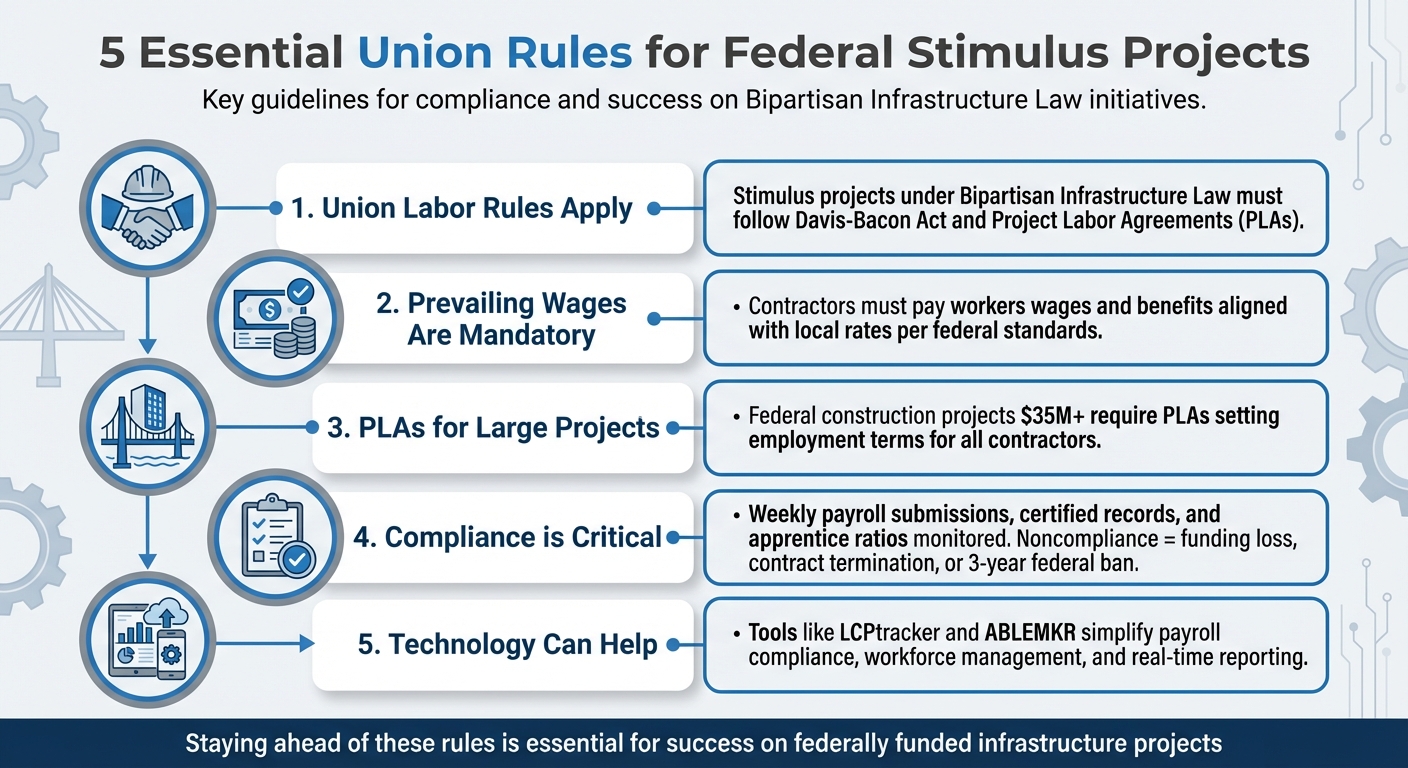
Working on federally funded infrastructure projects? Here’s what you need to know:
- Union Labor Rules Apply: Stimulus projects under the Bipartisan Infrastructure Law must follow strict labor requirements, including the Davis-Bacon Act and Project Labor Agreements (PLAs).
- Prevailing Wages Are Mandatory: Contractors must pay workers wages and benefits that align with local rates, as determined by federal standards.
- PLAs for Large Projects: Federal construction projects costing $35 million or more require PLAs, which set employment terms for all contractors involved.
- Compliance is Critical: Weekly payroll submissions, certified records, and apprentice ratios are strictly monitored. Noncompliance can result in funding loss, contract termination, or a three-year federal project ban.
- Technology Can Help: Tools like LCPtracker and ABLEMKR simplify payroll compliance, workforce management, and real-time reporting.
Staying ahead of these rules is essential for success. Contractors must understand union mandates, follow wage standards, and use digital tools to manage compliance efficiently.
5 Essential Union Rules for Federal Stimulus Projects Compliance
What Are Project Labor Agreements?
Definition and Purpose of PLAs
A Project Labor Agreement (PLA) is a pre-hire collective bargaining agreement established between one or more labor organizations and contractors for a specific construction project. It outlines the terms and conditions of employment before the project begins, ensuring clarity and consistency.
PLAs are designed to promote stability between labor and management, maintain safety standards, and enforce uniform work rules. They also help streamline coordination among multiple contractors working on the same project.
Now, let’s look at when these agreements are required and how they work in practice.
When PLAs Are Required
Under Executive Order 14063, federal agencies must use PLAs for "large-scale construction projects", defined as projects with an estimated government cost of $35 million or more. This requirement officially takes effect on January 22, 2024.
Agencies can also apply PLAs to projects costing less than $35 million if the work involves multiple trades, labor shortages, or extended timelines. Exceptions to the $35 million rule are possible with approval from a senior procurement executive. These exceptions typically include projects with short durations, work involving only a single trade, limited contractor availability, urgent deadlines, or cases where market research suggests that requiring a PLA might reduce competition and lead to higher costs.
How PLAs Impact Contractors and Workers
PLAs aim to ensure fair competition and compliance for everyone involved in the project.
Once a PLA is in place, it applies to all contractors and subcontractors on the project, regardless of their usual practices with collective bargaining agreements. This means non-union contractors can compete for PLA projects on equal terms.
For workers, PLAs set clear wage rates, benefits, and working conditions. They also include provisions to prevent strikes, lockouts, or other disruptions, along with binding procedures for resolving disputes. Non-union contractors can often negotiate to use their existing fringe benefit plans, provided those plans match the value of union benefits.
Another advantage of PLAs is access to union hiring halls, which supply a steady flow of skilled labor. Research shows that union contractors are 14% less likely to face difficulties filling craft positions and 21% less likely to encounter project delays due to labor shortages. This is particularly significant given that the construction industry averages around 646,100 job openings annually in construction and extraction roles.
What the requirement for project labor agreements means for federal construction projects
Union Requirements for Stimulus-Funded Projects
When working on stimulus-funded projects, understanding federal union mandates is crucial. These rules ensure fair labor practices and compliance with specific legal standards.
Davis-Bacon Act and Prevailing Wage Laws
Under the Davis-Bacon Act, any federally funded project exceeding $2,000 must pay laborers and mechanics at least the locally prevailing wages and fringe benefits. This can be fulfilled through all-cash payments or a combination of cash wages and approved benefits, such as health insurance or pension contributions. To determine the applicable wage rates, consult the wage determination on SAM.gov.
One key requirement is that workers must be paid weekly. If your normal payroll schedule is bi-weekly or monthly, you’ll need to issue supplemental payments or cash advances to meet this standard.
"There is no compliance alternative to weekly payments, nor can workers waive their rights to be paid weekly."
– U.S. Department of Energy
Union Hiring Requirements and Preferences
Federal stimulus projects are open to both union and non-union contractors. However, if a Project Labor Agreement (PLA) applies, all contractors and subcontractors must follow its terms, which often include hiring workers through union hiring halls.
For contractors using apprentices to reduce costs, there are strict rules. Apprentices must be registered in a program approved by the U.S. Department of Labor‘s Office of Apprenticeship or a State Apprenticeship Agency. They can only be paid below the journeyworker prevailing wage if they meet these criteria. Additionally, the apprentice-to-journeyworker ratio must align with program limits, and compliance is monitored daily.
Compliance Documentation and Reporting
Contractors are required to submit certified payroll records weekly, within seven days of payment, and retain these records for three years. For projects funded under the Bipartisan Infrastructure Law, the U.S. Department of Energy provides free access to LCPtracker software. This tool automates over 70 validations for payroll reports, ensuring accuracy before submission.
Semiannual enforcement reports are due on April 21 and October 21. Additionally, contractors must display the WH-1321 poster ("Worker Rights Under the Davis-Bacon Act") alongside the applicable wage determination. Prime contractors are also responsible for including all Davis-Bacon clauses and wage determinations in subcontracts. Failure to comply can lead to a three-year debarment from federal contracts.
sbb-itb-aa28329
Common Challenges in Union-Regulated Projects
Contractors working on stimulus-funded projects often encounter hurdles that can slow progress and drive up costs. These issues generally arise from the intricate nature of prevailing wage laws, tight labor markets, and the administrative weight of weekly compliance reporting.
Managing Mixed Union and Non-Union Workforces
Handling projects that involve both union and non-union workers requires meticulous attention to wage calculations and documentation. Under the Davis-Bacon and Related Acts, all workers – including independent contractors (1099s) – must be paid the locally prevailing wage and receive fringe benefits.
Fringe benefit calculations add another layer of complexity. Contractors are required to "annualize" benefits by dividing total contributions by the total hours worked across both covered and non-covered projects. This determines the allowable hourly credit for fringe benefits.
"When a project receives any funding that requires payment of Davis-Bacon prevailing wages, construction work at the site of the work for the entire project is generally subject to Davis-Bacon prevailing wage requirements, regardless of how the funding recipient chooses to allocate that funding."
– U.S. Department of Labor
Another challenge arises when workers perform tasks in multiple labor classifications within a single day. Without precise tracking of hours spent in each classification, contractors are required to pay the highest applicable wage rate for all hours worked.
These complexities often tie directly into broader issues, such as delays in workforce deployment on union-regulated projects.
Speeding Up Workforce Deployment
The administrative and wage-calculation challenges make timely workforce deployment a critical factor. For projects requiring collective bargaining agreements (CBAs), obtaining a conformed wage determination can take up to 60 days. As a result, contractors typically need at least 90 days of lead time before construction begins.
Digital workforce platforms are helping to accelerate this process. For example, ABLEMKR’s technology connects pre-vetted workers to job sites based on factors like certifications, safety training, availability, and location. This approach not only speeds up crew mobilization but also ensures compliance with prevailing wage requirements and union hiring hall procedures.
Starting administrative preparations at least a month in advance can prevent unnecessary delays. Contractors who wait too long often find themselves rushing to meet payroll deadlines while still onboarding employees.
Controlling Project Costs
Keeping costs in check requires a careful balance between meeting wage requirements and leveraging tools like registered apprentices and compliance software. Using Department of Labor–approved apprentices can be a cost-effective strategy, as they may earn less than the journeyman prevailing wage rate. However, the ratio of apprentices to journeymen must adhere to the limits of the approved apprenticeship program. If this ratio is exceeded, all workers must be paid journeyman wages.
Technology also plays a key role in reducing administrative costs. For instance, the Department of Energy offers access to LCPtracker at no cost for recipients of Bipartisan Infrastructure Law funding. This software automates over 70 validations on certified payroll reports, identifying errors in wage rates or work classifications before submission.
"Payroll-related costs incurred due to Davis-Bacon Act compliance should qualify as an allowable cost, so long as they are necessary, reasonable, allocable, and not otherwise unallowable."
– U.S. Department of Energy
Using Technology for Union Compliance
Digital tools have become a game-changer for managing union-regulated stimulus projects. By automating much of the administrative workload, these platforms help reduce errors and provide instant insights into workforce compliance. This is especially critical when adhering to Davis-Bacon Act requirements and meeting tight project deadlines. The result? Projects can be executed faster and with greater accuracy.
Faster Workforce Deployment with ABLEMKR

The ABLEMKR mobile-first platform is designed to speed up the process of mobilizing certified crews. It matches pre-vetted workers to job sites based on their certifications, safety training, availability, and location. Whether it’s a planned infrastructure project or an emergency deployment, contractors can quickly fill roles with qualified workers.
The platform also simplifies payroll workflows, which is a big deal for stimulus projects that must meet the Davis-Bacon Act’s weekly pay requirements. Workers are guaranteed on-time payments, while contractors get real-time updates on worker status, ensuring compliance is always on track.
Tracking Compliance in Real Time
Compliance software takes the guesswork out of certified payroll reporting by running over 70 automated checks on each report. It flags errors in wage rates, work classifications, and calculations before submission. This is crucial since contractors must submit certified payrolls within seven days of the regular payment date.
But it doesn’t stop at payroll. These tools provide instant insights into key metrics like union job counts, apprentice-to-journeyman ratios, and local hiring progress. This level of detail helps contractors avoid costly mistakes, such as exceeding approved apprentice ratios – a misstep that could require paying full journeyman wages to all impacted workers. By offering this level of transparency and accuracy, compliance tracking ensures contractors meet the rigorous standards required for stimulus projects.
To make these tools accessible, the Department of Energy provides LCPtracker at no cost to recipients of Bipartisan Infrastructure Law funding. Features like electronic signatures further streamline processes, replacing traditional "wet" signatures and cutting down on delays that can slow project approvals.
Improving Communication Between Workers and Contractors
Effective communication is essential when managing large-scale projects with multiple tiers of subcontractors. Digital platforms enable prime contractors to electronically review and approve payrolls submitted by subcontractors. They can flag issues like unauthorized deductions or inconsistent time tracking, adding notes for clarification.
ABLEMKR’s platform also enhances communication between project managers and workers. Through the mobile app, workers can view job details, confirm availability, and receive real-time updates. Meanwhile, contractors benefit from centralized documentation, which is crucial for meeting the Davis-Bacon Act’s three-year record retention requirement.
"Advantages of DBA compliance software include: Minimized paperwork, Reduced time spent reviewing CPRs, Reduced risk of errors and audit failures, [and] Real-time reporting by BIL provision."
– U.S. Department of Energy
Conclusion
Union rules tied to stimulus-funded projects require a firm grasp of federal regulations, proactive compliance measures, and the integration of effective technology. With the Bipartisan Infrastructure Law projected to create around 800,000 jobs, contractors who excel in meeting these standards are well-positioned to succeed in the competitive federal market. Understanding these requirements is key to navigating regulatory hurdles with confidence.
To avoid costly missteps, it’s essential to stay ahead of compliance demands. Keep detailed records, issue all required notices, and ensure subcontractors adhere to Davis-Bacon labor standards. These practices not only prevent errors that could disrupt your project but also safeguard your reputation.
Leveraging technology platforms like ABLEMKR can streamline critical tasks such as workforce management and real-time compliance tracking. These tools reduce administrative loads, improve accuracy, and lead to faster project completion. Plus, they enhance communication across teams, helping you avoid audit failures and keep projects on track.
FAQs
What are the main advantages of using Project Labor Agreements in federally funded construction projects?
Project Labor Agreements (PLAs) bring several advantages to federally funded construction projects. They play a significant role in keeping costs under control and ensuring projects are completed on schedule. By fostering strong labor-management relationships, PLAs help minimize the chances of strikes or work stoppages, which could otherwise disrupt progress.
Another key benefit of PLAs is their ability to provide access to a dependable pool of skilled workers. This is essential for maintaining high safety standards and sticking to project timelines.
On top of that, PLAs support fairness in the workforce by ensuring competitive wages, benefits, and opportunities for groups that are often underrepresented. This not only improves the overall quality of the work but also helps drive economic growth and strengthen local communities.
What steps should contractors take to comply with the Davis-Bacon Act on government-funded projects?
To meet the requirements of the Davis-Bacon Act for government-funded projects, contractors need to take specific steps to ensure compliance:
- Secure the correct prevailing wage determination, including fringe benefits, and incorporate these rates into contracts with both prime and subcontractors.
- Keep certified weekly payroll records accurate and up-to-date, and complete any necessary semi-annual reports.
- Display all required compliance notices at job sites and maintain thorough records to prove adherence.
Tools like ABLEMKR can make this process easier by helping track worker certifications, manage payroll data, and ensure all requirements are handled efficiently. Staying organized and ahead of deadlines is essential for avoiding penalties and keeping your project on track.
How does technology help manage union compliance in government-funded construction projects?
Technology has become a key player in making union compliance easier for construction projects backed by government stimulus funds. With the help of advanced tools, tasks like monitoring weekly payroll, ensuring workers receive union-mandated wages, and generating necessary reports can be automated.
These systems offer real-time insights into compliance with labor standards, cutting down on administrative headaches and helping businesses stay on top of regulations. By simplifying these processes, technology ensures smoother operations, timely payments, and a better experience for both employers and workers.


