
Relocation incentives are becoming a game-changer for industries like construction and energy, addressing critical labor shortages by helping workers move to high-demand areas. These programs cover moving expenses, temporary housing, and even lifestyle perks, making it easier for skilled professionals to relocate for better job opportunities. For businesses, the upfront cost is offset by reduced turnover and faster hiring, while cities and states benefit from economic growth and population boosts.
Key highlights:
- Relocation Benefits: Typically range from $5,000 to $15,000, covering expenses like moving, housing, and sometimes offering extras like outdoor perks or coworking memberships.
- Who Offers Them: Employers, local governments, and state programs aim to attract talent for hard-to-fill roles or underserved areas.
- Examples: Programs like Tulsa Remote and Ascend WV show high retention rates (70% and 97.3%, respectively) and significant economic impact.
- Tax Considerations: Relocation benefits are taxable, but some employers offer "gross-ups" to cover the tax burden.
- For Employers: Target high-need roles, consider public-private partnerships, and be transparent about tax implications to attract top talent.
Whether you’re a worker seeking better opportunities or an employer addressing staffing challenges, relocation incentives offer practical solutions to bridge the talent gap and drive economic growth.
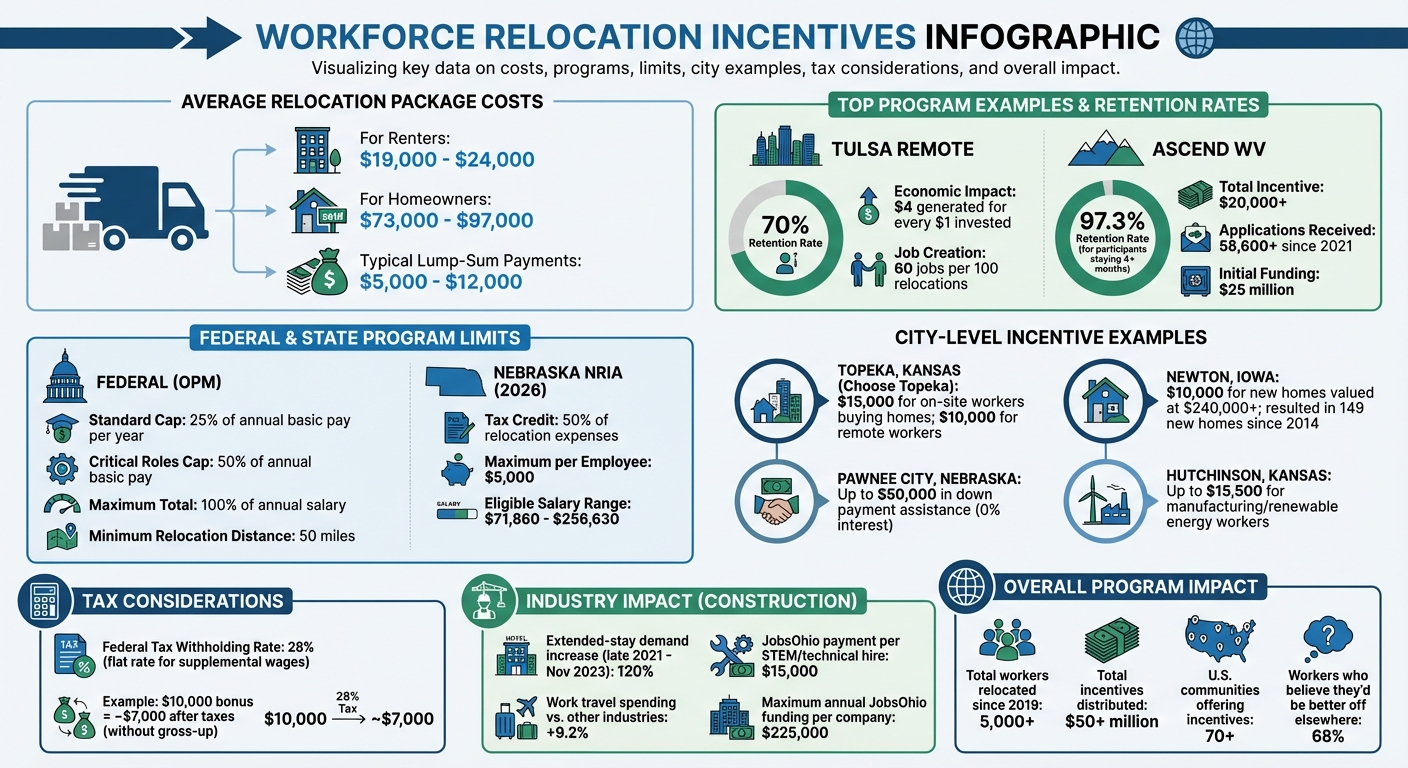
Workforce Relocation Incentives: Key Statistics and Program Comparisons
Cities Are Paying Remote Workers Up to $20,000 to Move – Here’s Why
sbb-itb-aa28329
What Are Relocation Incentives?
Relocation incentives are financial aids or perks offered by employers or government organizations to help workers manage the costs of moving for a job. These incentives aim to ease the financial burden of relocating, which can often discourage skilled workers from taking new opportunities. They typically cover expenses like packing, shipping household items, travel, temporary housing, and storage fees.
For employees, these programs provide immediate financial relief. On average, relocation packages cost employers between $19,000 and $24,000 for renters and $73,000 to $97,000 for homeowners. Beyond financial support, some packages even include benefits like coworking memberships or networking events to help workers integrate into their new communities.
Employers and local governments also benefit from these programs. Companies use them to fill roles in hard-to-staff locations, while cities and states employ these strategies to combat population decline and attract working-age individuals who contribute to the local economy.
Let’s take a closer look at the different types of relocation incentives.
Types of Relocation Incentives
Relocation incentives come in various formats, tailored to meet specific moving needs:
- Lump-Sum Payments: These are one-time cash grants, usually ranging from $5,000 to $12,000, that workers can use for any moving-related expenses.
- Housing Support: This is especially common in smaller towns and may include assistance with down payments. For instance, Pawnee City, Nebraska, offers up to $50,000 in down payment assistance as a 0% interest second mortgage through its New Homes initiative. Some areas also provide rent subsidies or stipends for temporary housing.
As Steve Glenn from the Economic Development Council put it, "In the virtual workplace, people can work from anywhere … we just have to offer them a reason to choose Pawnee City".
- Reimbursement Programs: Workers can submit receipts for specific moving expenses and get reimbursed by their employer or a government agency. While this gives employers more oversight on spending, it does require additional administrative effort.
- Tax Benefits: Although tax advantages were once a big part of relocation packages, changes in tax law now classify most benefits as taxable income. To counter this, many employers "gross up" payments to cover the added tax burden. Supplemental wages for these benefits are generally taxed at a flat 28% federal income tax withholding rate.
- Lifestyle Perks: These newer benefits go beyond financial aid. For example, West Virginia’s Ascend WV program offers a $12,000 financial incentive along with perks like free outdoor gear rentals and recreation passes. Such offerings have proven effective in retaining workers, with the program boasting a 97.3% retention rate among participants who stay for at least four months.
Who Provides Relocation Incentives?
Relocation incentives are typically offered by three key groups, each with distinct goals:
- Private Employers: Companies use these incentives to attract talent for roles that are hard to fill. Packages often include direct payments to moving vendors, temporary housing, and even job placement assistance for spouses or partners.
- City and Local Governments: Over 70 U.S. communities now offer incentives to draw in remote workers who bring external income into the local economy. For example, Newton, Iowa, provides up to $10,000 in cash to buyers of new homes valued at $240,000 or more. This initiative has led to the construction of 149 new single-family homes since 2014.
- State and Federal Agencies: These programs address workforce shortages in underserved areas. For example, West Virginia’s Ascend WV program, funded by a $25 million gift from Brad and Alys Smith to West Virginia University, has received over 58,600 applications since its launch in 2021. By September 2025, the program expanded to offer incentives exceeding $20,000 for new participants.
Federal, State, and Local Relocation Programs
Government relocation programs aim to address workforce needs across federal, state, and city levels.
Federal and State Programs
The Office of Personnel Management (OPM) provides relocation incentives to federal employees filling hard-to-staff positions. These benefits are capped at 25% of annual basic pay per year of a service agreement (up to four years). For critical roles, the cap can rise to 50% of basic pay, but the total cannot exceed 100% of the employee’s annual salary over the agreement period. To qualify, employees must relocate at least 50 miles from their current workplace and maintain a performance rating of "Fully Successful" or higher. These incentives apply to "prevailing rate" positions, which include trades, crafts, and construction-related federal jobs.
At the state level, Nebraska’s Relocation Incentive Act (NRIA) offers tax credits to employers. For the 2026 tax year, businesses can claim a refundable credit covering 50% of relocation expenses (up to $5,000 per employee) for eligible workers earning between $71,860 and $256,630 annually. Employers must submit Form NRIA-A to claim the credit, and clawback provisions apply if the employee leaves Nebraska within two years.
West Virginia’s Ascend WV program, funded by a $25 million donation from Brad and Alys Smith to West Virginia University, expanded in September 2024 to include Charleston. The program now offers participants over $20,000 in incentives, showcasing a robust effort to attract new residents.
In addition to federal and state initiatives, cities use direct cash grants and housing assistance to attract skilled workers.
City-Level Incentives
Topeka, Kansas runs the Choose Topeka program, offering tiered incentives: $15,000 for on-site workers who buy homes and $10,000 for remote workers purchasing property. A unique feature of the program is a $1,000 bonus from Jimmy John’s for residents who move into specific delivery zones.
Tulsa Remote, which has grown significantly since 2025, highlights the broader economic impact of such initiatives. Managing Director Justin Harlan explains:
For every 100 people that we bring to the city, there are 60 jobs created at a local level.
This statement underscores how city-level programs can drive economic growth, benefiting communities far beyond the direct participants.
Relocation Incentives in Construction and Energy
Remote infrastructure projects often face a tough challenge: a shortage of skilled local labor paired with limited amenities. To attract workers from a national pool, employers are stepping up with competitive incentives.
Industry-Specific Program Examples
Between late 2021 and November 2023, the demand for extended-stay accommodations for construction managers and tradespeople skyrocketed by 120%. During this same period, spending on work travel outpaced other industries by 9.2%.
Programs like JobsOhio are addressing this labor crunch head-on. They offer employers in energy, chemicals, and advanced manufacturing a $15,000 direct payment for each out-of-state STEM or technical hire who relocates to Ohio. Companies can receive up to $225,000 annually, and the program even allows retroactive eligibility within the same calendar year. Employers can allocate these funds however they see fit – whether for signing bonuses or recruitment campaigns.
Similarly, Hutchinson, Kansas, provides up to $15,500 in incentives for workers in advanced manufacturing and renewable energy sectors. These efforts aim to tackle what industry leaders see as a pressing issue. Jessica Roman, Director of Enterprise Sales at Navan, highlights the urgency:
Infrastructure construction is booming and there needs to be more skilled labor in every market to meet demand.
But money alone isn’t the solution. Mike Dorsey, Vice President of The Association of Union Constructors, points out the logistical hurdles:
How do we get a union pipefitter earning well in Chicago to go to Stanton, Tennessee, on a $6 billion Ford plant job?.
To make these moves more appealing, contractors are offering extended-stay accommodations, setting up trailer-friendly job sites, and even providing onsite services.
Project owners are also raising their expectations. Brian Gallagher, Vice President of Corporate Development at Graycor, explains:
When we’re proposing, owners are looking for ‘what is your plan?’ They want a very detailed plan for what your strategy is going to be.
These examples highlight how relocation incentives and detailed workforce strategies are becoming critical for addressing labor shortages.
How ABLEMKR Supports Workforce Deployment
ABLEMKR is stepping up to simplify workforce deployment in construction and energy. Their mobile-first platform connects pre-vetted skilled workers with projects across the U.S., matching them based on certifications, training, availability, and location. This allows contractors to quickly mobilize crews for tasks like pipeline repairs, mine development, or emergency shutdowns.
For employers, ABLEMKR handles the heavy lifting: hiring, onboarding, regulatory compliance, and even payroll workflows. Workers benefit from flexible, high-paying opportunities with guaranteed on-time payments. The platform also tracks compliance, ensuring contractors meet the rigorous workforce plans now required for major projects. This streamlined approach is crucial as competition for skilled labor in remote areas continues to grow.
How to Use Relocation Incentives Effectively
For Workers: Getting the Most from Relocation Benefits
Before diving into a relocation incentive, make sure you meet the eligibility criteria. Most programs require that you provide proof of remote employment, meet specific income thresholds, and commit to staying in the area – typically for at least 12 months. Programs with these requirements have shown strong retention rates among participants.
Keep in mind that relocation benefits are taxable. For instance, if you’re offered a $10,000 bonus, the actual amount you take home will be reduced after taxes. Some employers offer a "gross-up" to cover these taxes, so it’s worth asking if this option is available to ensure you receive the full intended amount.
Check the fine print of any service agreements. Many include clawback provisions, meaning you might have to repay the incentive if you leave before fulfilling the commitment period. If you’re part of a reimbursement-based program, keep detailed records of your moving expenses. And don’t overlook practical details – confirm the availability of reliable internet service in your new location using the FCC National Broadband Map before making any final decisions.
For Employers: Matching Incentives to Hiring Needs
While workers navigate the complexities of taxes and agreements, employers can fine-tune their strategies to attract the right talent. Start by identifying roles that are particularly hard to fill due to location, specialized skills, or labor shortages. Focus your relocation incentives on these positions to get the best return on your investment. A tiered incentive system can also help balance costs and fairness – adjusting bonuses based on factors like seniority, the distance of the move, or the critical nature of the role.
Be upfront with candidates about the tax implications of relocation benefits. Many workers don’t realize these incentives are taxable income. Offering a gross-up can make your offer more attractive, especially when recruiting for roles in remote or underserved areas.
You can also stretch your budget by partnering with public–private programs. Take Ascend WV, for example, which expanded to Charleston in September 2025, offering over $20,000 in incentives along with community support. For industries like construction and energy, platforms like ABLEMKR simplify workforce management by handling tasks like matching pre-vetted workers and managing payroll – making it easier to align with your broader hiring goals.
Whether you’re a worker or an employer, these strategies are key to addressing labor challenges and making the most of relocation incentives.
Conclusion
Since 2019, relocation incentives have played a significant role in reshaping workforce strategies, helping over 5,000 remote workers collectively secure more than $50 million. Industries like construction and energy are tapping into these incentives to address critical workforce shortages in underserved areas. However, these aren’t just simple cash bonuses – they’re carefully structured investments that require attention to tax considerations, service agreements, and strategies for long-term retention.
For workers, these incentives can make relocating financially feasible, even after accounting for taxes. For example, a $10,000 bonus typically leaves about $7,000 after taxes unless grossed up. Recent surveys reveal that 68% of full-time workers believe they would be better off living in a different U.S. city or town, highlighting the growing appeal of such programs.
Employers, on the other hand, see substantial returns on these investments. Take the Tulsa Remote program, which demonstrates how every $1 invested generates over $4 in local economic benefits and creates 60 jobs for every 100 relocations. These results underscore the economic ripple effects of well-executed relocation strategies.
Platforms like ABLEMKR are making it easier for industries like construction and energy to implement these programs. They handle the heavy lifting, from matching certified workers to job sites based on location to managing payroll logistics, tax withholdings, and compliance requirements. This streamlined approach minimizes administrative hurdles and speeds up workforce deployment, even in the most remote areas.
The takeaway is clear: relocation incentives, when paired with smart deployment tools, offer a practical solution to workforce shortages. Whether you’re a skilled worker or an employer, these programs provide a structured way to meet workforce demands. The tools and frameworks are already in place – the real question is, are you ready to use them effectively?
FAQs
How do relocation incentives affect my taxes?
Relocation incentives, such as reimbursements or bonuses, are treated as taxable income in the U.S. This became the case after the 2017 Tax Cuts and Jobs Act, which removed most moving expense deductions. As a result, these benefits are now subject to federal, state, and FICA taxes. If you’re considering relocation benefits, make sure to account for these taxes in your financial planning.
What happens if I move back before my commitment ends?
If you decide to move back before fulfilling your commitment, you might be required to repay any relocation incentives or benefits you received. It’s common for policies to include repayment or clawback provisions in cases of early termination or a reversed move. Be sure to review your agreement and any relevant laws to fully understand your responsibilities.
Which relocation incentive type is best for my situation?
Relocation incentives can vary widely, and the "best" option really depends on your personal situation. For employees, these might include bonuses, moving expense allowances, or even temporary housing support to ease the transition. For employers, offering such incentives can be a powerful way to draw in top talent, especially in competitive fields like energy or construction.
On top of that, some cities and states sweeten the deal by offering financial perks to encourage new residents. Whether you’re an employee or an employer, it’s a good idea to explore these options. Talking to your employer or researching local programs can help pinpoint the incentive that works best for you.


