
In New York, almost all businesses must provide workers’ compensation insurance to protect employees and ensure fair competition. Failing to comply can result in steep penalties, criminal charges, and even business disruptions. Here’s the key information:
- Who Needs Coverage: Any business with employees, including part-time, seasonal workers, and even unpaid volunteers.
- Penalties: Civil fines can reach $2,000 for every 10 days without coverage. Criminal charges apply for more severe violations, with fines up to $50,000 and potential jail time.
- Risk of Non-Compliance: Beyond fines, businesses may face stop-work orders, debarment from public contracts, and personal liability for corporate officers.
- How Violations Are Found: The state uses automated systems, audits, and employee claims to identify uninsured businesses.
- Steps to Stay Compliant: Secure proper insurance, keep accurate payroll records, and respond promptly to any notices from the Workers’ Compensation Board.
The cost of compliance is far lower than the risks of non-compliance. Maintaining proper coverage protects your employees, your business, and your reputation.
Financial and Criminal Penalties
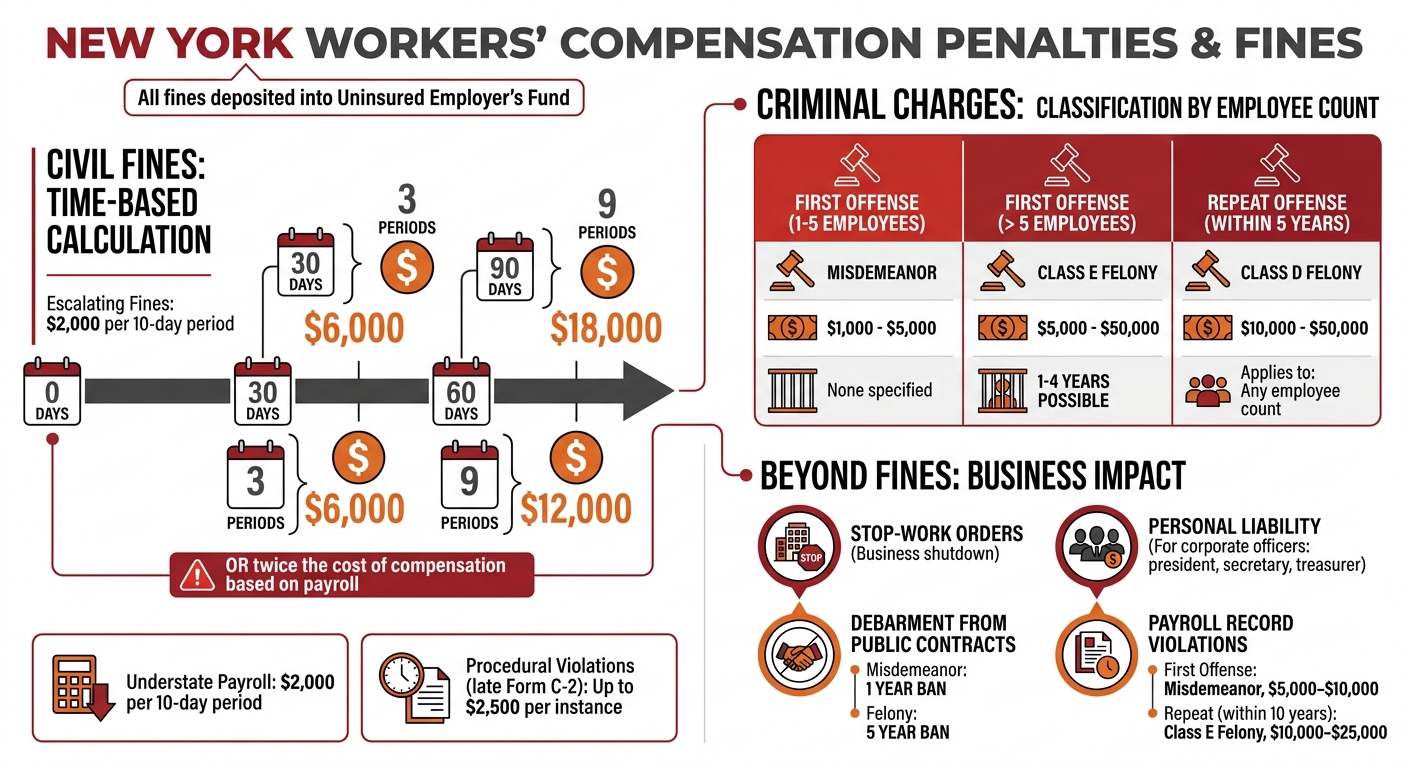
NY Workers’ Comp Penalties: Civil Fines vs Criminal Charges by Violation Type
When a violation is detected, New York imposes strict financial and criminal penalties. For civil penalties, employers face fines of up to $2,000 for every 10-day lapse. For example, a lapse lasting 30 days results in $6,000 in fines, 60 days incurs $12,000, and 90 days reaches $18,000.
The penalties can also be calculated differently. The Board may charge up to twice the cost of compensation based on the employer’s payroll during the period without coverage. If payroll records are missing, the Board uses an imputed payroll set at 1.5 times the state’s average weekly wage. Here’s a closer look at how these penalties are structured.
Base Fines for Missing Coverage
Civil fines can add up fast. Employers who deliberately understate payroll face additional fines of $2,000 per 10-day period. Procedural violations, such as failing to report an injury on Form C-2 or submitting it late, are penalized up to $2,500 per instance. These procedural fines alone bring in about $3 million annually, averaging $300 per new case.
| Duration of Non-Compliance | Number of 10-Day Periods | Total Potential Fine |
|---|---|---|
| 30 Days | 3 | $6,000 |
| 60 Days | 6 | $12,000 |
| 90 Days | 9 | $18,000 |
Criminal Charges for Serious Violations
Operating without workers’ compensation coverage is classified as a criminal offense in New York. For businesses with five or fewer employees, this is treated as a misdemeanor, carrying fines between $1,000 and $5,000. However, for businesses with more than five employees, the offense escalates to a class E felony, with fines ranging from $5,000 to $50,000. A class E felony conviction can also lead to one to four years in prison.
"Failure to secure the payment of compensation for more than five employees within a twelve month period shall constitute a class E felony."
– N.Y. Workers’ Compensation Law Section 52
Corporate officers, such as the president, secretary, and treasurer, are personally liable for fines and for failing to secure coverage. This liability applies even if they were unaware of the lapse. However, officers can avoid prosecution if they prove they took reasonable steps to ensure coverage.
| Violation Type | Employee Count | Legal Classification | Potential Fine |
|---|---|---|---|
| First Offense | 1–5 employees | Misdemeanor | $1,000–$5,000 |
| First Offense | More than 5 | Class E Felony | $5,000–$50,000 |
| Subsequent Offense | Any (within 5 years) | Class D Felony | $10,000–$50,000 |
Penalties for Repeat Offenders
Repeat offenses come with even harsher consequences. A second conviction for failing to secure coverage within five years is classified as a class D felony, with fines ranging from $10,000 to $50,000. This applies regardless of the number of employees. Additionally, employers convicted of a felony are banned from bidding on public works contracts for five years, compared to a one-year ban for misdemeanors.
Failing to maintain accurate payroll records also carries escalating penalties. A first offense is treated as a misdemeanor, with fines between $5,000 and $10,000. A subsequent offense within 10 years becomes a class E felony, with fines of $10,000 to $25,000. The Board can also issue stop-work orders, halting all business operations if coverage is missing or if previous penalties remain unpaid. All collected fines are deposited into the Uninsured Employer’s Fund, which covers claims for workers injured while employed by uninsured businesses.
sbb-itb-aa28329
How Enforcement Works
New York’s system for enforcing workers’ compensation compliance relies on automated monitoring and cross-agency data sharing. The Workers’ Compensation Board (WCB) oversees more than 800,000 employers, using data from the Department of Labor, business registrations, and insurance carrier reports to pinpoint coverage gaps. When discrepancies arise – like mismatches between payroll filings and insurance coverage – the system initiates an investigation.
Detection and Investigation Period
The automated system is designed to flag coverage issues quickly, often within 24 to 48 hours of a filing discrepancy or policy cancellation. Insurance carriers notify the WCB about policy cancellations, and if no replacement policy is found, an investigation begins automatically.
The Board also tracks Federal Employer Identification Numbers (FEIN). If an employer reports payroll to the Department of Labor but lacks matching coverage under the same FEIN, an inquiry notice is generated. Additionally, the WCB encourages tips through fraud hotlines, such as 1-877-WCNYSIF.
During the first 45 days, the process escalates from automated alerts and mailed notices to on-site inspections and violation classifications. Final penalty notices are issued after day 46. Roughly 25% of WCB investigations lead to criminal prosecution referrals. These rapid detection and investigation measures ensure accurate penalty assessments and allow for appeals when necessary.
Penalty Calculation and Appeals
If an employer fails to address the issue, it is deemed a violation, and the WCB issues a penalty notice. Penalties are calculated using the greater of two methods: $2,000 for every 10-day period of non-compliance or twice the cost of the required workers’ compensation insurance during that timeframe. If payroll records are unavailable during an appeal, the Board estimates payroll at 1.5 times the state’s average weekly wage.
Employers have 30 days from the penalty notice date to request a review. During this window, businesses can explain coverage lapses, provide proof of compliance, or request a penalty reduction. Missing the deadline allows the WCB to file a judgment without further notice. Employers can also email PCU@wcb.ny.gov to request an "offer of reduction", where penalties may be recalculated based on actual insurance premiums. For valid penalties, the Board offers interest-free payment plans lasting up to one year. Once finalized, penalties are enforced through collection actions.
Collection Methods and Enforcement Actions
For unpaid penalties with no review requested, the WCB takes aggressive steps to collect. It can file a court judgment without additional notice, offset unpaid debts against New York State tax refunds, or withhold other state payments. The Board may also issue stop-work orders, halting all business operations until compliance is restored and debts are settled.
Employers in violation face additional consequences, including public debarment from public works contracts. A misdemeanor conviction or civil penalty results in a one-year ban, while a felony conviction leads to a five-year ban. For corporations, the president, secretary, and treasurer are held personally liable for penalties. These enforcement measures underline the importance of maintaining compliance within New York’s workers’ compensation system.
Business Consequences Beyond Fines
Financial penalties and legal charges are just the tip of the iceberg when it comes to the fallout from non-compliance. The real impact often extends far deeper, affecting operations, client relationships, and a company’s overall reputation. These hidden costs can quickly add up, creating challenges that go well beyond the initial fines.
Stop-Work Orders and Lost Revenue
When a stop-work order is issued, a company is forced to halt operations until it restores compliance and fulfills its obligations. Unfortunately, while the revenue stops, fixed costs like rent, utilities, and equipment leases continue to pile up. This kind of disruption can derail project timelines, damage client trust, and even lead to canceled contracts. The financial hit from even a short shutdown can easily surpass the cost of maintaining proper coverage in the first place.
Public Debarment and Reputation Damage
Non-compliance can also leave a lasting stain on a company’s reputation. For example, New York keeps a public debarment list, and businesses on this list are prohibited from receiving government contracts. A misdemeanor conviction or civil penalty can result in a one-year ban, while felony convictions can lead to a five-year ban from bidding on public works projects.
The New York State Workers’ Compensation Board explicitly states:
"Payment of a valid penalty does NOT remove an employer from debarment. Only the rescission of an invalid penalty will remove an employer from debarment."
This means that even after paying fines, a company may remain barred from government contracts for the full duration of the debarment. For businesses that depend on public projects, this can be a devastating blow to revenue and growth.
Cost Comparison: Compliance vs. Penalties
Staying compliant with workers’ compensation requirements comes with predictable costs – your premium is calculated based on payroll and industry classification. On the other hand, non-compliance brings unpredictable and often overwhelming expenses. These can include:
- Full liability for an injured worker’s medical bills and lost wages.
- Legal fees from Workers’ Compensation Board proceedings and potential lawsuits.
- Revenue losses from shutdowns and canceled contracts.
If an employee gets injured while the company is uninsured, the employer is on the hook for all related expenses. When you add in the potential loss of future contracts due to debarment, it’s clear that the financial burden of non-compliance can spiral far beyond the costs of maintaining proper coverage.
How to Stay Compliant
Staying compliant with workers’ compensation and related insurance requirements in New York involves understanding the rules and following specific steps. State systems are designed to flag any gaps in coverage, so it’s important to stay on top of these obligations to avoid penalties.
Required Steps for Compliance
In New York, every employer must provide workers’ compensation, disability, and Paid Family Leave (PFL) insurance for all employees, including part-time, seasonal workers, and in some cases, volunteers. Once your coverage is in place, you must display a Notice of Compliance – Workers’ Compensation Law (Form C-105) in both English and Spanish at every worksite. Failing to post this notice can lead to fines of $500 per violation.
Additionally, ensure that the Federal Employer Identification Number (FEIN) on your insurance policy matches your IRS records to avoid any mismatches that could raise red flags.
If an employee is injured, you are required to report the incident to your insurance carrier within 10 days. Keep a record of every injury or illness using Form C-2F for at least 18 years. Payroll records, including details like employee classifications and wage data, must be retained for a minimum of four years. If you change insurance carriers, make sure there are no lapses in coverage, as any gap could lead to scrutiny.
| Requirement | Action Item | Retention/Deadline |
|---|---|---|
| Insurance Coverage | Secure workers’ compensation, disability, and PFL policies | Continuous (no lapses) |
| Worksite Posting | Display Form C-105 in English and Spanish | Permanent/Conspicuous |
| Payroll Records | Maintain employee count, wages, and classifications | 4 years |
| Injury Reporting | Report incidents to your insurance carrier | Within 10 days of incident |
| Injury Records | Keep Form C-2F or First Report of Injury | 18 years |
Using Technology to Track Compliance
Technology can make compliance easier and help you avoid costly mistakes. For example, the Board’s eCase system allows employers to monitor claim files and track injury cases in real time. You can request access through your insurance carrier to stay updated on claim statuses and hearing dates.
If your business operates in high-risk industries with on-demand staffing, platforms like ABLEMKR can simplify compliance. These tools integrate workers’ compensation coverage into workforce management, providing real-time visibility into worker status and ensuring proper coverage at job sites. This reduces the risk of gaps in coverage and helps you avoid automated inquiry notices from the Board.
Keep in mind that simply purchasing a policy isn’t enough to ensure compliance. Confirm that your insurance carrier has filed the electronic Proof of Coverage (POC) transaction with the Board. The Board matches Department of Labor payroll records with electronic coverage records, and any mismatch will trigger an inquiry notice. Accurate record-keeping and timely policy renewals are essential to avoid interruptions in coverage.
Record-Keeping and Policy Renewals
Accurate and accessible records are crucial for reviews by the Board, auditors, or insurers. If you can’t provide adequate business records during an investigation, penalties may be calculated based on an estimated weekly payroll equal to the New York State average weekly wage multiplied by 1.5.
Stay ahead of policy expirations to avoid lapses when switching carriers. If you receive an inquiry notice from the Board, respond within 30 days with proof of coverage or an exemption to avoid being presumed non-compliant. If you’re claiming an exemption, file the Certificate of Attestation of Exemption (Form CE-200) through the Board’s online application.
For businesses that hire subcontractors, it’s important to keep copies of their certificates of insurance and proof of their independent business status. This ensures you won’t be penalized for their lack of coverage. Use the Board’s online tools to audit your compliance and prevent fines or stop-work orders.
Conclusion
This guide highlights the serious repercussions of failing to comply with New York’s workers’ compensation requirements. The system is unforgiving – civil fines quickly add up for uncovered periods, while criminal violations can lead to felony charges, hefty penalties, and even jail time.
Non-compliance can also grind your business to a halt. Stop-work orders may force operations to shut down until proper coverage is in place. Additionally, businesses found non-compliant risk public debarment, which could bar them from government contracts for up to five years. On top of that, corporate officers may be held personally accountable for unpaid penalties and employee benefits.
"New York’s Workers’ Compensation Law (‘WCL’) is a minefield of penalties, fines, and criminal complications for the unwary."
– Greg Lois, Esq., Managing Partner, Lois Law Firm LLC
To protect your business from these risks, it’s crucial to maintain continuous coverage, keep payroll records accurate, and ensure employees are properly classified. For industries with higher risks and demands, ABLEMKR provides a solution with its platform, offering real-time compliance tracking. By integrating workers’ compensation coverage into workforce management, it helps minimize the chances of coverage gaps.
If you discover a lapse in coverage, act immediately. Reinstate coverage by contacting the Workers’ Compensation Board and addressing any inquiry notices within 30 days. Staying proactive with compliance and maintaining clear records are your strongest safeguards against New York’s rigorous enforcement measures.
FAQs
Do I need workers’ comp if I only have part-time or seasonal workers?
In New York, part-time and seasonal workers are classified as employees under the law. This means they must be included in workers’ compensation insurance coverage. Employers who fail to provide this coverage may face penalties and fines for failing to comply with legal requirements.
How does NY calculate fines if I don’t have payroll records?
Failing to keep proper payroll records in New York is classified as a misdemeanor. The state imposes fines ranging from $5,000 to $10,000 for not maintaining accurate records. These penalties are enforced under New York’s workers’ compensation laws.
What should I do first if I discover a lapse in coverage?
If you find a gap in your coverage, your first step should be reaching out to the New York State Workers’ Compensation Board. They can provide clarity on the situation and explain what you need to do to meet compliance standards. Make sure to collect any relevant documents, such as notices or communications from your insurance provider or the Board itself. These materials can help pinpoint the reason for the lapse and guide you in resolving the issue.


