
Workforce mobility in rural areas is about helping workers move or commute for jobs in industries like construction and energy. These regions face challenges like poor transportation, limited internet, and housing shortages, making it hard for businesses to hire and workers to access better opportunities. Here’s a quick overview of the key points:
- Transportation Issues: Long commutes, poorly maintained roads, and lack of public transit make it tough for workers to reach job sites.
- Broadband Gaps: Limited internet access hinders job searches, online training, and remote work opportunities.
- Housing Problems: High costs and lack of affordable housing force workers to either relocate or endure long, expensive commutes.
Solutions include employer-sponsored transportation, expanding broadband access, and using platforms like ABLEMKR for job matching and compliance tracking. By addressing these barriers, businesses can find skilled workers, and rural communities can access better jobs without leaving their hometowns.
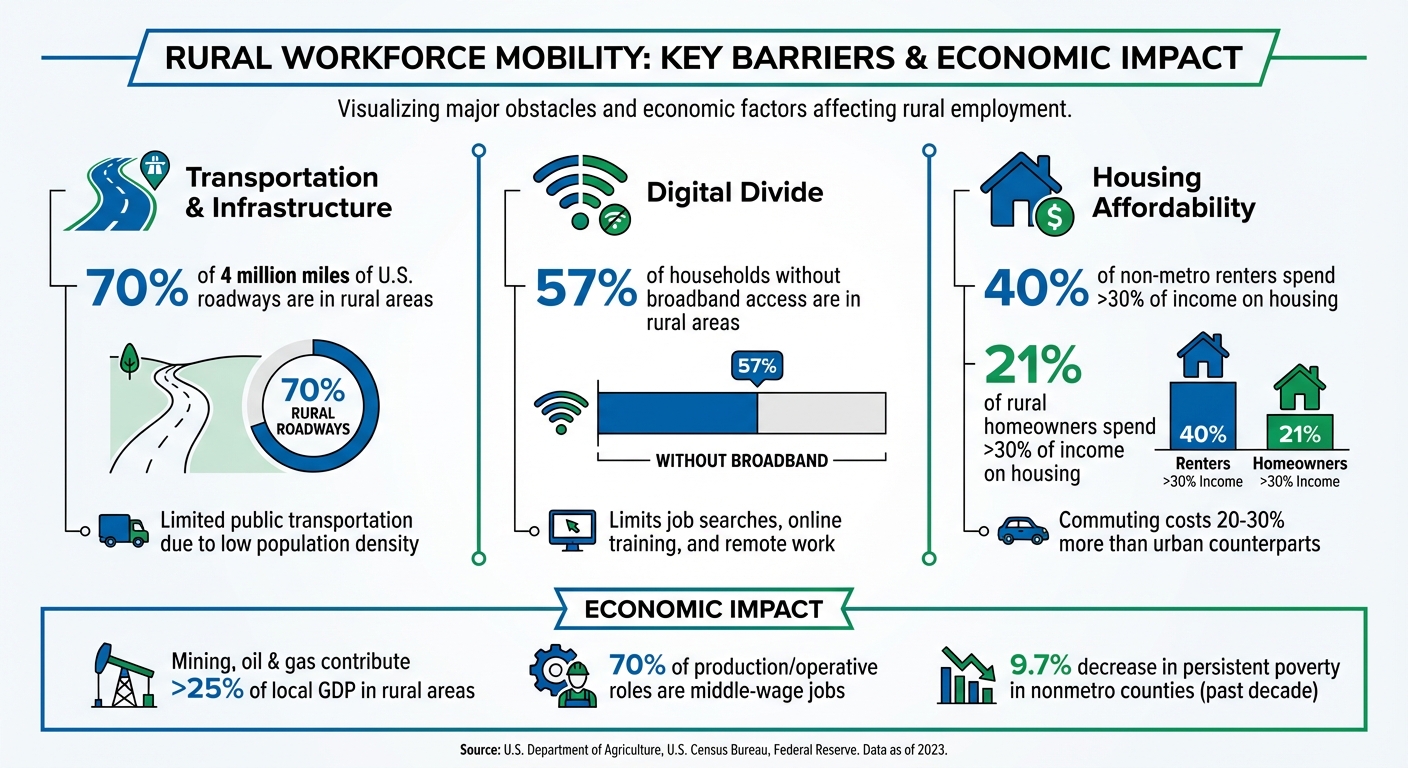
Rural Workforce Mobility Barriers: Key Statistics and Challenges
The Rural Reason to Focus on Workforce Policy with Manny Lamarre, Mary Wurtz and Andrew Campbell
Main Barriers to Workforce Mobility in Rural Areas
Workforce mobility in rural areas faces three major challenges that are deeply intertwined: transportation gaps, inadequate digital infrastructure, and a shortage of affordable housing. These obstacles not only make it tough for employers to hire but also limit access to well-paying jobs for workers. Let’s break down each of these barriers and their impact.
Transportation and Infrastructure Problems
Rural America accounts for over 70% of the 4 million miles of roadways in the United States, yet maintaining these roads and ensuring they connect effectively is a persistent issue. Workers often deal with long, unsafe commutes due to poorly maintained roads and the sheer distance between home and work. Public transportation, which is a lifeline in urban areas, is rarely a viable option in rural regions because of low population density, infrequent service, and prohibitive costs.
In many cases, rural areas depend on aviation and intercity bus services to link workers to economic opportunities. However, these services are often unreliable or too expensive for daily commuting. The lack of dependable transportation not only delays workers but also stalls the start of important projects, throwing off schedules and impacting productivity.
Limited Internet and Technology Access
The digital divide in rural areas is another significant barrier. Poor broadband access prevents workers from using online platforms to find jobs or complete certifications remotely. Instead, they’re forced to travel long distances for training that could easily be done online with better connectivity.
For employers, the lack of reliable internet complicates hiring and workforce management. Tools like virtual onboarding and digital workforce systems, which streamline modern hiring processes, are difficult to implement in areas with limited connectivity. This adds yet another hurdle to an already strained employment pipeline.
Housing Shortages and Affordability Issues
Housing is another major pain point. 40% of non-metropolitan renters and 21% of rural homeowners spend more than 30% of their income on housing costs. With affordable housing near job sites in short supply, workers are often left with two tough choices: move to areas where housing is unavailable or endure long commutes that eat up an extra 20% to 30% of their income compared to their urban counterparts.
This housing crunch is tied to rural areas’ smaller tax bases, which limit local governments’ ability to invest in the infrastructure needed for new housing developments. The result? A vicious cycle where skilled workers leave for places with better housing options, contributing to the "brain drain" that makes it even harder for rural employers to fill critical roles. These interconnected challenges highlight the urgent need for solutions to boost workforce mobility in rural communities.
Solutions for Improving Workforce Mobility in Rural Areas
Addressing transportation, connectivity, and deployment challenges is key to boosting workforce mobility in rural areas. By implementing practical strategies, employers can help bridge these gaps and create more opportunities for rural workers.
Employer-Sponsored Transportation Programs
Transportation can be a major hurdle for rural workers, especially when job sites are far from home. To tackle this, some companies are offering employer-sponsored transportation programs. These include shuttle services, rideshare options, and transportation stipends, which are particularly helpful in industries like construction, energy, and mining – sectors often located in remote areas.
In addition, partnerships with microtransit services are gaining traction. Unlike traditional buses with fixed routes, microtransit operates on-demand, much like rideshare apps. This flexibility makes it a better fit for rural areas, where public transportation often falls short.
Expanding Broadband Infrastructure
High-speed internet has become a necessity for modern workforce mobility. Reliable broadband allows rural workers to access job platforms, complete online training, and even take on remote jobs without leaving their communities. For employers, better connectivity means smoother workforce management. Tools like virtual onboarding, compliance tracking, and mobile-first deployment platforms become much more effective with robust internet access.
Broadband expansion also enables "virtual mobility." This means rural residents can work remotely for urban-based companies while staying in their hometowns. It’s a win-win: workers avoid lengthy commutes, and businesses gain access to a broader talent pool.
Using ABLEMKR for Rural Workforce Deployment
Platforms like ABLEMKR take digital connectivity a step further by streamlining workforce deployment. Using location-based technology, ABLEMKR matches workers to nearby job sites based on their certifications, availability, and proximity. Workers can quickly find local opportunities through its mobile-first platform.
For industries like oil and gas, mining, and heavy infrastructure, ABLEMKR simplifies the hiring process. It automates compliance tracking, eliminates delays caused by missing certifications, and speeds up crew mobilization. Whether it’s an urgent pipeline repair or a planned project, the platform ensures qualified workers are deployed efficiently. Employers also benefit from real-time visibility into worker status and integrated payroll features, making the entire process seamless.
sbb-itb-aa28329
Benefits of Better Workforce Mobility
Improving workforce mobility doesn’t just break down barriers – it creates tangible economic advantages for both employers and workers. By addressing mobility challenges, businesses can tap into a much broader talent pool, while workers gain access to better job opportunities that often come with higher pay and increased stability.
Access to More Qualified Workers
When mobility improves, employers in rural areas can recruit talent from beyond their immediate surroundings. This is especially vital in regions where industries like mining, oil, and gas dominate, contributing over 25% of local GDP. These sectors often struggle to find enough skilled workers without expanding their geographic reach.
Digital advancements have made it possible for rural workers to take on roles traditionally centered in urban areas, giving businesses access to a more diverse and qualified workforce. Programs like Georgia’s Quick Start and Alabama’s Industrial Development Training exemplify how targeted initiatives can align rural workforce skills with the demands of modern industries.
"Rural America is not merely a peripheral part of the national economy but a critical contributor to its innovation and productivity." – JP Julien, Partner at McKinsey
This expanded talent pool not only benefits employers but also opens doors for rural workers to secure better jobs, often without the need to relocate.
Better Job Access and Higher Wages for Workers
For rural workers, improved mobility means access to higher-paying jobs. In industries like energy, manufacturing, and mining, over 70% of production and operative roles are considered middle-wage jobs, offering a clear path to upward financial mobility.
Mobility solutions – such as enhanced transportation, reliable broadband, and innovative job-matching platforms – enable workers to connect with well-paying opportunities while staying in their communities. This flexibility not only reduces local unemployment but also helps workers build more stable and resilient careers.
Additionally, better mobility opens up opportunities for rural workers to engage in remote jobs and access professional services that were previously out of reach.
"Unlocking the full potential of rural America will require targeted, evidence-based interventions… to address systemic barriers, such as investments in workforce training, healthcare access, and education." – McKinsey Institute for Economic Mobility
How ABLEMKR Addresses Rural Workforce Challenges
ABLEMKR takes aim at the unique workforce challenges faced by rural construction and energy projects, offering tailored technological solutions to bridge critical gaps.
Remote projects often grapple with issues like finding qualified workers and scaling crews quickly. ABLEMKR’s platform is specifically designed to meet the demands of high-pressure industries operating in isolated areas.
Location-Based Job Matching
Using geo-location technology, ABLEMKR connects skilled workers to job sites near them, removing the inefficiencies of manual recruiting. Instead of painstakingly posting multiple job listings, ABLEMKR’s AI-driven system matches project requirements with a vast network of workers based on their location, certifications, and availability.
"Instead of filling out, manually, 50 job posts, we are using AI and automation techniques to drag and scrape what companies need and push it out to a publisher network." – Patrick Wallian, President and CEO, ABLEMKR
This approach not only accelerates hiring but also ensures precision. Through the mobile app, employers can track worker locations in real-time, making it easier to manage deployments – whether it’s for urgent pipeline repairs or mining operations in remote areas. This level of accuracy also helps meet regulatory demands efficiently.
Compliance Tracking and Onboarding
Rural energy and construction projects come with stringent safety and certification requirements. ABLEMKR simplifies compliance by pre-qualifying workers before deployment. The platform verifies certifications, safety training, and credentials, ensuring that every worker arriving at a job site meets the necessary standards from day one.
The system’s compliance tracking tools provide employers with real-time insights into worker qualifications, minimizing delays caused by incomplete paperwork. This streamlined onboarding process allows workers to hit the ground running, giving companies faster access to skilled labor.
Rapid Workforce Scaling for Rural Projects
Scaling a workforce quickly is a major hurdle for rural projects. Expanding a team from just a handful of workers to a full crew of 100 in a matter of weeks is no small feat.
"Companies have a really hard time going from six workers on site to 100 in six weeks." – Patrick Wallian, President and CEO, ABLEMKR
ABLEMKR’s platform makes this possible by enabling companies to scale operations rapidly. Through the mobile app, employers can schedule appointments, communicate with workers, and review profiles – all designed to assemble qualified crews in record time. This capability is especially critical in energy corridors and remote industrial zones where traditional hiring methods often fall short.
Conclusion
Tackling rural workforce challenges calls for focused, tech-driven solutions. Systemic barriers continue to hinder both employers and workers, with rural businesses often struggling more than urban ones to find skilled employees.
Breaking down these barriers yields clear economic rewards. Enhancing rural workforces through better infrastructure and specialized training programs drives regional economic development. Easier access to jobs and quicker hiring processes contribute to stronger local economies. By late 2023, rural employment levels have nearly rebounded to pre-pandemic figures, and persistent poverty in nonmetro counties has dropped by 9.7% over the past decade. These improvements create a foundation for digital tools to further close the mobility gap.
Technology is proving to be a game-changer in solving workforce challenges. Platforms like ABLEMKR directly address these issues by connecting skilled workers to job sites using location-based matching and automated compliance checks. This is especially critical as 57% of households without broadband access are in rural areas. By centralizing job opportunities in a digital platform, ABLEMKR ensures that workers in remote areas aren’t left behind.
Combining infrastructure upgrades with digital innovations creates pathways for lasting progress. For rural communities, this means access to higher-paying jobs and reduced economic isolation. For employers in energy corridors and remote industrial hubs, it enables faster crew scaling while maintaining compliance standards – without the inefficiencies of manual recruiting.
Success depends on collaboration among public, nonprofit, and private sectors to align workforce development with community infrastructure needs. By leveraging data to identify skill gaps and using technology to connect workers with opportunities, rural areas can achieve sustainable economic growth while meeting the labor demands of key industries. ABLEMKR’s approach, paired with cross-sector partnerships, helps ensure that rural communities and industries grow and thrive together.
FAQs
What are effective ways to address transportation challenges and improve workforce mobility in rural areas?
Rural communities can tackle transportation hurdles by blending modern technology, local solutions, and infrastructure improvements. For instance, connected-vehicle systems, smart road sensors, and broadband-powered traffic tools can enhance road safety and make travel more predictable. Additionally, flexible options like rideshare services and demand-responsive shuttles provide a lifeline for residents without personal vehicles, helping them access jobs, schools, and essential services with greater ease.
Federal initiatives often play a key role by funding projects to improve rural roads, expand vehicle fleets, and extend broadband access. Employers can also leverage mobile-first tools like ABLEMKR to connect skilled workers with job opportunities that align with their location, certifications, and schedule. When these tools are paired with better local transportation systems, rural areas can break down travel barriers, link workers to higher-paying jobs, and build a more efficient and adaptable workforce.
How does expanding broadband access improve job opportunities in rural areas?
Expanding broadband access is a game-changer for rural workers, opening doors to the digital economy and boosting job opportunities. With high-speed internet, people in remote areas can connect to remote work platforms, enroll in online training programs, and dive into e-commerce ventures that were once out of reach.
It doesn’t stop there. Broadband fuels economic growth by giving rural workers the tools to search for jobs, participate in virtual interviews, and collaborate with employers from across the country. It also helps communities become more attractive to businesses, supports skill-building, and provides access to vital services like telehealth and online education. Better connectivity means rural workers can explore a wider range of well-paying jobs and thrive in today’s digital landscape.
How does ABLEMKR simplify job matching and compliance tracking in rural areas?
ABLEMKR’s mobile-first platform is designed to make workforce deployment faster and more efficient, especially in rural areas. It connects employers with pre-vetted workers by considering factors like certifications, safety training, availability, and proximity. When a job is posted, the system instantly identifies qualified workers nearby, allowing teams to get to work in just hours rather than days.
The platform also takes the hassle out of managing time and attendance. Using GPS-based geofencing, it automates clock-ins, tracks attendance, and creates precise, audit-ready logs. This eliminates the need for manual timesheets and minimizes payroll errors. Plus, it keeps an eye on worker compliance in real time, flagging issues like missing certifications, overdue drug tests, or outdated safety training to ensure everything stays in line with regulations.
ABLEMKR is built with remote and low-connectivity areas in mind, making it a reliable tool for even the most isolated job sites. Employers can access up-to-date worker profiles, compliance records, and real-time crew status, ensuring smooth operations and giving peace of mind to both employers and workers.


