
Spill Prevention Plans (SPCC) are mandatory for facilities handling oil to prevent environmental harm and legal consequences. If your facility stores 1,320 gallons or more aboveground or 42,000 gallons underground, you need an SPCC plan to comply with the EPA‘s Clean Water Act regulations.
Key Takeaways:
- What is an SPCC Plan? A federally required framework to prevent oil spills from contaminating waterways.
- Who Needs It? Facilities that store oil in significant quantities or pose a risk of discharge into navigable waters.
- Core Components: Prevention measures, containment systems, and detailed spill response protocols.
- Compliance Requirements: Regular inspections, updates every five years, and adherence to EPA technical standards.
This guide explains how to assess risks, implement safeguards, and maintain compliance. Whether managing a construction site or an oil facility, these steps help protect resources and avoid penalties.
SPCC Quick Guide: Essentials for General Staff | Resource Management Associates
SPCC Plans and Regulatory Requirements
Building on the earlier discussion of SPCC Plans, this section dives into the regulatory framework and requirements that govern these essential safety measures.
What is an SPCC Plan?
A Spill Prevention, Control, and Countermeasure (SPCC) Plan is a federally mandated plan for facilities that handle oil products. It’s regulated under 40 CFR 112, which derives its authority from the Clean Water Act and the Oil Pollution Act of 1990. Since its introduction in 1973, the regulation has been updated to strengthen protocols for aboveground storage tanks.
"The goal of this regulation is to prevent oil from reaching navigable waters and adjoining shorelines, and to contain discharges of oil." – EPA
The SPCC Plan revolves around three main components: prevention, which involves measures and equipment to stop leaks; control, such as secondary containment systems to manage spills; and countermeasures, detailing cleanup actions. These elements are outlined in Subparts A, B, and C of the regulation, which specify the required procedures, methods, and equipment.
Now, let’s look at which facilities are required to implement these plans.
Who Needs an SPCC Plan?
The SPCC regulation applies to non-transportation-related facilities that store, process, refine, use, or consume oil – and have the potential to discharge oil into navigable waters or adjoining shorelines. This includes a wide range of operations, such as construction sites with diesel storage, mining operations, oil and gas facilities, pipeline stations, and power plants. These sectors are critical in ensuring environmental safety through spill prevention measures.
Facilities classified as "substantial harm" facilities have additional obligations. These operations must develop and submit Facility Response Plans (FRP) under Subpart D, which detail how they would handle a "worst-case discharge" scenario. Since July 1994, FRPs have been mandatory for facilities where a major spill could lead to severe environmental damage.
Regulations and Compliance Requirements
Facilities are required to follow strict technical standards for equipment and procedures aimed at containing oil releases. To assist operators, the EPA provides resources like the "Facility Owner/Operator’s Guide to Oil Pollution Prevention" and worksheets for calculating secondary containment volumes, ensuring compliance with regulatory requirements.
SPCC Plans must be reviewed and updated every five years – or sooner if facility changes impact spill risks. Regular inspections and maintenance of bulk storage containers are also mandatory to ensure systems remain compliant and effective at preventing spills.
Recent EPA alerts have flagged technical failures that could lead to spills, urging operators to adjust maintenance schedules and protocols. Staying informed about these alerts and making necessary updates is crucial for maintaining compliance and protecting the environment.
Core Elements of a Spill Prevention Plan
An effective SPCC Plan revolves around three key components: understanding the risks specific to your facility, implementing systems to prevent spills, and establishing clear procedures for responding to incidents. Together, these elements create a solid framework to minimize environmental hazards.
Facility Description and Risk Assessment
A well-thought-out spill prevention plan starts with a detailed understanding of your facility. Begin by mapping out all areas where oil is stored, transferred, or contained. Use diagrams to pinpoint the locations of tanks and other equipment, and analyze how spills might flow across the site.
Another critical step is drainage pathway analysis. Identify all ditches, gullies, storm sewer inlets, and sanitary sewer connections that could carry oil into nearby waterways. The EPA underscores the importance of this step:
"You should consider if ditches, gullies, storm sewers or other drainage systems may transport an oil spill to nearby navigable waters or adjoining shorelines." – US EPA
When evaluating the risk of oil reaching navigable waters, assume that manmade structures like dikes or barriers are absent. This approach provides a worst-case scenario for your risk assessment.
Additionally, create an inventory of all oil types used on-site – whether it’s petroleum, lubricants, vegetable oils, or animal fats – and document their maximum storage capacities. Keep SPCC threshold volumes in mind and review Safety Data Sheets (SDS) for each substance to assess hazards like toxicity, flammability, and reactivity.
Even minor slopes (less than 2%) can significantly influence spill behavior, with flow rates reaching up to 5 feet per second. Understanding your site’s topography is essential for accurately predicting spill patterns and impacts.
Once you’ve identified the risks, the next step is to implement physical safeguards to prevent spills.
Prevention Measures
Secondary containment systems, such as dikes, berms, and retaining walls, serve as the first line of defense against spills spreading to navigable waters. These structures must be appropriately sized, and the EPA provides calculation worksheets to ensure they can handle worst-case scenarios.
The August 2024 EPA Technical Alert revealed a growing concern: failures in overfill prevention systems at "Substantial Harm" facilities are now a leading cause of major discharge incidents. To address this, facilities should install automatic shut-off devices and alarms, and ensure they are regularly tested and maintained.
Bulk storage containers also require routine integrity testing. Follow the EPA’s "Bulk Storage Container Inspection Fact Sheet" to check for signs of corrosion, structural weaknesses, or leaks before they escalate. Proper drainage control is equally important to direct any potential leaks into containment areas, away from sensitive environments.
For facilities located in wildfire-prone areas, additional precautions are necessary to protect both underground and aboveground storage tanks from disaster-related spills.
Once preventive systems are in place, it’s crucial to establish detailed response procedures for managing potential incidents.
Response and Countermeasure Procedures
In the event of a spill, response procedures must be clear, accessible, and actionable. Your plan should outline your facility’s internal capabilities for spill detection and containment, as well as identify external cleanup contractors who can provide assistance.
Document all incident details, including the spill’s location, time, material type, quantity, source, affected areas, and any damages. Maintain an up-to-date contact list for quick communication.
If your facility cannot implement secondary containment, you must provide a written commitment outlining the manpower, equipment, and materials needed to control and remove harmful quantities of oil. This commitment must be approved by management and adhere to sound engineering practices.
Your response plan should also predict the direction, flow rate, and total volume of oil that could spill from major equipment failures, such as tank ruptures or loading rack leaks. Finally, include specific procedures for the legal disposal of recovered materials after cleanup operations.
| Required Response Element | What It Covers |
|---|---|
| Discovery | Steps for quickly identifying leaks or spills |
| Countermeasures | Actions to stop, contain, and mitigate the spill |
| Cleanup | Coordination between facility staff and external contractors |
| Reporting | Immediate notification to the NRC and local/state authorities |
| Disposal | Proper handling and legal disposal of oil-contaminated waste |
sbb-itb-aa28329
Creating and Implementing Your Spill Prevention Plan
SPCC Plan Requirements by Facility Storage Capacity
Plan Development Steps
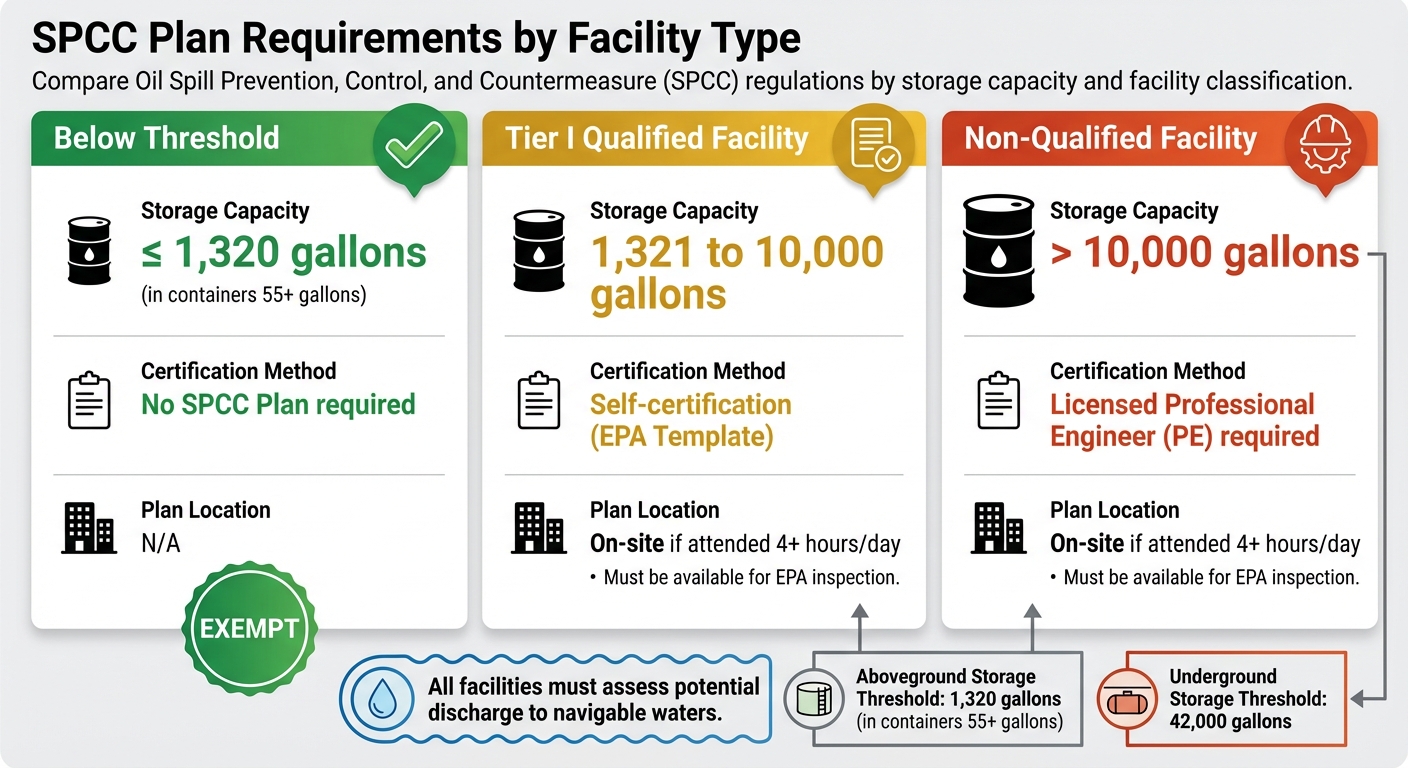
To determine if your facility needs an SPCC (Spill Prevention, Control, and Countermeasure) plan, start by checking your oil storage capacity. Facilities storing more than 1,320 gallons aboveground (in containers of 55 gallons or larger) or 42,000 gallons underground may require an SPCC plan if there’s potential for oil to reach navigable waters.
Certification requirements depend on storage capacity. Facilities with storage between 1,321 and 10,000 gallons can use the EPA’s self-certification template. However, if your facility stores more than 10,000 gallons, you’ll need a licensed Professional Engineer (PE) to certify the plan. Contact your state’s PE licensing board to find qualified professionals.
When assessing whether a spill could reach navigable waters, the EPA advises using a "manmade-blind" approach. This means ignoring any existing barriers like dikes, berms, or containment systems. Instead, focus on the natural layout of your site, including geography, drainage systems (e.g., ditches or storm sewers), and soil conditions. If oil could potentially reach water without these protective measures, an SPCC plan is required.
Once the plan is drafted, assign responsibilities and train your team to ensure everyone knows their role in preventing and responding to spills.
Training and Personnel Responsibilities
The facility owner or operator is responsible for preparing, maintaining, and implementing the SPCC plan. This is a non-delegable responsibility.
"The SPCC rule requires the owner or operator of the facility prepare and implement an SPCC Plan. The Plan must be maintained at the location of the facility that is normally attended at least four hours per day." – EPA
Regular training is critical to keeping your team prepared. The EPA suggests using "Train-the-Trainer" programs to equip key personnel to lead internal sessions and educate staff about SPCC requirements. Training should include identifying potential discharge points, operating containment systems, and responding to spills. This ensures everyone understands both prevention strategies and cleanup procedures.
After assigning roles, integrate the SPCC plan into daily operations. Regular reviews and system checks will help keep the plan effective and actionable.
Implementation and Periodic Review
For facilities attended at least four hours daily, the SPCC plan must be kept onsite and regularly updated. Conduct inspections to check drainage pathways, containment systems, and overfill prevention measures to ensure compliance. Implementation is not just about creating a document – it’s about making the plan part of your facility’s daily routine.
Frequent testing of overfill prevention systems is essential, as failures in these systems are a common cause of large spills. For Tier I Qualified Facilities, the EPA template simplifies compliance, eliminating the need for additional federal paperwork.
| Facility Type | Storage Capacity | Certification Method | Plan Location |
|---|---|---|---|
| Tier I Qualified | 1,321 to 10,000 gallons | Self-certification (EPA Template) | On-site if attended 4+ hours/day |
| Non-Qualified | > 10,000 gallons | Licensed Professional Engineer | On-site if attended 4+ hours/day |
| Below Threshold | ≤ 1,320 gallons | No SPCC Plan required | N/A |
SPCC Compliance in High-Risk Industries
Industry-Specific Challenges
High-risk industries such as oil and gas, mining, and utilities face unique hurdles when it comes to implementing SPCC (Spill Prevention, Control, and Countermeasure) plans. One of the biggest challenges lies in managing compliance for remote or unmanned facilities. SPCC regulations require that plans be stored at locations staffed for at least four hours a day, but many upstream oil sites and mining operations operate with minimal on-site presence or are only visited occasionally. This makes maintaining compliance in such areas a logistical challenge.
Operators in these industries must also assess oil discharge risks by considering natural terrain and soil conditions. This approach assumes worst-case scenarios where no manmade containment measures are in place, demanding a higher level of preparedness.
Another recurring issue is the failure of overfill prevention systems. In high-risk sectors, these automated systems require constant monitoring and must be backed by redundant manual procedures to avoid disastrous spills.
Environmental factors further complicate SPCC compliance. Remote facilities are increasingly vulnerable to wildfires, which can jeopardize the integrity of aboveground storage tanks. Additionally, industries relying on mobile refuelers, such as mining and utility construction, must navigate specific regulatory amendments while ensuring they have certified personnel on hand to handle operations across multiple sites.
Effectively addressing these challenges demands a combination of rapid workforce deployment and real-time compliance monitoring.
How ABLEMKR Supports Compliance

To tackle these challenges, ABLEMKR provides tailored compliance solutions designed for high-risk, remote operations. Managing SPCC compliance in these environments requires quick access to trained personnel who are well-versed in regulatory standards and site-specific risks. According to 40 CFR 112.7, all oil-handling staff must be trained in equipment operation, spill response protocols, pollution control regulations, and the facility’s SPCC plan.
ABLEMKR’s platform simplifies this process by connecting operators with pre-qualified workers who already have the necessary certifications and training. Using a mobile-first approach, the platform matches personnel to job sites based on their credentials, location, and availability. This is particularly critical for urgent situations, such as last-minute shutdowns or emergency pipeline repairs, where compliance cannot afford delays.
The platform also integrates real-time compliance tracking, giving operators instant visibility into worker credentials. This ensures that only qualified personnel are assigned to sensitive tasks, such as spill response operations, where certifications like HAZWOPER must be verified before deployment. For organizations managing facilities across multiple locations or energy corridors, ABLEMKR’s centralized system eliminates the need for manual tracking while ensuring all required documentation is readily available for inspections.
Conclusion
Preventing spills is essential for safeguarding public health, preserving water resources, and maintaining control in high-risk environments. As highlighted, "Due to the danger oil spills cause to public health and the environment, every effort must be made to prevent oil spills and to clean them up promptly once they occur". This guiding principle forms the backbone of SPCC compliance.
Facilities under specific federal mandates must do more than complete paperwork. Compliance involves ongoing training, regular inspections – using tools like EPA fact sheets and calculation worksheets – and staying updated on technical alerts, such as the August 2024 guidance addressing overfill prevention failures.
For industries like oil and gas, mining, and utilities, remote sites present unique challenges. These locations often require quick access to certified personnel who can handle spill response and understand SPCC requirements. Platforms like ABLEMKR (https://ablemkr.com) streamline this process by connecting operators with pre-vetted professionals skilled in equipment operation, spill protocols, and facility-specific regulations. This combination of trained personnel and strategic planning strengthens efforts to prevent spills.
Regulations demand not only the prevention of discharges but also preparedness for worst-case scenarios. Facilities are legally required to prevent discharges into navigable waters, prepare for potential disasters, and maintain records at sites staffed for at least four hours daily. These rules are enforced by the EPA for inland waters and by the U.S. Coast Guard for coastal operations.
A successful spill prevention strategy blends secondary containment measures with specialized training. By focusing on prevention, consistent training, and real-time compliance, operators can meet legal requirements while protecting both communities and the environment.
FAQs
What steps should I follow to create and implement an SPCC plan?
Creating a Spill Prevention, Control, and Countermeasure (SPCC) plan starts with determining whether your facility falls under SPCC regulations. Begin by conducting an oil inventory and identifying areas where spills could occur. Use this information to design spill prevention strategies and secondary containment systems that address your facility’s specific risks.
Next, draft the SPCC plan using sound engineering practices. Depending on your facility’s circumstances, the plan must either be certified by a Professional Engineer or self-certified if you meet the eligibility criteria.
Once the plan is finalized, put it into action. Train your team on proper spill prevention and response procedures, install any required equipment, and establish a schedule for regular inspections. To keep the plan effective, review and update it annually or whenever significant operational changes occur. A well-maintained SPCC plan not only safeguards your facility and workforce but also plays a critical role in protecting the environment from spill-related hazards.
How can facilities in remote or high-risk areas stay compliant with SPCC regulations?
Facilities located in remote or high-risk areas must adhere to the federal Spill Prevention, Control, and Countermeasure (SPCC) rule, which mandates having a written SPCC Plan. This plan should detail oil-handling procedures, outline measures like secondary containment and overfill prevention, and list the personnel, equipment, and resources necessary to prevent oil spills from contaminating navigable waters or shorelines. For smaller facilities without on-site engineers, the EPA provides a Tier I SPCC template, allowing operators to create a self-certified plan tailored to their specific site.
To stay compliant, facilities need to regularly perform risk assessments, conduct inspections, and provide staff training. Essential tasks include inspecting tanks and containment systems, testing the integrity of storage containers, and ensuring that secondary containment can handle the largest potential spill. Emergency response drills with trained personnel are equally important to manage and report spills promptly, as required by regulations.
ABLEMKR makes compliance simpler in remote or challenging locations by connecting operators with pre-vetted, certified workers who can assist with spill prevention training, inspections, and emergency response. The platform offers real-time updates on worker status and streamlines compliance tracking, helping facilities meet SPCC requirements even in the most isolated areas.
What happens if a facility required to have an SPCC plan doesn’t have one?
Facilities that are required to have an SPCC (Spill Prevention, Control, and Countermeasure) plan but neglect to implement one face serious repercussions. Without a proper plan, the risk of oil spills increases, which can harm public health, contaminate drinking water supplies, damage ecosystems, and disrupt local economies.
Beyond the environmental and community harm, the financial consequences can be steep. Facilities may face costly cleanup efforts, regulatory fines, and even civil liabilities. Developing and maintaining an SPCC plan not only helps reduce these risks but also ensures adherence to federal regulations.


