
Oil and gas companies rely heavily on contract staffing to meet tight deadlines, manage fluctuating work demands, and address labor shortages. This approach allows operators to quickly hire skilled professionals for specific projects, avoiding the long-term costs of permanent hires. Here’s what you need to know:
- Why It Matters: Contract staffing ensures rapid workforce scaling during high-demand periods, such as shutdowns or pipeline repairs, without the overhead of permanent employees.
- Challenges: The industry faces a shrinking pool of skilled workers, driven by retirements and competition from other sectors like renewables.
- Key Benefits: Contract workers bring certifications, safety training, and experience, ready to handle tasks like drilling, pipeline construction, and offshore operations.
- Costs: Daily rates range from $200–$1,200 depending on skill level, with additional expenses for overtime, per diems, and travel.
- Compliance: Companies must follow OSHA standards, manage certifications, and properly classify workers to avoid legal and financial risks.
Takeaway: Contract staffing has become a critical workforce strategy for the oil and gas sector, helping companies stay flexible, reduce costs, and maintain project timelines in a competitive, fast-changing environment.
Planning and Budgeting for Contract Workers
Oil and Gas Contract Staffing Costs and Rates 2025
When planning for contract workers, start by breaking down your project into phases – like exploration, drilling, maintenance, or turnarounds – and then assign roles for each stage. For example, a rig turnaround might need between 50 and 100 workers, while a pipeline repair crew could require just a dozen specialized technicians. The goal is to match staffing levels to peak demands and establish rotation schedules early on. Offshore projects often use a 28 days on/28 days off schedule, while onshore rotations might follow a 14/14 or 21/21 cycle to balance fatigue and ensure smooth operations. These decisions are critical for accurate budgeting and compliance planning.
Building a Staffing Plan Based on Project Needs
Your staffing plan should align closely with the project timeline. Break each work package – such as drilling, completions, shutdowns, or pipeline construction – into specific trades and roles. For projects requiring continuous operations, design rotations that maintain coverage without exhausting workers. For instance, a 14/7 rotation (14 days on, 7 days off) with 84-hour workweeks demands careful planning to ensure seamless crew transitions. Use historical data to estimate staffing levels and include buffers for remote locations or high-demand situations.
Determine your workforce mix by using permanent staff for core tasks and contract workers for peak periods or specialized roles. For highly specific skills – like rope access inspectors or subsea specialists – contractors are often the best choice to keep fixed costs manageable. Building a pool of pre-qualified contractors with up-to-date certifications allows for quick mobilization during emergencies, cutting hiring time by 30-50% and helping you avoid costly delays.
Calculating Contract Labor Costs
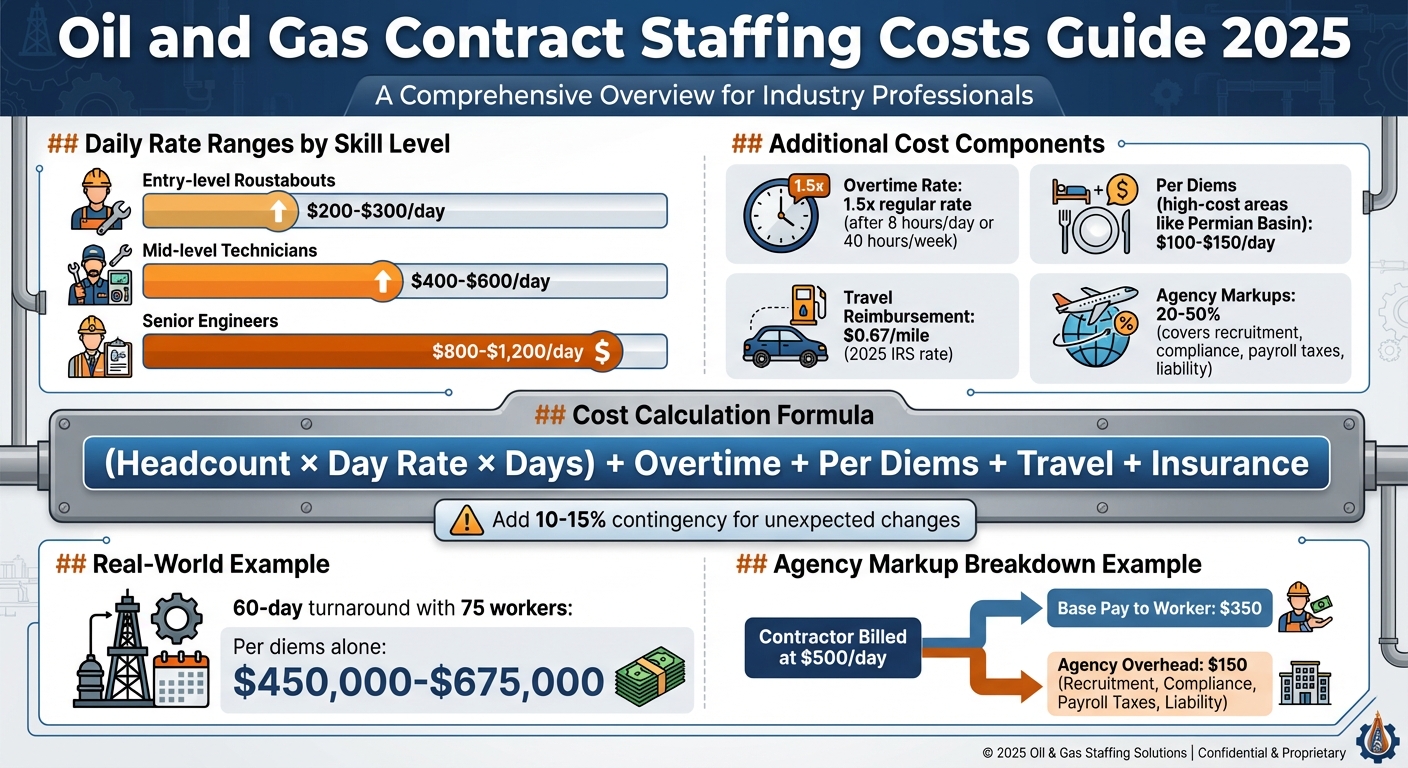
Contract labor costs can vary widely. In 2025, daily rates range from $200-$300 for entry-level roustabouts, $400-$600 for mid-level technicians, and $800-$1,200 for senior engineers. Overtime, calculated at 1.5x the regular rate, typically applies after 8 hours a day or 40 hours a week under the Fair Labor Standards Act. Per diems in high-cost areas like the Permian Basin average $100-$150 per day, covering meals and lodging. Travel expenses can add up quickly, with reimbursed mileage at $0.67 per mile (based on the 2025 IRS rate) or flights costing $5,000-$15,000 per mobilization.
Agency markups, which range from 20-50%, cover recruitment, compliance, payroll taxes, and liability. For instance, a contractor billed at $500 per day might receive $350 in base pay, with the remainder covering these overhead costs. To estimate total labor expenses, use this formula: (Headcount × Day Rate × Days) + Overtime + Per Diems + Travel + Insurance. Add a 10-15% contingency to account for unexpected changes. For a 60-day turnaround with 75 workers, per diems alone could cost between $450,000 and $675,000.
Required Certifications and Worker Qualifications
Once costs are calculated, ensure every worker has the necessary certifications to start immediately. Mid-level positions like floorhands or technicians typically require 3-5 years of experience, OSHA 10 or 30 training, and equipment-specific credentials. Senior roles demand 10+ years of experience, advanced certifications such as IWCF well control, and the ability to adapt to rotational work. Offshore workers must hold BOSIET (Basic Offshore Safety Induction and Emergency Training), HUET (Helicopter Underwater Escape Training), and TWIC (Transportation Worker Identification Credential) for secure sites. Role-specific certifications – such as API 510/570 for inspectors or NDT Level II for technicians – are essential for compliance and readiness.
To avoid delays, incorporate certification training into your project timeline and budget. Platforms like ABLEMKR can simplify this process by matching pre-vetted workers based on certifications, safety training, location, and availability. These tools reduce administrative burdens and ensure that crews are ready to work from Day 1, which is especially crucial for urgent shutdowns or remote pipeline repairs where delays can be costly.
Finding and Deploying Contract Workers
Once budgets and certification needs are finalized, the next step is finding the right talent to ensure projects stay on schedule. To meet this challenge, operators turn to various sources like specialist agencies, local labor pools, veteran networks, and digital platforms to quickly access skilled workers. Specialist staffing firms are particularly effective for filling technical roles, such as subsea engineers, or managing large-scale mobilizations that come with complex compliance requirements. For entry-level and semi-skilled positions near major basins like the Permian or Bakken, tapping into local talent – through labor pools or community colleges – not only cuts down on travel costs but also builds strong ties with the community. Once the sourcing strategy is in place, it’s critical to confirm that every candidate meets the project’s specific requirements.
Where to Find Oil and Gas Contract Workers
For high-volume, time-sensitive projects like refinery turnarounds or offshore shutdowns, specialist recruitment agencies are often the first choice. These agencies maintain extensive databases of pre-vetted contractors and handle the heavy lifting – bulk hiring, mobilization, and even payroll administration. For roles that demand a high level of discipline and safety awareness, veteran pipelines are an excellent resource, often facilitated through partnerships with military transition programs.
Digital platforms like ABLEMKR have also become game-changers. These platforms provide instant access to certified workers across the U.S., keeping real-time records of certifications, safety training, availability, and location. Project managers can post job requirements – such as specific skills, certifications, start dates, locations, and pay ranges – and receive matches from a pool of pre-qualified candidates within minutes. This is particularly useful for last-minute needs like emergency pipeline repairs or sudden crew shortages. With platforms like ABLEMKR, workers can often be mobilized within 24–72 hours by filtering for the closest qualified candidates. After sourcing, a thorough screening process ensures that only the best-suited workers are deployed.
How to Screen and Verify Contractors
Screening contractors starts with a clear checklist based on the pre-planned certification requirements. Digital platforms like ABLEMKR simplify this process by integrating sourcing and screening. A comprehensive checklist should include identity verification, work authorization in the U.S., validation of technical certifications (like API, NCCER, and welding credentials), OSHA-required safety training (such as OSHA 10/30 and HAZWOPER), and any site-specific credentials like TWIC or SafeGulf/SafeLand. For high-risk roles, it’s also essential to verify relevant experience and review safety records. Background checks and drug/alcohol testing should align with both company policies and legal regulations.
Using digital repositories to pre-qualify contractors before awarding projects can save significant time. Platforms like ABLEMKR maintain verified worker profiles, allowing hiring managers to filter candidates based on compliance. These platforms also conduct interviews and vet candidates according to customer specifications, ensuring the right fit for the job. Partnering with agencies or platforms that offer dedicated compliance teams can further ease the administrative burden on field leadership, speeding up the process while minimizing risks.
Using Technology to Speed Up Deployment
Technology has streamlined the entire deployment process, from finding workers to onboarding. Digital platforms centralize worker data, automate matching, and simplify onboarding, cutting down mobilization time dramatically. Instead of juggling multiple agencies, project managers can use a single interface to view real-time availability, certifications, and location data. Workers can use mobile tools to accept job offers, upload documents, complete safety training, and e-sign policies, reducing onboarding time from days to just hours.
When choosing a platform, look for integrations with HRIS and payroll systems to eliminate duplicate data entry and minimize pay errors. Other helpful features include learning management systems to track mandatory safety training, document management systems with alerts for expiring certifications, and customizable onboarding workflows tailored to specific project or site needs. The platform should also meet U.S. compliance standards, such as electronic I-9 verification, E-Verify, and overtime calculations under the Fair Labor Standards Act. Additionally, it should handle the complexity of oil and gas contracting, including multiple pay rates, per diems, and travel allowances. By centralizing these processes, companies can reduce the risk of hiring mistakes, cut overtime costs, and avoid project delays that often arise from fragmented, manual systems.
Compliance and Risk Management
For contract staffing to work smoothly, strict compliance with labor laws, safety rules, and insurance standards is a must. In 2024 alone, OSHA penalties hit a staggering $1.7 billion. A single compliance mistake can halt projects for 2–4 weeks and drive up insurance costs by as much as 30%. Knowing the regulations and structuring contracts accordingly is essential, especially in an industry already grappling with labor shortages and the need for quick mobilization. The upside? With the right knowledge and systems in place, you can keep operations running without legal troubles.
U.S. Labor Laws for Contract Workers
The Fair Labor Standards Act (FLSA) lays out the rules for paying contract workers. Non-exempt contractors must get overtime pay at 1.5 times their regular rate for any hours worked over 40 in a week, along with minimum wage protections. The real challenge? Proper classification. Misclassifying workers can result in fines of up to $1,000 per violation. The IRS applies Section 530 rules to determine if someone qualifies as an independent contractor by looking at three factors: behavioral control (who directs the work), financial control (who supplies tools and manages expenses), and the overall nature of the relationship. For mid-sized companies, mistakes in classification can lead to costs averaging $250,000.
To avoid pitfalls, employers should conduct quarterly contract audits and document key details, such as the contractor’s autonomy, whether they use their own equipment, and how payments are structured. Payments exceeding $600 annually require companies to issue Form 1099-NEC, with penalties of $310 for each missing form. Digital tools can simplify this process by automating 1099 filings and flagging potential FLSA issues, ensuring records are ready for audits.
Safety and Certification Requirements
In the oil and gas sector, OSHA regulations aren’t optional – they’re mandatory. General industry standards under 29 CFR 1910 cover critical areas like hazard communication, lockout/tagout procedures, and fall protection. For construction-related activities, standards under 1926 apply. High-risk sites, such as refineries, must comply with Process Safety Management (PSM) rules under 1910.119, with OSHA 300 logs maintained to track incidents. Fines for willful violations can reach $156,259 in 2025.
Many onshore positions require OSHA 10- or 30-hour training cards, along with specialized training in areas like H2S awareness and confined space entry. Offshore workers, particularly in the Gulf of Mexico, must complete certifications like BOSIET (Basic Offshore Safety Induction and Emergency Training) and HUET (Helicopter Underwater Escape Training), as mandated by the Bureau of Safety and Environmental Enforcement. Around 85% of job placements require up-to-date certifications, which are verified before deployment. Digital platforms can scan and track certifications, sending alerts for upcoming expirations, which helps cut deployment delays by 30%. These tools align with the industry’s move toward quicker, data-driven staffing solutions.
Insurance and Liability Requirements
Insurance is another critical layer of protection, safeguarding both companies and contractors in case of disputes or accidents. Workers’ compensation is required in most states. For example, Texas policies often provide $1 million per accident. General liability insurance should cover at least $2 million in aggregate, with high-risk activities sometimes requiring excess or umbrella policies. To transfer risk effectively, contractors are frequently required to name the hiring company as an additional insured.
Key strategies like hold-harmless agreements and flow-down clauses ensure contractors maintain insurance coverage at the same level as the primary company. For large-scale projects, Owner-Controlled Insurance Programs (OCIPs) bundle policies to centralize and manage risk. However, inadequate coverage is a major risk – underinsured contractors can leave companies facing claims exceeding $5 million. Using Employer of Record (EOR) services to bundle insurance can cut administrative tasks by 40% while ensuring proper coverage.
sbb-itb-aa28329
Managing and Retaining Contract Workers
Bringing contractors on board is just the beginning; keeping them engaged and committed is where the real effort lies. In industries dominated by project-based work – like offshore drilling, shutdowns, and infrastructure projects – how you manage and retain these workers can make or break your operations. Poor integration can lead to safety risks and high turnover, but well-planned retention strategies, supported by data, create a dependable talent pool that’s ready when you need them. Here’s how you can effectively integrate, retain, and maximize the performance of your contract workforce.
Integrating Contractors with Permanent Staff
To successfully integrate contractors with your full-time team, start with structured onboarding that emphasizes safety protocols and site-specific hazards. Pairing contractors with permanent staff as mentors helps close knowledge gaps, builds trust, and can reduce safety incidents by as much as 20%. Daily team meetings and shared digital tools ensure everyone stays aligned on goals and potential risks. When contractors feel like part of the team, they’re more likely to perform well and stick around.
Clear communication is just as vital as proper training. Equip your workforce with mobile-first tools to deliver real-time updates, ensuring both contractors and permanent employees receive the same information simultaneously. Establish unified reporting systems where contractors report to the same supervisors as full-time staff. Platforms like ABLEMKR provide real-time visibility into worker status, making it easier to manage both groups cohesively. Setting clear expectations around rotation schedules, working hours, and site rules before contractors arrive helps avoid conflicts that could lead to turnover. This seamless integration reinforces earlier efforts to ensure rapid mobilization and strict compliance.
How to Retain Top-Performing Contractors
Keeping your best contractors requires more than just fair compensation. While competitive pay is essential – ranging from $50–$150 per hour for skilled roles and $80–$120 per hour for mid-level technicians in Texas – on-time payments are equally crucial. Contractors who are confident they’ll be paid promptly are 40% more likely to return for future projects. Tools like ABLEMKR’s payroll workflows simplify this process, eliminating payment delays that could push contractors to look elsewhere.
Create a preferred contractor list to prioritize high performers for future projects. Offering early assignments – ideally 4–6 weeks before the current project ends – helps ensure back-to-back opportunities. Predictable rotations and clear project timelines also go a long way in building loyalty, as contractors value knowing when they’ll have time at home. Investing in upskilling and cross-training is another smart move. For instance, training mechanical technicians in automation or digital tools not only enhances their value but also increases the likelihood they’ll stick with your projects. Recognition programs and consistent re-engagement can turn one-off contractors into long-term collaborators.
Using Data to Improve Workforce Decisions
Once you’ve nailed integration and retention, data can take your workforce management to the next level. Use data to analyze contractor costs, factoring in travel, per diem, overtime, and rework expenses. This helps identify which workers deliver the most value. Tracking metrics like time-to-fill and mobilization lead times by role and vendor can improve planning for shutdowns and seasonal demands, with companies cutting time-to-fill by 25% when using data-driven forecasting.
Data platforms can also monitor productivity metrics like tasks completed per shift and equipment uptime, offering real-time performance insights. Building digital talent pools allows you to track past performance, certifications, and site experience, making it easier to match workers to future roles. For example, ABLEMKR’s platform pairs pre-vetted workers with job sites based on their qualifications, safety training, availability, and proximity, while also ensuring compliance and providing real-time visibility for better staffing decisions.
Conclusion
Contract staffing in the U.S. oil and gas industry has become a critical response to market fluctuations, tight project deadlines, and a growing shortage of skilled labor. Companies that thrive in this environment prioritize workforce planning, compliance, and technology as essential components of their operations. By aligning workforce strategies with project phases, creating transparent budgets that account for wages, per diem, travel, and overtime, and adhering to OSHA standards and certification requirements, operators can minimize delays, control costs, and reduce safety risks.
Advanced digital tools play a key role in meeting these challenges. Platforms that maintain pre-vetted, skills-tagged talent pools and quickly match workers based on certifications, safety training, and location significantly cut down the time needed to fill positions. For instance, solutions like ABLEMKR simplify deployment and ensure compliance, which is especially critical for time-sensitive tasks like shutdowns, remote repairs, or multi-phase projects where even minor delays can escalate.
Effective contractor management is another cornerstone of operational success. Establishing a standardized role matrix and developing a 12- to 24-month resource forecast tied to your project schedule can make a huge difference. Regularly audit contractor rosters to identify expired certifications or misclassifications, and track key performance indicators such as incident rates, rehire rates, time-to-fill, and labor costs. Additionally, focusing on the contractor experience – clear job scopes, timely payments, and predictable rotations – can turn staffing into a strategic advantage, helping meet both schedule and safety goals.
The growing reliance on short-term, project-based contracts is reshaping workforce models in 2025, making agility a necessity. By staying compliant, optimizing costs, and using data to refine workforce strategies quarterly, companies can build a dependable bench of skilled talent. When done right, this approach ensures workers arrive prepared, operate safely, and return for future projects, creating a cycle of reliability and efficiency.
FAQs
What steps can oil and gas companies take to stay compliant with labor laws when hiring contract workers?
To comply with labor laws, oil and gas companies need to prioritize careful screening of contract workers to ensure they fulfill both legal and industry-specific standards. This process should include checking certifications, verifying safety training, and confirming work eligibility.
Equally important is keeping detailed records of worker documentation, following wage and hour laws, and implementing thorough onboarding procedures. Using workforce management platforms tailored for the oil and gas sector can make it easier to track compliance. These tools offer real-time updates on worker status, helping companies stay aligned with their legal responsibilities.
How can employers retain top contract workers in the oil and gas industry?
Retaining top contract workers in the oil and gas industry hinges on offering more than just a paycheck. Competitive compensation is essential, but so is providing steady work opportunities, prioritizing safety, and investing in professional growth. Workers are more likely to stay when they see a clear path for development and feel their well-being is a priority.
Creating a positive work environment is equally crucial. Clear communication about job roles, expectations, and potential for growth can make a significant difference. Additionally, using workforce management platforms can simplify processes like hiring, onboarding, and ensuring compliance. These tools not only make operations smoother but also show workers they are valued, which can go a long way in building loyalty among skilled professionals.
How does technology streamline managing contract workers in oil and gas projects?
Technology has made managing contract workers in oil and gas projects much easier by providing real-time updates on worker status and automating essential tasks such as hiring, onboarding, and compliance checks. It connects pre-vetted workers to job sites based on criteria like certifications, safety training, and proximity, ensuring the right people are assigned quickly – even for urgent or hard-to-reach projects.
With tools like built-in payroll systems and compliance monitoring, operations become more streamlined and transparent. This not only helps employers deploy crews efficiently but also cuts down on administrative hassles, keeping projects on track and within budget.


