
Hazard identification training is essential for preventing workplace injuries, improving safety, and ensuring compliance with U.S. regulations like OSHA and MSHA standards. This training helps workers in high-risk industries, such as construction and energy, recognize and address dangers like falls, electrical hazards, and chemical exposures. It also reduces downtime, lowers costs, and strengthens workplace safety practices.
Key takeaways include:
- What It Covers: Identifying hazards (e.g., physical, chemical, ergonomic) and assessing risks based on severity and likelihood.
- Why It Matters: Prevents accidents, ensures compliance, and promotes a safer work environment.
- Training Methods: Combines classroom learning, on-site practice, and simulations (e.g., VR, AR).
- Tools: Use of JSAs, checklists, digital apps, and real-time monitoring technologies.
- Compliance: Employers must document hazards, train workers, and meet OSHA/MSHA standards.
- Technology: Platforms like ABLEMKR manage training records, certifications, and compliance.
OSHA Hazard Identification And Risk Assessment In 6 Minutes
Hazard Identification and Risk Assessment Basics
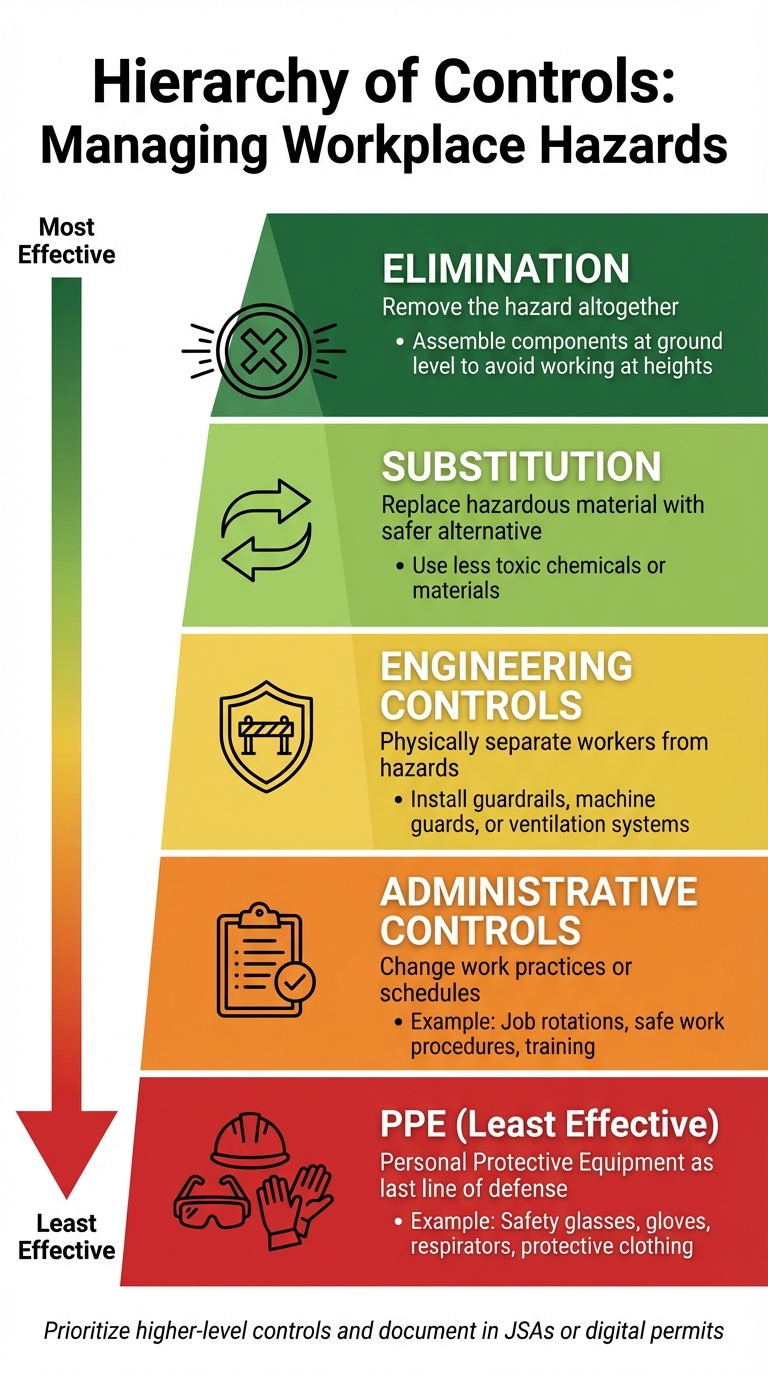
Hierarchy of Controls for Workplace Hazard Management
Understanding what separates a hazard from a risk is key to ensuring workplace safety. A hazard refers to anything – an object, condition, or situation – that has the potential to cause harm, such as injuries, illnesses, property damage, or environmental harm. Risk, on the other hand, is the combination of how likely that harm is to occur and how severe the consequences could be. For instance, an exposed edge at a construction site is a hazard. The risk depends on how often workers are near the edge and how serious an injury could be if someone falls. Identifying hazards helps pinpoint dangers, while risk assessments determine how urgently those dangers need to be addressed.
Common Hazard Types in Construction and Energy
Jobsites in construction and energy industries are often full of hazards, which can generally be grouped into the following categories:
- Physical hazards: These include falls, impacts, loud noise levels, and extreme temperatures.
- Electrical hazards: Examples are contact with overhead power lines, frayed extension cords, or improper use of lockout/tagout protocols.
- Mechanical hazards: These involve risks like unguarded moving machinery, pinch points, or pressurized systems (e.g., steam or hydraulics) that could release stored energy suddenly.
- Chemical hazards: Workers can be exposed to harmful substances, such as fumes from welding or toxic gases like hydrogen sulfide during oil and gas operations.
- Environmental hazards: These include poor lighting, unstable or uneven surfaces, confined spaces with inadequate ventilation, and severe weather conditions.
- Ergonomic hazards: Risks arise from repetitive motions, awkward body positions, or heavy lifting that can strain the body.
- Organizational hazards: Issues like excessive overtime, production pressures leading to shortcuts, or poor communication between shifts fall into this category.
Given the wide range of potential hazards, a structured process is essential for identifying and managing associated risks effectively.
How to Identify Hazards and Assess Risks
The first step in identifying hazards is to gather as much existing information as possible. Review Job Safety Analyses (JSAs), Safety Data Sheets (SDSs), and past incident reports to uncover potential dangers. A diverse team of supervisors, workers, and safety experts should then work together to ensure no risks are overlooked.
Perform workplace walkthroughs before and during work to observe tools, equipment, access routes, housekeeping practices, and worker behaviors. Structured checklists tailored to the specific environment – whether construction or energy operations – can help ensure thorough inspections. Engage workers in discussions about recent near misses or workaround solutions, as these often highlight overlooked hazards. Breaking tasks into smaller steps using JSAs can also make it easier to document hazards and their controls.
Once hazards are identified, assess the risks by considering both the likelihood of an incident occurring and the severity of its potential outcomes. A risk matrix can be used to assign numerical values to these factors, categorizing risks as low, medium, or high. Supervisors often use this approach during quick safety meetings, while more detailed assessments may be reserved for higher-risk tasks.
To manage risks, follow the hierarchy of controls. Start with elimination, which involves removing the hazard altogether – for example, assembling components at ground level to avoid working at heights. If elimination isn’t possible, consider substitution, such as replacing a hazardous material with a safer one. Engineering controls aim to physically separate workers from hazards, like installing guardrails or machine guards. Administrative controls focus on adjusting work practices or schedules, such as introducing job rotations or safe work procedures, to reduce exposure. Finally, Personal Protective Equipment (PPE) acts as the last line of defense. Prioritizing higher-level controls and documenting them in JSAs or digital permits reinforces a proactive safety culture.
Dynamic Risk Assessment for Changing Job Sites
Initial risk assessments are just the starting point. As jobsite conditions evolve, dynamic risk assessments ensure that hazards and risks are continuously re-evaluated. This ongoing process is critical for large construction projects, where new trades, equipment, or temporary structures can appear daily, and in energy operations, where conditions may shift during activities like startup, shutdown, or process changes.
External factors, such as severe weather, poor visibility, unexpected ground conditions, or nearby crews performing tasks like hot work, can also introduce new risks. Workers are trained to pause and reassess the situation whenever changes occur – whether in scope, crew, equipment, or the environment. Integrating dynamic risk assessments into routine meetings, such as start-of-shift huddles or toolbox talks, helps ensure hazard identification remains an ongoing priority throughout the workday. This approach keeps safety at the forefront of every task.
Training Methods for Hazard Identification
Preparing workers to identify hazards effectively requires a mix of formal instruction, practical experience, and scenario-based exercises. The best programs combine classroom learning with hands-on field practice and simulated scenarios to help workers recognize hazards in a safe environment before they encounter them in the field.
Classroom and Online Training Options
Classroom sessions and online learning provide the foundation for understanding hazard identification. In-person classes and live virtual sessions are ideal for introducing complex concepts like the hierarchy of controls. These formats also encourage discussions about real incidents from your workplace, helping clarify key terms, OSHA processes, and the use of tools like checklists and risk matrices.
Self-paced e-learning is a great option for onboarding new employees or accommodating shift workers. Microlearning modules – short lessons or videos lasting five to ten minutes – are particularly effective for quick refreshers on specific hazards, such as struck-by risks, confined spaces, or electrical dangers. These bite-sized lessons keep workers informed without taking them away from their tasks for long periods.
Many organizations design tiered training programs to address different roles:
- Baseline modules: General hazard awareness for all employees.
- Role-specific training: For supervisors, focusing on inspections and corrective actions.
- Advanced courses: For safety professionals, covering risk assessment and program evaluation.
For a more interactive approach, OSHA offers a free Hazard Identification Tool. This gamified resource allows workers to practice spotting hazards in a virtual workplace, reinforcing classroom lessons with hands-on learning.
On-Site Training Techniques
Field-based methods are essential for turning theory into practice. Pre-job safety reviews, also known as pre-task plans, involve crews walking through the day’s activities, identifying hazards – like overhead power lines or excavation edges – and documenting necessary controls. This process encourages active risk assessment before work begins.
Toolbox talks, held at the start of a shift, focus on current site conditions or recent incidents. These discussions are most effective when workers actively point out hazards around them instead of just listening. Supervisors can also use incident or near-miss reports to share quick stories about what went wrong, what was missed, and how to avoid similar issues in the future.
Task observations involve supervisors or safety professionals watching workers step-by-step, asking questions to prompt hazard recognition, and providing immediate feedback. Periodic hazard hunts or safety walks, where teams use checklists or mobile apps to scan for risks, help uncover overlooked issues and keep hazard awareness top of mind throughout the day.
Simulation and scenario-based training can further refine these skills, offering workers a chance to practice in controlled environments.
Simulation and Scenario-Based Training
Simulations and scenario exercises provide a safe way for workers to practice identifying hazards. Low-tech options include reviewing jobsite photos with hidden risks, tabletop exercises where teams assess a fictional job plan, or mock training setups like trenches or scaffolds seeded with hazards. Video-based training that pauses to ask, "What hazards do you see here?" is another effective refresher, especially when tailored with site-specific examples. These methods are affordable and can be conducted in break rooms, training trailers, or safety meetings, making them accessible even for smaller companies and remote locations.
For more advanced training, VR and AR technologies create immersive environments where workers can practice recognizing hazards without actual danger. VR modules simulate high-risk scenarios, like working at heights or in confined spaces, challenging workers to identify and prioritize risks under time pressure. AR tools overlay digital prompts onto real equipment or mock-ups, guiding workers step-by-step through hazard checks and controls. These technologies allow for repeated practice, standardized scenarios, and measurable performance metrics, such as the percentage of hazards identified or the time taken to complete tasks.
Such tools are particularly valuable for rare but high-stakes tasks, where learning by doing in real life might be too risky. Platforms like ABLEMKR, used in industries such as construction, oil and gas, and utilities, help track worker profiles, certifications, and training statuses. This ensures that only workers with up-to-date safety training are assigned to specific sites, simplifying compliance and documentation.
sbb-itb-aa28329
Tools and Technology for Hazard Identification
Modern hazard identification blends traditional methods with cutting-edge digital tools to create a safety system that works in real-world conditions. The right mix depends on your industry, site specifics, and workforce skills, but understanding the options available is key to building an effective system.
Paper-Based and Digital Hazard Management Tools
Job Safety Analysis (JSA) forms, also known as Job Hazard Analysis (JHA), are a mainstay for identifying hazards on U.S. construction and energy sites. These forms break tasks into individual steps, highlight potential risks for each step, and outline measures to reduce those risks. Many crews still rely on paper JSAs during toolbox talks or pre-job briefings, ensuring everyone reviews and signs off before work begins. Paper forms are simple, device-free, and ideal for workers less familiar with technology. However, they come with drawbacks like illegible handwriting, lost documents, delayed reporting, and challenges in analyzing trends.
Digital JSA apps streamline these processes by enabling forms to be completed on tablets or smartphones. These apps allow users to attach photos, geotag locations, and automatically send completed forms to safety managers for review. They also integrate key OSHA elements, like incident reporting and hazard logs, providing a unified risk management view. Digital risk matrices, which rate hazards by severity and likelihood, go a step further by automatically scoring risks and alerting supervisors to high-priority issues via email or push notifications – ensuring quicker responses compared to paper-based methods.
Inspection checklists – whether in physical or digital form – help standardize safety walkthroughs, ensuring no common hazards are overlooked. For example, checklists for scaffolding, electrical systems, or confined spaces prompt users with OSHA-compliant questions. Digital versions can trigger corrective actions immediately when issues are identified, reducing the chance of oversight. Similarly, hazard reporting tools range from traditional "near-miss" cards to mobile apps that let workers submit real-time reports with photos and GPS data, boosting both reporting rates and visibility for safety teams.
These digital advancements naturally pave the way for real-time monitoring, further strengthening workplace safety.
Real-Time Hazard Monitoring Technology
Connected sensors and IoT devices are increasingly used to track conditions like gas levels, heat stress, noise, and structural shifts in real time. These tools are especially common in industries like oil and gas, mining, and heavy infrastructure. For instance, modern gas detectors can connect via Bluetooth or Wi-Fi, offering live data and alarms. In refineries and pipelines, these devices can trigger automatic shutdowns and evacuations when dangerous gas levels are detected, enabling swift action.
Wearable devices embedded in hard hats, vests, or ID badges monitor worker safety by detecting falls, tracking locations, or flagging unauthorized entries into hazardous zones. Some systems use geofencing to create virtual boundaries around danger areas, such as crane swing zones, and alert workers if they enter restricted spaces. On large worksites, telematics on equipment like forklifts or cranes monitor risky behaviors like near-collisions or speeding, shifting hazard identification from periodic checks to continuous monitoring.
Data analytics and dashboards pull data from sensors, wearables, and reports to uncover patterns – such as hotspots for near-misses or recurring high-risk areas. These tools allow safety managers to focus on leading indicators, like the number of hazards reported or the time taken to resolve issues, instead of relying solely on lagging indicators like injury rates. Dashboards can highlight trends by location, task, or contractor, helping teams target specific areas for training, engineering fixes, or staffing changes.
Integrating these technologies with digital systems simplifies compliance and training management.
Managing Training Records and Compliance with ABLEMKR

Digital hazard management tools also extend to tracking training records, which are essential for compliance and workforce safety. Training record management systems maintain detailed records of certifications, course completions, expiration dates, and refresher requirements. For U.S. employers, having quick access to this information – such as training dates in MM/DD/YYYY format or course details – is invaluable during OSHA inspections or client audits.
ABLEMKR, a mobile-first workforce platform, takes this a step further by linking training records to specific job roles and sites. This ensures that only qualified workers – those with certifications like OSHA 10/30, confined space training, or H2S awareness – are assigned to high-risk tasks. The platform keeps records up-to-date and allows filtering by site, contractor, or role, making it easier to prepare for audits or inspections.
When assembling a team for a project, such as a pipeline repair or refinery maintenance, ABLEMKR automatically flags workers with missing or expired certifications. This prevents non-compliant assignments and reduces risks. Safety teams can generate reports to confirm that all workers meet training requirements before mobilization, and automated reminders help avoid lapses in certifications that could jeopardize safety or compliance.
How to Build a Hazard Identification Training Program
Program Structure and Core Components
Start by creating a written hazard identification standard. This document should clearly define types of hazards, assign responsibilities for addressing them, and outline processes like inspections, pre-job checks, and reporting. It should also align with OSHA’s guidelines for safety and health programs, serving as the backbone for all training activities.
Develop a training matrix that links job roles to specific hazard identification training requirements. For example:
- All workers need basic training in hazard recognition and reporting.
- Foremen should learn how to lead job safety analyses and conduct field verifications.
- Safety professionals require advanced training in risk assessment and data analysis.
Include refresher timelines, such as annual reviews, post-incident training, or updates prompted by process changes. Each training module should be tied to a regulatory requirement or company policy to ensure compliance.
To make hazard identification part of daily routines, integrate it into workflows. For instance, include hazard walk-throughs in site orientations and require quick hazard scans during daily planning meetings. Train supervisors to guide workers by asking open-ended questions like, "What could be a risk here?" rather than relying on pre-written scripts.
These steps lay a solid foundation for evaluating training effectiveness and driving ongoing improvements.
Measuring Training Effectiveness and Making Improvements
Assess workers’ hazard identification skills through a combination of written tests and hands-on evaluations. Use standard checklists to observe crews during hazard scans and job safety analyses, checking how accurately and thoroughly they identify risks. You can also conduct hazard-spotting exercises using staged scenarios or site images, comparing workers’ findings to an expert-prepared key.
Track both leading and lagging indicators to measure training success. Leading indicators might include hazard reporting rates, training completions, and the time it takes to address reported risks. Lagging indicators, like recordable incidents or lost-time injuries, provide additional context. Collect baseline data before launching the program and compare it to results 6–12 months after implementation to gauge progress.
Dive into incident reports and hazard logs to identify recurring issues. Link these gaps to specific tasks, roles, or training modules to determine where hazards were overlooked or underestimated. Update training content as needed, using real-life case studies from your operations to make the lessons more relevant. Gather worker feedback through surveys, post-incident reviews, and focus groups, and let employees know how their input is shaping improvements. This transparent approach encourages engagement and continuous learning.
With these insights, digital tools like ABLEMKR can help streamline compliance and workforce management.
Using ABLEMKR to Support Training and Compliance
The ABLEMKR platform simplifies managing hazard identification training and compliance. It centralizes worker training records, linking them to roles and certifications. You can track completed courses, training dates, upcoming refreshers, delivery methods, and certifications, while generating audit-ready reports that detail who was trained, on what, and when – all aligned with OSHA expectations.
For high-risk projects like pipeline repairs, refinery maintenance, or confined space work, ABLEMKR’s matching engine ensures only qualified workers are assigned. It filters candidates based on verified training, certifications (like OSHA 10/30 or H2S awareness), and recent refresher dates. Workers with expired or missing certifications are flagged automatically, reducing the risk of non-compliance. Supervisors can even check training statuses in real time through mobile access during pre-mobilization checks.
This real-time visibility into training and qualifications not only supports compliance but also allows organizations to connect training records with incident data. By ensuring that only properly trained and certified workers are deployed, ABLEMKR helps improve safety outcomes while maintaining regulatory compliance across industries like construction, energy, and mining.
Conclusion: Key Points for Hazard Identification Training
Structured hazard identification training plays a vital role in reducing workplace incidents and injuries while ensuring OSHA compliance across construction and energy sectors in the U.S. Organizations that prioritize training methods like walkthroughs, checklists, and job hazard analysis often experience fewer recordable incidents, reduced workers’ compensation expenses, and fewer OSHA violations. This is because potential hazards are identified and mitigated early. Given the dynamic nature of job sites – with changing crews, equipment, tasks, and weather – training must be a continuous effort. Refresher courses, toolbox talks, and retraining after incidents are critical for maintaining sharp hazard identification skills and demonstrating a commitment to safety.
Effective programs go beyond basic training by embedding hazard identification into daily routines. Practices like pre-job briefings, pre-task plans, shift-start walkthroughs, and hazard hunts ensure that teams actively discuss potential risks and controls before starting work. Supervisors play a key role in fostering a strong safety culture by modeling best practices, such as pausing work when unexpected hazards arise, applying the hierarchy of controls, and sharing lessons learned with their teams. In high-risk industries, this proactive approach not only minimizes serious accidents but also helps projects stay on track.
For employers managing multiple sites and high employee turnover, digital tools like ABLEMKR simplify compliance efforts. These tools centralize training records, match workers to projects based on verified certifications, and send reminders for upcoming expirations. With its mobile-first design, ABLEMKR also allows crews to access hazard checklists and submit real-time reports, streamlining safety improvements. This digital integration ensures compliance during audits and reinforces the importance of proactive risk management.
To consistently improve safety performance, leaders should, within 30–90 days, review incident data, formalize daily hazard documentation, incorporate scenario-based training, and configure digital platforms to trigger refresher courses and capture observations. Aligning these practices with OSHA standards transforms hazard identification from a routine task into a critical operational strength, reinforcing the safety culture outlined above.
FAQs
What are the best ways to conduct hazard identification training?
The best ways to train employees in hazard identification include interactive sessions, on-site walkthroughs, and simulations of real-world scenarios. Tools like safety checklists and posters are great for reinforcing essential points, while technology – like mobile apps or virtual reality – can make learning more engaging and easier to grasp.
It’s also important to hold regular refresher courses and encourage workers to report hazards actively. When these strategies come together, the training becomes not just informative but also practical and engaging for everyone.
How does ABLEMKR improve hazard identification and ensure compliance?
ABLEMKR uses technology to make workplaces safer by providing real-time updates on worker certifications, safety training, and availability. This ensures that only workers with the right training and qualifications are assigned to job sites, cutting down risks and promoting a safer work environment.
Through its integrated compliance tracking, ABLEMKR enables employers to keep a close eye on safety protocols and regulatory standards. By simplifying this process, it helps reduce potential hazards while keeping operations running smoothly and in line with industry requirements.
Why is ongoing hazard assessment essential on ever-changing job sites?
On job sites where conditions can change in the blink of an eye, regularly assessing hazards is a must. These evaluations help spot new risks as they arise, ensuring quick action can be taken to protect workers and maintain compliance with safety standards.
Staying ahead of potential dangers not only keeps accidents at bay but also helps avoid delays and costly interruptions. This practice is particularly crucial in industries like construction, energy, and mining, where worker safety and smooth operations are always front and center.


