
The energy industry faces a major workforce challenge. Here’s what you need to know:
- 60% of the energy and chemicals workforce (1.2 million workers) need training in digital tools and processes by 2033.
- 32 million workers must be hired within the next decade: 17 million replacements and 15 million in new roles.
- Clean energy jobs now make up 50% of global energy roles, and this share is growing.
- Rapid advances in technology, an aging workforce, and the shift to clean energy are driving the demand for upskilling.
Upskilling programs can help companies address skill shortages, improve productivity, and reduce reliance on external hires. Workers benefit by transitioning into stable, future-focused careers in clean energy. With tools like AI, virtual reality (VR), and mobile learning platforms, training can now be faster and more effective than ever.
This guide covers strategies for identifying skill needs, selecting training methods, and measuring results to ensure workforce readiness for the energy transition.
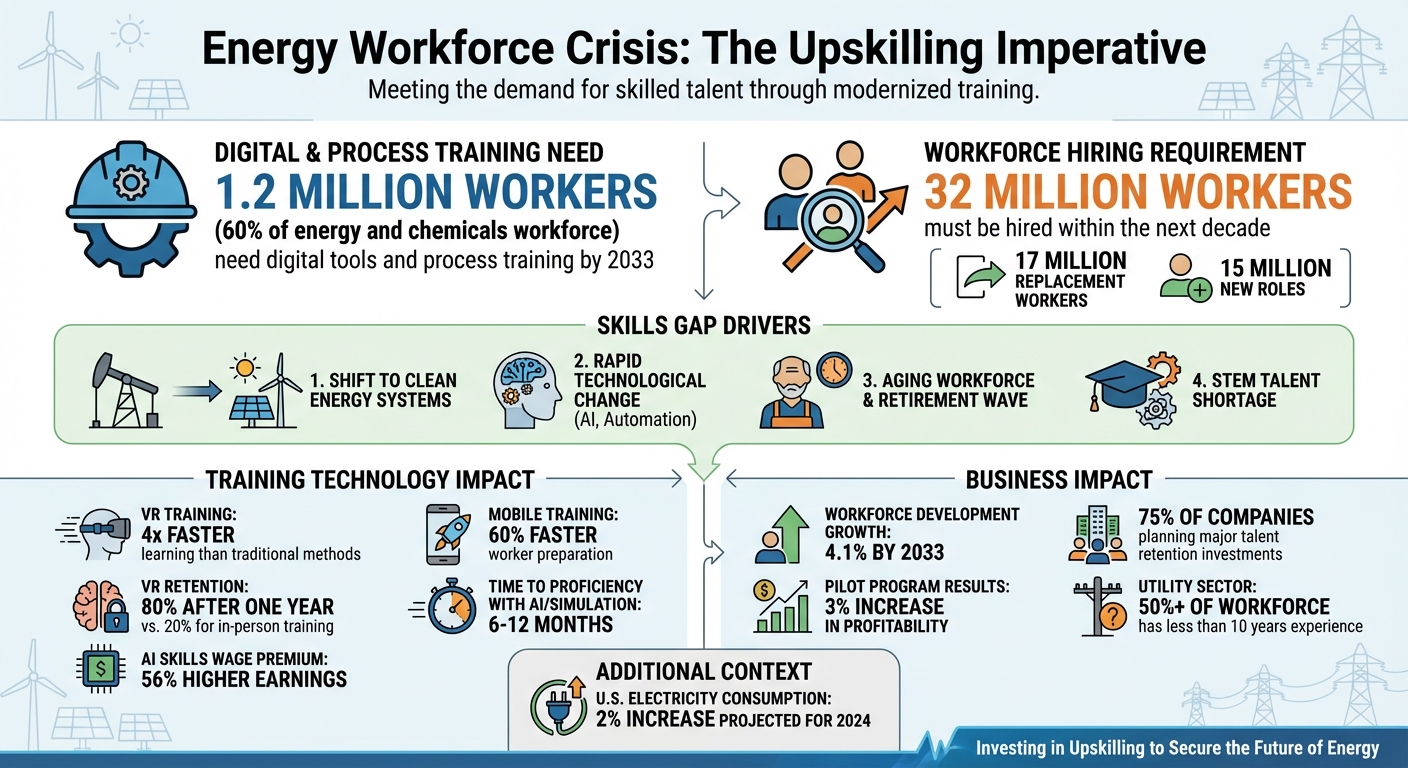
Energy Workforce Crisis: Key Statistics and Upskilling Needs by 2033
GETI 2026 | Make Career Development the Energy Talent Strategy
sbb-itb-aa28329
The Energy Sector’s Skills Gap
The gap between the skills energy workers have today and what the industry will need tomorrow is becoming a serious issue. It’s affecting efficiency, safety, and even the speed of the energy transition. To address this, it’s crucial to understand what’s driving the problem and how to tackle it effectively.
What’s Causing the Skills Gap
A mix of factors is fueling this skills shortage. One major reason is the shift from fossil fuels to low-emission energy systems. This transition requires millions of workers to build and manage new infrastructure like solar panels, wind farms, battery storage facilities, and upgraded grid systems. These jobs demand expertise that goes beyond what traditional energy roles have typically required.
Another challenge is the rapid pace of technological change. Tools like AI-driven analytics and digital process automation are transforming energy operations, but many workers lack the digital skills to use these advancements effectively. As Nichelle McLemore, US Oil and Gas Leader at Deloitte Consulting LLP, explains:
"Companies must foster a culture of continuous learning, agility, and collaboration to navigate changes and capitalize on new opportunities".
On top of that, the sector faces an aging workforce. As experienced employees retire, they take years – sometimes decades – of institutional knowledge with them.
There’s also a shortage of STEM talent, which is critical for roles like advanced engineering and cybersecurity. In fact, the U.S. Department of Energy recently funded a new center at New York University to address cybersecurity training gaps in the electric power sector, highlighting just how urgent this issue has become.
Together, these factors make it clear that upskilling isn’t just a nice-to-have – it’s a necessity.
Business Costs of Skills Shortages
The impact of these skills shortages is hitting businesses hard. For one, project delays are becoming a common problem. Without enough qualified workers, timelines stretch, and costs rise. The U.S. Department of Energy has warned that these workforce shortages could derail the entire energy transition if left unchecked.
Operational inefficiencies are another issue. Companies often face a tough decision: invest in cutting-edge technology that might not be fully utilized due to a lack of skilled workers, or stick with older systems that hold them back competitively.
Safety and compliance risks also increase when workers aren’t properly trained, creating potential liabilities for companies.
On the bright side, training existing employees is far more cost-effective than constantly hiring externally. Upskilling builds loyalty, preserves valuable institutional knowledge, and creates a steady talent pipeline. With workforce development in the energy and chemicals sector expected to grow by 4.1% by 2033, companies that prioritize training now will be better equipped to attract and retain the skilled workers they need. Addressing these challenges with targeted training programs is crucial for staying ahead in the evolving energy landscape.
How to Design Workforce Upskilling Programs
Creating a strong upskilling program starts with a clear plan, guided by data and focused on practical outcomes. The U.S. Department of Energy highlights the importance of using labor market data to guide workforce investments before launching any program or initiative. This ensures resources are allocated efficiently, avoiding unnecessary training for outdated skills or overlooking critical ones.
A key step is breaking down technology silos. Instead of training focused on a single technology, emphasize cross-functional skills that are useful throughout the energy sector. This not only prepares workers to adapt to changing technologies but also offers greater flexibility for employers and employees alike.
The energy industry faces a massive workforce challenge: 17 million replacement workers and 15 million new workers will be needed over the next decade. To meet this demand, leveraging existing education systems – like union apprenticeships and labor-management partnerships – is smarter than creating entirely new programs. These established frameworks are scalable and effective, providing a solid base for identifying future skills, selecting training methods, and integrating safety practices.
Identifying Future Energy Skills
The shift to clean energy brings new skill demands, from wind turbine installation to maintaining hydrogen infrastructure. Workers across the sector will need to develop digital competencies in areas like process operations, analytics, and emerging technologies to stay relevant in the future job market.
Digital proficiency is now essential. Skills in advanced engineering, data analytics, and cybersecurity are critical for roles involving grid management and predictive maintenance. For example, the U.S. Department of Energy recently funded a cybersecurity training center at New York University to address gaps in the electric power sector. This underscores the growing need for specialized expertise.
Rather than focusing on narrow tasks, prioritize broad occupational training. The Department of Energy notes that this approach improves worker retention and equips employees with skills that apply across multiple roles. It’s a smarter investment, ensuring workers remain valuable even as specific technologies evolve.
Selecting Training Methods
After identifying the skills your workforce needs, the next step is to choose training methods that align with these goals. The format should match both the skills being taught and the realities of your workforce. For example:
- In-person training is ideal for hands-on skills like equipment maintenance and safety protocols.
- Online training works for remote workers or those balancing shift schedules.
- Hybrid models combine online foundational learning with supervised, hands-on practice, offering a balanced approach.
Modular learning and micro-credentials are becoming popular because they allow workers to build skills gradually without needing to take long breaks from work. Instead of requiring a six-month certification program, workers can complete shorter modules that stack toward a full credential. This flexibility is crucial when downtime isn’t an option.
Registered Apprenticeships are another proven option. These programs combine on-the-job training with classroom instruction, offering a clear path from entry-level roles to skilled positions. They also tend to have higher completion rates compared to standalone programs, as participants can earn wages while they learn.
Adding Safety and Compliance Training
Safety and compliance training is just as important as technical skills, especially in high-risk energy operations. Rather than treating safety as a separate topic, integrate safety training into all workforce development efforts so workers see how it connects to every part of their job.
Regulatory requirements differ based on the role and location. Workers in oil and gas have different compliance needs than those in solar or grid maintenance. Your training program should reflect these differences while maintaining consistent safety standards across the board.
Embedding safety into ongoing learning ensures workers stay up to date with evolving regulations. It also reinforces the link between continuous development and operational excellence, making safety a core part of the organization’s culture. From initial training to long-term learning, this integrated approach supports both worker retention and workplace safety.
Using Technology to Speed Up Upskilling
Technology has drastically reduced the time it takes to upskill employees, shrinking what once took years into just months. With 1.2 million energy workers needing digital training by 2033 and 400,000 employees set to retire in the next decade, traditional classroom-based methods simply can’t keep up. Modern tools make training faster, scalable, and accessible to workers spread across various locations.
The energy sector comes with its own set of challenges – remote worksites, high-risk environments, and the need to retain knowledge from retiring experts. Today’s training technologies are stepping up to solve these issues. By offering immersive learning experiences, personalizing training paths through data, and delivering content directly to workers’ mobile devices, these tools are changing the game. Among them, virtual reality (VR) stands out as a powerful tool for skill transfer.
Virtual Reality and Simulation Training
VR has proven to be a game-changer in training, helping employees learn up to four times faster than traditional methods, with retention rates hitting 80% after one year, compared to just 20% for in-person training.
For example, in March 2024, GTI Energy partnered with Oberon Technologies to create a fully immersive VR training module for emergency response scenarios. This program not only helped trainees comply with federal safety regulations but also aimed to boost long-term knowledge retention by 80% or more. By incorporating VR into their curriculum, they enhanced both engagement and learning outcomes.
One of VR’s biggest advantages is risk-free practice. Workers can simulate responding to fires, explosions, or high-voltage equipment failures without the dangers of real-life scenarios. Dynamic simulators allow operators to practice handling alarms and equipment malfunctions in a controlled setting. These sessions can be recorded, enabling mentors to review and provide detailed feedback on a trainee’s decisions and movements, speeding up the learning process.
"Virtual reality training solutions… capture tribal knowledge and use it to create a fully immersive virtual experience that provides an innovative way to reskill, upskill and train employees with maximum efficiency." – Vi Kellersohn, Chief Marketing Officer, Oberon Technologies
VR also addresses the challenge of preserving the expertise of retiring workers. Decades of hands-on knowledge, often hard to document, can be captured and simulated through VR. Trainees can virtually explore facility layouts and equipment setups before stepping into high-risk environments, cutting down onboarding time and improving safety.
AI-Powered Workforce Analytics
AI is revolutionizing how companies identify skills gaps and tailor training programs. By analyzing performance data, certifications, and operational history, machine learning pinpoints exactly what each worker needs to learn. This is critical in an industry where workers with AI skills earn a 56% wage premium and 40% of core skills are expected to change by 2025.
Platforms like ABLEMKR use AI to match workers to jobs based on certifications, training, availability, and location. These platforms also track upskilling progress in real time, giving employers a clear view of worker competencies and ensuring certifications stay current across the workforce.
AI doesn’t stop at matching workers to training – it also personalizes learning paths. By combining foundational knowledge with role-specific training, AI tailors education to each individual’s career goals. In control rooms, "Advisory Mode" AI offers real-time recommendations, allowing junior operators to compare their decisions with AI insights, turning everyday tasks into learning opportunities.
The data generated by AI analytics provides insights that manual tracking often misses. Companies can measure training ROI, identify top performers, and track how quickly employees reach proficiency. With a combination of AI and simulation training, most energy sector workers can achieve proficiency in just six to twelve months, a timeline that would be impossible without these tools.
Mobile and Remote Learning Platforms
For workers in the field – whether on remote pipelines, offshore rigs, or utility installations – desktop access and classroom sessions are often impractical. Mobile-first learning platforms solve this problem by delivering training directly to smartphones and tablets, enabling learning "anywhere, anytime."
The best mobile platforms come equipped with offline functionality, allowing workers to download materials and complete training modules even in areas with no internet connectivity. This is especially useful in remote operations, where maintaining access to safety protocols and training resources is critical. Cloud-based systems ensure that updates to regulatory content are instantly available across global teams, reaching thousands of employees simultaneously.
Mobile-enabled training can prepare workers for their roles up to 60% faster than traditional methods. These platforms often integrate with existing Learning Management Systems (LMS), centralizing compliance tracking for certifications like GWO or SCADA. AI-powered tools further enhance this by creating custom lessons based on individual skill gaps, while real-time analytics track engagement and error rates.
Microlearning – short, focused training sessions delivered via mobile devices – has proven particularly effective for field workers. Instead of requiring long classroom sessions, employees can access specific procedures or safety protocols exactly when they need them. This approach reinforces knowledge through repetition and real-world application, making it an ideal fit for on-the-job learning.
Measuring Results and Retaining Workers
When assessing upskilling programs, it’s more effective to focus on business outcomes rather than simply tallying training hours. Some leading energy companies have adopted a Return on Learning Investment (ROLI) approach. This method connects training efforts to specific business goals, defines measurable metrics, and evaluates whether those goals have been met.
Setting Key Performance Indicators (KPIs)
The first step in measuring success is to establish Key Performance Indicators (KPIs) across four main areas: business impact, productivity, retention, and speed to mastery.
- Business impact can be tracked through metrics like profitability, customer satisfaction, and the ability to implement AI solutions.
- Productivity focuses on outputs such as error reduction, task completion times, and individual worker performance.
- Retention examines metrics like employee engagement and reduced turnover rates.
- Speed to mastery measures how quickly employees transition from onboarding to full competency, including tracking certification completion rates.
For example, in January 2024, a global energy company tested an upskilling program targeting frontline leaders. They used A/B testing to compare a pilot group against a baseline, focusing on KPIs like profitability. The pilot group showed a 3% increase in profitability, providing measurable ROI that justified scaling the initiative across the organization. Interim metrics like enrollment rates and periodic assessments also served as early indicators of the program’s potential long-term success.
| KPI Category | Specific Metrics to Track | Purpose |
|---|---|---|
| Business Impact | Profitability, Customer Satisfaction, Innovation Speed | Align training with corporate strategy |
| Productivity | Output per worker, Error rate reduction, Task completion time | Measure role-specific performance |
| Retention | Attrition rate reduction, Employee Engagement | Evaluate engagement and loyalty |
| Speed to Mastery | Days to full competency, Certification completion rates | Assess training efficiency |
Using these KPIs as a foundation, organizations can strengthen retention efforts by building clear career pathways for employees.
Creating Career Pathways and Ongoing Learning
Upskilling programs are most successful when directly tied to career advancement. With 75% of companies planning major investments in talent retention and development, structured career roadmaps are essential. These pathways help employees see how their new skills and certifications lead to promotions, better pay, or more fulfilling work. When workers understand the tangible benefits of their development, they’re more likely to stay committed to the organization.
"Companies must foster a culture of continuous learning, agility, and collaboration to navigate changes and capitalize on new opportunities."
– Nichelle McLemore, US Oil and Gas Leader, Deloitte Consulting LLP
The need for clear career pathways is especially pressing in the utility sector, where over 50% of the workforce has less than 10 years of experience. By aligning upskilling programs with career progression, companies can reduce turnover and retain skilled employees, ensuring their workforce is prepared for future challenges.
Using Workforce Platforms for Real-Time Data
Once KPIs are in place, real-time data platforms can help fine-tune training efforts. These platforms provide instant insights into worker competencies, certifications, and compliance, allowing managers to identify skill gaps and track proficiency gains in real-time.
For instance, ABLEMKR offers integrated tools for monitoring upskilling progress. The platform matches workers to roles based on their certifications, availability, and location, while also tracking compliance to ensure qualifications remain up to date. This kind of visibility enables companies to quickly address skill shortages and measure the ROI of their training investments accurately.
Conclusion
The energy sector is at a crossroads, facing an urgent need for millions of new and replacement workers, alongside the digital upskilling of 1.2 million employees. Addressing these challenges now is more than just a necessity – it’s an opportunity to prepare for rapid industry changes while gaining a competitive edge.
Upskilling isn’t just about filling roles; it’s about fostering a culture of continuous learning. This approach fuels innovation, boosts operational efficiency, and strengthens employee retention. Industry leaders recognize that proactive workforce development can shift from being a cost to a strategic investment, yielding benefits like higher productivity, lower turnover, and greater adaptability.
Technology is a game-changer in scaling and measuring upskilling initiatives. Tools like AI-driven analytics, mobile learning platforms, and workforce management systems such as ABLEMKR offer real-time insights into skills and certifications. These tools help employers track training outcomes, pinpoint skill gaps, and align workers with roles that match their evolving capabilities – ensuring upskilling efforts directly enhance operations. When paired with robust industry partnerships, these technologies amplify the impact of workforce development initiatives.
Collaboration is equally critical. The energy transition demands cooperation among employers, training providers, unions, and government agencies like the U.S. Department of Energy. By leveraging shared resources and aligning efforts, the industry can establish sustainable training pipelines. This collaborative framework not only meets immediate workforce needs but also creates clear, long-term career pathways for workers.
With U.S. electricity consumption projected to rise 2% in 2024 and maintain steady growth through 2026, the pressure to adapt is intensifying. Companies that prioritize workforce development, embrace digital tools, and build strong partnerships will be well-positioned to thrive in this rapidly evolving energy landscape. The time to act is now – building a skilled, adaptable workforce is essential for long-term success.
FAQs
How can I identify the most urgent future skills for my energy workforce?
To pinpoint essential future skills, keep an eye on trends like the shift to clean energy, decarbonization efforts, and evolving technologies. Core focus areas include renewable energy systems, energy storage solutions, and modernizing power grids. It’s also important to account for workforce changes, such as retirements in traditional energy sectors, and emphasize skills like digital proficiency, safety protocols, and the ability to adjust to new challenges. Conducting regular workforce evaluations in line with industry developments is key to staying resilient and meeting the energy needs of tomorrow.
What training format is best for field crews with limited connectivity?
Virtual reality (VR) training works incredibly well for field crews operating in areas with limited or no internet access. By creating immersive, hands-on simulations, VR allows workers to practice and refine their skills without needing a stable online connection. This makes it a perfect fit for remote locations. Research also supports the idea that tech-focused training methods like VR can provide flexible, scalable, and safe ways to build essential skills. With VR, training can be customized to match specific operational needs, ensuring teams are ready to handle their tasks – even in areas where connectivity is a challenge.
How can I prove ROI from upskilling beyond training completion rates?
To show the return on investment (ROI) beyond just training completion rates, shift your focus to the program’s real-world impact on the business. Look at metrics such as productivity improvements, employee retention rates, enhanced quality, better safety performance, and project results. Tie these measurements directly to your company’s objectives and monitor progress over time to evaluate success. By linking upskilling initiatives to measurable outcomes, you can clearly demonstrate their role in improving operational efficiency, stabilizing the workforce, and contributing to overall business success.


