
The U.S. energy sector is undergoing a massive transformation, creating new career opportunities across clean energy fields. By 2030, government initiatives aim to recruit 400,000 clean energy workers, driven by the growth of solar, wind, battery storage, EV charging, and smart grid technologies. Here’s what you need to know:
- Entry-Level Roles: Jobs like solar installers, wind turbine technicians, and power line workers are growing rapidly. Salaries range from $35,000 to $55,000, with training programs like OSHA certifications and NABCEP boosting prospects.
- Mid-Career Opportunities: Positions such as energy project managers and grid modernization engineers offer higher salaries, averaging $89,000 to $142,000. Transitioning from other industries is easier with certifications like PMP or SCADA expertise.
- Leadership Roles: Senior positions, including renewable energy project managers and energy traders, require 8-10+ years of experience plus advanced certifications. Salaries can reach $139,000 or more.
- Skills in Demand: Key areas include renewable energy systems, AI, data analytics, and safety protocols. Digital tools like SCADA and predictive maintenance are critical for advancement.
- Career Support: Platforms like ABLEMKR connect certified workers to energy projects, streamlining job searches and career progression.
The clean energy sector offers diverse pathways for growth, with roles tailored to various skill levels and expertise. Focus on certifications, hands-on experience, and digital skills to thrive in this dynamic industry.
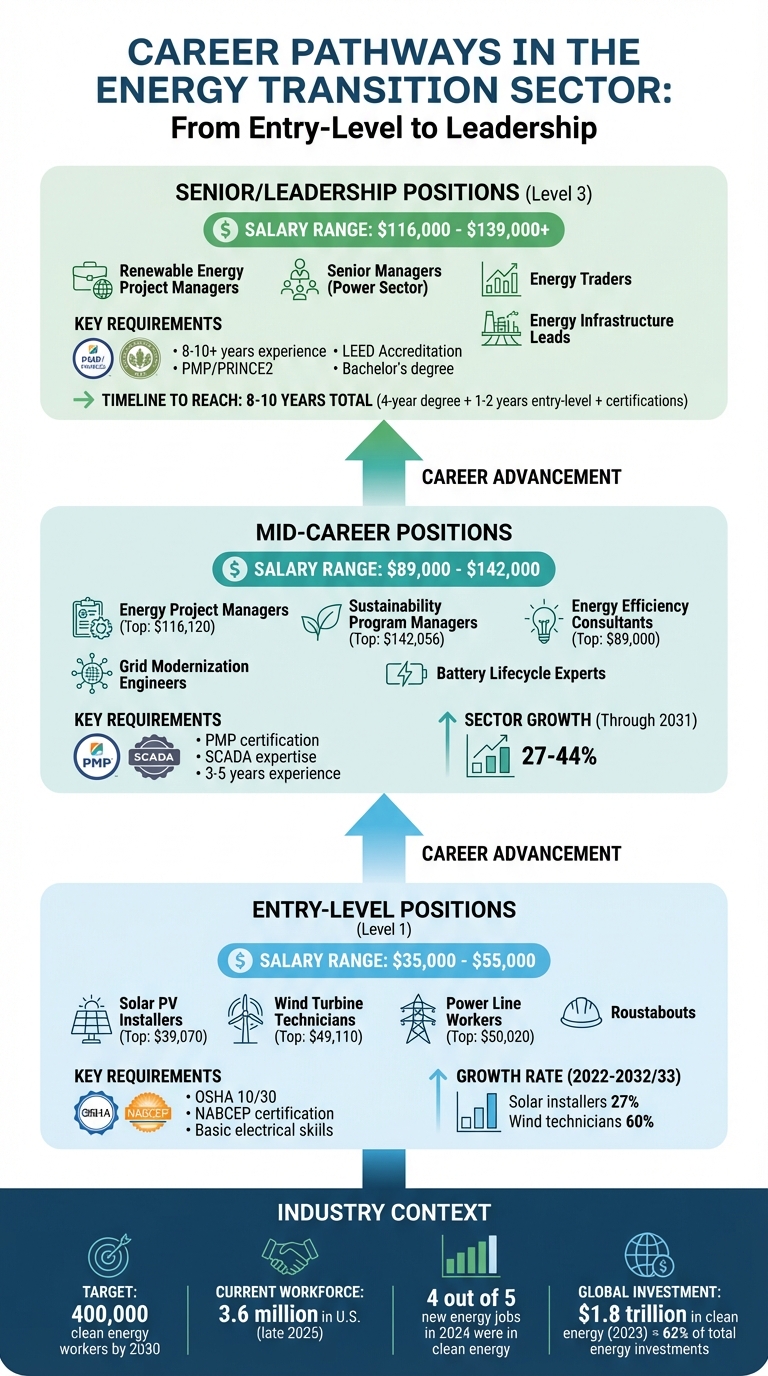
Energy Transition Career Pathways: Roles, Salaries, and Requirements by Level
Entry-Level Positions in Energy Transition Trades
Common Entry-Level Roles
Solar Photovoltaic Installers are responsible for setting up solar panels, connecting systems, and testing them to ensure they function properly. This job often involves working outdoors in varying weather conditions and requires comfort with heights and basic electrical skills. With an expected growth of 27% between 2022 and 2032, this is one of the fastest-growing entry points into clean energy.
Wind Turbine Service Technicians focus on maintaining and repairing wind turbines, frequently working at heights over 250 feet. Their duties include inspecting turbine blades, performing mechanical repairs, and troubleshooting electrical systems. This role is projected to grow by an impressive 60% from 2023 to 2033, positioning it as one of the most rapidly expanding opportunities in the energy sector.
Other roles include Roustabouts, who handle general labor tasks on energy sites; Power Line Workers, responsible for installing and repairing electrical transmission lines in all weather conditions; Meter Readers, who collect utility consumption data and identify service issues; and Power Plant Laborers, who assist operations teams with material handling and maintenance tasks at generation facilities.
To break into these roles, gaining relevant certifications is essential.
Required Certifications and Training Programs
Most energy trade roles require OSHA 10 or 30 certifications and a basic understanding of electrical systems. For solar workers, obtaining certification from the North American Board of Certified Energy Practitioners (NABCEP) is highly recommended. Wind technicians can benefit from training programs provided by the American Clean Power Association (ACP) to build their expertise.
Apprenticeships offer hands-on training while earning a starting salary of $35,000 to $40,000 annually, with pay increasing as skills improve. Community colleges and trade schools also provide certificate programs in areas like renewable energy technology, electrical systems, and power plant operations. These programs typically last six months to two years and include practical training with industry-standard equipment.
By earning certifications and completing training, workers can improve their skill sets and boost their earning potential.
Entry-Level Salary Ranges
Salaries for entry-level roles vary based on the position and location. For example:
- Wind Turbine Technicians: Approximately $49,110 annually
- Power Line Workers: Around $50,020
- Electrician Apprentices: About $39,430
- HVAC Technicians: Starting at $39,130
- Solar Installers: Around $39,070
- Roustabouts and General Laborers: Between $35,000 and $55,000
Geography plays a significant role in determining pay. In states like Illinois, Oregon, and Alaska, where demand is high, median salaries in core trades exceed $82,000. Union membership and working on prevailing wage projects often lead to higher compensation compared to non-union roles. Additionally, overtime, bonuses, and benefits can significantly increase total earnings. Specialized roles or additional certifications can help workers advance more quickly, with median pay ranges typically falling between $51,000 and $92,560, depending on the trade.
Understanding the Workforce Opportunities & Demand in Skilled Trades Within the Energy Industry Pt 1
Mid-Career Roles in Energy Transition
After gaining foundational experience in entry-level positions, mid-career professionals in the energy transition sector take on more complex responsibilities. These roles often involve project management, technological advancements, and a deeper understanding of regulatory and environmental requirements. For example, Energy Project Managers play a key role in developing solar farms, wind parks, and grid upgrades. They manage budgets, coordinate teams, and ensure projects meet deadlines.
Another critical role is that of Grid Modernization Engineers, who work to upgrade electrical grids to handle renewable energy sources and large-scale battery systems. They rely on SCADA systems and advanced data analysis tools to optimize energy flow. Additionally, Sustainability Program Managers – earning an average of $142,056 annually – oversee environmental goals within organizations and lead clean energy initiatives.
Other important roles include Energy Efficiency Consultants, who conduct audits to help clients reduce energy consumption (average salary: $89,000), and Battery Lifecycle Experts, who focus on the sustainability and recycling of batteries used in electric vehicles and energy storage systems. By late 2025, the clean energy sector employed over 3.6 million people in the U.S., with four out of every five new energy jobs created in 2024 being in clean energy. These mid-career roles not only build on the skills gained in entry-level positions but also open doors to specialized and leadership opportunities in the energy transition field.
Transitioning from Traditional Energy Sectors
For mid-career professionals, transitioning from traditional energy industries to the clean energy sector is a logical next step. Many skills developed in oil and gas, construction, or utilities are directly applicable. For instance, electricians familiar with power distribution can upskill in smart grid technologies and SCADA systems, making them strong candidates for Grid Modernization Engineer roles. Similarly, mechanical maintenance workers from conventional power plants can shift their expertise to areas like green hydrogen development or geothermal system installations.
"The sustainable energy industry grapples with complex challenges in economics, technology, and governance. Solving problems in this industry requires a solid technical foundation, but understanding economics, finance, policy processes, and politics is equally important."
- Johannes Urpelainen, Director and Prince Sultan bin Abdulaziz Professor of Energy and Environment, Johns Hopkins University
This quote highlights the need for professionals to expand their skill sets beyond technical knowledge. Certifications in renewable project management, energy data analysis, or energy-efficient HVAC controls can be particularly helpful. Community colleges and technical schools often offer short-term programs designed for those transitioning from traditional energy sectors. By leveraging existing expertise in areas like large-scale infrastructure, fluid dynamics, and safety protocols, professionals can successfully pivot into roles within the clean energy industry.
Mid-Career Role Comparison
| Role | Average U.S. Salary | Primary Responsibilities | Key Skills Required |
|---|---|---|---|
| Energy Project Manager | $116,120 | Oversees solar, wind, and grid upgrade projects; manages budgets and risks | Leadership, technical expertise, regulatory compliance |
| Grid Modernization Engineer | N/A | Integrates renewable energy into electrical grids; optimizes energy flow using SCADA | Electrical engineering, data analysis, SCADA systems |
| Sustainability Program Manager | $142,056 | Oversees organizational environmental goals; coordinates interdependent projects | Strategic planning, stakeholder engagement |
| Energy Efficiency Consultant | $89,000 | Audits building systems; reduces client energy consumption | Analytical skills, effective communication, energy auditing |
| Battery Lifecycle Expert | N/A | Manages battery sustainability and recycling for EVs and energy storage | Environmental engineering knowledge and circular practices |
With renewable energy jobs expected to grow between 27% and 44% through 2031, mid-career roles are among the fastest-growing opportunities in the U.S. job market. The sector’s growth is further underscored by the $1.8 trillion invested in clean energy globally in 2023, which accounted for 62% of total energy investments that year . This momentum positions mid-career professionals to advance into senior-level and leadership positions, offering long-term career growth in a thriving industry.
sbb-itb-aa28329
Senior and Leadership Positions in Energy Transition
Senior-Level Position Examples
As the energy transition evolves, senior and leadership roles play a key role in driving large-scale projects while balancing technical expertise with strategic planning. After excelling in mid-level roles, professionals can step into leadership positions by building on their technical knowledge and honing advanced project management skills.
These senior roles combine technical know-how with strategic oversight. Take Renewable Energy Project Managers as an example – they handle every phase of clean energy projects, from planning timelines and budgets to coordinating engineering teams and liaising with government or community stakeholders. They work with large budgets and ensure compliance with complex legal and safety standards. Senior Managers in Power Sector Transition focus on creating strategies and analyzing policies to decarbonize the power sector. Their responsibilities include managing portfolios of grid decarbonization projects, leading stakeholder meetings, and mentoring junior staff. Salaries for Renewable Energy Project Managers typically range from $80,000 to $120,000, while Senior Managers can earn between $116,000 and $139,000, with higher earnings possible depending on project scale and location.
Another critical role is that of Energy Traders, who ensure grid stability by analyzing weather patterns and market data to trade power in 15-minute intervals. These professionals juggle multiple screens of live data to ensure renewable energy plants meet demand.
"Short-term trading on the spot market is more than just an exciting job for me – we are actively working on the energy transition. We help to ensure that renewable energy plants produce on demand."
- Julia Schleper, Energy Trader, Next Kraftwerke
Leadership roles like Energy Infrastructure Leads and Site Supervisors oversee the physical construction and integration of renewable energy systems into existing grids. They ensure compliance with safety (HSE) and environmental standards. With renewables expected to generate over one-third of global electricity by 2025, these roles are vital for expanding the industry and preparing professionals for even greater leadership responsibilities.
Requirements for Leadership Roles
Stepping into leadership requires a mix of deep experience, specialized credentials, and cross-functional expertise. Senior positions typically demand 8 to 10+ years of professional experience alongside a bachelor’s degree in fields like engineering, environmental science, or project management. Certifications such as the Project Management Professional (PMP) credential are highly valued in North America, while PRINCE2 is often preferred for projects in Europe and the UK. Additionally, LEED Accreditation is increasingly sought after for validating knowledge in sustainable practices.
Beyond technical qualifications, modern energy leaders need to bridge technical and financial domains effectively. Employers often favor engineers who transition into project management, especially in renewables, where projects are highly complex. Essential soft skills include analytical thinking, problem-solving, and time management, paired with a strong understanding of regulatory compliance. Given the frequent shifts in energy policies, leaders must adapt quickly while maintaining strategic focus.
Typically, reaching a leadership role takes around 8–10 years, including a 4-year bachelor’s degree, 1–2 years of entry-level experience, and 6 months to a year to complete relevant certifications. A study of energy professionals in Norway revealed that 30% of leaders and experts moved from oil and gas to renewable energy, highlighting the industry’s growing appeal.
How to Advance into Leadership
Advancing into leadership builds on mid-career achievements and requires a focused approach. Start by managing specific project components – like civil works or grid connections – for 6–18 months. Document measurable outcomes such as budget performance, safety metrics, and project capacities (in MW).
Shadow experienced project managers to gain insights into negotiating with regulators and landowners. Networking is another key step. Joining organizations like the American Solar Energy Society and attending major events such as Solar Power International can help professionals connect with senior leaders and unlock new opportunities. Engaging on LinkedIn by participating in industry groups and sharing relevant content can also boost visibility among recruiters and peers.
Platforms like ABLEMKR offer access to high-profile projects across the U.S., enabling professionals to gain diverse experience in utilities and heavy infrastructure. The platform’s real-time tracking and compliance tools help build a strong track record on large-scale projects, a critical factor for leadership roles. Current demand for senior energy transition professionals is particularly high in regions like the North Sea (offshore wind), North America (utility-scale solar and battery storage), and Southeast Asia (grid modernization).
Required Skills and Certifications
Technical and Digital Skills
Building a career in energy transition trades requires a mix of hands-on expertise and digital know-how. Professionals need to understand renewable energy systems – like solar photovoltaic installations, wind turbines, hydrogen infrastructure, and geothermal technology. Additionally, knowledge of electrical grid systems, including smart grids and microgrids, is essential. Considering that clean energy supplied around 41% of the electricity in the U.S. in 2023, these skills are in demand at every career level.
Digital skills are becoming just as critical. Data analytics, artificial intelligence, and machine learning are now key tools for forecasting energy needs, tracking real-time usage, and improving resource allocation. For mid-career professionals, predictive maintenance skills – such as analyzing sensor data, vibration patterns, and temperature changes to identify equipment issues – are particularly valuable. At senior levels, digital twin technology is frequently used to create virtual models of assets like wind farms or hydrogen plants, helping to simulate operations and fine-tune maintenance. These digital tools are transforming how energy professionals manage projects and infrastructure.
Safety knowledge is another must-have. Workers need to be familiar with Health, Safety, and Environmental (HSE) standards, especially for hybrid systems. This includes understanding how to prevent thermal runaway in battery systems and manage stranded energy within grids. With the global renewable energy workforce growing to 36.2 million in 2023 – a 4.3 million increase since 2021 – advanced safety expertise is now a competitive edge in the job market.
| Career Level | Essential Technical & Digital Skills | Key Focus Areas |
|---|---|---|
| Entry-Level | Installation, repair, basic electrical systems, OSHA/HSE safety | Solar PV/Wind turbine maintenance, equipment setup |
| Mid-Career | Smart grid management, predictive maintenance, SCADA, IoT integration | Data visualization, energy storage, Agile project management |
| Senior/Leadership | Operational analysis, cybersecurity for assets, energy governance | Budget optimization, stakeholder management, strategic planning |
"Acute skills shortages could constrain renewable energy deployment, effecting the pace of energy transition, economic competitiveness and sustainable development opportunities." – IRENA
Alongside these technical abilities, certifications play a critical role in validating expertise and advancing careers.
Industry Certifications
Certifications are a key stepping stone for professionals at every stage of their career. In the U.S., credentials like NABCEP certification are highly regarded, particularly in the solar industry, where 67% of jobs focus on installation and project development. OSHA safety training is another cornerstone, ensuring workers meet baseline safety standards across all energy projects.
Specialized certifications can also enhance career prospects. For those working with wind turbines, the Global Wind Organisation (GWO) certification ensures compliance with international standards. Mid-career professionals often benefit from credentials like the Project Management Professional (PMP), which is widely respected across North America. Workers transitioning from other industries should highlight transferable certifications – such as Six Sigma or Lean for process improvement – or supply chain management credentials, which are valuable for renewable energy logistics. Effective project management can even cut energy costs by 7% to 10%.
"Professionals who can adapt their expertise from other industries bring fresh perspectives and problem-solving approaches that add immediate value to projects." – Brenda Ramírez, Recruitment Consultant, WTS Energy
Combining technical skills with the right certifications is essential for navigating the rapidly growing energy sector.
Using ABLEMKR for Career Mobility

To help professionals advance their careers, ABLEMKR offers a platform that connects certifications with job opportunities. It matches certified and safety-trained workers to nearby projects based on their availability. This system is especially useful for professionals with specialized credentials, such as NABCEP or GWO certification, enabling them to quickly find roles in areas like last-minute shutdowns, remote pipeline repairs, or planned utility infrastructure projects.
The platform also provides real-time visibility into opportunities, benefiting both workers and employers. Workers enjoy flexible access to high-paying jobs across major U.S. cities and energy hubs, with on-time payments that eliminate typical deployment headaches. ABLEMKR tracks certifications, safety records, and project experience automatically, creating a verified portfolio that can help professionals move into higher-level roles. With built-in payroll and continuous monitoring, every project adds measurable value to a worker’s career, making it easier to showcase the hands-on expertise employers look for in leadership positions.
Conclusion
The energy transition is opening doors to careers at every level, from entry-level technicians to senior leadership roles. As the clean energy sector grows – both in electricity generation and workforce needs – opportunities are expanding at a rapid pace. Success in this field hinges on blending practical technical skills with digital expertise, safety knowledge, and key certifications like NABCEP or GWO.
Professional credentials play a crucial role in advancing careers. Certifications not only validate your expertise but can also lead to higher-paying positions. Whether you’re shifting from traditional energy sectors or starting fresh in renewables, focused training and skill development are vital to staying competitive. Employers are actively searching for professionals who can integrate renewable systems with digital tools, such as predictive maintenance and smart grid technologies.
Platforms like ABLEMKR help certified workers find projects that match their credentials, safety records, and location. This simplifies access to well-paying jobs across major U.S. energy hubs. Each project also adds valuable hands-on experience, which employers prioritize when hiring for mid-level and leadership roles.
As energy demands evolve, combining technical skills with the right certifications is more important than ever. Invest in your development, pursue relevant certifications, and use modern tools to connect with the right opportunities. With grid upgrades, renewable installations, and infrastructure modernization accelerating by 2026, taking action now can set you on a path to quick advancement in this dynamic industry.
FAQs
Which energy transition job fits my background?
Finding the right energy transition job depends on your unique mix of skills, experience, and interests. If you enjoy hands-on work, roles like solar installer or wind turbine technician might be a great fit. These positions often come with clear paths for career growth.
For those with experience in project management or operations, consider roles in grid modernization or energy system integration – fields that play a key role in shaping the future of energy.
Boosting your qualifications can make a big difference too. Earning certifications like NABCEP (for solar professionals) or GWO (for wind energy workers) can help you stand out and access more specialized opportunities.
What certifications should I get first?
To kick off a career in the energy transition sector, it’s crucial to prioritize certifications that build both safety and technical expertise. Consider starting with OSHA 10/30 Hour Training, which covers workplace safety essentials, or GWO Basic Safety and Technical Training, designed specifically for wind energy professionals. Adding rigging and signal person credentials to your skillset can also make you more versatile in the field.
For more specialized roles, certifications like NABCEP (ideal for solar energy professionals) or advanced GWO certifications for wind energy can significantly improve your job prospects and prepare you for higher-level responsibilities. Additionally, using VR training platforms can be a game-changer. These tools provide a hands-on, efficient way to practice safety protocols and technical skills in a controlled environment, helping you stay ahead in this rapidly evolving industry.
How fast can I move into leadership roles?
Advancing to leadership roles in the energy transition field hinges on your experience, skills, and the direction of your career. While this progression typically takes anywhere from 5 to 10 years, the timeline can differ based on individual circumstances. Key steps to help you move forward include building strong technical expertise, earning certifications like the Certified Energy Manager (CEM), and participating in leadership training programs. Structured professional development, mentorship opportunities, and a commitment to ongoing learning can significantly speed up your journey – especially when paired with specialized training tailored to this industry.


