
The construction industry is facing a massive shortage of 499,000 workers in 2026, driven by infrastructure projects, semiconductor manufacturing, and data center expansions. Traditional hiring methods can’t keep up with unpredictable project demands, but solutions are emerging:
- Apprenticeships: Enrollment in trade schools rose by 16% (2022–2023), and registered apprenticeships increased by 114% over the last decade, reaching 680,000 participants in FY2024. Workers in these programs see wages rise by 77% upon completion.
- Digital Skills: Tools like BIM, drones, AR/VR, and automation are reshaping construction, but a lack of digital skills slows adoption. Training programs are addressing gaps with certifications in platforms like Procore and AutoCAD.
- Staffing Platforms: Platforms like ABLEMKR streamline hiring by vetting workers for certifications (e.g., OSHA, state licenses) and matching them to job requirements within 24–48 hours.
- Partnerships: Companies are collaborating with trade schools to create pipelines for skilled labor, offering hands-on training and work-study models.
- Retention: Firms are focusing on career development and safety programs to reduce turnover, which can cost 30–50% of a worker’s annual salary.
The industry is shifting to data-driven workforce planning and targeted training to meet growing demand. Contractors who act now can avoid higher labor costs and project delays.
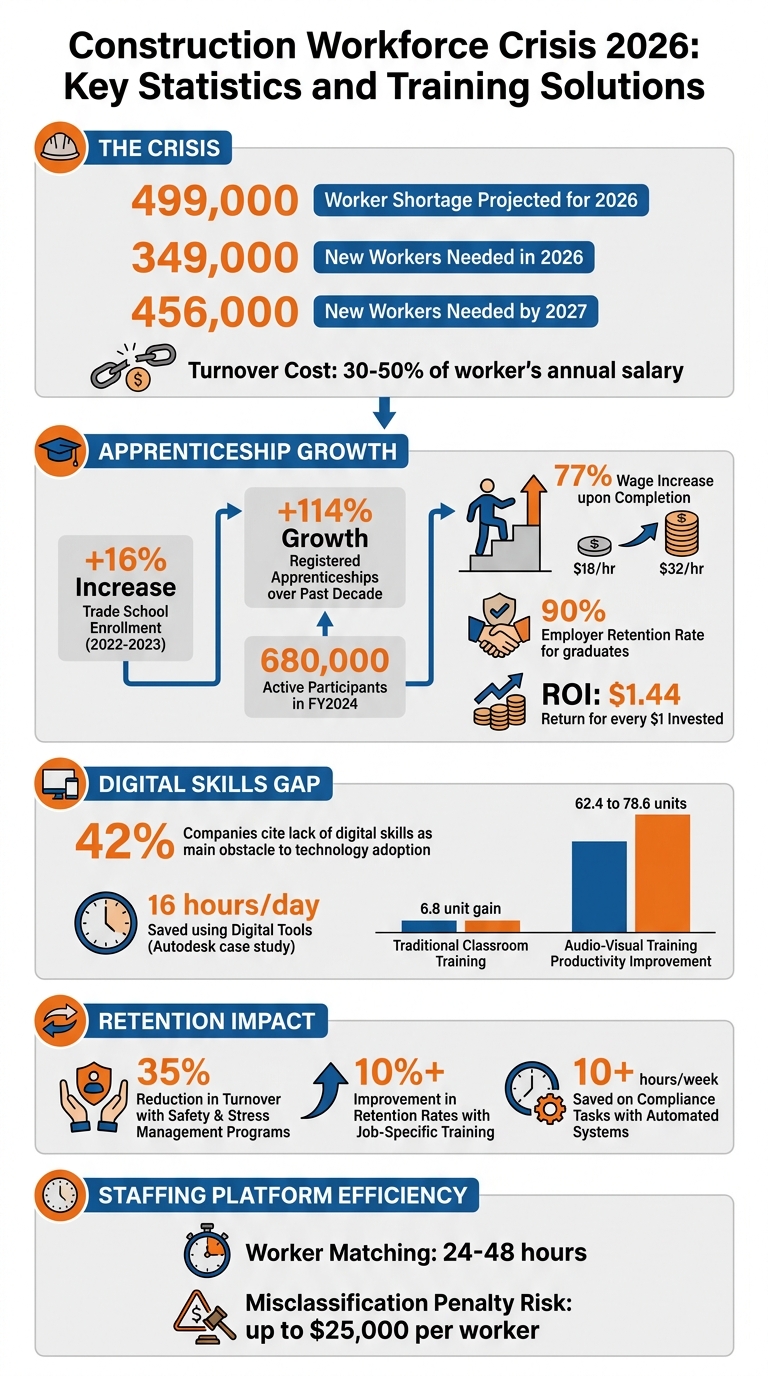
Construction Workforce Crisis 2026: Key Statistics and Training Solutions
Apprenticeships and On-the-Job Training Programs
Why Apprenticeships Matter
Apprenticeships address a critical timing issue in construction staffing. While trade school enrollment has grown by 16% in recent years, it still takes 3–5 years for an apprentice to progress to journeyman status. The earn-while-you-learn model plays a crucial role here, allowing workers to gain essential skills while earning a steady income and sidestepping student debt.
The statistics highlight the impact. In FY2024, registered apprenticeships had about 680,000 active participants – a 114% jump over the past decade. Those who complete these programs see their wages rise significantly, from an average of $18/hour at entry to $32/hour upon completion – a 77% increase. Employers also reap the rewards, with a 90% retention rate among apprenticeship graduates. Additionally, every dollar invested in an apprentice yields a median return of $1.44 through increased productivity and reduced turnover.
"We don’t just need more awareness of the workforce problem – we need a solutions-first mindset that embraces apprenticeships as a practical, proven path forward." – Engineering News-Record
On-the-Job Training for Temporary Workers
On-the-job training can significantly ease the supervisory demands that often cost between $750 and $1,200 per hire for complex tasks. Without proper training, temporary workers are prone to making 3–5 times more errors than experienced staff during their first 30 days, which can disrupt project timelines and inflate budgets.
Tailored, project-specific training programs help mitigate these challenges. By focusing on immediate needs – like compliance, operating specialized equipment, or meeting site-specific safety standards – these programs transform temporary staffing into a "try-before-hire" system. This approach not only prepares workers for permanent roles but also supports long-term workforce planning. These targeted investments pave the way for better retention strategies and more effective, data-driven workforce management.
sbb-itb-aa28329
Digital Skills Training for Construction Technology
New Technologies Changing Construction Work
Modern construction sites are increasingly dependent on advanced digital tools, creating a growing need for workers with strong digital skills. For instance, Building Information Modeling (BIM) has become a critical tool, functioning as a real-time data hub for construction projects. At the same time, drones are being used to identify structural issues, improving site monitoring and accuracy. Tools like Augmented Reality (AR) and Virtual Reality (VR) allow workers to virtually explore projects before construction begins, which requires enhanced spatial understanding.
The rise of robotics and automation is reshaping – not replacing – construction jobs. For example, robotic total stations now handle layout tasks, while semi-autonomous earthmoving equipment requires skilled operators to manage them effectively. However, a lack of digital skills is slowing down the adoption of these technologies. In fact, 42% of construction companies in the Asia Pacific region have identified this skills gap as the main obstacle to implementing new technology. Additionally, cloud-based project management tools like Procore and PlanGrid are becoming essential for tasks like real-time communication, time tracking, and administrative coordination. All of this underscores the urgency for targeted digital training programs.
"BIM will be evolving from a design tool into a central data platform for the entire building process." – Victoria Sokolova, Digital Transformation Expert, Epicflow
Training Programs for Digital Tools
To address these skill gaps, construction training programs are adapting to meet the demands of modern technology. For example, in 2024, Fredon used Autodesk Construction Cloud during Stage 3B of the WestConnex project in Australia, saving 16 hours per day by streamlining data management. This kind of efficiency is why more contractors are emphasizing digital training for their teams.
Educational institutions are also stepping up. TU Dublin‘s School of Surveying and Construction Innovation offers a one-year, part-time BSc (Hons) in BIM (Digital Construction), focusing on multidisciplinary coordination and BIM technologies. A 2025 study led by Pradeep Kumar Rao MK in India evaluated 400 construction workers across four trades. Workers trained with audio-visual simulations improved their productivity scores significantly – from 62.4 to 78.6 units – compared to a smaller gain of 6.8 units for those in traditional classroom settings.
Autodesk has also partnered with Singapore’s University of Social Sciences to train students and workers in identifying workflow bottlenecks and creating customized digitalization strategies. Certifications in widely-used tools like Bluebeam, Procore, and AutoCAD can further enhance a worker’s appeal to contractors. For those balancing full-time jobs, self-paced online platforms such as VDCI offer accredited courses to help workers acquire technical skills without interrupting their schedules. These types of programs ensure that temporary and full-time workers alike can quickly adapt to the digital demands of the industry, supporting the growing need for skilled, on-demand talent.
Partnerships Between Trade Schools and Staffing Agencies
Creating a Skilled Worker Pipeline
Construction companies are teaming up with trade schools to build direct pipelines for skilled workers. A great example of this is the partnership formed in February 2026 between Austin Community College (ACC) District and Sundt Construction. This collaboration, announced at the ACC Riverside Campus, focuses on developing craft trade programs and pre-apprenticeship opportunities that lead to registered apprenticeships. Spearheaded by ACC Chancellor Russell Lowery-Hart and Sundt VP Sean Ray, the partnership uses an integrated work-study model. Sundt hires ACC students while they’re still in school, paying them as they gain hands-on experience. This approach connects students directly to major regional projects like the 183 North Mobility Project in Central Texas.
"Sundt offers both registered and non-registered apprenticeships, and they hire our students while they’re in school and pay them. It’s the true earn-and-learn model we plan to use with our industry partners moving forward." – Russell Lowery-Hart, Chancellor, Austin Community College District
This collaboration ensures that students graduate with skills tailored to real-world demands and industry-recognized credentials. Employers benefit by gaining access to pre-vetted, job-ready workers. With the construction industry projected to need 349,000 new workers in 2026 and 456,000 by 2027, these partnerships are essential for addressing the growing skills gap. By aligning education with workforce needs, these initiatives create scalable solutions for training the next generation of skilled professionals.
Scalable Training Models
Beyond individual partnerships, companies are rolling out short-term, intensive training programs that can be scaled efficiently. In December 2025, JLG Industries expanded its workforce pipeline through a partnership with the Tennessee College of Applied Technology (TCAT) near its Jefferson City facility. Under the guidance of COO Andy Tacelosky, TCAT students joined JLG’s maintenance teams, working part-time while applying their classroom learning directly to real-world tasks. Students gained hands-on experience in areas like maintenance, welding, and painting, all while continuing their education.
JLG also introduced its Weld Trainee Program, which blends three to four weeks of classroom instruction with three weeks of on-the-job training under experienced mentors. This 6-to-7-week program quickly produces skilled welders to meet immediate production needs. Additionally, JLG’s School-to-Work programs partner with local high schools, allowing juniors and seniors to earn both school credit and a paycheck while training in technical roles such as assembly and fabrication. These flexible training models not only address the widening skills gap but also provide real-time workforce solutions. Digital tracking systems further enhance these programs by enabling data-driven workforce planning.
"In America today, there are more students who want hands-on technical education than there are classroom seats available. We saw an opportunity, not just to hire talent but to help create it one student, one trainee and one craft professional at a time." – Andy Tacelosky, Chief Operating Officer, JLG
Data-Driven Workforce Planning and Retention
Using Data to Predict Skills Gaps
Construction firms are shifting from instinct-based hiring to a more calculated approach by integrating workforce forecasts into project planning. Instead of treating labor needs as an afterthought, they’re aligning staffing predictions with bid pipelines, project schedules, and anticipated start dates.
Analytics are playing a huge role here. By tracking trade school enrollment – which saw a 16% surge in just one year – and apprenticeship completion rates, companies can better anticipate worker availability. Modern platforms offer real-time insights into temporary labor, compliance status, and productivity across multiple job sites. This creates what many in the industry refer to as a "central command center" for workforce management. Weekly tracking of this data not only gives firms a competitive edge in bidding but also ensures smoother project execution.
Regional labor trends are equally important. For instance, megaprojects like semiconductor fabs, EV battery plants, and data centers can drain local workforces, creating labor shortages. Automated systems are stepping in to ease the burden by handling tasks like background checks, OSHA 10/30 credential verification, and tracking. These tools save project managers more than 10 hours per week.
This level of data-driven planning lays the groundwork for retention strategies that strengthen workforce stability.
Keeping Workers Through Career Development
With predictive insights in hand, companies are turning their attention to retention, focusing on career development as a key strategy. The cost of replacing a skilled tradesperson can reach 30–50% of their annual salary when factoring in recruiting, onboarding, and lost productivity. Firms that invest in safety training and stress management programs see worker turnover drop by as much as 35%.
Career development programs are proving to be a game-changer. Structured 2–4-year craft training programs foster loyalty to the trade. Clearly defined advancement paths – from Laborer to Apprentice to Journeyman to Foreman – reduce uncertainty and encourage workers to stay longer. Additionally, job-specific training can improve retention rates by over 10%.
"Retention is not a soft HR metric, it is a core project control that directly influences schedule reliability, safety performance, and margin." – NSC Staffing
How ABLEMKR Supports Training and Compliance
Worker Deployment with ABLEMKR
ABLEMKR makes it easy for contractors to connect with workers who meet specific credential requirements. When contractors post a job, they can outline exactly what they need – whether it’s OSHA 10/30 certifications, state-licensed electricians, forklift operators, or specialized safety training like confined space or fall protection. The platform then filters for workers who already hold these verified credentials, ensuring a precise match.
"Specify what you need, and we’ll only show you workers who already have those credentials." – ABLEMKR
Each worker’s profile includes verified certifications, work experience, and ratings from previous jobs. This allows contractors to quickly assess qualifications without the lengthy vetting process that often takes weeks. The platform also uses geo-location data to match workers with nearby job sites. Plus, GPS-enabled timecards in ABLEMKR’s mobile app allow real-time tracking of worker activity, giving project managers full oversight.
All workers are employed as W2 employees, which includes workers’ compensation and general liability coverage. This eliminates the risk of worker misclassification and potential fines that can reach up to $25,000 per worker. By streamlining deployment, ABLEMKR sets the foundation for effective compliance monitoring on active job sites.
Tracking Compliance and Safety Certifications
ABLEMKR simplifies compliance by automatically verifying trade licenses and safety credentials specific to each state. From HVAC technician certifications to rigging and scaffolding training, the platform ensures all certifications are valid and tracks expiration dates, sending alerts to keep everything up-to-date. It covers a wide range of credentials, including OSHA safety training, equipment licenses like crane operator certifications, and health-related requirements such as First Aid/CPR and drug testing.
Workforce strategy and economic insight shaping construction in 2026
Conclusion
By 2026, the construction industry faces a daunting shortfall of 499,000 workers, even as trade school enrollments hit record highs. The challenge is clear: traditional hiring methods can’t keep up with the demand for mobilizing crews within 24–48 hours.
To tackle this, contractors are shifting their focus to expanding apprenticeships, improving digital skills, and adopting data-driven workforce strategies. Over the past decade, registered apprenticeships have grown by 114%, offering participants a 77% wage increase from entry to completion. This approach not only addresses immediate staffing challenges but also lays the groundwork for a stronger, more capable workforce in the future.
Platforms like ABLEMKR are accelerating this transformation. By cutting down the time needed for compliance tasks – once taking over 10 hours a week – ABLEMKR simplifies worker vetting and certification tracking. It ensures workers are pre-vetted for OSHA certifications, state-specific licenses, and provides tools to monitor certification expirations. Additionally, it streamlines W-2 employment and workers’ compensation coverage, allowing project managers to focus on getting the job done rather than drowning in administrative tasks. This blend of compliance efficiency and workforce readiness bridges the gap between training innovations and day-to-day operations.
The industry is moving from reactive hiring to proactive workforce development. Contractors who invest in building a certified and automated workforce are positioning themselves for success in a labor market that leaves little room for hesitation. Waiting until projects are awarded to start recruitment risks higher labor costs and missed deadlines.
As economist Anirban Basu cautions, failing to attract enough workers will not only drive up labor expenses but also limit the number of projects that can be completed. The tools and training models are already in place – the time to act is now.
FAQs
How can contractors ramp crews in 24–48 hours without sacrificing safety?
Contractors can quickly assemble crews within 24–48 hours while keeping safety a priority by leveraging platforms that link them with pre-screened, highly skilled workers. These platforms pair workers with jobs based on their certifications, safety training, and availability, ensuring all compliance requirements are met right from the beginning. This method not only cuts down onboarding time but also simplifies the hiring process, enabling contractors to efficiently deploy qualified teams without sacrificing safety standards.
Which digital tools should field workers learn first to stay employable?
Field workers should prioritize learning digital safety tools and collaboration platforms to maintain their edge in the industry. Some essential tools include wearable technology, apps for real-time incident reporting, mobile inspection tools, and centralized dashboards. These not only improve safety but also simplify documentation processes. On top of that, cloud-based project management and communication software play a big role in enhancing on-site coordination. By mastering these technologies, workers can keep up with industry advancements and stay indispensable in today’s tech-driven construction landscape.
What should I track weekly to forecast labor shortages and cut turnover?
To stay ahead of labor shortages and manage turnover effectively, it’s essential to keep a close eye on a few critical metrics every week. Start by tracking the number of open positions in skilled trades like electricians and pipefitters. Compare hiring rates to turnover rates to spot trends, and keep tabs on average wages – currently around $39.33 per hour – to remain competitive in the market.
It’s also important to monitor certification levels, such as OSHA and AWS, to ensure your workforce meets industry standards. Evaluate regional labor availability to understand the local talent pool and watch enrollment numbers in apprenticeship programs or trade schools. By analyzing these factors, you can pinpoint workforce gaps and plan ahead to meet future demand.


