
SCADA (Supervisory Control and Data Acquisition) is the backbone of renewable energy operations, enabling remote monitoring, control, and optimization of wind, solar, and battery systems. With over 67,000 wind turbines and 2,500 solar plants in the U.S., demand for SCADA expertise is surging. SCADA systems ensure stable grid performance by managing real-time data, maintaining grid frequency (60.00 Hz), and controlling power output efficiently. Operators must master hardware (sensors, RTUs, PLCs), software (HMI, data processing), and communication protocols (e.g., Modbus, DNP3, OPC UA).
Key skills for SCADA professionals include:
- Customizing SCADA software and HMI for better control and diagnostics.
- Cybersecurity knowledge to protect systems from rising threats.
- Real-time data management to optimize energy production and grid stability.
Certifications like Rcademy SCADA and TectraPro SCADA offer hands-on training in these areas, with modules on renewable energy integration, AI-driven predictive maintenance, and cloud-enabled SCADA systems. Emerging technologies like AI, cloud platforms, and 5G connectivity are reshaping SCADA operations, making continuous training vital for staying competitive in the renewable energy sector.
SCADA uncovered: Monitoring and control basics
sbb-itb-aa28329
SCADA System Components and Architecture
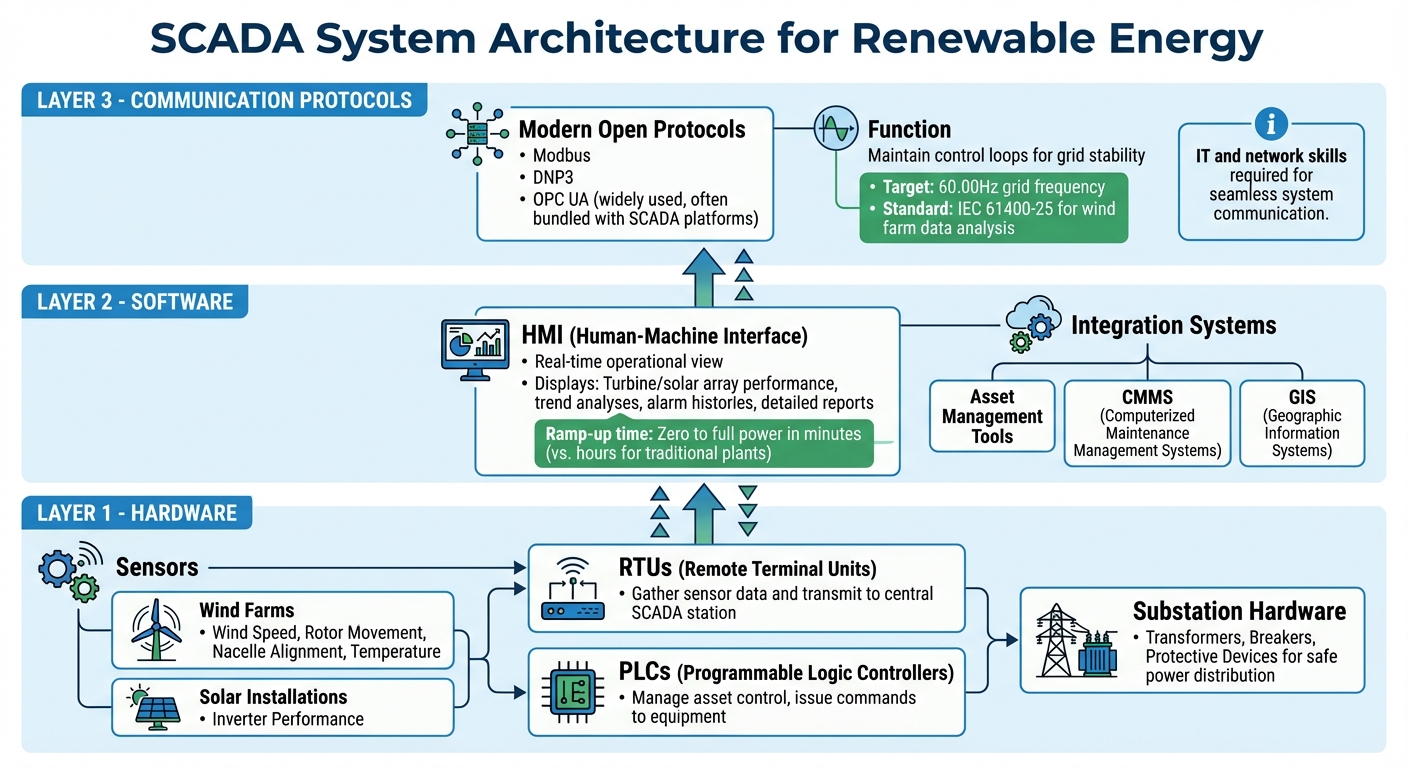
SCADA System Architecture: Hardware, Software, and Communication Layers
Understanding SCADA architecture is essential for building the skills needed in renewable energy sectors. Knowing how these systems work reveals the specific expertise required for effective operation. SCADA systems are built on three key layers: hardware for data collection, software for processing and visualization, and communication protocols that connect all components.
Hardware: Sensors, RTUs, and PLCs
Sensors are the backbone of data collection, capturing both analog and digital metrics like wind speed, rotor movement, nacelle alignment, and temperature at wind farms. For solar installations, they monitor inverter performance and other critical parameters.
Remote Terminal Units (RTUs) gather this sensor data and send it to the central SCADA station. At the same time, Programmable Logic Controllers (PLCs) manage asset control, issuing commands to adjust or stop equipment like solar inverters or wind turbine parts.
Substation hardware – such as transformers, breakers, and protective devices – works in tandem with these components to ensure safe power distribution. All these devices rely on robust communication channels to function effectively. These hardware elements are crucial for designing SCADA training programs that focus on real-world applications.
Software: HMI and Data Processing
Once hardware collects the data, software takes over to interpret and present it. The Human-Machine Interface (HMI) offers a real-time view of operations, displaying turbine and solar array performance, trend analyses, alarm histories, and detailed reports. Unlike traditional power plants, which can take hours to reach full capacity, SCADA-controlled renewable systems can ramp up from zero to full power in just minutes.
Modern SCADA software often integrates with asset management tools, CMMS (Computerized Maintenance Management Systems), and GIS (Geographic Information Systems) platforms. This integration requires operators to have both operational and networking skills. These software capabilities are central to creating training programs tailored to SCADA systems.
Communication Protocols in SCADA
Modern SCADA systems rely on open communication protocols like Modbus, DNP3, and OPC UA, which have replaced older proprietary standards. Among these, OPC UA is widely used and often comes bundled with SCADA platforms.
These protocols are critical for maintaining control loops that ensure grid stability. For example, SCADA systems help keep grid frequency close to 60.00Hz, enabling quick adjustments to maintain reliable performance. Additionally, the IEC 61400-25 standard provides a consistent framework for analyzing wind farm data. As Woodrow Boles, Jr. explains:
"IT and network skills are required for the systems to communicate seamlessly with one another".
Mastering these protocols is a key skill for operators, ensuring smooth system integration and consistent grid performance.
Core Skills for SCADA Operations
Managing SCADA systems in renewable energy demands a mix of technical expertise that extends well beyond simple monitoring tasks. With the renewable energy sector growing rapidly, the need for skilled SCADA operators is increasing as well. Professionals in this field must be proficient in software customization, cybersecurity, and real-time data management to ensure smooth and efficient operations.
SCADA Software and HMI Customization
A key skill for SCADA operators is the ability to customize SCADA software and Human-Machine Interfaces (HMI). These interfaces are critical for allowing operators to interact directly with process equipment. Engineers in this role need to be adept at configuring devices and interpreting schematics to diagnose issues accurately. As Woodrow Boles, Jr., Director of Renewables SCADA for EverLine, puts it:
"Acting as the central nervous system for sensors, alarms, and switches, utility SCADA links hardware and software components of a site to monitor, control, and analyze performance".
The industry is increasingly adopting open-architecture platforms, which are reshaping how customization is approached. These platforms use reliable OEM hardware and software, ensuring long-term support and effortless third-party integration. They also support standard networking technologies, such as Ethernet, TCP/IP, and OPC UA, enabling operators to transform raw data into real-time dashboards. These dashboards can display key metrics like wind speed, power output, and inverter efficiency, providing operators the tools they need to maintain and optimize performance in a connected environment.
Cybersecurity in SCADA Operations
Once operators master customization, they must also focus on securing SCADA systems. The merging of IT and operational technology (OT) has significantly increased the vulnerability of these systems, making cybersecurity training a must for protecting critical infrastructure. In 2021, vulnerabilities in OT devices and their management systems rose by over 50%. To counter these risks, operators need a solid understanding of networking fundamentals and security protocols. Following frameworks such as the ISA/IEC 62443 series can guide them through risk assessments, implementing countermeasures, and maintaining regular security updates.
Boles emphasizes the importance of cybersecurity knowledge:
"Cybersecurity knowledge is also needed to protect those systems. It is advantageous for SCADA operators to have knowledge of fiber, radio, and LTE".
Practical steps for securing SCADA systems include segmenting networks, enforcing strong authentication protocols, and keeping up with patch management. For grid-connected assets, operators must also navigate regulatory requirements set by entities like NERC and FERC.
With secure systems in place, the next focus is on managing real-time data streams effectively.
Data Management and Real-Time Monitoring
Efficient data management is the backbone of SCADA system performance in renewable energy environments. Real-time data management allows renewable energy sites to meet grid demands within minutes, a level of responsiveness that traditional power plants often cannot achieve. SCADA systems play a crucial role in maintaining grid frequency near the standard 60.00 Hz by using control loops that measure frequency at interconnection substations and adjust power output in real time. This process requires operators to monitor multiple data streams to optimize energy production.
Operators must also be familiar with concepts like device response, repeatability, and hysteresis, as well as the use of deadbands to prevent over-controlling the system. Modern SCADA systems often integrate with other tools, such as asset management platforms, computerized maintenance management systems (CMMS), and geographic information systems (GIS). This means operators need the ability to manage data across various platforms seamlessly.
A structured approach to alarm management is another critical aspect. By focusing on essential system changes – like overheating turbine components – operators can avoid being overwhelmed by excessive or irrelevant alarms. Additionally, linearizing non-linear signals from measuring devices is vital for maintaining accurate dynamics in closed-loop control systems.
SCADA Certifications and Training Programs
Formal certifications and training programs are essential for SCADA operators working in renewable energy. These programs combine hands-on practice with instruction aligned to industry standards, offering specialized knowledge tailored to renewable energy applications.
Rcademy SCADA Certification
Rcademy provides a range of SCADA training programs, from a 3-day intensive course to a 15-day masterclass. The curriculum includes SCADA architecture, HMI configuration, and advanced cybersecurity techniques. A standout feature is Module 13, which focuses on renewable energy integration and automation practices.
The program offers flexibility in its delivery. Live online sessions run for 3 hours per day, while in-person classroom training provides 8 hours of daily instruction. Costs start at $2,500 for the 3-day online course and go up to $13,200 for the 15-day in-person program held in Singapore. Participants also engage in lab sessions with modern PLCs, RTUs, and SCADA software, alongside interactive workshops. Certification is awarded after passing a remotely proctored exam.
Rcademy regularly updates its curriculum to address newer technologies. Recent modules cover AI and machine learning for predictive maintenance, cloud-enabled SCADA systems for remote monitoring, and AI-driven tools for advanced threat detection. Woodrow Boles, Jr., Director of Renewables SCADA at EverLine, highlights the importance of staying current:
"One of the biggest threats to the renewable energy industry is falling behind competitively, which can happen if the workforce doesn’t possess the skills in emerging automation technologies".
TectraPro SCADA for Solar and Wind
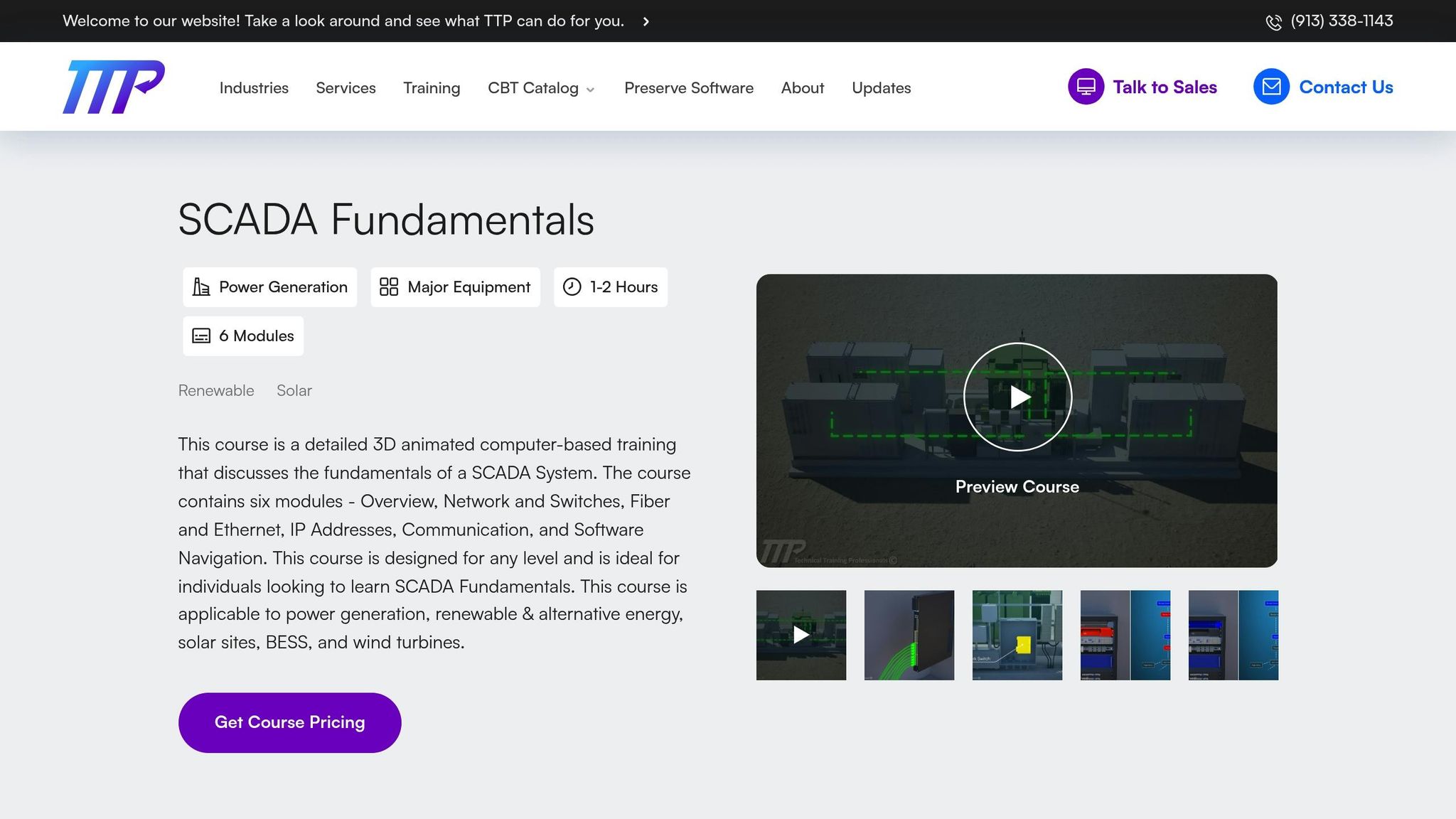
As renewable energy systems grow, specialized training programs like TectraPro’s SCADA Fundamentals course focus on specific technologies. This program uses 3D computer-based training simulations, making it particularly effective for SCADA applications in solar farms, wind turbines, and Battery Energy Storage Systems (BESS).
The course is designed for technicians working in solar, wind, and BESS operations, offering hands-on training without the expense of in-person workshops. The 3D simulation provides a practical and affordable way to develop technical skills applicable to real-world scenarios.
CREATE Energy Center SCADA Curriculum
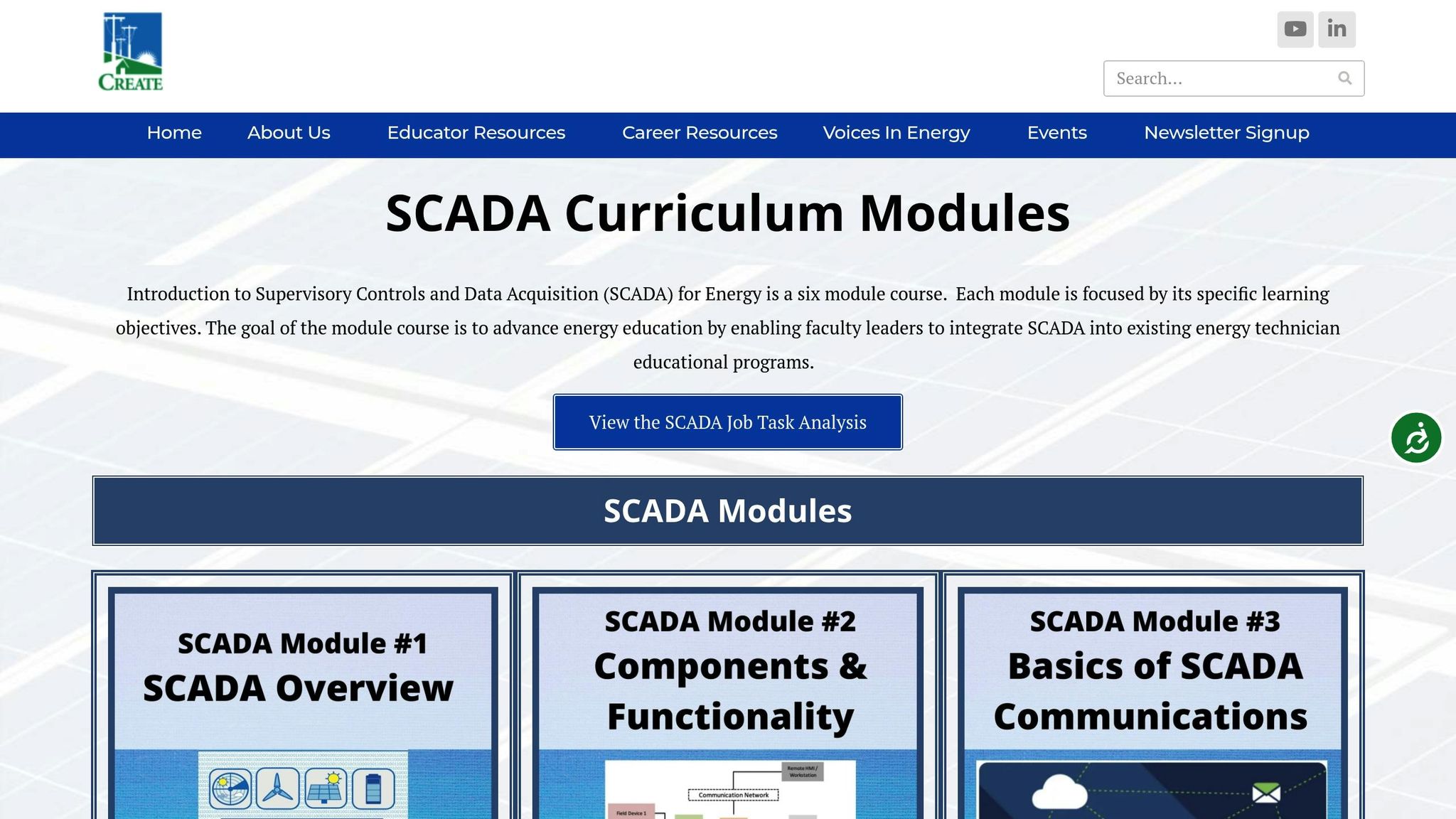
The CREATE Energy Center offers a six-module course titled "Introduction to SCADA for Energy," designed to integrate into existing energy technician programs. This curriculum begins with SCADA fundamentals and progresses through components, communication systems, and HMI, eventually covering energy-specific applications and trends.
Highlights include Module 4, which features an HMI Lab for hands-on interface practice, and Module 5, which provides a Simulation Lab focused on real-world applications like solar PV and energy storage systems. What sets this program apart is its accessibility – CREATE offers the curriculum materials under a Creative Commons license, allowing community colleges and technical schools across the U.S. to incorporate SCADA training without additional licensing fees. This approach makes SCADA education more widely available, fostering skill development across a broader audience.
New Developments in SCADA for Renewable Energy
The renewable energy sector is undergoing rapid technological changes, directly influencing how SCADA systems are designed and operated. Staying informed about these shifts is crucial for professionals aiming to remain relevant in the industry. Three major advancements are shaping SCADA training needs: cloud infrastructure, artificial intelligence, and 5G connectivity.
Cloud-Based SCADA Solutions
Cloud-based SCADA platforms are steadily replacing traditional on-site systems, offering scalability that can support everything from small solar arrays to vast, multi-state networks. By eliminating the need for expensive on-site control rooms, these platforms integrate IT and OT through universal protocols like Ethernet, TCP/IP, and OPC UA, while also delivering enterprise-grade infrastructure and disaster recovery options.
The rise of SCADA-as-a-Service models, managed by third-party control rooms, is helping to address the industry-wide skills gap. For example, Woodrow Boles, Jr., Director of Renewables SCADA at EverLine, oversaw the integration of nearly 10 GWs of renewable energy assets into one of North America’s largest NERC-compliant third-party control centers between 2020 and 2022. This showcases the scale and efficiency of centralized, cloud-based operations.
AI and Predictive Analytics in SCADA
Building on cloud technologies, artificial intelligence is taking SCADA systems to the next level by shifting from reactive monitoring to predictive control. Machine learning models like Long Short-Term Memory (LSTM) and Convolutional Neural Networks (CNN) are being used to analyze time-series data, achieving over 95% anomaly detection accuracy in smart grid simulations and reducing response times to threats by 30%.
AI integration enables SCADA systems to follow a "detect, react, and pro-act" model, anticipating grid changes and addressing potential issues before they escalate. This is especially critical for managing the variable output of solar and wind energy.
"The ‘detect, react, and pro-act’ features in DER-based SG can only be accomplished at the fullest level with the use of technologies like Artificial Intelligence (AI), the Internet of Things (IoT), and the Blockchain (BC)." – Kabir Mamun, Energies
Predictive analytics also streamline maintenance schedules and optimize resource allocation across complex renewable projects. As the industry evolves, utilities are introducing roles like "Electric Utility Data Science Leader" to bridge the gap between traditional engineering expertise and AI-driven data analysis.
5G Connectivity for SCADA Networks
The evolution of wireless networks, particularly LTE and 5G, is transforming field connectivity for SCADA systems. These advanced networks are crucial for monitoring and managing equipment across widely spread solar and wind farms. They also enable seamless communication between SCADA systems and business tools like geographical information systems and asset management software.
Reliable connectivity plays a key role in maintaining grid stability. SCADA systems use real-time data to adjust power output within minutes, ensuring grid frequency stays as close to 60.00Hz as possible.
"Renewable power plants are often the target of curtailments due to their ability to respond quickly and efficiently." – Woodrow Boles, Jr., Director of Renewables SCADA, EverLine
Additionally, advanced wireless networks support mobile apps that allow technicians to monitor and control SCADA systems remotely. This improves maintenance efficiency for inverters, turbines, and other critical components. With wind, solar, and battery storage projected to account for 81% of all new energy capacity in 2021, demand for professionals skilled in wireless SCADA networks continues to rise.
These advancements highlight the growing need for updated SCADA training programs to prepare renewable energy workers with the skills required for these emerging technologies.
Conclusion
SCADA training plays a critical role in ensuring renewable energy workers can maintain grid stability and meet the demands of a rapidly growing industry. With the clean energy workforce expected to double to nearly one million workers by 2030, employers need skilled technicians ready to address operational challenges in real time. Unlike traditional plants with slower ramp times, renewable energy sites can go from zero to full production in just minutes. This makes operators who can maintain a steady 60.00Hz grid frequency and manage reactive power indispensable.
Beyond credentials, certifications set a standard of competency that boosts employer confidence in their teams. With tens of thousands of wind and solar installations across the U.S., the demand for qualified SCADA operators continues to grow. Programs like those offered by the Clean Power Institute help unify training across wind, solar, and battery sectors, preparing technicians for installation, maintenance, and troubleshooting. These certifications not only validate expertise but also equip operators to handle the integration of IT and OT systems, a challenge increasingly common in the field.
Mastering IT and OT integration requires knowledge of industrial Ethernet, cybersecurity protocols, and various communication technologies like fiber optics and LTE networks. As Woodrow Boles, Jr., Director of Renewables SCADA at EverLine, cautions:
"One of the biggest threats to the renewable energy industry is falling behind competitively, which can happen if the workforce doesn’t possess the skills in emerging automation technologies".
Continuous education and certification maintenance ensure that operators remain prepared for both routine operations and emergency situations. This ongoing training highlights the importance of advanced SCADA expertise in navigating the complexities of modern energy systems.
Skilled SCADA operators improve efficiency, safety, and cost management. Real-time monitoring allows for early issue detection, reducing breakdowns and extending the lifespan of critical assets. With renewable energy consumption in the U.S. surpassing coal for the first time in 130 years back in 2019, the sector’s rapid growth underscores the value of SCADA expertise as one of the most important skill sets in energy today.
FAQs
What SCADA skills do renewable energy employers want most?
Renewable energy employers place a high value on SCADA (Supervisory Control and Data Acquisition) skills, as these are essential for real-time monitoring, controlling, and analyzing systems such as solar plants, wind turbines, and battery storage units. Key competencies include setting up and maintaining SCADA hardware and software, ensuring smooth operations, and protecting the integrity of system data.
With the growing overlap of IT and OT (Operational Technology), cybersecurity expertise has become increasingly important. Employers are looking for professionals who can fine-tune systems, identify and address faults, and leverage data insights to improve energy production and system reliability.
Which SCADA protocols should I learn first for wind and solar?
When diving into renewable energy SCADA systems, it’s important to begin with protocols like Ethernet/IP, Modbus, and DNP3. These are some of the most commonly used protocols in wind and solar energy projects. They serve as the backbone for communication and control, ensuring seamless data exchange between devices and systems. Mastering these protocols provides a solid starting point for understanding how renewable energy systems operate efficiently.
How do SCADA operators keep grid frequency near 60.00 Hz?
SCADA operators work to keep the grid frequency close to 60.00 Hz by relying on control mechanisms such as inertial control, primary control, and secondary control. These systems are designed to constantly monitor and make real-time adjustments, ensuring the grid remains stable and balanced.


