
The shortage of skilled workers in green construction is slowing progress toward climate goals. With buildings responsible for 37% of global emissions, the industry needs a workforce capable of implementing energy-efficient technologies and sustainable practices. However, only a small fraction of workers possess the necessary skills, creating delays, higher costs, and missed opportunities.
Key Challenges:
- Workforce Shortage: By 2026, the U.S. construction sector will need 349,000 new workers, with demand rising to 456,000 by 2027.
- Skill Gaps: Only 17.6% of the global workforce has at least one green skill, leaving areas like heat pump installation, energy auditing, and digital tools under-resourced.
- Competition: Other industries, like tech, are hiring from the same limited talent pool, intensifying the challenge.
Solutions:
- Government Funding: Programs like the YouthBuild 2025 grant and DOE initiatives offer resources for training workers in green construction.
- Company-Led Training: Employers can focus on practical skills like heat pump installation, mass timber construction, and Building Information Modeling (BIM).
- Tech Platforms: Tools like ABLEMKR streamline hiring and certification, ensuring skilled workers are deployed efficiently.
Closing the skills gap requires immediate action from governments, businesses, and educational institutions to meet the growing demand for green construction expertise.
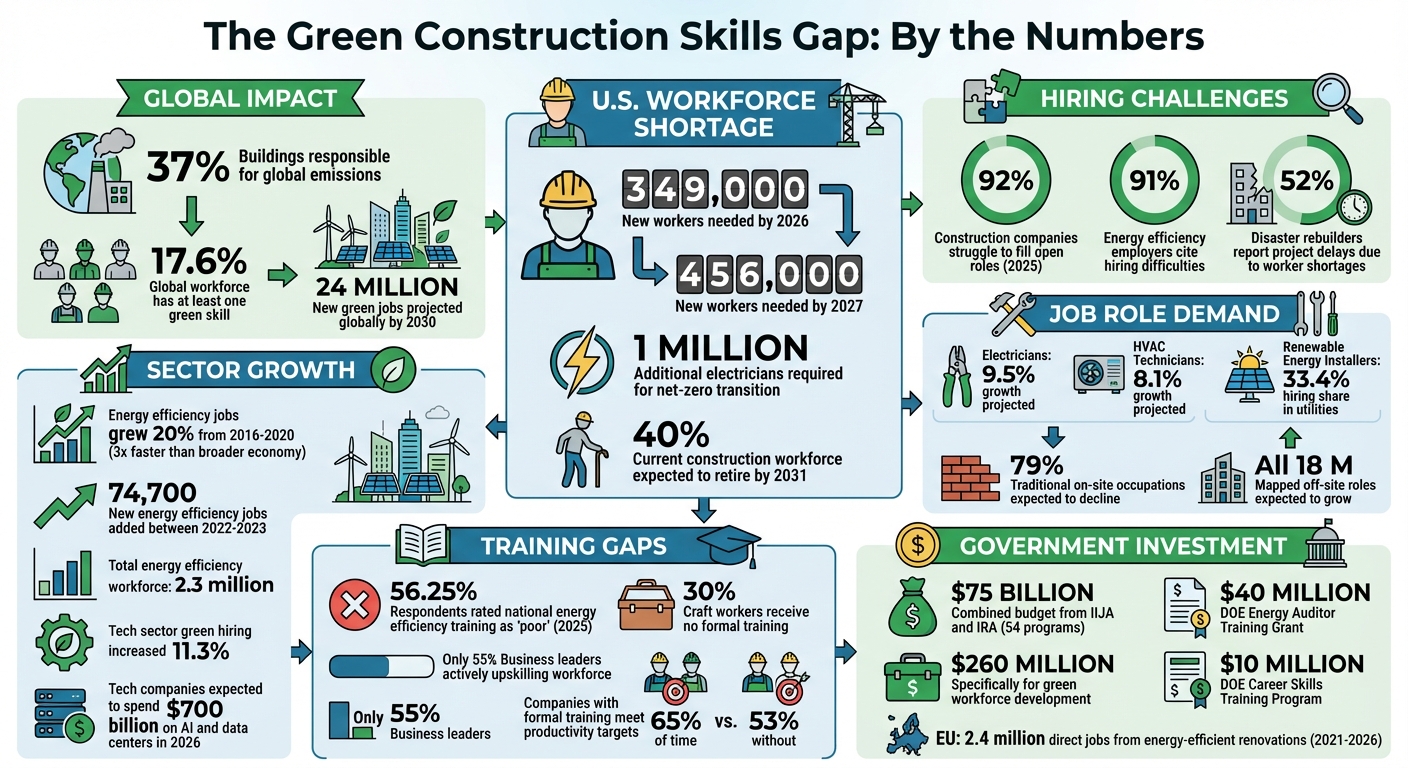
Green Construction Skills Gap: Key Statistics and Workforce Challenges 2025-2027
CIOB Student Festival 2025 | Bridging the Green Skills Gap in Construction
sbb-itb-aa28329
The Green Skills Gap: Current Challenges
Reaching sustainable construction goals hinges on addressing critical hiring challenges. By late 2025, 92% of construction companies reported struggling to fill open roles. Similarly, 91% of employers in the energy efficiency sector cited hiring difficulties, pointing to a lack of technical skills and limited applicant pools. This mismatch between industry needs and workforce capabilities has created a significant barrier.
But it’s not just about finding workers – it’s about finding the right workers. From 2016 to early 2020, jobs in energy efficiency grew by 20%, outpacing the broader U.S. economy by three times. Yet, the supply of skilled professionals hasn’t kept up. Sue Duke, Vice President of Public Policy at LinkedIn, summed it up well:
"The gulf between demand and supply of skilled workers continues to put [the climate transition] at risk."
Adding to the challenge, competition for talent is intensifying. Technology and utility sectors, which grew green hires by 11.3%, are pulling from the same pool of electricians, HVAC technicians, and energy specialists. And with tech companies expected to spend $700 billion on AI and data centers in 2026, the pressure on this already limited talent pool is only increasing.
Workforce Shortage Numbers
The numbers paint a stark picture. By 2026, the U.S. construction industry will need 349,000 new workers, and that figure jumps to 456,000 by 2027 just to keep up with demand. To meet climate goals, an additional 1 million electricians will be required to support the transition to a net-zero economy. Yet, as of 2025, only 17.6% of the global workforce had even one green skill.
Retirements are another looming issue. Around 40% of the current construction workforce is expected to retire by 2031. Anirban Basu, Chief Economist at Associated Builders and Contractors, warned about the consequences:
"Failing to [bring in new workers] will worsen labor shortages, especially in certain occupations and regions, placing further upward pressure on labor costs."
These shortages are already causing delays. Over half (52%) of disaster rebuilders report project setbacks due to a lack of qualified workers. In the energy efficiency sector, 74,700 new jobs were added between 2022 and 2023, bringing the workforce to 2.3 million, but employers still struggle to find skilled candidates.
Job Roles Most Affected
Some roles are feeling the pinch more than others, particularly those tied to decarbonizing the built environment. Electricians are expected to grow by 9.5%, and HVAC technicians by 8.1%. Yet, even these increases are unlikely to meet the surging demand. Other roles under strain include energy auditors, heat pump installers, and renewable energy specialists.
The shift toward off-site and modular construction adds another layer of complexity. While demand for 79% of traditional on-site occupations is expected to decline, all 18 mapped off-site roles – like assembly, fabrication, and logistics – are set to grow. This evolution demands new skills that traditional training programs often fail to address.
Digital expertise is increasingly critical, too. As buildings become more automated, there’s soaring demand for workers proficient in Building Information Modeling (BIM), 3D modeling, and AI-assisted design tools. Unfortunately, many construction management programs still fall short in training students on whole-building systems integration and advanced building science. This leaves graduates unprepared for the complexities of modern green construction.
| Job Role | Projected Growth/Demand | Why the Gap Matters |
|---|---|---|
| Electricians | 9.5% growth; 1M more needed | Critical for renewable energy projects and electrification efforts |
| HVAC Technicians | 8.1% growth | Key to energy-efficient retrofits and heat pump installations |
| Energy Auditors | High demand in residential sector | Essential for identifying areas to reduce emissions |
| BIM Specialists | Growing demand in off-site construction | Needed for tech-driven, modern building practices |
| Renewable Energy Installers | 33.4% hiring share in utilities | Vital to support the 95% growth in renewable power generation |
Green Construction Skills in High Demand
Reaching net-zero targets hinges on having the right technical expertise. Bridging the skills gap requires a strong focus on advanced technical and digital capabilities.
Carbon Auditing and Footprint Analysis
Skills like Life Cycle Assessment (LCA), Environmental Product Declaration (EPD) interpretation, and embodied carbon analysis have become essential. These tools help teams measure and manage emissions from both materials and building operations.
Billy Lusk from One Click LCA highlighted the industry’s role in emissions:
The construction industry plays a significant role in global emissions, responsible for approximately 21% of all greenhouse gas (GHG) emissions.
To address this, the One Click LCA Academy launched a major initiative in June 2024. Their goal? Train one million low-carbon experts by 2030, offering free courses on LCA, embodied carbon, and EPDs to construction professionals.
Regulations are also driving demand for these skills. The EU’s Energy Performance of Buildings Directive (EPBD) mandates carbon transparency, and similar standards are emerging worldwide. Yet, only 1 in 8 workers currently has even one green skill, underscoring the urgent need for training.
Retrofitting skills are equally crucial, especially when it comes to unlocking the potential of existing structures.
Retrofitting and Energy Efficiency Techniques
Existing buildings hold immense potential for decarbonization. This has created a surge in demand for expertise in heat pump installation, heat recovery systems, and building envelope upgrades. These skills are critical for meeting 2050 climate goals.
The EU estimates that energy-efficient renovations will create 2.4 million direct jobs between 2021 and 2026.
In April 2024, the Canada Green Building Council (CAGBC) introduced its "Building Our Future" strategy in British Columbia. Supported by the BC Ministry of Post-Secondary Education and Future Skills, the initiative highlighted a pressing need for training in heat pump installation and building envelope upgrades to meet the province’s net-zero target by 2032. Thomas Mueller, CAGBC President and CEO, emphasized:
Achieving the Province’s ambitious emissions reduction targets required low‐carbon buildings to become the standard… tradespeople will play a critical role in achieving low‐carbon buildings at scale.
Emerging Technology Skills
New technologies are revolutionizing green construction. Skills in Building Information Modeling (BIM), AI-assisted design tools, 3D modeling, and digital twins are becoming indispensable. These tools allow for precise energy modeling and can speed up off-site and modular construction by up to 50%.
Sarah Truitt, a researcher at the National Renewable Energy Laboratory (NREL), explained the shift:
As buildings become more automated, digitized, and interconnected, the workforce that supports the design, build, operation, and maintenance of these buildings must also evolve.
In addition to digital tools, there’s rising demand for skills in mass timber construction and modular assembly techniques. These methods reduce waste and construction time but require a different skill set compared to traditional on-site construction. Workers also need a solid understanding of building science – how air quality, moisture, and energy systems interact – to ensure that high-efficiency technologies deliver on their promises.
| Skill Category | Specific High-Demand Skills | Why It’s Critical |
|---|---|---|
| Carbon Management | LCA, EPD, Embodied Carbon Analysis | Enables carbon transparency and compliance with regulations |
| Energy Efficiency | Heat pump installation, Building envelope upgrades | Reduces operational emissions and maximizes energy savings |
| Digital/Tech | BIM, AI-assisted tools, Digital Twins | Improves accuracy in energy modeling and modernizes processes |
| Modern Methods | Mass timber, Modular/Off-site assembly | Cuts construction time by up to 50% and minimizes waste |
Why Training Gaps Exist in Green Construction
The construction industry is grappling with a growing demand for green skills, but systemic barriers are preventing workers from getting the training they need. Tackling these challenges is essential to addressing the skills gap and supporting the industry’s green transition.
Mismatch Between Education and Industry Needs
Educational programs often fall short of meeting the demands of green construction. While technical STEM skills dominate curriculums, critical areas like leadership and project management are often overlooked. As the Edge Foundation Report highlights:
A simple focus on only technical skills fails to capture the demands of complex building sites and the need for greener construction and business practices.
This lack of balance leaves construction management graduates underprepared for the realities of modern building practices. Key areas like whole building systems, energy efficiency, and the integration of design with construction are frequently underemphasized. Additionally, students often graduate with outdated knowledge of green regulations and carbon management, as academic resources are fragmented across niche topics rather than presented within cohesive frameworks.
The problem extends to training providers themselves. Without ongoing professional development, many fall behind on the latest advancements in decarbonization. On top of that, rapidly changing regulations and evolving climate science create uncertainty, making business leaders hesitant to invest in long-term training programs. These challenges contribute to a workforce that struggles to keep up with rising demand for green skills, leading to instability across the sector.
High Turnover and Hiring Difficulties
Workforce instability adds another layer to the training gap. By late 2025, 92% of construction firms reported difficulties in hiring, forcing them to prioritize immediate project needs over long-term upskilling for green practices. High turnover further discourages companies from investing in training, as they worry about losing newly skilled employees. Sue Duke, Vice President of Public Policy at LinkedIn, underscored the urgency of this issue:
The gulf between demand and supply of skilled workers continues to put this at risk. We will only close the gap if decisive action is taken now to make skills and workforce training a core part of climate and energy policy.
The lack of formal training programs not only affects retention but also reduces productivity. For example, companies with formal craft training meet labor productivity targets 65% of the time, compared to just 53% for those without such programs. Alarmingly, nearly 30% of all craft workers report receiving no formal training at all. Meanwhile, competition from the tech sector, which has increased green hiring by 11.3% to support AI and data center infrastructure, is drawing workers away with promises of higher pay.
Limited Access to Specialized Training
Access to quality training is also uneven, particularly for small and medium enterprises (SMEs). For these companies, the cost of taking workers off job sites for professional development is often prohibitive, leading to reliance on informal, non-standardized learning methods. Many business leaders view sustainability training as an expense rather than an investment, further limiting funds for retraining.
The fragmented nature of the construction industry complicates efforts to coordinate training across the value chain. Complex organizational structures and a lack of innovation slow the adoption of updated training protocols. Additionally, the absence of clear national standards and green building regulations creates uncertainty, making companies hesitant to invest in training for technologies that may not yet be required.
Regional disparities add to the problem. Green job opportunities and specialized training are often concentrated in urban or capital regions, leaving rural areas with fewer resources. With 40% of the current construction workforce expected to retire by 2031, the industry faces a significant talent drain that outpaces the entry of new, well-trained professionals. Right now, only 55% of business leaders are actively upskilling their workforce to meet green transition needs, putting critical climate goals at risk across the sector.
How to Close Training Gaps in Green Construction
Addressing the training gap in green construction requires collaboration between government programs, industry efforts, and technological solutions. With federal funding available and innovative tools emerging, there’s a clear path to equipping the workforce with the skills needed for sustainable construction.
Government Programs and Funding
Federal initiatives provide substantial opportunities for workforce development in green construction. The Infrastructure Investment and Jobs Act (IIJA) and the Inflation Reduction Act (IRA) include 54 programs with a combined budget of $75 billion. While only $260 million is specifically earmarked for green workforce development, much of the funding allows flexibility for state and local governments to allocate resources toward training and apprenticeships.
One key initiative is the YouthBuild 2025 grant program (FOA-ETA-26-38), which began accepting applications in December 2025 and closes on March 2, 2026. This program offers pre-apprenticeship training in construction, preparing participants for registered apprenticeships and in-demand roles while they gain hands-on experience building affordable housing. Similarly, the Department of Energy’s (DOE) $10 million Career Skills Training Program, launched in June 2022, combines classroom learning with practical training, helping students earn certifications for energy-efficient building technologies.
Another noteworthy program is the DOE’s Energy Auditor Training Grant, funded at $40 million, which supports states in training professionals to conduct building audits. On a state level, Michigan offers the Workforce Training Center Equipment Grant Program, providing up to $90,000 for employer-driven training initiatives. Companies can monitor funding opportunities on Grants.gov and collaborate with state agencies to access additional resources for workforce development. Together, these programs create a foundation for companies to design and implement targeted training efforts.
Company-Led Training Programs
While government funding lays the groundwork, companies must design industry-specific training programs to meet the growing demand for green construction skills. These programs should focus on whole building systems, ensuring workers understand how energy performance, air quality, and moisture management are interconnected. High-demand skills include techniques like mass timber construction, heat pump installation, ventilation system commissioning, and working with materials that reduce embodied carbon.
On-the-job training is especially important for ensuring energy-efficient technologies perform as intended. Partnerships with equipment manufacturers can provide specialized training, particularly for advanced HVAC and heat pump systems. As the Canada Green Building Council notes:
The skilled trades will be a vital component of the construction sector’s transformation… Industry must invest in initiatives encompassing all aspects of workforce development.
Companies can also utilize resources like the DOE’s Building Science Education Solution Center and the Better Buildings Workforce Page, which offer training tools and career maps. Micro-credentials and certificates are another effective way to help workers upskill without requiring long breaks from their current roles. With 91% of energy efficiency construction employers reporting hiring challenges in 2019, investing in thorough training programs isn’t just beneficial – it’s necessary to remain competitive.
Using ABLEMKR for Workforce Deployment
Technology platforms like ABLEMKR are transforming how trained workers are deployed in green construction projects. This mobile-first platform connects pre-vetted, certified workers to job sites, considering factors like their credentials, availability, and location. This streamlined approach ensures rapid deployment for tasks such as energy efficiency retrofits, renewable energy installations, and low-carbon construction.
Certification tracking is a vital component of green construction. Workers often need specialized credentials, such as EPA Section 608 certification for HVAC systems or LEED professional credentials, to prove their expertise. ABLEMKR automates the process of verifying these credentials, ensuring compliance with regulatory and performance standards. By focusing on skills rather than traditional four-year degrees, the platform lowers entry barriers for workers pursuing green construction careers.
In addition to certification management, ABLEMKR offers real-time worker tracking and integrated payroll, allowing employers to focus on project execution instead of administrative tasks. For workers, this platform provides flexible access to well-paying opportunities in an industry employing over 2.1 million people in the U.S., including 1.3 million in construction trades. As federal funding fuels $75 billion in green workforce activities, platforms like ABLEMKR play a crucial role in connecting skilled workers with the projects that need them most.
Conclusion
The research highlights a critical shortage of green construction skills, a gap that poses a major obstacle to meeting climate goals. With buildings accounting for 37% of global emissions, the lack of skilled professionals in areas like heat pump installation, carbon auditing, and energy-efficient retrofitting is a significant challenge. Alarmingly, 56.25% of industry respondents rated national energy efficiency training as "poor" in 2025. Bridging this divide calls for urgent, coordinated efforts from both governments and industry leaders.
Collaboration between federal programs and company-led initiatives is essential to implement practical, results-driven training programs. Data shows that firms offering formal training are 65% more likely to meet productivity targets, and trained workers achieve full productivity within six to 18 months. These figures underscore the tangible benefits of investing in workforce development.
Sue Duke, Vice President of Public Policy at LinkedIn, aptly stated:
We will only close the gap if decisive action is taken now to make skills and workforce training a core part of climate and energy policy.
With projections of 24 million new green jobs globally by 2030, the clock is ticking to build a workforce equipped for the challenges ahead.
Digital platforms like ABLEMKR provide a vital solution, offering tools for rapid, compliant workforce mobilization. By leveraging such technologies alongside strategic investments and focused training, the construction industry can address its skills gap and contribute to a more sustainable future. This combination of effort and innovation is key to aligning construction practices with the climate objectives our world urgently needs.
FAQs
Which green construction skills should I learn first?
To build a strong foundation in green construction, begin with skills that align with industry needs and sustainability objectives. Prioritize learning about energy-efficient design, retrofitting buildings to meet sustainability standards, and the concept of embodied carbon. Familiarity with renewable energy systems, environmental legislation, and certifications like LEED can also set you apart. These areas are critical as the construction industry strives to cut emissions and comply with changing regulations, ensuring you’re well-prepared for the challenges ahead.
How can small contractors train crews without losing jobsite time?
Small contractors can train their crews effectively by focusing on specific, practical methods. Craft training programs and digital learning tools are excellent choices for this. Short, modular sessions – whether on-site or in a classroom – allow workers to quickly develop essential skills without disrupting project schedules.
Digital platforms also play a key role. They provide flexible learning opportunities and credentialing programs that help workers gain expertise in areas like green-building techniques. This ensures crews can stay productive and adapt to industry demands without lengthy downtime. By addressing skill gaps directly, these approaches boost workforce performance and keep projects moving smoothly.
How does ABLEMKR help verify certifications and deploy workers faster?
ABLEMKR simplifies the process of deploying workers with a mobile-first platform that connects pre-vetted workers to job sites. Matching is based on factors like certifications, safety training, availability, and location, enabling quick crew mobilization for both planned and urgent projects. The platform also offers real-time updates on worker status, integrates payroll workflows, and tracks compliance. This helps minimize delays while ensuring safety and adherence to regulations.


