
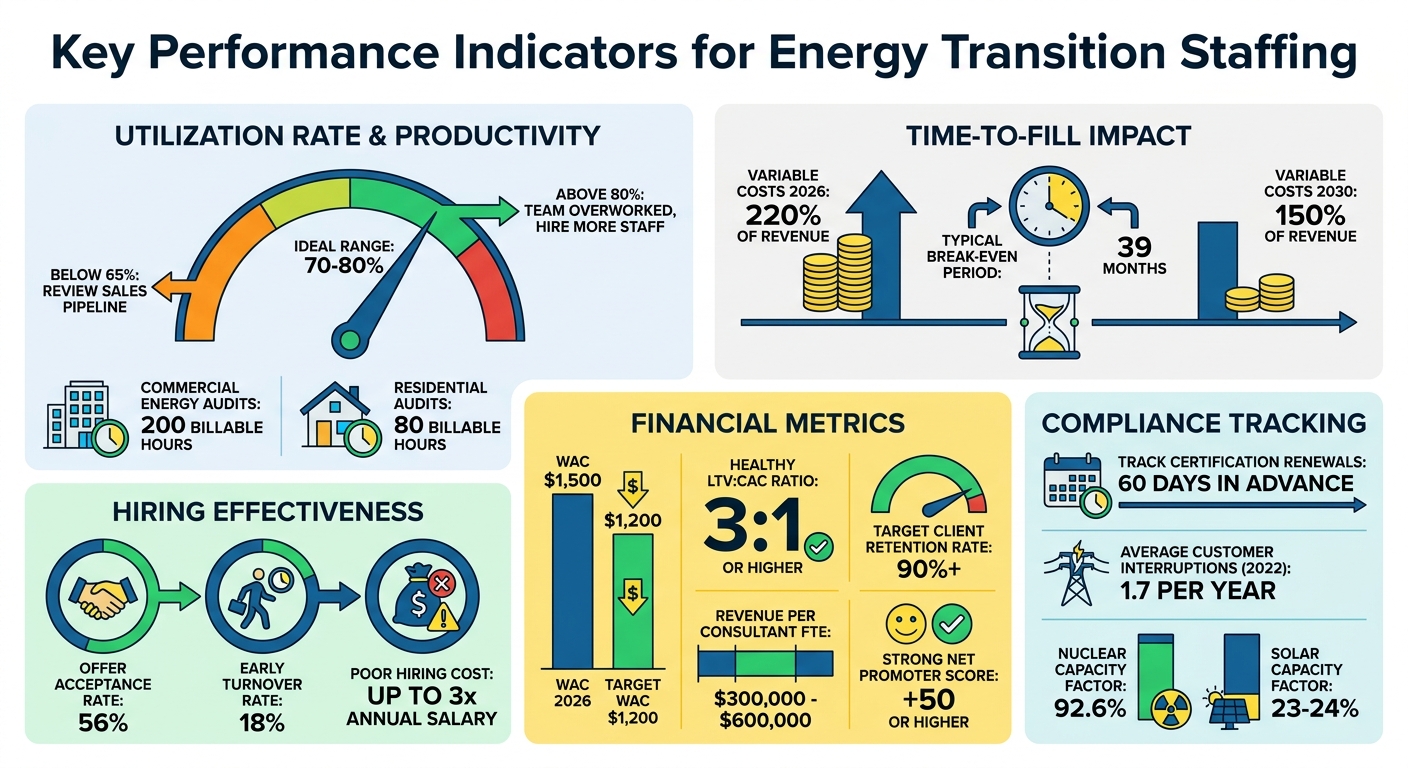
Key Performance Indicators (KPIs) are essential for ensuring effective staffing in energy transition projects. Poor hiring decisions can cost up to three times a role’s annual salary, and metrics like offer acceptance rates (56%) and early turnover (18%) highlight the need to prioritize quality over quantity in recruitment. By focusing on KPIs like Utilization Rate, Time-to-Fill, and Compliance Tracking, companies can align workforce performance with project goals, reduce inefficiencies, and improve retention.
Key points covered:
- Utilization Rate: Measures billable hours vs. available hours. Ideal range: 70-80%.
- Time-to-Fill: Tracks the time from job opening to deployment, crucial for minimizing revenue loss.
- Compliance Tracking: Ensures certifications and safety standards are met to avoid project delays.
- Financial Metrics: Worker Acquisition Cost (WAC) and breakeven analysis link labor investments to profitability.
- Technology: Tools like ABLEMKR provide real-time monitoring, automate compliance, and enhance decision-making.
Essential KPIs for Energy Transition Staffing Success
KPIs & Benchmarking in the Electric Utility Industry Deep Dive
sbb-itb-aa28329
Key KPIs for Energy Transition Staffing
Energy transition projects require precision and careful planning. The right KPIs can reveal whether your workforce is operating efficiently or if revenue is slipping through the cracks due to idle time or poor resource management. These metrics bridge the gap between daily operations and project outcomes, helping you spot potential issues before they disrupt schedules or budgets. Let’s dive into some of the most important performance indicators, from workforce productivity to compliance, that are critical for success in energy transition projects.
Utilization Rate and Workforce Productivity
Utilization Rate reflects the percentage of available working hours spent on billable client work. It’s a straightforward way to see if your team is generating revenue or sitting idle between tasks. For energy consulting and transition projects, the sweet spot for utilization is typically between 70% and 80%.
To calculate weekly utilization, divide the billable hours by the standard 40-hour workweek (adjusted for holidays and PTO). Tracking this metric at the individual level, rather than just team averages, can reveal specific performance gaps.
"Utilization Rate shows how efficiently your consulting team uses its time. It measures the percentage of total available working hours that are actually spent on billable client work." – Ruth Heuss, Financial Analyst
If utilization climbs above 80%, it could mean your team is overworked, signaling a need for additional hires. On the flip side, if it dips below 65%, it’s time to review your sales pipeline to ensure your workforce stays engaged between projects. For context, commercial energy audits typically require 200 billable hours per project, while residential audits only need 80 hours. Recognizing these differences allows you to allocate skilled workers to higher-value projects, ensuring maximum productivity.
Time-to-Fill and Deployment Speed
Quick deployment is key to maintaining revenue flow. Every unfilled position or idle worker translates into lost billable hours and revenue. In energy transition projects, infrastructure delays – like those caused by the interconnection queue – make rapid workforce deployment essential to hitting deadlines and achieving policy goals.
This KPI measures the time from when a position opens to when a worker begins billable work on-site. Delays can stretch break-even timelines, especially in a sector where initial costs are high. For example, variable costs in energy transition projects are expected to start at 220% of revenue in 2026 but should fall to 150% by 2030 as efficiency improves. With typical energy consulting projects aiming for a 39-month break-even period, slow deployment can significantly impact profitability.
"The interconnection queue is a huge policy problem. There are two ways to fix it: 1. Build more transmission lines 2. Reform the interconnection queue." – Luke Ashton, HData
To maximize revenue, prioritize staffing for larger, high-hour commercial projects over smaller residential ones.
Compliance and Certification Tracking
Speed alone isn’t enough – compliance is just as critical. Energy transition projects operate under strict regulatory standards, and lapses in worker certifications or safety training can bring work to a halt and expose your company to liability.
Track certification renewal dates at least 60 days in advance to avoid disruptions. For example, in 2022, utility customers experienced an average of 1.7 interruptions per year, lasting a total of 315 minutes. These reliability metrics (SAIDI and SAIFI) highlight the importance of having a certified, compliant workforce to maintain safety and project integrity.
Standardizing audit processes can help ensure consistent compliance across various project types. For instance, nuclear energy projects boast an average capacity factor of 92.6%, compared to solar’s 23-24%. With such narrow margins for error, maintaining compliance is non-negotiable. To stay ahead, bundle initial certifications with 12-month monitoring contracts to ensure ongoing adherence to regulatory standards beyond the initial project phase.
Using Data to Improve Workforce Management
Effectively using KPIs turns raw data into actionable strategies that enhance workforce performance and project outcomes. By 2026, successful staffing will go beyond just extending job offers – it will focus on confirmed starts and ensuring managers feel confident about a worker’s fit for the role. High candidate activity in earlier stages means little if top candidates drop out before starting or leave shortly after.
"A signed offer is no longer the finish line. Hiring success in 2026 needs a longer lens that reflects business continuity, not just transaction completion." – Vbeyond Corporation
Offer acceptance rates currently average around 56%, with nearly 18% of new hires leaving during their probation period. These numbers highlight the financial and productivity costs of poor hiring decisions. This data underscores the importance of shifting from focusing on volume to prioritizing outcomes. Tracking workforce composition and performance metrics is essential for refining staffing strategies.
Workforce Mix and Skill Allocation
Understanding the skill distribution within your workforce helps ensure the right talent is allocated to the right projects. For example, labor productivity can be measured using Revenue per Consultant FTE (Full-Time Equivalent). In specialized energy consulting, annual revenue per professional typically ranges from $300,000 to $600,000. If your team falls below this range, it may indicate underutilization or misallocation to lower-value tasks.
Redeployment rates are another critical metric, showing how well you’re reassigning proven talent to new projects. For example, moving a certified pipeline technician from a completed remote repair project to scheduled maintenance saves time and reduces onboarding costs compared to hiring new talent.
Balancing one-off projects with recurring revenue is also vital. Aiming for over 50% recurring revenue by 2028 can stabilize workforce allocation, reducing the constant need to chase new contracts. Segmenting billable rates by service type can highlight opportunities for improvement. For instance, if Renewable Energy Consulting rates are projected at $22,000 per hour in 2026, prioritizing hires with those credentials becomes a clear strategy.
Tracking continuing education and training hours alongside quality-of-hire metrics can help spot skill gaps. Regular KPI reviews ensure that staffing adjustments happen in time to meet evolving demands.
Service Quality and Worker Performance Metrics
Measuring service quality is just as important as optimizing workforce allocation. Client retention rates are a key indicator of service quality, with specialized B2B energy consulting aiming for retention rates of 90% or higher. Similarly, a Net Promoter Score (NPS) above +50 indicates strong client satisfaction and likelihood of contract renewals, while a score below +20 signals potential issues. These metrics validate whether staffing decisions are meeting client expectations. If a specific consultant or team consistently generates low NPS scores, it’s worth reevaluating their client-facing roles.
On-time project completion rates and supervisor feedback provide real-time insights into worker performance. For high-risk or niche roles – like senior engineers or risk specialists – using paid work samples can help confirm skills under realistic conditions before assigning them to critical projects.
To minimize early exits, structured 30/60/90-day plans can help new hires integrate effectively while clarifying roles and responsibilities. Monitoring onboarding duration also helps prevent client churn. Addressing potential compensation or relocation hurdles early, using "close plans" during the recruitment process, ensures smooth labor allocation and avoids late-stage offer rejections.
Linking worker and manager bonuses to retention rates within their portfolios encourages accountability and maintains high service standards. Tools that offer real-time location tracking, detailed worker profiles, and performance ratings can provide transparency and improve accountability. For example, ABLEMKR’s mobile-first platform integrates these features, offering a comprehensive way to optimize workforce deployment and increase productivity in energy transition projects.
Financial KPIs for Workforce Sustainability
Financial KPIs are the backbone of connecting labor investments to project profitability, especially in energy transition projects. By closely monitoring these metrics, companies can ensure their workforce strategies are not only effective but also financially sound. Without proper cost oversight, staffing initiatives can quickly become a drain on resources, making it crucial to link labor spending with revenue outcomes and identify the break-even point.
Recruitment Cost and Hiring Efficiency
Understanding the full cost of recruiting skilled workers is key to spotting budget inefficiencies. One way to measure this is through Worker Acquisition Cost (WAC), which adapts the Customer Acquisition Cost formula. To calculate WAC, divide the total recruitment, marketing, and sales expenses by the number of workers hired. For example, energy consulting firms in 2026 aim to keep their WAC around $1,500 per hire, with a goal to reduce it to $1,200 by 2030.
"If your mix is heavily skewed toward initial audits, expect higher Customer Acquisition Costs (CAC) because you constantly need new logos." – Ruth Heuss, Financial Analyst
Another critical metric is the LTV:CAC ratio (Lifetime Value to Customer Acquisition Cost). A healthy ratio of 3:1 or higher indicates strong returns on recruitment spending. For instance, if you’re spending $1,500 to hire a worker who generates only $3,000 in billable revenue, you’re barely covering costs after overhead. Regularly reviewing CAC – ideally monthly – helps catch cost increases early. If recruitment spending exceeds targets for two straight months, it may be time to pause non-essential expenses.
Worker utilization also plays a big role in financial health. Aligning workforce capacity with revenue goals ensures minimal idle time. Time tracking on a weekly basis can uncover revenue gaps caused by non-billable tasks, allowing you to shift resources toward higher-value projects. For instance, commercial energy audits might yield 200 billable hours at $175/hour, compared to residential projects with only 80 hours at $100/hour.
Breakeven Analysis for Workforce Programs
When comparing workforce strategies, profitability often hinges on balancing hiring costs with internal development. Reskilling existing employees often proves more cost-efficient than recruiting new talent. For example, training a plumber to become a heat pump technician might take just a few days, while onboarding someone with no experience could take up to four years. This makes internal development a smart choice when possible.
The Alberta Coal Workforce Transition Program provides a real-world example of breakeven planning. Launched in January 2018, the program offered tuition vouchers of up to CAD $12,000 for post-secondary education and relocation assistance of up to CAD $5,000 for workers moving at least 25 miles. These efforts aimed to offset nearly 2,900 job losses by creating between 1,970 and 3,570 full-time renewable energy jobs annually by 2030. Factoring in costs like severance, relocation assistance, and reemployment grants is essential for accurate breakeven calculations.
To calculate Months to Breakeven (MTBE), divide total cumulative losses by the average monthly net profit. For energy consulting firms, breakeven often takes around 39 months. With initial Cost of Goods Sold (COGS) for energy services reaching up to 90% of revenue, only 10% gross margin remains for labor and overhead. Streamlining processes to reduce direct labor hours per project can gradually improve these margins.
Sector-specific wage differences also impact profitability. Workers in the fossil fuel industry often earn higher wages than those in the renewable sector, which can drive up retention costs and long-term labor expenses. Securing recurring revenue streams, such as ongoing management contracts, can stabilize income and reduce the need for constant customer acquisition.
"Certifications are also of paramount importance… as they reduce time delays and transaction costs associated with shifting skilled workers from one sector or region to another." – Enel Foundation / IEA
For consistent financial tracking, it’s helpful to standardize workforce data using Full-Time Equivalent (FTE) – defined as 40 hours per week for 52 weeks. This ensures labor costs are comparable across different regions and project types. Tools like ABLEMKR’s integrated payroll workflows provide real-time visibility into workforce metrics, making it easier to track these financial KPIs and maintain profitable workforce investments in energy transition projects.
These insights highlight the importance of leveraging technology to simplify KPI tracking and ensure workforce profitability.
Technology for KPI Tracking
Tracking KPIs effectively in energy transition projects requires advanced technology. Relying on manual processes and spreadsheets for workforce KPI management can lead to errors and slow decision-making. Modern technology platforms address this by centralizing workforce data into real-time dashboards. This approach not only enhances team accountability but also ensures that quarterly plans are executed more efficiently. For energy transition projects, where speed and compliance are critical to profitability, having instant access to accurate workforce metrics is a game-changer. It creates a seamless connection between daily operations and strategic workforce planning.
Real-Time Workforce Data and Analytics
The ABLEMKR platform is designed to provide live updates on key workforce metrics through its mobile-first interface. Employers can monitor critical data points like billable hours, time-to-fill rates, and certification expiration dates on a daily basis. This real-time visibility allows project managers to make faster, more informed staffing decisions, whether it’s mobilizing crews for urgent tasks or reallocating workers to higher-priority projects.
One standout feature is the platform’s geo-location matching, which assigns workers based on their proximity to job sites. This ensures optimal staffing for energy projects in real time. Additionally, by tracking both past performance indicators (results) and forward-looking metrics (like upcoming certification renewals), teams can proactively adjust staffing plans. For example, the platform automatically flags workers with soon-to-expire certifications, helping managers address compliance issues before they disrupt operations.
"The key is to align your team around the proper KPIs with a good mix of results and leading indicators." – Rhythm Systems
ABLEMKR also segments workforce data by project type, allowing employers to compare productivity across different energy sectors. These insights help identify areas for improvement. Automation further enhances this process by streamlining compliance tracking and payroll management.
Automated Compliance and Payroll Systems
Compliance becomes more manageable when certifications, safety training, and work permits are integrated directly into the platform. ABLEMKR automates the process by flagging workers with expiring credentials and blocking non-compliant assignments. This reduces administrative workload and lowers the risk of deploying unqualified workers to regulated job sites.
Payroll processes are also simplified through automation. Workers benefit from guaranteed on-time payments, while employers gain tools for tracking metrics like timesheet submissions and billable hours. The platform standardizes workforce data using Full-Time Equivalent (FTE) calculations – based on 40 hours per week for 52 weeks – making it easier to compare labor costs across regions and project types. Real-time invoicing features further support financial oversight, helping employers monitor cash flow and maintain both short-term stability and long-term profitability.
Conclusion
Tracking KPIs effectively ties workforce data to measurable project outcomes. By 2026, success will depend on whether employees initiate, sustain, and achieve project goals – not on activity-based metrics like outreach numbers or offer counts. As VBeyond Corporation aptly states, "The future of hiring belongs to teams that prioritize outcomes over activity".
The financial stakes, as previously highlighted, are immense. Focusing on outcomes ensures better financial oversight. Keeping an eye on metrics like time-to-fill, utilization rates, and redeployment percentages allows you to spot issues early, preventing them from escalating into costly delays or budget overruns.
Technology plays a crucial role here. Real-time dashboards offer instant access to workforce data, from certification tracking to billable hours, enabling faster crew mobilization and streamlined compliance. Platforms like ABLEMKR centralize this information and automate repetitive tasks, allowing your team to concentrate on strategic workforce planning.
The energy transition sector demands both precision and speed. By balancing result indicators (what has already occurred) with leading indicators (what’s likely to happen), you can create a staffing operation that quickly adapts to evolving project demands. Regular weekly reviews of top KPIs keep teams aligned and help make swift adjustments when the data signals a need for change.
FAQs
Which staffing KPIs matter most for energy transition projects?
When it comes to energy transition projects, the most important staffing KPIs revolve around efficiency, quality, and retention. These projects demand a workforce that’s not only skilled but also aligned with the fast-paced and high-stakes nature of the energy sector.
Some critical metrics include:
- Time to Fill (TTF): Measures how quickly open positions are filled. A shorter TTF ensures projects stay on schedule.
- Time to Hire (TTH): Tracks the time between identifying a candidate and their acceptance of the offer. This highlights the efficiency of your recruitment process.
- Cost Per Hire (CPH): Evaluates the financial investment required to bring a new hire onboard, helping manage budgets effectively.
- Quality of Hire (QoH): Assesses the value new employees bring to the organization, ensuring long-term success.
Additionally, aligning these KPIs with goals like safety compliance and required certifications is crucial. This approach ensures the workforce is not only well-prepared but also supports the project’s demands for safety and reliability in a competitive and evolving industry.
How do I set KPI targets by project type and role?
To establish effective KPI targets, start by aligning them with your energy transition objectives. Clearly define what success looks like, keeping in mind the specific project type and the role of your team or organization. Incorporate relevant data points such as safety records, productivity levels, or environmental performance metrics.
Set targets that are measurable and realistic by using historical performance data or comparing them to industry standards. Make it a habit to regularly review and adjust these targets based on performance insights. This ensures they stay relevant and support continuous improvement while keeping in step with your overall strategic goals.
How can ABLEMKR help automate KPI, compliance, and payroll tracking?
ABLEMKR simplifies the management of KPIs, compliance, and payroll through real-time updates on worker status, certifications, safety training, and geo-location. Designed with a mobile-first approach, the platform makes hiring, onboarding, and compliance processes more efficient while seamlessly integrating payroll workflows. This helps ensure precise, up-to-date tracking, minimizes manual tasks, and enables smoother workforce management for energy projects with high demands.


