
In 2026, five states – Texas, Georgia, Ohio, New Mexico, and Arizona – are leading destinations for skilled labor relocation. These states combine strong job growth, competitive pay, and affordable living costs, driven by federal infrastructure funding and private investments in industries like semiconductors, renewable energy, and advanced manufacturing. Here’s why:
- Texas: $90 billion in annual commercial construction spending, no state income tax, and major projects like Samsung‘s $17 billion semiconductor plant.
- Georgia: Rapid EV and battery production growth with 28,000–35,000 new jobs expected in 2026.
- Ohio: Manufacturing boom led by Intel’s semiconductor facilities, adding 20,000–26,000 jobs.
- New Mexico: Fastest-growing state for construction jobs, driven by renewable energy projects and federal funding.
- Arizona: A hub for semiconductor manufacturing and solar energy, with wages rising due to labor shortages.
With the U.S. construction industry projected to need 456,000 new workers by 2027, these states offer skilled workers better opportunities, higher take-home pay, and long-term job stability. Platforms like ABLEMKR are simplifying relocation by matching workers with high-demand projects, ensuring timely payments, and easing the transition process.
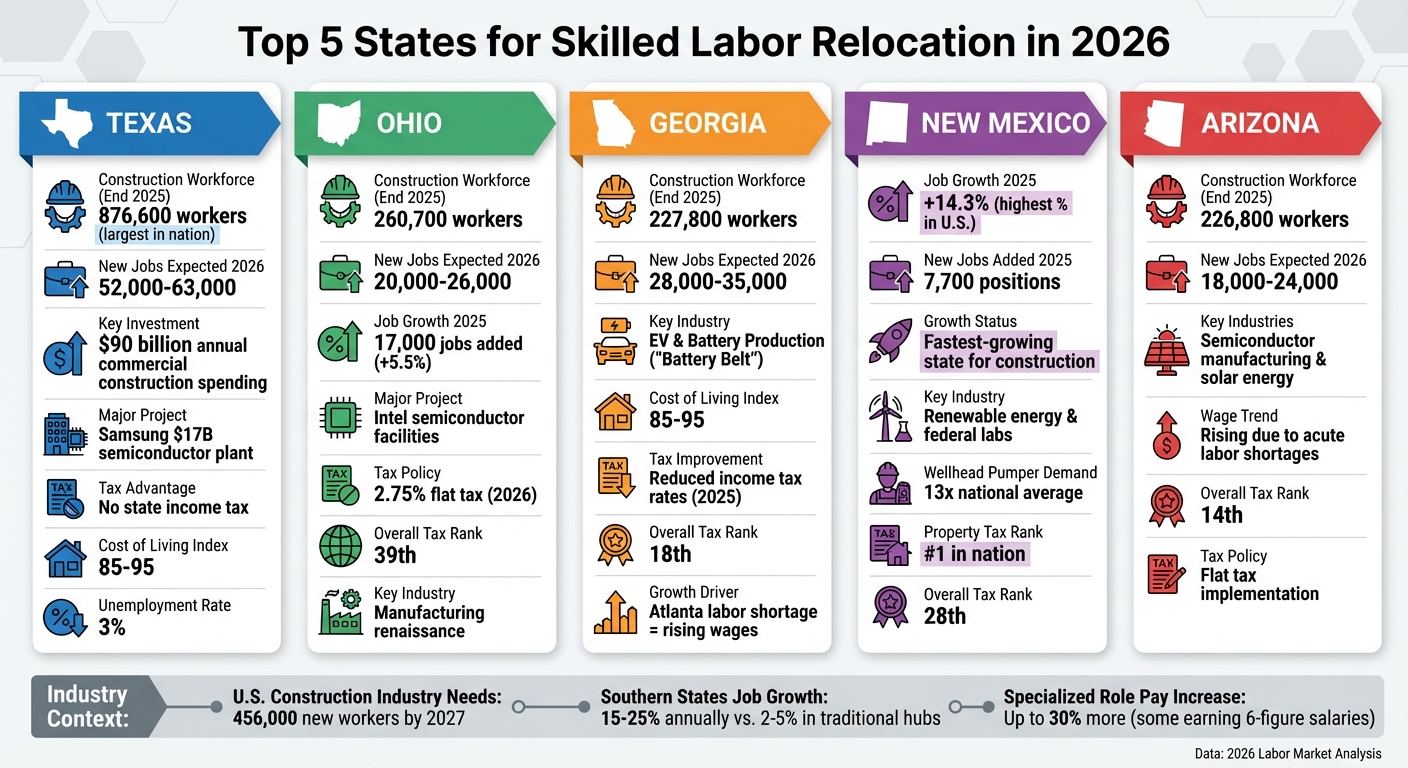
Top 5 States for Skilled Labor Relocation 2026: Jobs, Wages & Tax Comparison
Can the United States Meet Skilled Trade Labor Demand Through 2030?
sbb-itb-aa28329
Top States for Skilled Labor Relocation in 2026
If you’re considering a move for better job opportunities in skilled trades, five states stand out in 2026: Texas, Georgia, Ohio, New Mexico, and Arizona. These states offer a mix of job growth, competitive pay, and affordable living costs, thanks to investments in industries like semiconductors, renewable energy, and advanced manufacturing. Federal initiatives, such as the Infrastructure Investment and Jobs Act, also play a role in bolstering these opportunities.
"2026 is shaping up to be one of the strongest job markets in decades for trades and industrial careers – especially in Texas, Georgia, Ohio, New Mexico, and Arizona."
- April Taylor, Davron
Here’s a closer look at what makes each state a hotspot for skilled workers.
Texas
Texas is leading the charge in job creation for 2026, boasting the highest level of commercial construction spending in the U.S. – a staggering $90 billion annually, more than double that of any other state. From May 2024 to May 2025, the state added 28,600 construction jobs, reflecting a 3.4% growth, with unemployment in the sector hitting a low of 3%.
In 2026, Texas is expected to add between 52,000 and 63,000 new jobs in construction and manufacturing. By the end of 2025, the state employed 876,600 construction workers – the largest workforce in the nation.
Massive infrastructure and manufacturing projects are fueling this demand. Samsung’s $17 billion semiconductor plant in Taylor is set to begin production in late 2026, employing thousands during its construction. Similarly, Texas Instruments is building a $30–60 billion megafab complex in Sherman, with ongoing construction through 2026.
The energy sector also continues to thrive. Brazos Midstream’s $185 million Sundance II natural gas facility in Martin County will double its capacity in 2026, requiring specialized trades. Meanwhile, Vantage Data Centers is developing a $25 billion "Frontier" campus in Shackelford County, with initial operations starting in 2026.
"Texas distinguishes itself through the convergence of billions of dollars in new manufacturing, energy, and digital infrastructure projects."
- TradeSTAR Inc.
With no state income tax and a cost-of-living index between 85 and 95 (far lower than California or New York), Texas offers skilled workers higher take-home pay. Employers are also sweetening the deal with retention bonuses and travel allowances.
Ohio
Ohio is undergoing a manufacturing renaissance, making it another top choice for skilled workers in 2026. The state added 17,000 construction jobs in 2025 – a 5.5% increase – and is expected to create 20,000 to 26,000 new jobs in construction and manufacturing during 2026. By the end of 2025, Ohio’s construction workforce reached 260,700.
Intel’s massive semiconductor facilities are driving much of this growth, spurring industrial park developments and utility upgrades that will continue into 2027. These projects demand expertise in electrical, mechanical, and controls systems, with union training programs helping workers gain advanced certifications.
Ohio’s location in the Midwest makes it ideal for those seeking affordable housing and proximity to major metro areas, offering a strong foundation for long-term careers in high-tech industries.
Georgia
Georgia is becoming a key player in the "Battery Belt", with its booming EV and battery production industries creating thousands of jobs. The state is set to add 28,000 to 35,000 new jobs in construction and manufacturing in 2026. By the end of 2025, Georgia’s construction workforce reached approximately 227,800 workers.
The state’s growth is driven by large-scale EV and battery facilities, which provide multi-year employment opportunities for trades like electricians and mechanical installers. Aerospace, logistics, and data center expansions – particularly around Atlanta – are also contributing to the surge in demand.
Atlanta’s labor shortage has led to rising wages and competitive benefits for skilled workers. With a cost-of-living index between 85 and 95, workers in Georgia enjoy significantly higher purchasing power compared to coastal cities.
"Southern states are winning on three fronts. First, multi-year public funding creates predictable project timelines… Second, private investment in data center construction, advanced manufacturing, and healthcare is expanding. Third, lower costs improve take-home pay."
- Brian Binke, Founder & CEO, The Birmingham Group
New Mexico
New Mexico is the fastest-growing state for construction employment by percentage in 2026. In 2025, the state saw a 14.3% increase in construction jobs, adding 7,700 positions – the highest percentage growth in the U.S..
Federal laboratory expansions and renewable energy projects are driving this rapid growth. The state’s energy sector is particularly strong, with demand for wellhead pumpers over 13 times the national average. Investments in solar energy and battery storage facilities are also creating opportunities for trades like electricians and controls technicians.
Federal funding ensures long-term stability for construction jobs, blending traditional and renewable energy projects to diversify opportunities.
Arizona
Arizona has emerged as a hub for semiconductor manufacturing and solar energy infrastructure, making it a top destination for skilled labor in the Mountain West. The state is expected to add 18,000 to 24,000 new jobs in construction and manufacturing in 2026. By the end of 2025, Arizona’s construction workforce reached 226,800 workers.
Acute labor shortages are pushing wages higher, attracting skilled tradespeople to projects like semiconductor fabs and renewable energy installations. For workers seeking opportunities in cutting-edge industries, Arizona offers a strong combination of job growth and competitive pay.
What Drives Skilled Labor Relocation
When it comes to skilled labor, the decision to relocate isn’t just about job listings – it’s about finding opportunities, affordability, and long-term stability. In 2026, states combining strong job markets with competitive wages and lower living costs are leading the pack. Federal infrastructure spending, corporate reshoring efforts, and the rise of AI-related projects are reshaping where work happens. As a result, skilled workers are flocking to the South and Mountain West in record numbers.
Job Availability and Growth
The U.S. construction industry is projected to need 456,000 new workers by 2027. For every $1 billion spent on construction, the demand for skilled labor climbs significantly. This trend is especially evident in states like Texas, Georgia, and Ohio, where public funding and private investments are driving steady employment opportunities.
Southern states are experiencing annual job growth rates of 15–25%, far outpacing the 2–5% growth seen in traditional hubs like California, New York, and Illinois. Investments in semiconductor plants, electric vehicle (EV) manufacturing, and energy infrastructure are fueling this boom. For instance:
- Intel’s semiconductor facilities in Ohio are spurring industrial park developments and utility upgrades, with projects expected to continue through 2027.
- In Georgia, suppliers for Hyundai and Rivian are driving double-digit growth in advanced manufacturing jobs.
- The QTS Eagle Mountain data center in Utah, under construction since January 2026, highlights the demand for skilled trades in AI-related projects.
"How can we reshore all this stuff if we don’t have people to work there?"
- Jim Farley, CEO, Ford
Skilled trades are projected to grow by an average of 5.3% through 2034, with electricians seeing a 9.5% increase and HVAC technicians growing by 8.1%. High-growth states also offer quicker paths to leadership, greater job security, and chances to work with cutting-edge technologies like digital workflows and predictive maintenance.
Wages and Benefits
While rising wages are part of the equation, what truly matters is take-home pay – and this is where the South and Mountain West excel. These regions combine competitive salaries with lower living costs, delivering higher effective income for workers.
For example, project managers in these areas earn between $95,000 and $120,000 annually, compared to $130,000–$150,000 in traditional markets. However, with cost-of-living indexes ranging from 85 to 95 (versus 140 to 180 in higher-cost states), workers in the South often end up with more purchasing power.
Contractors are also sweetening the deal with enhanced compensation packages, including retention bonuses, travel per diems, and clear career paths leading to executive roles. In some fast-growing cities, employers are even offering short-term housing stipends or travel support to help new hires settle in quickly. With 92% of construction firms reporting difficulties in finding qualified workers, wages remain elevated in states like Texas and Arizona, where labor shortages are most acute.
"Southern states are winning on three fronts. First, multi-year public funding creates predictable project timelines… Second, private investment in data center construction… is expanding. Third, lower costs improve take-home pay and quality of life for skilled workers in the construction sector."
- Brian Binke, Founder & CEO, The Birmingham Group
Cost of Living and Taxes
Living costs and tax policies play a huge role in where skilled workers choose to relocate. States with no individual income tax – such as Wyoming, South Dakota, Alaska, Florida, Tennessee, Texas, and New Hampshire – are especially attractive in 2026. Texas, for instance, not only has no state income tax but also boasts a cost-of-living index between 85 and 95, allowing workers to keep more of their earnings.
Recent tax reforms have made other states equally appealing. Georgia reduced its individual and corporate income tax rates in 2025, and Ohio is set to implement a flat 2.75% state income tax in 2026. Meanwhile, Idaho lowered its flat tax rate to 5.3%, and Louisiana introduced a new 3% flat income tax. New Mexico, ranked first in the nation for property tax structure, is another standout for workers looking to buy homes.
Here’s a snapshot of how some states rank:
| State | Overall Tax Rank | Individual Income Tax Rank | Notable Tax Policy |
|---|---|---|---|
| Wyoming | 1 | 1 | No individual or corporate income tax |
| South Dakota | 2 | 1 | No individual or corporate income tax |
| Florida | 5 | 1 | No individual income tax |
| Texas | 7 | 1 | No individual income tax |
| Tennessee | 8 | 1 | No individual income tax |
| Arizona | 14 | 9 | Flat tax implementation |
| Georgia | 18 | 16 | Phasing down tax rates |
| New Mexico | 28 | 37 | Best-ranked property tax structure |
| Ohio | 39 | 33 | Moving to a 2.75% flat tax in 2026 |
Workers considering relocation should weigh salary-to-cost ratios carefully. A slightly lower salary in a state like Texas can translate to higher purchasing power compared to a higher salary in a high-tax state. For those planning to move to states like Arizona or Texas, starting license transfer paperwork 60–90 days before relocating can help avoid delays in beginning new assignments.
How ABLEMKR Supports Skilled Labor Relocation
Relocating for work in construction and energy often involves hurdles like finding the right job, meeting certification requirements, and securing timely payments. ABLEMKR tackles these challenges by linking pre-vetted workers with high-demand projects across the U.S., particularly in states experiencing significant growth.
Streamlining Job Matching
ABLEMKR’s mobile-first platform takes the guesswork out of job matching. It connects workers to projects based on verified certifications, location, and real-time availability. This level of precision is vital, especially with the industry projected to need 456,000 new workers by 2027. Employers can instantly see available talent, enabling them to quickly assemble crews – whether for an urgent pipeline repair in Texas or a scheduled solar project in Arizona. Automation in the matching process cuts out the usual hiring delays, ensuring skilled workers are placed where they’re needed most. This efficiency aligns with the growing demand across states, helping workers and projects come together seamlessly.
Empowering Skilled Workers
Matching workers to jobs is just one part of the equation – supporting them through the relocation process is equally important. ABLEMKR ensures workers are paid on time, eliminating the stress of payment delays. With integrated payroll systems and W2 employment, workers can focus on their tasks instead of chasing down invoices. The platform’s mobile app gives workers instant access to job opportunities in booming sectors like data centers and renewable energy, where specialized roles can pay up to 30% more, with some workers earning six-figure salaries. This combination of reliable pay and high-paying opportunities makes relocation less daunting and more rewarding.
Scaling for the Energy Transition
As energy projects expand rapidly, managing workforce needs becomes increasingly complex. With the U.S. investing heavily in infrastructure like LNG facilities and battery plants, ABLEMKR’s platform is designed to scale alongside these multi-year initiatives. Features like compliance tracking and real-time workforce visibility help employers efficiently manage large-scale demands. By maintaining a strong presence in key energy corridors and fast-growing metro areas, ABLEMKR ensures that skilled workers can be deployed quickly for major projects. This positions the platform as an essential resource for companies navigating the evolving energy landscape.
Conclusion
Texas, Ohio, Georgia, New Mexico, and Arizona are emerging as prime destinations for skilled workers in 2026. These states are attracting attention due to their strong job growth, affordable living conditions, and the potential for higher net income compared to traditional coastal cities.
With competitive wages, steady project pipelines, and consistent work opportunities throughout the year, relocating to these areas offers clear financial advantages. The construction industry alone is projected to need 456,000 new workers by 2027, while tech companies are set to invest $700 billion in AI infrastructure in 2026. Specialized roles, such as those in data center construction, are already seeing significant pay boosts – some workers are earning up to 30% more, with salaries reaching six figures.
To simplify the relocation process, platforms like ABLEMKR are stepping in. By connecting pre-vetted workers to high-demand projects in these booming states, ABLEMKR ensures that workers are matched based on their certifications, location, and availability. Features like integrated W2 systems for on-time payments and instant access to job opportunities make transitioning seamless and stress-free. This technology-driven approach perfectly complements the growing demand for skilled labor.
For workers looking to advance their careers, relocating to states where opportunities align with affordability – and leveraging tools that eliminate traditional barriers – offers a practical and rewarding path forward in 2026 and beyond.
FAQs
Which trade roles are most in demand in these states in 2026?
In 2026, trade roles like electricians, heavy equipment operators, carpenters, welders, and HVAC technicians are expected to be among the most sought-after professions. These jobs play a key role in supporting large-scale projects in infrastructure, energy, and construction – sectors bolstered by federal funding and expanding private investments. The demand is especially high in rapidly growing areas, such as Texas and parts of the South, where development is booming.
How do I compare take-home pay after taxes and cost of living?
To get a clear picture of your financial situation, compare your take-home pay with the cost of living in your area. Start by evaluating your net income against essential expenses like housing, transportation, and healthcare. Tools like wage calculators and cost-of-living calculators can help you estimate how far your income will stretch in different states. Additionally, cost-of-living indexes offer a broader perspective on regional affordability, showing how factors like taxes and living expenses affect your overall purchasing power.
How early should I start license and certification transfers before moving?
Begin transferring your licenses and certifications well in advance of your move – aim for 3 to 6 months before relocating. This timeline gives you enough room to handle state-specific requirements, complete any pre-licensing education, and pass necessary exams. Even if some states have reciprocity agreements to simplify the process, applications and approvals can still take a while. Starting early ensures you’re fully prepared to begin working as soon as you settle in.


