
The Inflation Reduction Act and Bipartisan Infrastructure Law have fueled over $300 billion in U.S. energy investments since 2022, driving job growth across clean energy sectors like battery manufacturing, EVs, solar, and nuclear. Clean energy jobs expanded three times faster than overall employment in 2023, creating 149,170 roles. Here’s how five states are leading this transformation:
- Texas: Leads with $62.3 billion in investments, 283,000 clean energy jobs, and projects in wind energy, carbon capture, and hydrogen.
- California: Second in investments with $34 billion, employing 552,300 in clean energy – seven times more than its fossil fuel workforce.
- Florida: Solar jobs dominate, with a 23.3% increase in clean energy roles from 2020-2024, despite some policy setbacks.
- New York: Focused on energy efficiency, EV charging, and offshore wind, with 185,000 clean energy jobs and major workforce training programs.
- Ohio: Balances clean energy and fossil fuels, adding 5,164 clean energy jobs while maintaining strong natural gas investments.
These states are shaping the U.S. energy landscape, creating high-paying jobs and modernizing infrastructure to meet ambitious federal energy goals.
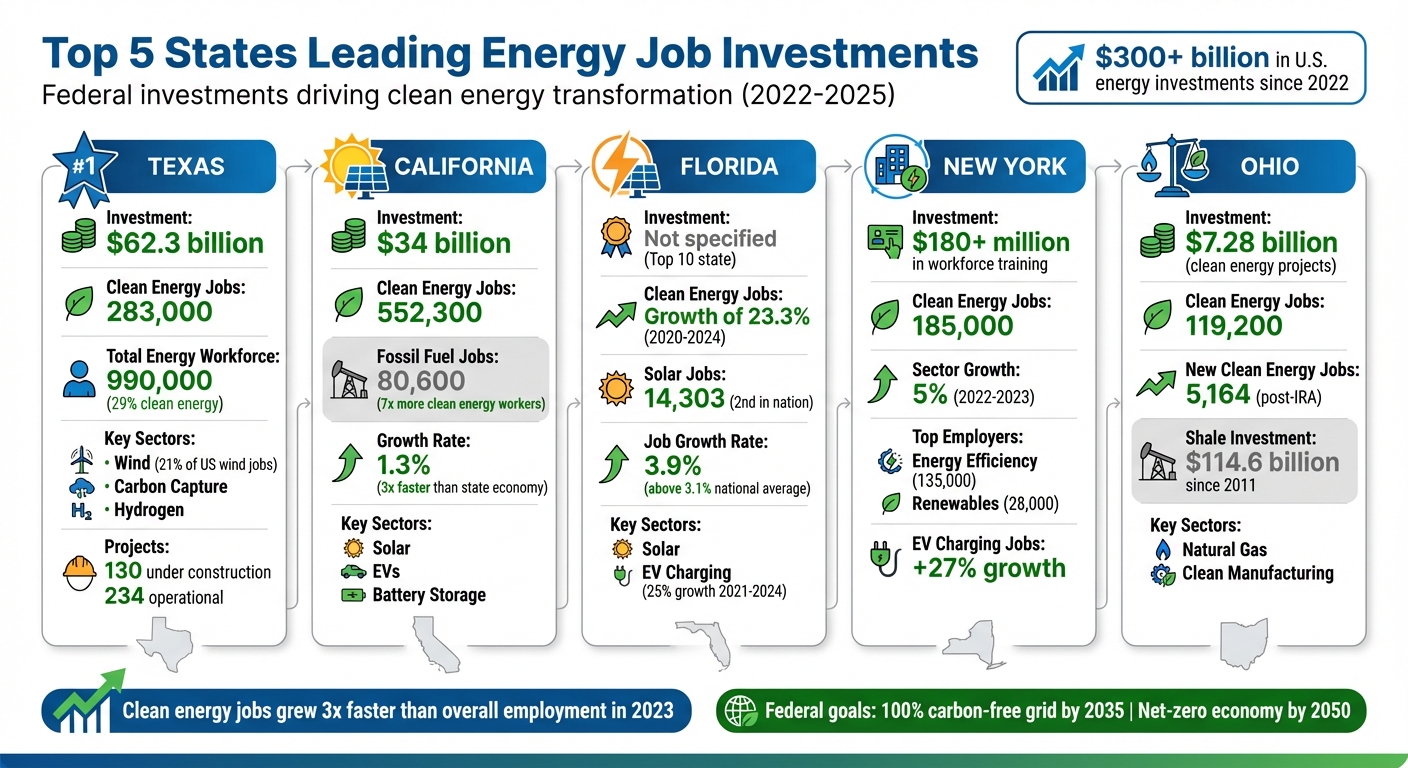
Top 5 US States Leading Energy Job Investments: Investment and Employment Comparison
1. Texas
Clean energy job growth
Texas has firmly established itself as the leader in clean energy investments across the country, pulling in a staggering $62.3 billion between Q2 2022 and Q1 2025. The state’s clean energy sector employs more than 283,000 workers, which makes up 29% of its 990,000-strong energy workforce. On top of that, Texas is home to 21% of all wind energy jobs in the U.S. as of 2024.
Currently, there are 130 clean energy projects under construction in Texas, while 234 projects are already operational. The state has also lined up an estimated $128.5 billion in investments for over 250 additional announced projects. Certain areas are seeing concentrated growth – like the 19th congressional district, which is projected to add over 10,000 jobs thanks to clean energy investments. State-level policies are playing a major role in driving these developments forward.
Policy-driven investments
Federal programs under the "Investing in America" initiative have spurred significant private sector energy investments in Texas. The state has taken advantage of efficient permitting and approval systems to quickly launch projects across a range of technologies. These include not just traditional renewables but also emerging solutions like carbon capture, hydrogen production, and sustainable aviation fuel.
Fossil fuel vs. clean energy balance
Texas continues to hold its title as both the largest energy consumer and the largest net supplier of energy among U.S. states. This position gives it the flexibility to incorporate clean energy technologies into its existing industrial base. While clean energy jobs are growing rapidly, they still represent a smaller portion of the workforce compared to Texas’s dominant fossil fuel industry. For instance, coal mining jobs in the state dropped by 14% from 2021 to 2024, even as the nation saw a slight increase in coal-related employment during the same period.
Regional infrastructure development
Key regions in Texas, such as the Gulf Coast and the "Texas Triangle" (spanning Dallas, Houston, and San Antonio), are receiving targeted investments to upgrade and expand infrastructure. These efforts include boosting battery storage capacity and strengthening transmission networks. Growth in the "clean transmission, distribution, and storage" sector has become a major source of new jobs, creating the physical framework needed to support Texas’s diverse energy mix.
Powering Prosperity: Unleashing Clean Energy Manufacturing and Jobs in America
2. California
California is making waves in the clean energy sector, following closely behind Texas in driving industry advancements.
Clean energy job growth
California holds the second spot nationally for total clean energy investments, pulling in an impressive $34 billion between Q2 2022 and Q1 2025. By early 2026, the state employed 552,300 workers in clean energy – almost twice the size of Texas’ clean energy workforce. In 2024 alone, California added approximately 7,300 new clean energy jobs, growing at a rate of 1.3% compared to the overall economy’s 0.4% growth. That’s over three times faster than the rest of California’s job market. This surge in employment is largely driven by targeted policies aimed at expanding the state’s clean energy footprint.
Policy-driven investments
Federal incentives, such as tax credits and grants under the Inflation Reduction Act, have played a major role in attracting private investments to California’s energy sector. On top of that, state-level policies introduced during the 2025 legislative session have solidified California’s standing as a clean energy leader. The clean energy workforce has proven resilient, with the construction and professional services industries – key employers in this space – leading the way in building infrastructure and deploying advanced technologies.
Fossil fuel vs. clean energy balance
California’s energy landscape has undergone a dramatic shift. The clean energy sector now employs about seven times more workers than the fossil fuel industry – 552,300 compared to 80,600. This stark contrast highlights California’s commitment to technologies like solar, wind, electric vehicles (EVs), and battery storage. While the national fossil fuel sector faced challenges maintaining growth, California’s clean energy industries have consistently outpaced both fossil fuel employment and the broader state economy.
Regional infrastructure development
California’s investments are not just creating jobs – they’re also laying the foundation for future energy advancements. The focus includes areas like advanced renewables, hydrogen production, carbon capture, and geothermal technologies. To support the federal goal of achieving a 100% carbon-free electrical grid by 2035, California is prioritizing infrastructure for transmission, distribution, and storage. Although smaller Western states may see higher per capita benefits, California stands out as a leader in total investment and the concentration of clean energy facilities.
3. Florida
Clean Energy Job Growth
Florida stands out as one of the top 10 states for clean energy job growth. From 2020 to 2024, the state saw an impressive 23.3% increase in clean energy jobs. By 2024, Florida was home to 14,303 solar jobs, ranking second only to California. That year alone, the state added 194 new solar jobs, reflecting a 1.4% growth. Like Texas and California, Florida has effectively tapped into federal investments to drive its clean energy sector forward.
Policy-Driven Investments
Federal programs, such as the Investing in America agenda, have been instrumental in reshaping Florida’s energy landscape. Clean energy jobs in the state grew by 3.9%, outpacing the national growth rate of 3.1%. However, not all news has been positive. Policy changes in early 2025 led to the cancellation of over $22 billion in planned investments, which in turn wiped out approximately 17,000 expected jobs.
Regional Infrastructure Development
Florida’s clean energy job market has also been bolstered by significant infrastructure advancements. The expansion of utility-scale and residential solar markets has played a major role, alongside rapid growth in electric vehicle (EV) charging infrastructure and grid modernization. Between 2021 and 2024, jobs related to EV charging and grid upgrades surged by nearly 25%. Across the broader South region, which includes Florida, clean energy jobs grew by 13% during the same period – marking the fastest growth rate in the country.
The demand for technology, particularly from data centers and AI applications, has further fueled the addition of renewable energy capacity. In 2024, renewable sources like solar and wind accounted for about 90% of all new power capacity added to Florida’s grid. Natural gas, on the other hand, took a back seat due to a lengthy seven-year wait time for new turbine installations.
To meet the growing demand for skilled workers, organizations like ABLEMKR are stepping in to connect talent with these projects. Florida’s ongoing progress mirrors broader national trends in energy job investments, highlighting the state’s pivotal role in the clean energy transition.
sbb-itb-aa28329
4. New York
Clean Energy Job Growth
By late 2024, New York reached an impressive milestone with 185,000 clean energy jobs. Between 2022 and 2023, the clean energy sector grew 5%, surpassing the state’s overall economic growth rate. Among these jobs, building decarbonization and energy efficiency led the way, employing 135,000 workers. Meanwhile, renewable electric power generation contributed an additional 28,000 positions.
Electric vehicle (EV) charging jobs saw a remarkable 27% increase during the same period. Clean and alternative transportation also saw a boost, growing 16% and adding 2,100 jobs in just one year. On top of that, entry-level clean energy roles offer an average pay that’s 12% higher than comparable positions in other industries.
This rapid job expansion has set the stage for major policy investments to sustain and accelerate this growth.
Policy-Driven Investments
To support its clean energy goals, NYSERDA has committed over $180 million to workforce training, including $45 million to expand union-affiliated programs and $94 million for partnerships aimed at training 40,000 New Yorkers. These investments are part of a broader strategy to transform the state’s climate and workforce landscape.
"Through a combination of comprehensive workforce development initiatives and programs that are increasing clean energy deployment and reducing emissions from buildings, transportation, and the electric grid, we are fostering more prosperous communities with access to good-paying jobs statewide." – Governor Kathy Hochul
New York’s climate policies ensure at least 35% of the benefits from clean energy investments reach disadvantaged communities. Currently, 40% of NYSERDA’s training funds are allocated to support low-income individuals, veterans, and formerly incarcerated people. Additionally, the National Electric Vehicle Infrastructure (NEVI) Program has allocated $1.5 million to train workers in the installation and maintenance of EV charging stations.
Regional Infrastructure Development
Jobs related to grid modernization and energy storage grew by 7%. Offshore wind development has emerged as a key focus area, driving career pathway programs and regional energy upgrades. Public sector initiatives are also prioritizing solar installations on county-owned land and electrifying public vehicle fleets.
To support this growth, workforce deployment platforms are using technology to connect skilled workers with these expanding projects. The sector’s appeal is evident – 93% of clean energy workers expect career advancement within the next year, and 65% report being "very satisfied" with their jobs. New York’s clean energy focus is creating long-term, high-quality employment opportunities across the state.
5. Ohio
Fossil Fuel vs. Clean Energy Balance
Ohio’s energy strategy walks a fine line between traditional and modern approaches. As of 2024, the state supported 119,200 clean energy jobs, while its fossil fuel sector remains a powerhouse. Since 2011, Ohio’s shale energy industry has drawn an impressive $114.6 billion in investments. In just the latter half of 2024, the state secured $3.5 billion in new shale investments.
Natural gas plays a pivotal role in Ohio’s economy, powering energy-intensive industries like data centers while also bolstering clean energy manufacturing. Following the Inflation Reduction Act, Ohio landed 19 clean energy projects worth $7.28 billion, creating 5,164 jobs.
"Ohio’s rich shale resources continue to attract billions in investment, reflecting global confidence in our exceptional workforce, infrastructure and business climate."
- J.P. Nauseef, President & CEO, JobsOhio
Regional Infrastructure Development
Ohio is doubling down on infrastructure to sustain its dual energy approach, driving economic and job growth across the state.
Midstream investments in the second half of 2024 totaled $280.1 million, with $124.4 million allocated to gathering lines and $155.7 million to compression facilities. Additionally, construction began in 2025 on over 30 miles of high-pressure pipeline to deliver natural gas to power plants supporting the state’s expanding data center network.
Upstream activities are also booming. The second half of 2024 saw 191 new wells – the highest six-month total since 2017. Over 70% of these wells focused on oil-rich areas in the Utica shale. New policies, such as Ohio HB 15, aim to encourage further development of gas-fired power plants and downstream projects, promising even more jobs and investments.
This infrastructure growth requires a skilled workforce, spanning drilling, pipeline construction, electrical installation, and maintenance. Platforms like ABLEMKR are stepping in to connect pre-qualified workers with these opportunities, ensuring Ohio’s energy ambitions remain on track.
State-by-State Data Comparison
A closer look at the numbers highlights strong growth in the energy sector. Between 2021 and 2022, the national energy workforce expanded by 3.8%, surpassing the overall job growth rate of 3.1%. Similarly, in 2021, energy jobs grew by 4.0%, compared to 2.8% for the broader economy.
Much of this growth is being driven by clean energy. In 2022, clean energy jobs grew by 3.9% nationwide, with every state seeing an increase. Sectors like solar, wind, and electric vehicles are leading the way, contributing to job growth across all five key states.
"Clean energy jobs increased in every state and grew 3.9% nationally." – U.S. Department of Energy
The job landscape varies significantly across Texas, California, Florida, New York, and Ohio, reflecting each state’s energy priorities. Texas leads in both traditional fossil fuels and emerging clean energy manufacturing. California focuses heavily on clean energy, particularly solar and electric vehicles. Florida’s workforce is centered on solar power and energy efficiency. New York emphasizes energy efficiency and upgrades to transmission and distribution infrastructure. Meanwhile, Ohio is shifting toward clean technology manufacturing and motor vehicle components. These differences illustrate how states are finding their own ways to balance traditional energy with investments in clean energy.
This ongoing growth supports ambitious goals, such as achieving a 100% carbon-free grid by 2035 and a net-zero economy by 2050. As states continue to expand their energy infrastructure, the need for skilled workers remains high. ABLEMKR plays a key role by connecting pre-vetted workers to these growing projects, ensuring teams can quickly mobilize across various energy sectors and regions.
Conclusion
Texas, California, Florida, New York, and Ohio are leading the charge in energy job creation, each playing to its strengths. Texas boasts a strong renewable energy capacity, while California leans heavily on its clean energy initiatives. A key driver behind this growth is the federal "Investing in America" agenda, which has attracted billions in private sector commitments, fueling job growth that consistently outpaces the broader U.S. economy.
These federal investments are not just expanding industries – they’re also reinforcing the country’s commitment to a cleaner energy future. Clean energy sectors are reshaping the national workforce, creating jobs at a faster rate than traditional industries. This growth aligns with ambitious federal goals: achieving a 100% carbon-free electrical grid by 2035 and a net-zero economy by 2050. These targets are setting the stage for sustained economic development in energy-rich regions.
For workers, this shift means access to more stable, high-paying jobs with better benefits and career opportunities. Energy sector positions now offer median wages about 20% higher than the national average. Additionally, unionized employers report fewer challenges in hiring skilled labor. Still, the industry faces hurdles – nearly 90% of energy efficiency companies report difficulty finding technically skilled workers. This highlights a pressing need for training and workforce development to keep pace with the rapid growth.
As these states continue building out their energy infrastructure, the demand for skilled labor grows more urgent. That’s where ABLEMKR steps in, connecting pre-vetted workers with critical projects in both traditional and renewable energy sectors. This approach ensures quick crew deployment while providing secure, well-paying jobs for America’s evolving energy workforce.
FAQs
How do federal programs drive energy job growth in certain states?
Federal programs play a crucial role in driving energy job growth by offering incentives such as tax credits, grants, and funding. These incentives encourage private investments in renewable energy and infrastructure projects, creating a ripple effect in job creation. For example, the Inflation Reduction Act of 2022 has led to significant investments in solar power, wind energy, and grid modernization, resulting in thousands of new jobs across the United States.
Many of these programs focus on states that are actively pursuing clean energy efforts, which boosts employment in industries where demand is growing rapidly. Beyond funding, federal initiatives also support workforce development through training programs and apprenticeships. This ensures a pipeline of skilled workers ready to take on energy sector projects. Together, these efforts not only stimulate economic growth but also open up more job opportunities nationwide.
What are the challenges for states balancing clean energy growth with traditional energy industries?
States experiencing growth in energy jobs face a tricky balancing act: expanding clean energy while addressing the needs of traditional energy industries. One of the biggest challenges is managing the economic shift from fossil fuels to renewables. This can be particularly tough for regions that rely heavily on coal, oil, or natural gas. These states must figure out how to support communities dependent on traditional energy while also creating opportunities in the renewable sector.
Another pressing issue is ensuring workers aren’t left behind during this transition. Retraining programs and investments in renewable energy infrastructure are key to opening up new job opportunities for those in traditional energy roles. On top of that, integrating renewable energy into existing power grids brings its own set of challenges. Upgrading infrastructure and ensuring grid reliability require thoughtful planning and strong policy backing.
Finding the right balance between energy growth and economic stability is no small task, but it’s a necessary step for states looking to embrace a cleaner energy future.
How does the growth of clean energy jobs boost state economies?
The growth of clean energy jobs is delivering major economic advantages across the U.S. In 2024, the energy sector employed 8.5 million workers, making up 5.4% of all jobs nationwide. States like Texas, California, and Michigan are at the forefront, offering high-paying positions in manufacturing, construction, and operations. These jobs are boosting local economies by driving consumer spending and generating tax revenue.
At the same time, investments in renewable energy and modernizing the power grid are opening doors in areas like engineering, skilled trades, and data analysis. This shift is doing more than just creating jobs – it’s helping to diversify state economies while drawing in innovation and private capital. By blending environmental progress with economic growth, this transition is setting the stage for stronger, more resilient economies in the years ahead.


