
In industries like construction and energy, collaborative robots (cobots) are transforming high-risk tasks such as welding, chemical cleanup, and heavy lifting. However, operating these machines safely requires specialized certifications. These programs ensure compliance with safety standards, help prevent accidents, and improve operational efficiency. Key certifications include:
- ANSI/RIA R15.06 Compliance: U.S. safety standard emphasizing risk assessment, stopping distances, and cybersecurity for cobot operations.
- ISO 10218/ISO-TS 15066: International standards focusing on human-robot collaboration, force limits, and safety protocols.
- CSA Z434: Canadian standard prioritizing training in cobot setup, programming, and maintenance.
- Manufacturer-Specific Programs: FANUC, ABB, and others offer brand-focused training for advanced skills like programming, vision systems, and software-based safety.
Certifications not only ensure compliance with OSHA and other safety regulations but also make operators more employable in a competitive job market. Employers benefit from hiring certified workers to reduce risks, avoid delays, and meet legal requirements. Compliance tracking tools like ABLEMKR streamline verification, ensuring operators are job-ready and certified.
For operators and employers alike, these certifications bridge the gap between cobot design and safe, effective use in demanding environments.
Robot Safety Essentials: Navigating Standards and Practical Solutions
Industry Standards for Collaborative Robot Operations
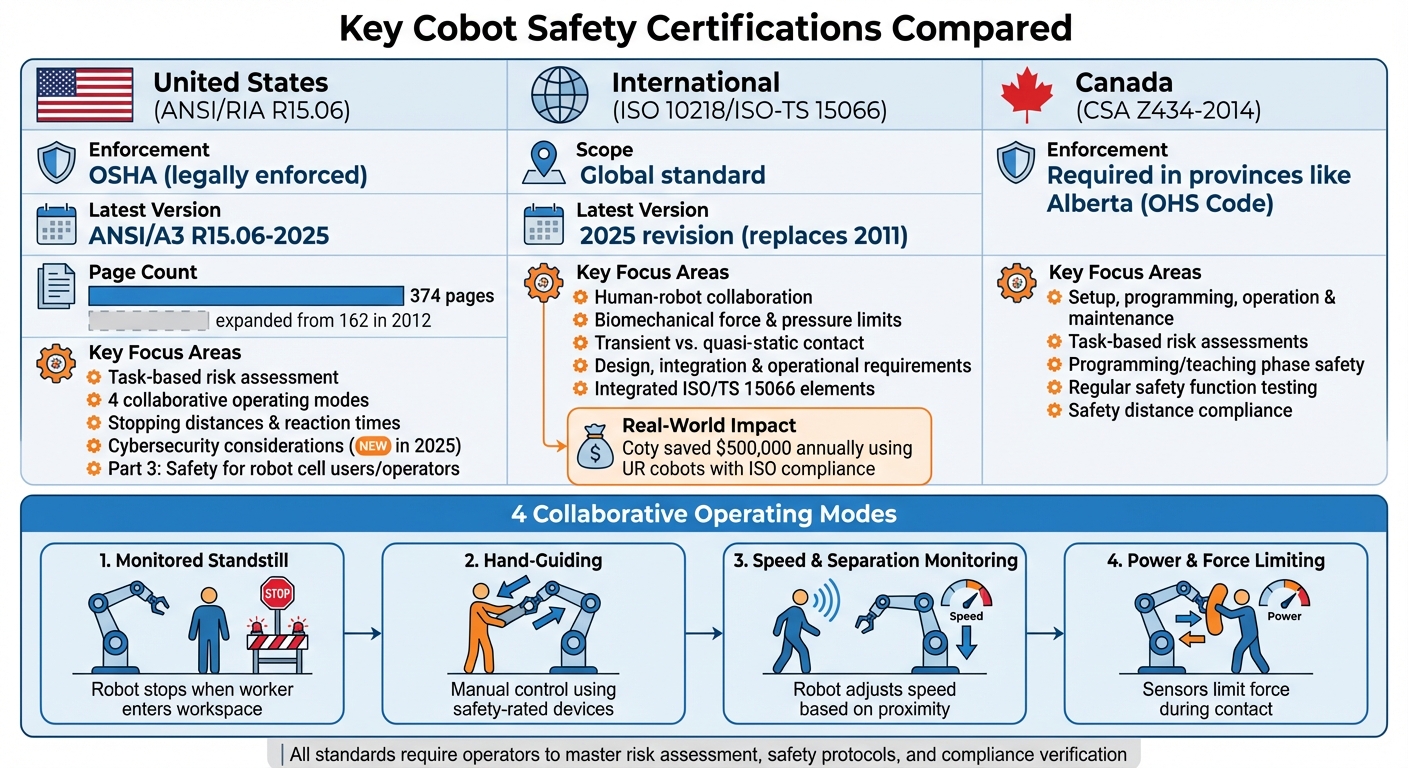
Comparison of Key Cobot Safety Certifications: ANSI, ISO, and CSA Standards
In North America, cobot safety is guided by three key standards: ANSI/RIA R15.06 in the U.S., ISO 10218/ISO-TS 15066 internationally, and CSA Z434 in Canada. These certifications ensure operators know not only how to operate cobots but also how to configure them safely for high-risk environments like construction sites and energy facilities. Below, we’ll break down the specifics of each standard and their latest updates.
ANSI/RIA R15.06 Compliance Certification
This U.S. standard is the cornerstone of collaborative robot safety and is legally enforced through OSHA. The most recent version, ANSI/A3 R15.06-2025, has grown significantly – expanding from 162 pages in 2012 to 374 pages – to reflect advancements in technology and safety protocols. A major addition in this update is Part 3, which focuses on safety requirements for robot cell users and operators.
Operators must be proficient in task-based risk assessment, which evaluates injury severity, exposure frequency, and hazard avoidance during all phases of operation, including maintenance and tool changes. The standard mandates the use of at least one of four collaborative operating modes:
- Monitored standstill: The cobot halts when a worker enters the workspace.
- Hand-guiding: Manual control using safety-rated devices.
- Speed and separation monitoring: The cobot adjusts its speed based on the worker’s proximity.
- Power and force limiting: Sensors detect contact, limiting force to prevent injury.
The 2025 revision introduces cybersecurity considerations, requiring operators to evaluate external threats that could compromise physical safety – especially relevant when cobots are connected to site networks in sectors like construction and energy. Operators are also trained to calculate stopping distances and reaction times to ensure the cobot halts before making contact with humans.
"Functional safety requirements are now made explicit instead of implied. This helps manufacturers and integrators better understand what compliance demands." – Association for Advancing Automation (A3)
ISO 10218 and ISO/TS 15066 Certifications
Globally, ISO 10218 (Parts 1 and 2) lays the groundwork for industrial robot safety, outlining design, integration, and operational requirements. ISO/TS 15066 builds on this by focusing on human-robot collaboration, setting biomechanical limits for force and pressure to minimize injury during contact. Together, these standards ensure a consistent approach across international borders.
The 2025 revision of ISO 10218 replaces the older 2011 versions, integrating elements from ISO/TS 15066. This reflects a shift toward treating collaborative applications as standard practice rather than a niche area. Operators are trained to distinguish between transient contact (temporary, unrestricted contact) and quasi-static contact (where a worker could become trapped), ensuring force limits are calculated accurately for each scenario.
One real-world example of these standards in action is Coty, a global cosmetics manufacturer. In 2025, the company deployed Universal Robots‘ UR3e and UR5e cobots on mobile carts for packaging tasks. By adhering to ISO 10218, Coty saved $500,000 annually and reassigned 13 workers to higher-value roles. This demonstrates how proper certification can enhance both safety and operational efficiency.
"ISO/TS 15066 transforms a robot from ‘collaborative in name’ to collaborative in compliance." – Airline Hydraulics
CSA Standard Z434-2014 Training
In Canada, CSA Z434 builds on U.S. and international frameworks, refining safety measures further. Certain provinces, like Alberta, explicitly require compliance with this standard through their Occupational Health and Safety Code. CSA Z434 emphasizes thorough training in setup, programming, operation, and maintenance of robotic systems. Like ISO standards, it prioritizes task-based risk assessments during both normal operations and programming phases.
A critical focus is the programming or "teaching" phase, where traditional safety measures might be bypassed. This phase carries heightened risks, requiring operators to master specific skills and employers to enforce strict safety protocols. Operators are trained to regularly test safety functions, such as monitored stops, to ensure compliance with required safety distances.
| Collaborative Mode | Description | Application |
|---|---|---|
| Speed & Separation Monitoring | Uses sensors to slow or stop based on worker proximity | High-speed operation when workers are absent |
| Hand-Guided Controls | Robot moves only under direct operator control | Manual part placement or "teaching" motions |
| Power & Force Limiting | Limits pressure and force during contact | Cobots with rounded edges designed for physical contact |
| Monitored Standstill | Robot stops completely when worker enters workspace | Similar to traditional safeguarding but integrated into the controller |
Manufacturer-Specific Certification Programs
Manufacturer-specific certifications take standardized safety protocols and tailor them to the unique features and interfaces of specific brands. This approach ensures operators are equipped with the precise skills needed for high-risk environments like construction and energy sites, where efficiency and safety are non-negotiable.
FANUC Certified Robot Operator Credentials
FANUC’s Certified Robot Operator (Level 1) program focuses on foundational skills such as robot safety, teach pendant operation, basic programming, and material handling. These credentials align with national assessments through NOCTI (FCR-O1 and FCR-O2), making them portable across employers. The training highlights the FANUC CRX series, known for its user-friendly programming and 8 years of maintenance-free operation – a major benefit for remote energy sites where technician access is limited.
A key feature of the program is the use of ROBOGUIDE software, which allows operators to simulate robotic workcells in 3D without the need for physical prototypes. This virtual setup minimizes costs and safety risks, especially valuable in unpredictable field conditions. The curriculum also emphasizes internal and external safety devices, teaching operators how to safely configure cobots for high-risk tasks. With over 600,000 unfilled manufacturing jobs in the U.S. – a figure projected to hit 2 million – FANUC certification offers a competitive edge in the labor market.
FANUC Certified Robot Technician Credentials
For those looking to advance their skills, FANUC’s Certified Robot Technician (Level 2) program delves into intermediate techniques like 2D iRVision integration, conveyor system management, advanced troubleshooting, and digital/Ethernet I/O. This certification (NOCTI FCR-T1 and FCR-T2) is particularly beneficial for energy applications, where variable part placement is common. With iRVision, robots can "see" and adapt to their environment, eliminating the need for costly positioning fixtures.
Participants also gain expertise in "fenceless" collaborative robots, such as the CR-7iA, which use high-sensitivity sensors to operate safely alongside humans without physical barriers.
| Feature | Certified Robot Operator (Level 1) | Certified Robot Technician (Level 2) |
|---|---|---|
| Primary Focus | Basic operations, safety, and setup | Advanced programming and systems integration |
| Key Technologies | Teach pendants, basic HandlingTool | 2D iRVision, Ethernet I/O, Conveyors |
| Assessment | NOCTI FCR-O1 & FCR-O2 | NOCTI FCR-T1 & FCR-T2 |
| Skill Outcome | Entry-level workforce readiness | Intermediate technical problem-solving |
ABB Robotics Training Programs
ABB trains over 20,000 students annually across 40 global locations, offering hands-on, virtual, and on-site training tailored for high-risk environments. Their SafeMove Certification focuses on software-based safety monitoring, replacing traditional hardware safety equipment with restricted zones managed by software – perfect for collaborative spaces where humans and robots work side by side. Operators also train on RobotStudio®, a leading offline programming tool that allows users to design, test, and refine setups virtually before implementation.
ABB’s Cobot Expert Program certifies operators and partners through an online test, verifying proficiency with collaborative robots like GoFa™, SWIFTI™, and YuMi®. The program incorporates Wizard Easy Programming, a block-based, graphical interface that enables workers without coding experience to program cobots step by step. Free online tutorials further support training in setup, programming, operation, and troubleshooting, making these resources accessible to workers at any skill level. For facilities upgrading equipment, ABB provides guidance on transitioning from older IRC5 systems to the latest OmniCore™ controllers, ensuring operators stay up to date.
"To ensure that robot equipment is used in a safe way and to their full potential, it is important to keep your personnel up to date on the latest technical developments." – ABB
These manufacturer-specific programs add depth to the certification options available for cobot operators, equipping them with brand-specific expertise to meet the demands of modern industries.
sbb-itb-aa28329
Workforce Deployment and Integration
Certifications hold the most value when they lead directly to job opportunities. In industries like construction and energy, delays between training completion and job placement can be costly. 28.8% of manufacturers have reported losing projects due to a lack of skilled workers. This highlights the pressing need to connect certified professionals to job sites without delay.
Faster Hiring and Onboarding
Workforce deployment platforms are changing the game by quickly linking certified cobot operators with critical projects. These platforms maintain databases of pre-vetted workers, matching them to job sites based on factors like certifications, safety training, availability, and location. Whether it’s an emergency shutdown, a remote pipeline repair, or a planned mine development, this system eliminates the time-consuming process of manually verifying credentials.
Online credential services make instant certification verification possible, which is crucial for projects requiring immediate staffing. Take NCCER, for example – it offers an online service that lets employers in construction and industrial sectors instantly verify certifications for crane operators and riggers. This ensures workers meet OSHA and ASME standards before stepping onto the job site. Industry-recognized certifications not only provide workers with "instant employability" but also give manufacturers access to a skilled workforce, speeding up the hiring process for everyone involved.
"The perfect target application for automation is a repetitive task that is a mix of dull, dirty, and dangerous… if you pair a mid-level factory job that requires some higher level education and certification, with a cobot that can operate in conjunction with the human operator, then you can fill those factory labor jobs." – Joe Campbell, Senior Manager of Strategic Marketing and Applications Development, Universal Robots
This streamlined approach doesn’t just simplify hiring – it also lays the foundation for ongoing compliance monitoring on-site.
Real-Time Compliance Tracking
Once hiring is handled efficiently, keeping certifications up to date becomes critical. In the U.S., employers are required to meet OSHA standards to prevent workplace injuries. Real-time compliance tracking ensures that every operator on-site has valid and current certifications, a necessity in environments where collaborative robots (cobots) work alongside human operators.
ABLEMKR’s platform offers real-time visibility into worker certifications, enabling project managers to confirm compliance before workers arrive on-site. This minimizes risks, reduces non-compliance penalties, and helps avoid project delays. Since certifications often have expiration dates, the platform actively tracks them, ensuring records remain current. This allows employers to confidently staff projects while adhering to regulatory standards, including ANSI/RIA R15.06, ISO 10218, and ISO/TS 15066 compliance requirements.
Conclusion
Certifications play a critical role in ensuring safety, compliance, and career advancement in the construction and energy industries. The misconception that a cobot is "safe by design" without proper compliance measures can lead to accidents, production delays, and wasted investments. Every cobot installation requires a customized risk assessment to bridge this gap.
For operators, certifications like ANSI/RIA R15.06, ISO 10218, and manufacturer-specific credentials can significantly boost job opportunities and earning potential. These qualifications make workers more employable and open pathways to high-paying technical roles. The growing demand for certified professionals highlights the industry’s need for skilled and compliant operators.
Employers also benefit from hiring certified workers. Verified credentials help minimize liability, ensure OSHA compliance, and reduce the risk of costly project delays. Proper training should address key areas like risk assessment, safety function validation, and managing power/force limitations.
In these fast-paced sectors, having a workforce that is both safe and readily deployable is essential. Tools like ABLEMKR simplify certification verification and compliance tracking, enabling employers to quickly mobilize skilled workers without interruptions. By prioritizing certifications, companies not only protect their teams but also enhance efficiency and maintain smooth operations in these demanding industries.
FAQs
What are the benefits of getting certified as a cobot operator?
Earning a certification as a cobot operator can be a game-changer for your career and workplace efficiency. It signals that you have the skills to program and safely operate collaborative robots, making you a standout candidate in fields like construction, energy, manufacturing, and logistics. This kind of credential can lead to better job prospects and career advancement.
Beyond career benefits, certified operators play a critical role in creating safer work environments. With specialized training, they ensure smooth collaboration between humans and robots, minimizing risks and enhancing safety standards. Certification programs often teach advanced skills, such as programming, safety protocols, and techniques tailored to specific industries. These abilities not only help operators tackle complex tasks but also contribute to more efficient and productive operations. In industries where safety and precision are essential, certified professionals are increasingly in demand.
What are the differences between ANSI, ISO, and CSA standards for cobot safety?
When it comes to industrial robots and collaborative robots (cobots), safety is a top priority. That’s where standards like ANSI, ISO, and CSA come into play, each offering a framework to ensure safe and efficient operations.
- ANSI Standards: For industrial robots, ANSI/RIA R15.06-2012 lays out safety requirements, focusing on risk assessments and protective measures. These guidelines are designed to minimize hazards and maintain safe operations in industrial settings.
- ISO Standards: Collaborative robots, or cobots, are covered under ISO/TS 15066:2016. This standard dives into the specifics of human-robot interaction, outlining safety limits on force, speed, and design features to make collaboration between humans and robots as safe as possible.
- CSA Standards: Commonly used in Canada, CSA standards align with global safety principles but may incorporate adjustments to meet local compliance needs. These standards ensure that safety measures are tailored to regional requirements while adhering to international best practices.
Together, these standards create a robust safety framework, helping operators work confidently with robots and cobots while maintaining a secure environment.
Why is it important for cobot operators to receive training from the manufacturer?
Manufacturer-specific training plays a crucial role for cobot operators, as it delivers the precise knowledge required to safely and effectively operate, program, and troubleshoot specific robot models. This focused approach prepares workers to handle the unique features and capabilities of each cobot, minimizing the risk of mistakes and promoting a safer work environment.
Beyond safety, this training empowers operators to get the most out of their cobots, boosting productivity and ensuring smoother workflows. With a solid understanding of the manufacturer’s tools and systems, operators can tackle challenges with confidence and maintain peak efficiency in their tasks.


