
New York’s construction industry is struggling with a labor shortage that’s delaying projects and increasing costs. Despite raising wages by 12.4%, 92% of firms still can’t find enough skilled workers. Turnover rates have hit 56%, and outdated hiring methods only make things worse. Technology is stepping in to address these challenges by:
- Faster hiring: Digital platforms match workers to jobs within hours using certifications, location, and availability.
- Streamlined compliance: Automated systems handle safety certifications and payroll, reducing errors and delays.
- Real-time adjustments: Tools provide instant workforce updates, helping employers quickly respond to staffing needs.
Platforms like ABLEMKR are leading this shift, connecting pre-vetted workers to job sites and simplifying workforce management. This approach is helping firms meet growing demands while offering workers flexible, well-paying opportunities.
Construction Tech Worker Shortage – How to Fill the Gap
Why Traditional Solutions Haven’t Worked
Companies in New York have tried raising wages and improving benefits to address the construction labor shortage, but these efforts haven’t solved the problem. Higher pay and better perks haven’t stopped workers from leaving the industry. Meanwhile, outdated apprenticeship programs fail to fill the gap left by retiring workers, who take decades of expertise with them when they leave. As Debbie Trecek from Buildertrend points out:
Employees want to be managed better.
The situation is worsened by the fact that many business owners are too overwhelmed with day-to-day operations to focus on long-term workforce strategies. This lack of planning leaves critical areas, like employee development, neglected. According to CMiC:
Labor scarcity has emerged as the primary constraint limiting growth in the commercial construction sector.
On top of these internal challenges, external pressures like regulatory requirements add another layer of complexity.
Obstacles Preventing Progress
External factors only make the situation tougher. Regulations such as Local Law 196 require detailed tracking of safety training, something paper-based systems simply can’t handle efficiently. In addition, New York’s diverse workforce faces language barriers during onboarding, which can lead to safety risks and delays when training materials aren’t accessible.
Adding to the challenge, younger workers expect modern, tech-driven processes. However, outdated tools like manual scheduling, phone calls, and spreadsheets are still widely used, creating a disconnect. For a generation accustomed to seamless digital communication, this lack of modernization makes construction less appealing. These inefficiencies highlight the pressing need for technology-driven solutions to improve workforce management and attract new talent.
How Technology Addresses Workforce Management
With the challenges outlined earlier, technology has stepped in as a game-changer for workforce management in New York’s construction industry. Modern platforms are replacing outdated systems, making it easier to connect skilled workers with job opportunities in just hours. Considering that 92% of construction firms report difficulties filling positions and 88% have openings for craft workers, these digital tools offer a practical way to tackle issues that traditional methods have struggled to resolve. This shift enables faster job matching, smoother hiring processes, and immediate scheduling adjustments.
Matching Workers to Jobs Faster
Digital platforms leverage tools like certifications, safety training records, geo-location, and availability to quickly match workers to job sites. Unlike traditional hiring methods, which can take days or even weeks to verify credentials and coordinate schedules, automated systems can identify qualified workers within hours. For New York firms juggling multiple sites, location-based matching ensures crews are assigned efficiently. These quick matches go hand-in-hand with simplified hiring and compliance processes, saving time and effort.
Automating Hiring and Compliance
Automation simplifies hiring by verifying safety certifications, keeping digital records of worker credentials, and ensuring compliance with safety and regulatory standards. Integrated payroll systems eliminate manual data entry and prevent payment delays. With 57.6% of construction workers now earning over $100,000 annually, timely payments are crucial for maintaining workforce satisfaction. By automating these tasks, management can shift their focus to project execution instead of administrative burdens.
Real-Time Data and Flexible Scheduling
Real-time data tools take automation a step further, offering employers the ability to make quick staffing adjustments. Digital dashboards display worker availability, location, and certification status, allowing for rapid crew mobilization in response to last-minute changes or unexpected absences. Workers also benefit from mobile platforms that provide instant access to job details and schedules. This flexibility is especially important for New York’s diverse workforce, including the 20% who are self-employed, making construction careers more accessible and appealing to a broader range of professionals.
sbb-itb-aa28329
ABLEMKR: Solutions for New York Construction
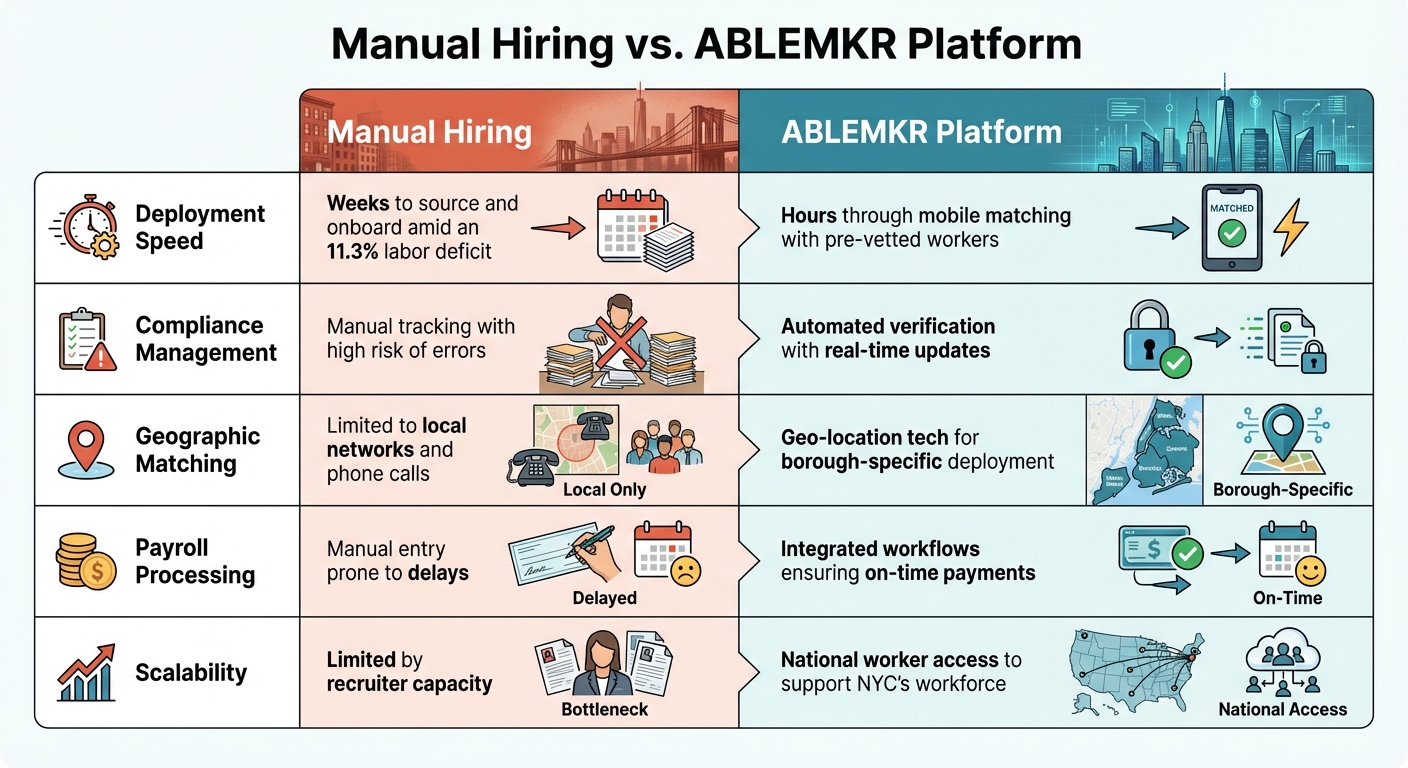
Manual Hiring vs ABLEMKR Platform Comparison for NYC Construction
The construction industry in New York has long grappled with labor shortages and outdated hiring practices. ABLEMKR steps in to tackle these challenges head-on by connecting pre-vetted workers to job sites across the city’s five boroughs. As of 2024, the sector faces a significant shortfall, with employment sitting 11.3% (18,200 jobs) below 2019 levels. While the city accounts for 143,100 construction jobs – 36.7% of the statewide total – only 19% of the jobs lost during the pandemic have been regained. ABLEMKR’s tailored approach leverages technology to address these pressing issues.
Mobile Platform for Quick Worker Deployment
ABLEMKR uses a mobile-first platform to match workers with job sites based on certifications, safety training, availability, and location. This streamlined system ensures rapid deployment, reducing delays that can cost construction firms both time and money. For instance, whether a heavy infrastructure project needs certified workers for an urgent repair or a residential remodeling job requires immediate staffing, ABLEMKR can deploy qualified personnel within hours instead of weeks. This capability is especially critical in a market like Manhattan, where the industry has lost 18,100 jobs (a 4.6% decline) over the past year.
Features for Employers and Workers
The platform offers robust tools for both employers and workers:
- For Employers: Real-time visibility of workers, integrated payroll systems, and automated compliance tracking simplify managing New York’s complex construction workforce. These features address verification challenges in a sector where the average salary reached $95,800 in 2024.
- For Workers: Flexible, well-paying opportunities with guaranteed on-time payments eliminate traditional hiring headaches. This model resonates with a diverse workforce, including the addition of 29,000 Hispanic workers since 2020. Gary LaBarbera, President of the Building and Construction Trades Council of Greater New York, highlights that this growth offers "robust wages that secure middle-class careers".
Manual Hiring vs. ABLEMKR
| Aspect | Manual Hiring | ABLEMKR Platform |
|---|---|---|
| Deployment Speed | Weeks to source and onboard amid an 11.3% labor deficit | Hours through mobile matching with pre-vetted workers |
| Compliance Management | Manual tracking with a high risk of errors | Automated verification with real-time updates |
| Geographic Matching | Limited to local networks and phone calls | Geo-location tech for borough-specific deployment |
| Payroll Processing | Manual entry prone to delays | Integrated workflows ensuring on-time payments |
| Scalability | Limited by recruiter capacity | National worker access to support NYC’s workforce |
Conclusion: Technology’s Role in New York Construction
Main Points
Digital platforms are stepping up to address New York’s construction labor shortages. Across the country, many firms face long delays due to a lack of skilled workers. ABLEMKR’s platform offers a fast, efficient solution by connecting pre-vetted workers with job sites in just hours. It also simplifies hiring by automating compliance and payroll processes.
This shift benefits both employers and workers. Construction firms gain real-time insights into their workforce and can deploy certified personnel across all five boroughs without being limited to local networks. Workers, on the other hand, enjoy access to flexible, well-paying roles with guaranteed timely payments – an important factor in an industry with a 56% turnover rate. Experts agree that delays are often tied to a shortage of qualified workers, and technology platforms are helping bridge this gap by expanding the talent pool far beyond traditional hiring methods.
These immediate solutions lay the groundwork for tackling the industry’s broader challenges.
Future Growth Potential
New York’s growing infrastructure needs demand workforce solutions that can scale over time. With an aging workforce and limited interest from younger generations, the labor gap is expected to widen unless technology steps in. ABLEMKR’s mobile-first approach helps firms adapt to these demographic and project-based shifts. By providing access to a national pool of workers, New York firms can quickly assemble teams for tasks ranging from major infrastructure repairs to energy transition projects.
The platform’s reach into energy and extractive sectors is also crucial for New York’s utility upgrades and energy transition efforts. As Boyd Worsham, President and CEO of NCCER, puts it:
By expanding access to industry training and career and technical education, we can prepare people for meaningful careers, strengthen contractors’ ability to deliver projects and build the communities we all depend on.
FAQs
How is technology helping New York’s construction industry hire faster?
Technology is transforming the way New York’s construction industry approaches hiring. Gone are the days of drawn-out, manual processes. Now, platforms like ABLEMKR are stepping in to connect contractors with pre-vetted workers in just minutes. Compare that to traditional hiring methods, which often take more than a month, and the difference is striking.
These platforms simplify the process by centralizing critical information like worker certifications, availability, and locations – all accessible through a mobile-friendly interface. Contractors can quickly find the right people for the job, while real-time notifications keep workers informed about new opportunities. This not only speeds up response times but also helps reduce no-shows. The result? Companies can assemble and deploy qualified crews within hours, ensuring projects stay on schedule and delays are kept to a minimum.
How can automating compliance and payroll benefit construction companies?
Automating compliance and payroll takes tasks that are often time-consuming and prone to mistakes and turns them into smooth, accurate processes that can make a big difference for construction companies. For instance, payroll errors can drop by as much as 40%, helping companies steer clear of fines, disputes, and the hassle of manual fixes. Staying compliant with the latest labor laws and certification requirements also becomes much easier, reducing the risk of costly penalties.
Beyond accuracy, automation saves a ton of time – cutting payroll processing hours by up to 50%. This gives managers more room to focus on essential responsibilities like project planning and keeping costs in check. Plus, having real-time insights into labor costs allows companies to stick to their budgets and make quick adjustments when needed. On the workers’ side, getting paid accurately and on time builds trust and can improve employee retention – a key factor in dealing with the ongoing labor shortages.
Solutions like ABLEMKR bring all these features together in a mobile-first, cloud-based platform. From automated compliance checks and payroll processing to real-time reporting, it simplifies operations while ensuring crews are mobilized efficiently and safely. At the same time, it reduces administrative burdens and shields companies from compliance risks.
How does ABLEMKR help New York construction companies manage a diverse workforce?
ABLEMKR is transforming how New York’s construction industry manages its workforce with a mobile-first, data-driven platform. It connects skilled laborers to the right projects by maintaining verified worker profiles. These profiles include details like certifications, safety training, language skills, and work history. Using real-time analytics, the platform matches workers to job sites based on factors like availability, location, and project requirements. This not only cuts down on inefficiencies like overtime and idle time but also boosts productivity and ensures compliance with safety standards.
For workers, ABLEMKR provides instant access to job opportunities. They can update their availability, upload necessary documents, and accept shifts – all from their smartphones. On the employer side, the platform offers a centralized dashboard that gives real-time insights into on-site workers, their qualifications, and any compliance issues. This helps construction firms stay aligned with New York’s stringent labor and safety regulations. By simplifying processes like hiring, payroll, and compliance management, ABLEMKR helps construction companies quickly assemble diverse crews, stick to project timelines, and attract top talent in a highly competitive market.


