
The construction industry faces high risks, from workplace injuries to compliance issues and project delays. Traditional methods like manual inspections and paper checklists often fall short in addressing these challenges. Here’s how technology is stepping in to make a difference:
- Real-time monitoring: IoT devices, sensors, and wearables help identify hazards early, reducing accidents and disruptions.
- Automated compliance: Digital tools streamline insurance tracking, safety audits, and credential verification, cutting errors and improving accountability.
- Data-driven prevention: Centralized platforms consolidate project data, enabling teams to predict and address risks before they escalate.
- Operational efficiency: Automated time tracking and workforce deployment tools save time, reduce payroll errors, and keep projects on schedule.
Platforms like ABLEMKR exemplify how construction companies use technology to improve safety, compliance, and efficiency. By adopting these tools, firms not only meet regulatory requirements but also protect workers and reduce financial risks.
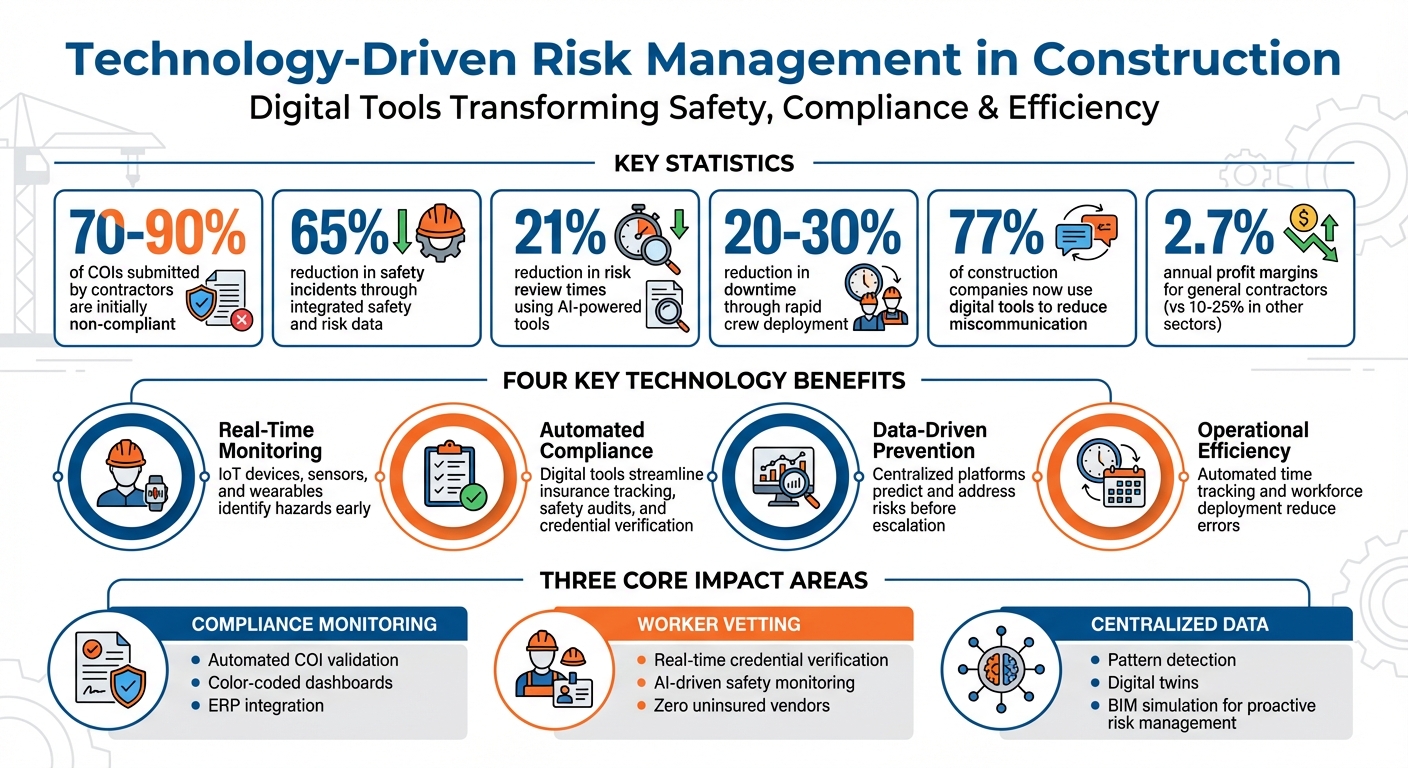
How Technology Reduces Construction Risk: Key Statistics and Benefits
Risk Innovation Expert: Managing your Risk Portfolio, The Role of Technology in Construction & Th…
Where Technology Improves Construction Risk Management
Construction companies are discovering that digital tools are game-changers in three key areas: ensuring workers comply with regulations, verifying that on-site personnel have the proper qualifications, and using data to identify risks before they escalate into major issues. This shift highlights the growing role of technology in minimizing risks across the industry.
Real-Time Compliance Monitoring and Reporting
Tracking compliance manually is a risky endeavor. Studies show that 70% to 90% of Certificates of Insurance (COIs) submitted by contractors are initially non-compliant. This creates significant liability for general contractors, who could face financial repercussions if accidents occur.
Digital solutions now automate the process of collecting and validating COIs, immediately flagging missing endorsements or expired policies. Color-coded dashboards provide clear, real-time insights into subcontractor compliance. When connected to ERP systems like Procore or CMiC, these tools can automatically request insurance documents as soon as a new vendor is onboarded.
Mobile apps have also revolutionized how safety audits are conducted. Instead of relying on paper forms, field teams can now use apps for pre-task planning and hazard reporting, with all data syncing instantly to office dashboards. This integration of safety and risk data has reduced safety incidents by up to 65%. Additionally, AI-powered tools can analyze complex contract details to pinpoint potential risks, cutting risk review times by over 21%.
"Document Crunch was a software that helped not only efficiently review but effectively catch everything we are looking for to allocate risk appropriately and now it’s a tool not only for the risk team and lawyers, but also for our project teams".
- Jeffrey Brannen, SVP Legal at Balfour Beatty
Beyond compliance tracking, ensuring workers have the right qualifications adds another layer of security to job sites.
Worker Vetting and Safety Credential Verification
Allowing unqualified workers to perform high-risk tasks can lead to serious liabilities. Digital platforms now verify insurance coverage, confirming details like "Additional Insured" status, "Waivers of Subrogation", and exclusions that might void policies. Automated systems also track expiration dates and send alerts for renewals, ensuring credentials stay up to date.
But these platforms do more than just manage paperwork. AI-driven tools and wearable technology, like smart helmets and vests, monitor workers in real time to check for proper PPE use, signs of fatigue, or unauthorized access to restricted areas. Centralized prequalification systems allow firms to assess vendor safety records and financial stability during onboarding. One company even reported achieving "zero uninsured vendors" on their sites after implementing automated COI tracking.
Centralized Data for Risk Prevention
Consolidating data from various sources onto a single platform reveals patterns that spreadsheets simply can’t. When worker deployment details, project updates, and compliance metrics are all in one place, companies can shift from reactive problem-solving to proactive risk management. Technologies like sensors and digital twins replicate site conditions in real time, tracking worker movements and environmental factors to identify hazards before accidents occur.
Project teams can also use Building Information Modeling (BIM) to simulate safety risks – such as crane movements or worker positioning – before construction even begins.
"The platform is easy to use and significantly aids in making data-driven decisions during preconstruction".
- Hans Seggelke, Estimator at Balfour Beatty
Instead of waiting for OSHA violations or insurance claims to highlight issues, firms can now use their data to detect warning signs early and take immediate action. This proactive approach, powered by technology, is transforming how risks are managed in the construction industry.
How Digital Platforms Reduce Financial and Operational Risks
Digital tools have become a game-changer for construction companies, especially when it comes to reducing errors and delays. In an industry where general contractors operate on razor-thin margins – just 2.7% annually compared to the 10% to 25% seen in other sectors – even small efficiencies can make a noticeable difference. Let’s dive into how automation improves time tracking, payroll accuracy, and workforce deployment.
Automated Time Tracking and Payroll Accuracy
Relying on manual timekeeping often leads to payroll disputes and errors. Digital solutions, like mobile apps, allow workers to clock in and out with ease, syncing their hours directly to payroll systems. This eliminates the need for paper timesheets and manual data entry, streamlining the entire process. Workers gain clarity on their earnings, reducing misunderstandings, while employers can avoid disputes over hours or pay rates.
For managers, integrated payroll systems simplify the review and approval process, cutting down on administrative tasks. Accurate and timely payments not only improve employee satisfaction but also help retain skilled workers, reducing turnover and recruitment costs. In short, automation reduces errors, saves time, and lowers financial risks tied to payroll management.
Cost Savings Through Faster Workforce Deployment
Labor shortages and mismatched skills can quickly derail a project, leading to costly delays. Digital platforms address this by swiftly matching pre-vetted crews to projects based on their certifications, location, and availability. This rapid deployment minimizes downtime and helps keep projects on schedule and within budget.
Additionally, tools like estimating software and project management platforms refine labor cost predictions by leveraging historical data and real-time insights. These tools also provide clarity on resource management and flag scheduling conflicts early in the preconstruction phase. By reducing delays and improving cost forecasting, digital platforms help construction companies stay on track and manage financial risks more effectively.
sbb-itb-aa28329
ABLEMKR: Technology-Driven Risk Management in Action
As the construction industry increasingly adopts technology, ABLEMKR stands out as a prime example of how digital tools can streamline risk management. This platform tackles critical challenges like credential verification, quick crew mobilization, and compliance tracking using a mobile-first design that prioritizes efficiency and precision.
Connecting Qualified Workers to High-Risk Projects
ABLEMKR uses data like certifications, safety training records, availability, and geo-location to match pre-screened workers with job sites across the U.S. This allows contractors to assemble qualified crews quickly for urgent or specialized projects. By verifying credentials in advance, the platform reduces the risk of unqualified personnel on-site, which is crucial for safety. Its geo-location feature ensures that nearby, pre-vetted workers can be deployed swiftly, cutting downtime by 20–30%. These capabilities form the backbone of its focus on matching, monitoring, and maintaining compliance.
Real-Time Monitoring and Compliance Management
ABLEMKR provides employers with real-time insights into worker status, alongside built-in compliance tracking tools. Managers can oversee active crews, monitor certification expiration dates, and generate compliance reports automatically – eliminating the need for time-consuming manual updates. The system also flags upcoming certification renewals, ensuring companies remain compliant with industry regulations. Additionally, ABLEMKR integrates payroll functions to simplify compliance processes further. This approach aligns with broader industry trends, where over 77% of construction companies now use digital tools to reduce miscommunication and manage risks more effectively.
Conclusion
The construction industry is quickly embracing digital risk tools to tackle challenges like hazards, defects, property damage, and liability risks. Traditional risk management approaches are finding it harder to keep up with the growing complexity of modern projects. By moving from reactive problem-solving to proactive risk prevention, new technologies are giving contractors access to real-time data that helps them make smarter decisions and protect their projects. This shift is driving the industry’s digital evolution.
Tools like IoT devices, wearables, and sensors are providing immediate insights that help reduce risks. Contractors are increasingly relying on these tools, and insurers are looking for partners who use data-driven methods to manage risks effectively. This collaboration between technology and industry stakeholders is reshaping how construction companies operate.
Platforms such as ABLEMKR highlight how digital tools are revolutionizing risk management. These systems tackle critical issues like credential verification, compliance tracking, rapid crew deployment, and payroll accuracy. By matching pre-vetted workers based on certifications, safety training, and location, they remove uncertainty and minimize the risk of assigning unqualified workers to high-stakes job sites.
For contractors aiming to stay competitive, investing in technology is no longer optional. By adopting integrated, tech-driven solutions, companies can better manage risks, meet insurer expectations, and deliver projects safely and profitably.
FAQs
How do IoT devices and wearables enhance construction site safety?
IoT devices and wearables are changing the game when it comes to construction site safety, offering real-time insights into both worker conditions and the environment. Wearable sensors can track critical details like a worker’s location, heart rate, exposure to noise or heat, and even confirm if they’re wearing the required safety equipment. At the same time, fixed IoT sensors keep tabs on environmental risks, such as gas leaks, structural shifts, or dangerous vibrations. All this data flows into a centralized system, where AI steps in to quickly spot potential hazards. For example, it can detect when a worker enters a dangerous area without proper gear and send immediate alerts to supervisors or the worker.
When combined with platforms like ABLEMKR, these technologies become even more effective. ABLEMKR uses live data from IoT devices and wearables to ensure that certified workers are deployed safely and efficiently. The platform offers real-time safety updates, compliance monitoring, and geo-fenced alerts. This proactive approach helps prevent accidents, cuts down on injury-related expenses, and boosts productivity, ensuring that workers are protected and projects stay on schedule.
How do digital platforms streamline compliance tracking in construction?
Digital platforms make compliance tracking much easier by offering real-time insights into workers’ certifications, safety training, and legal status. Managers can instantly verify that their teams meet both federal and state regulations, which helps avoid potential violations or delays that could disrupt projects. These systems also handle tasks like renewing licenses, OSHA certifications, and safety permits automatically. This eliminates much of the manual paperwork and frees up valuable administrative time.
Thanks to cloud-based technology, updates to labor laws or industry standards are applied automatically. This ensures payroll, taxes, and reporting stay compliant without requiring constant manual oversight. By flagging expired certifications, these platforms not only help avoid penalties but also promote safer working conditions. On top of that, integrated tools link compliance data with payroll and audits, making reporting faster and more accurate. This also reassures employees that payments will be processed correctly and on time.
How does technology help prevent delays in construction projects?
Technology plays a key role in keeping construction projects on track by enabling real-time decision-making and improving how teams are managed. Tools like automated scheduling software ensure tasks are assigned to workers with the right certifications and availability, making sure the right people are on-site when needed. These systems also build in flexible buffers, helping projects stay on course even when unexpected changes occur.
Mobile platforms add another layer of efficiency by providing live updates on labor status, GPS-based attendance tracking, and instant time logs. This eliminates the need for manual data entry, reduces errors, and speeds up payroll processes. As a result, managers can focus more on maintaining project timelines. On top of that, on-demand staffing solutions allow contractors to quickly connect with pre-vetted workers, ensuring crews can be mobilized rapidly – whether for planned work or emergencies.
By integrating real-time data, automated scheduling, and on-demand staffing, these technologies create a smoother, more adaptable workflow, minimizing the chances of delays in construction projects.


