
Misclassifying workers in Massachusetts can cost your business big time. The state enforces some of the strictest worker classification laws in the country, using the "ABC test" to determine if a worker is truly an independent contractor. If even one part of this test isn’t met, the worker is considered an employee by default.
Here’s why this matters:
- Financial Penalties: Employers face treble damages (3x lost wages), 12% annual interest, and fines up to $25,000 per violation.
- Criminal Charges: Willful violations can lead to prison time (up to 1 year for first offenses).
- Personal Liability: Corporate officers may be held accountable, putting personal assets like homes and savings at risk.
- Federal Liabilities: The IRS can impose back taxes, penalties, and interest for unpaid Social Security, Medicare, and unemployment contributions.
To avoid these risks, businesses should carefully evaluate worker relationships, conduct compliance audits, and maintain thorough documentation. Leveraging tools like automated payroll systems can also ensure proper classification and reduce exposure to penalties.
Massachusetts Worker Misclassification Penalties and Costs
Tax Penalties for Worker Misclassification in Massachusetts
State-Level Penalties and Fines
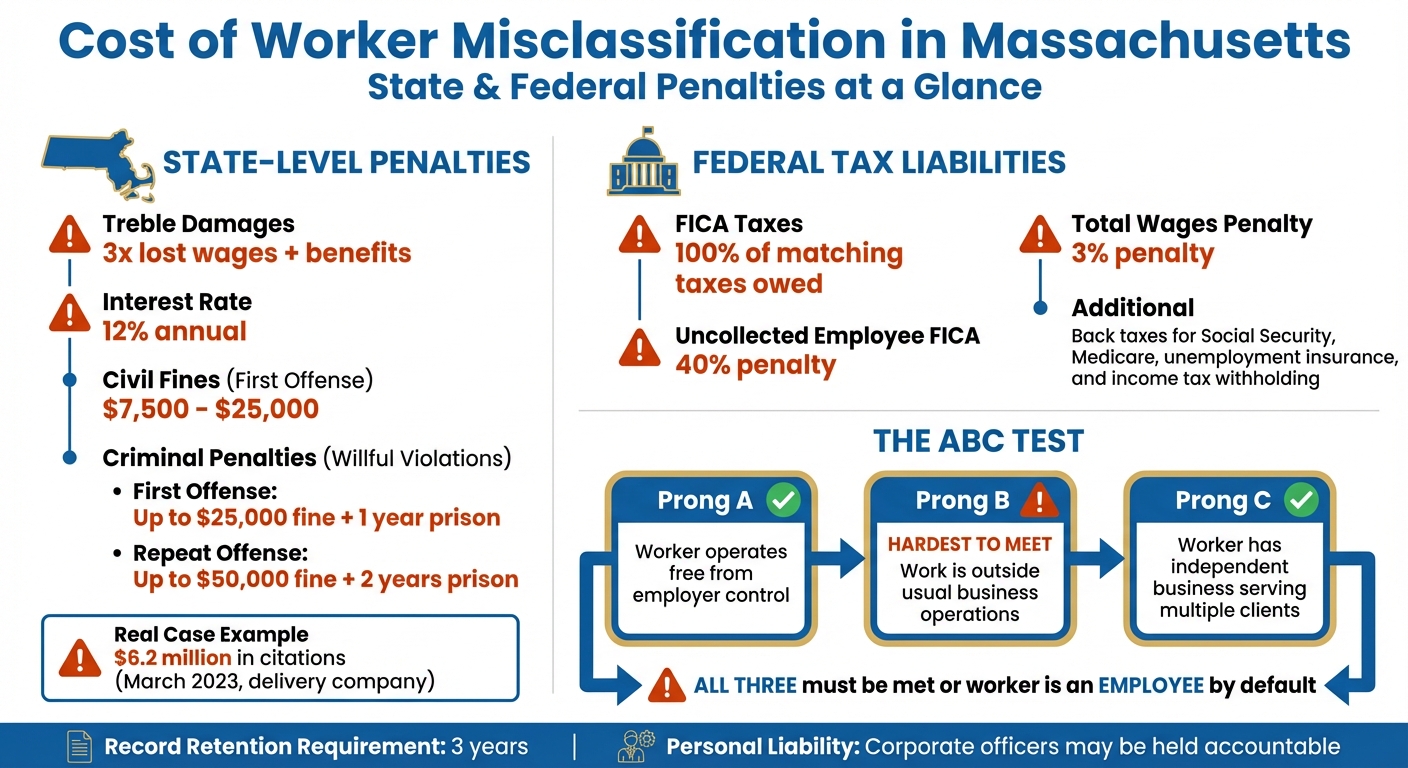
Massachusetts takes a strict stance on worker misclassification, enforcing some of the toughest penalties in the country. Under state law, courts are required to award treble damages – three times the amount of lost wages and benefits – to workers who have been misclassified, even if the employer did not intend to violate the law. On top of that, a 12% interest rate is applied, further increasing the financial burden.
Civil citations from the Attorney General’s office range from $7,500 to $25,000 for a first-time offense. For willful violations, criminal penalties can include fines of up to $25,000 and one year in prison for a first offense. Repeat offenders face even steeper consequences, with fines reaching $50,000 and up to two years of imprisonment. A recent example highlights the severity of these penalties: in March 2023, the Attorney General’s office issued citations exceeding $6.2 million against a delivery company for misclassifying drivers, failing to provide accurate paystubs, and denying earned sick leave.
These state-level penalties become even more burdensome when combined with federal tax liabilities, as explored below.
Federal Tax Liabilities
Federal tax laws add another layer of risk for employers who misclassify workers. By treating employees as independent contractors, companies avoid paying key contributions like Social Security, Medicare (FICA) taxes, federal unemployment insurance, and federal income tax withholding. However, if the IRS detects misclassification, it can impose back taxes, interest, and various penalties. These include fines for failing to issue accurate W-2 forms or for underreporting payroll taxes.
The financial impact is especially severe when misclassification involves multiple workers over several years. In these cases, the combined state and federal penalties can easily outweigh any perceived cost savings from avoiding employee-related tax obligations.
Case Studies of Enforcement Actions
Massachusetts courts have consistently ruled in favor of workers in misclassification disputes, providing clear examples of how these laws are enforced.
- Martins v. 3PD, Inc. (March 2013): A federal court determined that delivery drivers working for a retail logistics company were misclassified. The court ruled that the drivers’ work was integral to the company’s business, despite the company’s arguments to the contrary.
- Driscoll v. Worcester Telegram & Gazette: The Massachusetts Appeals Court found that news carriers were employees, not independent contractors. The newspaper’s control over delivery routes and its ability to terminate carriers based on customer complaints were key factors in the decision.
- Amero v. Townsend Oil Co. (April 2009): An Essex Superior Court judge ruled that oil delivery drivers were misclassified under the Massachusetts ABC test, reinforcing the importance of this legal framework.
These cases highlight the critical role of the ABC test in determining worker classification and demonstrate the costly consequences of getting it wrong.
sbb-itb-aa28329
The Massachusetts Three-Prong Test for Worker Classification
How the Three-Prong Test Works
In Massachusetts, the law assumes that anyone working for your business is an employee by default. Under M.G.L. c. 149, § 148B, it’s up to you – the employer – to prove otherwise. To classify a worker as an independent contractor, you must meet all three parts of the "ABC Test." If even one prong isn’t satisfied, the worker is legally considered an employee.
Prong A deals with control. The worker must operate independently, free from your direction in how they carry out their work. This independence must be reflected both in the written agreement and in actual practice. If you’re setting their hours, giving detailed instructions, or closely managing their tasks, you fail Prong A.
Prong B is about whether the worker’s role is outside the scope of your regular business activities. This is often the toughest hurdle. The Massachusetts Attorney General differentiates between "necessary" and "incidental" services. For example, if a drywall company hires a drywaller, that work is considered necessary to its operations, making the worker an employee. Conversely, if an accounting firm hires movers to relocate their office, those services are incidental.
"When one is in the business of dispatching limousines, the services of chauffeurs are provided in the usual course of business because the act of driving is necessary to the business." – Massachusetts Office of the Attorney General
Prong C requires the worker to have an independent business. This means they must work for other clients, own their equipment, carry their own insurance, and have the freedom to work for competitors. A worker who depends solely on your company for income won’t meet this standard.
Now, let’s look at common mistakes employers make when applying this test.
Common Classification Mistakes
Employers often misstep when trying to apply the ABC test, and understanding these errors can help you avoid them. For starters, simply labeling someone as an "independent contractor" in a contract doesn’t override the reality of the working relationship. Courts focus on the actual conditions of the job, not just what’s on paper.
Prong B is a frequent source of confusion. In Martins v. 3PD, Inc., a company wrongly argued that delivery services were outside its core business, leading to misclassification. Similarly, in Amero v. Townsend Oil Co., the court ruled that delivering oil was central to the company’s operations, making the workers employees.
Prong A violations often come from too much oversight. For example, in Driscoll v. Worcester Telegram & Gazette, the newspaper failed this prong because it controlled delivery routes and could terminate carriers based on customer complaints.
Missteps with Prong C are also common. For example, contracts that require workers to be exclusive to your business eliminate their ability to run an independent operation. Forcing workers to form an LLC just to work for you is another tactic that doesn’t hold up under Massachusetts law.
One notable case highlights how challenging it is to meet the test’s criteria. In Kubinec v. Top Cab Dispatch, Inc. (June 2014), a taxi dispatch company successfully classified its drivers as independent contractors. The company charged a flat fee for equipment and referrals, didn’t take a share of fares, and allowed drivers to accept or reject jobs freely. This rare example shows how strictly the test is applied.
How to Avoid Worker Misclassification Penalties
Conduct Regular Compliance Audits
Misclassifying workers can lead to hefty penalties, so taking a proactive approach is key. One of the safest strategies is to assume all workers are employees unless proven otherwise. In fact, Massachusetts law follows this exact principle, placing the burden of proof on employers. Conducting regular compliance audits can help you catch potential issues before enforcement agencies do.
When auditing, review every 1099 worker relationship against the ABC test, paying particular attention to Prong B – whether the work falls outside your usual business operations. This is where most misclassification errors occur. If you identify misclassified workers, consider using the IRS Voluntary Classification Settlement Program (VCSP). This program allows you to reclassify workers for future periods while securing partial relief from federal employment taxes. Acting voluntarily is far less expensive than waiting for enforcement actions like those mentioned earlier.
Documentation is your strongest defense. During audits, ensure all contracts and invoices align with evidence of independent operations, such as proof of insurance and serving multiple clients. In Massachusetts, you’re required to keep employee records for at least three years. Attorney Darren Griffs of MVS LLP underscores the importance of documentation:
"Your best defense is usually documentation: contracts, payment records, project details, proof of independent work, and evidence that the person runs their own business".
These steps also set the stage for integrating technology and training to further minimize risks.
Use Technology to Manage Compliance
Automated platforms can simplify compliance tracking and record-keeping. They help you meet the three-year record retention requirement, manage payroll tax withholding, and ensure timely wage payments as mandated by the Wage Act. By reducing human error, these systems can prevent the types of mistakes that often lead to investigations.
For example, ABLEMKR’s platform is designed to handle workers as W-2 employees, removing the risk of misclassification entirely. Its payroll workflows automatically manage tax withholding for state and federal income taxes, FICA, Medicare, and Massachusetts Paid Family Medical Leave (PFML). The platform also tracks compliance in real-time, creating an audit trail that meets legal documentation requirements. This is particularly helpful in industries like construction and energy, where worker classification has historically been a challenge.
Train Your HR and Management Teams
Proper training for HR staff and field managers is essential, especially since excessive control over workers can invalidate independent contractor status. For instance, avoid setting strict schedules, giving detailed task instructions, or closely supervising work – these actions can violate Prong A of the ABC test. Training should focus on evaluating the actual working relationship, not just the paperwork.
Tailor training to address risks specific to your industry. In sectors like construction or energy, hiring contractors to perform the same core tasks as employees is a common red flag for misclassification. Regularly scheduled training sessions ensure that your team stays informed about classification standards and avoids costly errors.
Employee or Contractor? How Misclassification Could Be Hurting You
How ABLEMKR Helps with Compliance and Workforce Management
ABLEMKR tackles the compliance headaches many businesses face by simplifying workforce management and reducing the risks tied to worker misclassification.
Reducing Misclassification Risks
One of ABLEMKR’s standout features is its ability to sidestep misclassification issues by classifying all workers as W-2 employees. This approach aligns with the Massachusetts ABC test, which assumes workers are employees unless strict conditions are met. For industries like construction and energy, this is especially critical since hiring contractors for core trade roles often violates Prong B of the test.
By treating workers as employees from the get-go, ABLEMKR removes the burden of proving worker independence. Its automated payroll system handles all the essentials – federal FICA at 7.65%, Medicare, Massachusetts state income tax, unemployment insurance, and workers’ compensation contributions. This thorough process not only protects corporate officers and managers from personal liability but also shields businesses from the state’s harsh penalties, including triple damages for unintentional misclassification errors.
Simplifying Workforce Deployment
The platform’s mobile-first design makes it easy to match prequalified workers to job sites based on certifications, safety training, availability, and location. This is a game-changer for industries like oil and gas or mining, where fast crew mobilization is often needed for emergency shutdowns or repairs in remote areas.
On top of that, ABLEMKR keeps detailed records for three years, creating a reliable audit trail for enforcement agencies. With real-time compliance tracking, employers can monitor worker status, tax obligations, and project expenses throughout the entire deployment process.
Benefits for Employers and Workers
Employers gain a clear view of worker status, compliance metrics, and project costs through ABLEMKR’s intuitive dashboard, helping to reduce joint employer liability risks. Meanwhile, workers benefit from guaranteed on-time payments, workers’ compensation coverage, and unemployment insurance.
The platform also ensures workers are paid overtime at 1.5 times their regular rate and receive proper meal breaks, all in line with Massachusetts wage laws. By integrating these protections, ABLEMKR not only helps employers avoid costly penalties but also strengthens the legal and financial well-being of their workforce.
Conclusion
Massachusetts has some of the toughest worker classification laws in the country. Under the state’s ABC test, every worker is assumed to be an employee unless proven otherwise. Violating these rules can lead to severe consequences, including triple damages on unpaid wages and benefits, 12% prejudgment interest, and civil fines ranging from $7,500 to $25,000 per violation. Corporate officers can even face personal liability for these penalties .
Federal penalties add another layer of financial risk. The IRS, for example, can demand 100% of matching FICA taxes, 40% of uncollected employee FICA taxes, and a 3% penalty on total wages. When you factor in state unemployment insurance penalties, back taxes, and attorney’s fees, a single misclassification case can quickly spiral into a costly ordeal.
The good news? These risks can be avoided with the right compliance measures. Conducting regular audits, maintaining thorough documentation, and using technology to handle classification and payroll can help businesses stay on the right side of the law. These steps not only meet the strict ABC test requirements but also create a proactive approach to workforce compliance.
For industries like construction, energy, and mining – where managing a fast-moving workforce is especially challenging – platforms like ABLEMKR offer a practical solution. They ensure workers are classified as W-2 employees from day one, while also providing real-time compliance tracking, automated tax withholding, and audit-ready documentation. By adopting such systems, businesses can minimize misclassification risks and focus on growth rather than dealing with costly legal battles. In the end, investing in compliance is far more affordable than facing the penalties of misclassification.
FAQs
How do I apply the ABC test to my 1099 workers?
To determine whether your 1099 workers qualify as independent contractors under Massachusetts law, you’ll need to apply the ABC test. This test has three key criteria:
- They work free from your control and direction: The worker must have the freedom to decide how they perform their job without being micromanaged.
- Their work is outside your company’s usual business activities: Their role should not align with the core services or products your business provides.
- They operate an independent trade or business: The worker must run their own business, offering similar services to others and maintaining independence.
If a worker doesn’t meet any one of these requirements, they are presumed to be an employee under Massachusetts law. This classification directly affects your tax responsibilities and compliance requirements.
What does Prong B mean for my core job roles?
Under Massachusetts law, Prong B specifies that for workers to be classified as independent contractors, their primary job duties must fall outside the usual scope of your business operations. This rule plays a key role in ensuring compliance with worker classification regulations and helps businesses steer clear of potential penalties.
What records should I keep to defend my classifications?
Employers need to keep thorough records to back up worker classifications. These should include proof of the worker’s independence, documentation showing their work falls outside the company’s regular operations, and evidence that they run their own independent trade or business. Such records play a crucial role in ensuring compliance and protecting against potential misclassification disputes.


