
When workplace accidents happen, the focus often shifts to assigning blame, typically targeting individual workers. But here’s the problem: labeling incidents as "human error" ignores deeper organizational issues that create unsafe conditions in the first place. Systemic failures – like poor training, faulty equipment, or unrealistic deadlines – are often the root causes, while individual errors are just the visible symptoms.
Key takeaways:
- Systemic failures are hidden flaws in processes, policies, or equipment that set workers up to fail.
- Individual errors are isolated mistakes, but many stem from systemic pressures.
- Blaming workers doesn’t fix the real problem. Addressing organizational weaknesses does.
- Example: The Grenfell Tower fire showed how systemic negligence can turn minor incidents into disasters.
Focusing on fixing systems instead of blaming individuals leads to safer workplaces and fewer accidents.
Don’t Blame Staff When You Provide Them With a System With Failure Built in (HSG48)
sbb-itb-aa28329
Defining Systemic Failures and Individual Errors
To tackle construction accidents effectively, we need to clarify what we’re dealing with. The distinction between systemic failures and individual errors isn’t just theoretical – it’s the difference between addressing surface-level problems and solving deeper, more persistent issues.
What Are Systemic Failures?
Systemic failures are the hidden weaknesses in an organization – often called "latent conditions" – that exist long before an accident happens. These flaws stem from decisions made by designers, managers, or those responsible for procedures. Think of them as cracks in the foundation of your safety system that only become visible when the right (or wrong) conditions align.
A helpful way to picture systemic failures is through the Swiss Cheese Model. Imagine your safety system as a stack of Swiss cheese slices, where each slice represents a layer of defense – like training, engineering controls, or supervision. The holes in these slices are weaknesses, and when those holes line up, an accident slips through every layer.
Examples of systemic failures include things like understaffing, unrealistic deadlines, poorly maintained equipment, or a lack of clear communication between management and workers. Sometimes, procedures look great on paper but are impossible to follow in real-world scenarios. These aren’t one-off errors; they’re patterns that force workers to adapt to flawed systems. As Professor James Reason puts it:
"The basic premise in the system approach is that humans are fallible and errors are to be expected, even in the best organisations. Errors are seen as consequences rather than causes."
A key concept tied to systemic failures is "local rationality." This means workers often make decisions that seem logical based on the flawed tools, information, or pressures they’re dealing with. The problem isn’t the worker’s judgment – it’s the system that placed them in an impossible situation.
But not all failures stem from these deeper organizational issues.
What Are Individual Errors?
Unlike systemic failures, individual errors are isolated mistakes made at the moment of action.
These errors happen when someone slips up during a task. For example, a worker might forget to secure their safety harness, an equipment operator might misjudge a distance, or a driver might lose focus and hit a pedestrian. These lapses generally fall into four categories:
- Mistakes: Not knowing the correct method.
- Mismatches: When the task exceeds physical or mental capacity.
- Noncompliance: Deliberately skipping a procedure.
- Slips and lapses: Forgetfulness or fatigue.
What sets individual errors apart is that they occur without a systemic issue actively pushing the worker toward failure. However, many seemingly isolated mistakes often have systemic roots. For instance, skipping a safety step might be driven by tight deadlines, or a lapse in attention could result from overwork due to chronic understaffing.
As Professor James Reason explains:
"It is often the best people who make the worst mistakes – error is not the monopoly of an unfortunate few."
The real question isn’t just whether an error happened – it’s whether the system set the worker up to fail.
Case Studies: Systemic Failures and Individual Errors in Construction
Real-life tragedies show how systemic failures and individual errors can intertwine, often with devastating consequences. Understanding the distinction between these two factors is crucial, especially when lives are on the line. Let’s take a closer look at systemic failures through the lens of the Grenfell Tower fire.
Systemic Failures: The Grenfell Tower Fire
The Grenfell Tower fire, which occurred on June 14, 2017, claimed 72 lives, marking it as the deadliest residential fire in the UK since World War II. What began as a refrigerator fault spiraled into a national disaster, largely due to systemic issues that had been festering for decades. A six-year investigation spanning 1,700 pages shed light on the layers of negligence and deceit that contributed to the tragedy [21,22,23].
One of the most alarming revelations was the role of deliberate deception. Between 2005 and 2017, Arconic Architectural Products SAS sold Reynobond 55 PE cladding, despite knowing it performed poorly in fire tests when installed in cassette form. This concealment was identified as a "principal reason" for the rapid spread of the fire [20,21]. Similarly, in 2014, Celotex manipulated a critical BS 8414 safety test by using magnesium oxide boards to ensure a passing result – without disclosing this modification [21,24]. Inquiry Chair Martin Moore-Bick summarized the issue bluntly:
"One very significant reason why Grenfell Tower came to be clad in combustible materials was systematic dishonesty on the part of those who made and sold the rainscreen cladding".
Certification bodies like the British Board of Agrément (BBA) and the Building Research Establishment (BRE) also failed to act as independent watchdogs. Instead, they succumbed to commercial pressures, compromising their integrity [20,26]. Architects at Studio E and contractors at Rydon lacked the necessary technical knowledge to interpret fire safety regulations properly, often assuming that responsibility lay elsewhere [24,26].
Government policies exacerbated these systemic issues. Warnings about the dangers of combustible cladding had been ignored since 1991, as successive administrations prioritized deregulation under a "red tape" cutting agenda [21,24]. The London Fire Brigade, meanwhile, failed to adequately train firefighters on the risks posed by cladding fires, and the "Stay Put" policy remained in place long after it was clear that compartmentation had failed [21,23]. Moore-Bick’s conclusion was stark:
"The simple truth is that the deaths that occurred were all avoidable".
Even years later, the problem persists. As of July 2024, 3,280 buildings in Britain, each at least 11 meters (about 36 feet) tall, still had unsafe cladding awaiting replacement. While systemic failures dominated the Grenfell tragedy, it’s also important to examine how individual errors can play a role in less extreme scenarios.
Individual Errors: Worker Mistakes on Job Sites
Unlike systemic failures, individual errors are isolated incidents – such as a worker forgetting to secure a safety harness, an operator misjudging equipment clearance, or a driver losing focus momentarily. These mistakes typically have limited consequences when proper safeguards, supervision, and clear protocols are in place. However, in systems already weakened by cost-cutting, understaffing, or lax regulations, even a small error can escalate into a major crisis [22,25].
The Grenfell fire illustrates this overlap. The initial refrigerator fire was a "perfectly foreseeable" domestic accident, but its impact was magnified by combustible cladding and the rigid enforcement of the "Stay Put" policy. The Grenfell Tower Inquiry Phase 1 Report highlighted this dynamic:
"The bravery and commitment to duty shown by individual firefighters cannot mask or excuse the deficiencies in the command and conduct of operations".
These examples show that while individual mistakes may spark incidents, it’s the systemic flaws that often turn them into large-scale disasters.
Key Differences Between Systemic Failures and Individual Errors
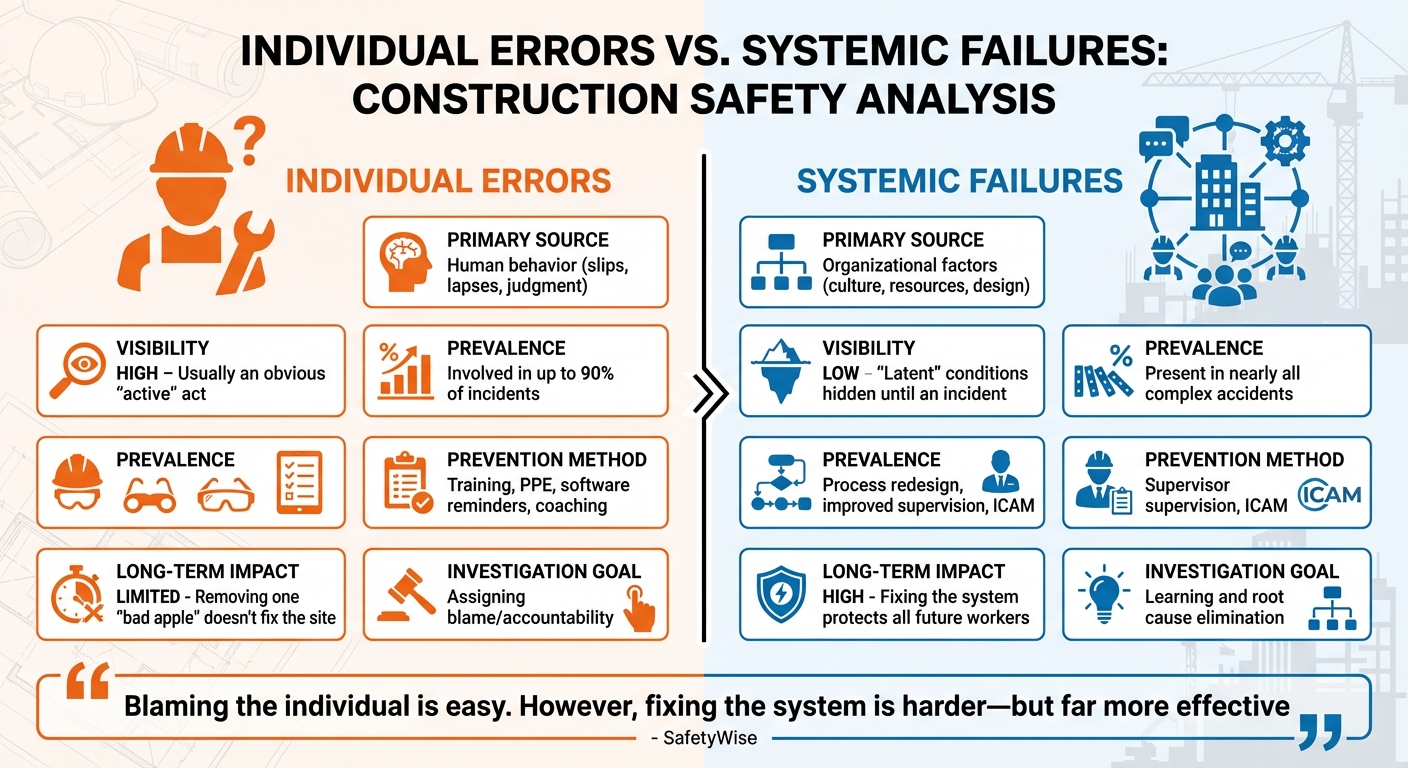
Systemic Failures vs Individual Errors in Workplace Safety
Grasping the distinction between systemic failures and individual errors is more than just theoretical – it’s the difference between temporary fixes and lasting safety improvements. Individual errors are the immediate, visible mistakes people make – like forgetting to secure a harness, misjudging a distance, or skipping a safety check. These are the "on-the-spot" errors that are easy to identify. On the other hand, systemic failures are the hidden flaws within an organization, such as poorly designed procedures, insufficient training, budget cuts that compromise oversight, or a workplace culture that prioritizes speed over safety. These issues often stay unnoticed until a specific error exposes them.
The key difference lies in the aftermath. Pointing fingers at an individual might lead to quick fixes like retraining, issuing warnings, or even firing someone – but this doesn’t address the root cause. As SafetyWise aptly states, "Blaming the individual is easy. However, fixing the system is harder – but far more effective". Removing one worker doesn’t solve systemic issues. If the same pressures, inadequate tools, or unclear protocols remain, another worker will likely make the same mistake.
This distinction is reflected in how investigations are conducted. Individual error analysis focuses on "Who made the mistake?" while systemic analysis digs deeper, asking, "What allowed this to happen?". Mark J. Steinhofer, CHST, CSP, CUSP, from Safety Management Group, explains it this way:
"The system approach assumes that you could put multiple people in the same position with the same conditions, and each of them will fail because the system is inherently flawed".
Shifting the focus from "who" to "why" is essential for creating strategies that prevent future accidents.
Although human error is often blamed for up to 90% of construction injuries, these mistakes are rarely random. Instead, they usually highlight deeper systemic issues. In complex incidents, the worker’s error is often just the last step in a chain of organizational weaknesses. Peter G. Furst, President of The Furst Group, emphasizes this point:
"What people do makes sense to them at that point in time – given their goals, situational focus and knowledge – otherwise they wouldn’t do it".
Workers act based on the environment and conditions they’re placed in, not out of sheer carelessness. Recognizing this difference is crucial for developing safety measures that address the root causes and protect everyone on the job.
Comparison Table: Systemic Failures vs. Individual Errors
| Feature | Individual Errors | Systemic Failures |
|---|---|---|
| Primary Source | Human behavior (slips, lapses, judgment) | Organizational factors (culture, resources, design) |
| Visibility | High; usually an obvious "active" act | Low; "latent" conditions hidden until an incident |
| Prevalence | Involved in up to 90% of incidents | Present in nearly all complex accidents |
| Prevention Method | Training, PPE, software reminders, coaching | Process redesign, improved supervision, ICAM |
| Long-term Impact | Limited; removing one "bad apple" doesn’t fix the site | High; fixing the system protects all future workers |
| Investigation Goal | Assigning blame/accountability | Learning and root cause elimination |
Solutions: Addressing Systemic Failures and Preventing Individual Errors
Reducing construction accidents means rethinking flawed systems and giving workers the tools and support they need to minimize mistakes. With modern technology and structured accountability frameworks, both goals are achievable.
The Role of Accountability and Oversight
True accountability starts by asking, “Why did this decision seem reasonable at the time?” Instead of pointing fingers with “Who’s at fault?”, organizations should focus on understanding the reasoning behind actions. This approach shifts investigations from blame to learning opportunities. Frameworks like ICAM (Incident Cause Analysis Method) allow companies to assess the broader context – People, Environment, Equipment, Procedures, and Organization (PEEPO) – instead of stopping at the worker’s immediate actions.
Creating a reporting culture is just as important. Workers need to feel safe sharing near-misses without fearing consequences. These reports provide early warnings about dangerous patterns that could lead to serious accidents. Mark J. Steinhofer from Safety Management Group explains:
"Blaming individuals is the easy way out, and it doesn’t prevent errors… mishaps are anything but random; they tend to fall into recurring patterns".
The challenge lies in building oversight systems that strengthen safety measures – like ensuring proper staffing, reasonable deadlines, and well-maintained equipment – without creating a culture of fear.
Technology also plays a key role. Platforms offering real-time visibility into worker status and compliance tracking help bridge the gap between job sites and management. Often, management only receives financial performance updates, leaving safety measures overlooked. Automated systems ensure critical safety layers – such as training certifications, equipment checks, and engineering controls – are consistently maintained. Workforce management platforms take these principles further by embedding oversight into daily operations.
Using Workforce Management Platforms
Workforce management platforms bring accountability into practice by integrating safety measures directly into every stage of operations. Take ABLEMKR as an example. This platform addresses underlying risks by matching pre-screened workers to job sites based on their certifications, safety training, availability, and location. By ensuring qualified workers are assigned to the right tasks from the start, it eliminates a common organizational failure: assigning unqualified workers due to scheduling pressures or poor oversight.
The embedded compliance tracking feature reinforces multiple safety layers at once. Automated checks ensure training and certifications are up-to-date, reducing the likelihood of “slips and lapses” caused by forgetfulness or distraction. Supervisors gain real-time visibility into workers’ conditions, allowing them to spot signs of fatigue or overwork – an issue that affects about 40% of the U.S. construction workforce regularly. By integrating production planning, these platforms also help reduce task unpredictability, a major factor in hazardous situations and production pressures.
These systems encourage proactive safety practices. TJ Ryals, Director of Business Development at Speedshield Technologies, sums it up well:
"The operator of tomorrow isn’t someone expected to sustain impossible levels of vigilance. They’re a skilled professional who is supported by systems that recognize the limits of human attention".
Conclusion
Construction safety involves addressing both systemic issues and individual mistakes, as workplace incidents often result from complex interactions between people, equipment, and organizational processes. The statistics are sobering: construction accounts for about 20% of all occupational deaths in the U.S., with 2023 alone seeing 1,056 fatalities and over 165,000 nonfatal injuries. These numbers highlight deeper systemic problems that need attention.
To improve safety, organizations must identify hidden risks like understaffing, unrealistic deadlines, and outdated or insufficient equipment – factors that create environments prone to errors. As Robert O’Neill from Work Safety Hub explains:
"By attributing accidents solely to human error, we miss the opportunity to investigate the multitude of causes and learn from the incidents".
This perspective encourages a shift toward proactive solutions. Creating error-tolerant systems involves building multiple layers of defense that work in unison. Advanced technology plays a crucial role here. Workforce management platforms, such as ABLEMKR, showcase how tools can help by matching workers to job sites based on certifications, safety training, and proximity – strengthening these protective layers.
The benefits of prioritizing safety are clear. Companies with strong safety cultures report up to 40% fewer accidents and see productivity gains of 15–20% compared to industry norms. Additionally, digital monitoring tools have been shown to reduce incident rates by 25–30%. Beyond protecting workers, this approach also saves businesses from the staggering $13 billion in direct costs tied to construction accidents in a single year.
The industry stands at a pivotal moment. Companies that adopt a systems-based approach, encourage open reporting, and utilize modern tools can lead the way toward a safer and more productive future. On the other hand, those that continue to place blame on individuals while ignoring organizational flaws risk repeating the same costly errors. By focusing on systemic improvements instead of individual fault, the construction sector has the opportunity to achieve meaningful and lasting safety advancements.
FAQs
How can I tell if an accident was systemic or a one-off mistake?
To figure out whether an accident was part of a larger pattern or just a random mistake, it’s important to dig into its root causes and the broader organizational environment. Systemic failures usually arise from ongoing issues like flawed policies, ineffective processes, or a problematic workplace culture. On the other hand, one-off mistakes are typically isolated events triggered by immediate human error or unique circumstances. A structured investigation can help uncover patterns – such as gaps in management or weak safety leadership – that point to deeper, systemic problems.
What should an investigation ask besides “Who messed up?”
When investigating, it’s crucial to consider why the person’s actions seemed logical at the time. Instead of simply assigning blame, the focus should shift to examining organizational and systemic factors. This perspective can uncover deeper issues like insufficient training, ambiguous procedures, or systemic pressures that may have played a role in the incident.
How can ABLEMKR help reduce safety risks on job sites?
ABLEMKR helps make workplaces safer by identifying risks early, encouraging open communication, and using digital tools like hazard reporting and OSHA compliance tracking. Together, these features enhance safety and strengthen accountability across teams.


