
Sustainable energy project management is becoming a critical career path as renewable energy transitions from ambitious goals to large-scale infrastructure projects. Professionals in this field need expertise in technical engineering, financial oversight, and regulatory compliance to lead projects like solar farms, wind turbines, and energy storage systems. However, there’s a growing skills gap, with demand for trained experts outpacing supply.
Key certifications like Certified Energy Project Manager (CEPM), Green Project Manager (GPM), and Certified Renewable Energy Project Manager (CREPM) validate skills in managing renewable energy projects. These programs cover project planning, environmental compliance, and emerging technologies like smart grids and AI tools. Salaries for certified professionals range from $50,000 to over $120,000 annually, depending on experience and role.
Platforms like ABLEMKR connect certified professionals with job opportunities in the U.S. energy sector, bridging the gap between training and employment. Whether you’re an entry-level candidate or a seasoned professional, this training equips you to manage complex projects while meeting financial and environmental goals.
Key Takeaways:
- Certifications like CEPM and GPM focus on renewable energy project management.
- Training emphasizes project planning, compliance, and technology trends.
- Salaries range from $50,000 to $170,000 based on role and experience.
- Platforms like ABLEMKR help certified professionals find relevant opportunities.
This training prepares you to thrive in a rapidly growing industry while contributing to the global energy transition.
How Large Renewable Energy and Green Hydrogen Projects Are Really Managed
sbb-itb-aa28329
Top Certifications for Sustainable Energy Project Managers
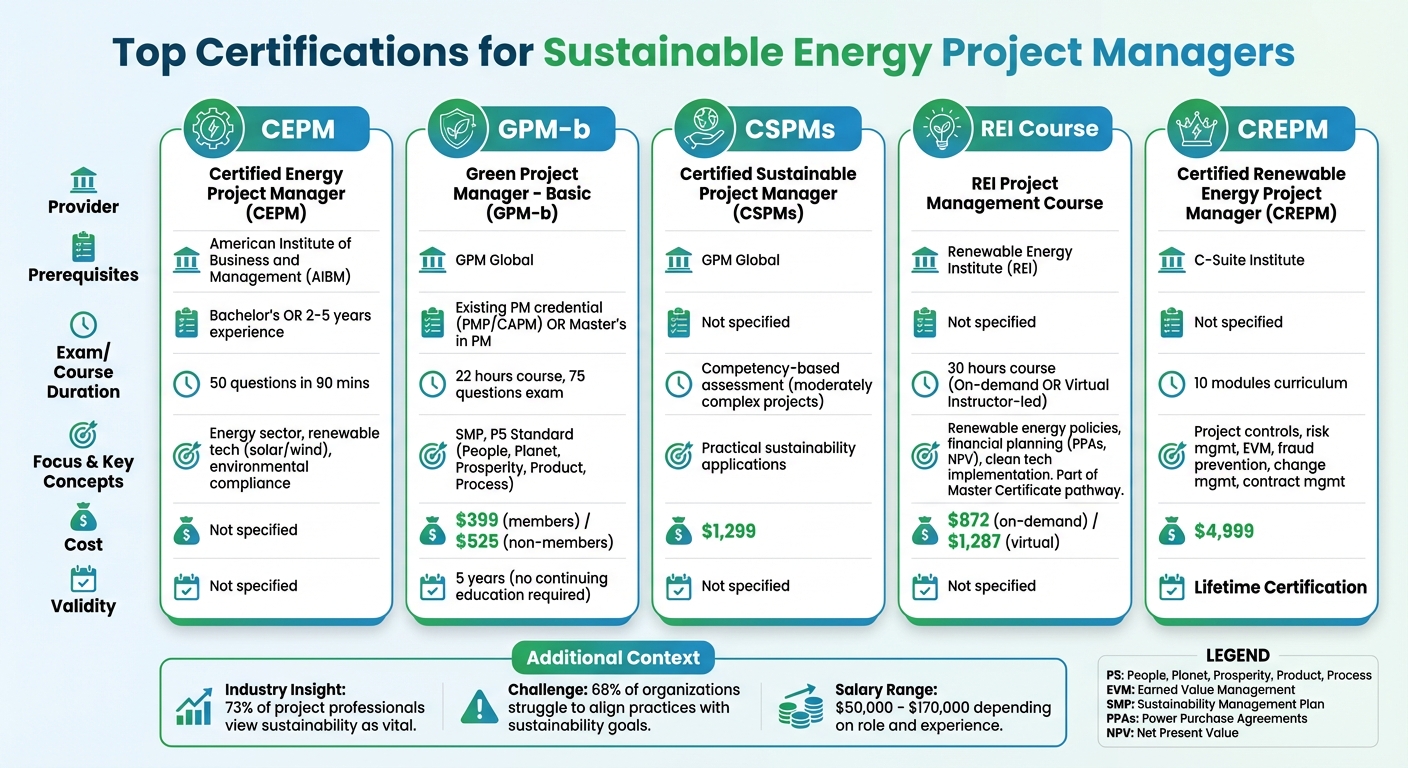
Sustainable Energy Project Management Certifications Comparison Guide
Certifications in renewable energy project management validate your ability to handle projects that meet strict environmental and operational guidelines. These credentials have become key benchmarks in the industry, addressing various aspects of sustainable project management. Choosing the right certification depends on your experience, career goals, and whether you aim for a broad understanding of sustainability or a more focused expertise in energy. These programs not only highlight your skills but also address the growing demand for qualified professionals in this sector.
Certified Energy Project Manager (CEPM)
Offered by the American Institute of Business and Management (AIBM), the Certified Energy Project Manager (CEPM) is tailored specifically for the energy sector. It covers the essentials of energy project management, focusing on sustainable energy solutions and the latest trends in energy technology and innovation. The program emphasizes renewable technologies like solar and wind, ensuring compliance with environmental standards and operational efficiency. To qualify, candidates need a Bachelor’s degree or 2–5 years of relevant experience. The certification exam consists of 50 questions to be completed within 90 minutes.
Green Project Manager (GPM) Certifications
The GPM certification suite is designed to integrate sustainability principles into project management across industries.
- GPM-b (Green Project Manager – Basic): This entry-level certification requires candidates to hold an existing project management credential (such as PMP or CAPM) or a Master’s degree in Project/Program Management. The 22-hour course focuses on creating a Sustainability Management Plan (SMP) using the P5 Standard (People, Planet, Prosperity, Product, Process). The exam includes 75 questions, with pricing starting at $399 for members and $525 for non-members. Certification remains valid for five years without the need for continuing education credits.
- Certified Sustainable Project Manager (CSPMs): This advanced option costs $1,299 and uses a competency-based assessment to evaluate practical sustainability applications in moderately complex projects. According to GPM Global’s 2024 report, while 73% of project professionals view sustainability as vital, 68% of organizations struggle to align their practices with sustainability goals.
Renewable Energy Certifications
The Renewable Energy Institute (REI) offers specialized training through its Project Management course and the broader Galileo Master Certificate (GMC) pathway.
- Project Management Course: Available online, this course costs $872 (on-demand) or $1,287 (virtual instructor-led) and spans 30 hours. It covers renewable energy policies, financial planning tools (like Power Purchase Agreements and Net Present Value), and the technical implementation of clean technologies.
- Project Management Consultant Expert Certificate: This pathway requires completing three courses, with costs ranging from $1,577 to $2,421. It includes training in Renewable Energy Management & Finance alongside an elective specialization. Participants typically have 3–6 months to complete the on-demand courses. REI trains over 5,000 individuals annually, and its graduates have made significant contributions to the field. For example, Alhaji Cham of the National Water and Electricity Company Ltd used REI training to develop a wind turbine power project for the United Nations Industrial Development Organization. Similarly, Tom Young from Community Energy Scotland applied his REI training to support renewable initiatives across Scotland.
- Certified Renewable Energy Project Manager (CREPM): Offered by the C-Suite Institute, this lifetime certification costs $4,999. Its ten-module curriculum covers topics like project controls, risk management, earned value management (EVM), fraud prevention, change management, and contract management/claims.
With these certifications outlined, the next step is understanding the core skills needed to excel in sustainable energy project management.
Core Skills and Training Modules
Sustainable energy project management training typically focuses on three essential skill areas, developed through 20–90 CPD hours. For instance, the Renewable Energy Institute offers a 30-hour course that emphasizes these key competencies. These skills are crucial for effectively managing and delivering sustainable energy projects.
Project Planning and Execution
Training in this area addresses the entire project lifecycle: feasibility, planning, execution, and closure. You’ll learn how to create Work Breakdown Structures (WBS), develop schedules that account for potential delays (like weather or supply-chain issues), and apply both qualitative and quantitative risk mitigation techniques. Advanced programs go further, covering Engineering, Procurement, and Construction (EPC) management, as well as Operations and Maintenance (O&M) strategies to ensure assets remain efficient. Additionally, managing compliance with environmental standards is an integral part of project success.
Environmental Compliance and Sustainability
Modules on environmental compliance help you navigate the often-complex permitting processes while ensuring adherence to environmental standards. Training includes conducting Environmental Impact Assessments (EIAs) and Life Cycle Assessments (LCAs) to measure a project’s environmental footprint from construction to decommissioning. Programs also incorporate Environmental, Social, and Governance (ESG) metrics to streamline decision-making and foster community trust.
"I gained a much greater knowledge about the principles of sustainable design and the finance mechanisms available to implement a scheme. The knowledge will help me identify opportunities for my company to engage our clients at new points in project lifecycles".
This insight from Marc David at The MET Office highlights the practical benefits of completing REI training.
Technology Trends and Efficiency Optimization
Technology modules dive deep into renewable energy systems such as solar, wind, hydro, biomass, hydrogen, and geothermal. You’ll also explore smart grid integration, energy storage technologies (like lithium-ion and flow batteries), and grid connection challenges. Advanced training includes tools like Digital Twins, AI forecasting, and IoT sensors for real-time monitoring, alongside Levelized Cost of Energy (LCOE) calculations. These skills help balance initial capital investments with long-term operational savings, ensuring efficient project management.
Tom Young from Community Energy Scotland shared how he applied this knowledge:
"This course has given me experience and knowledge which I’ll pass onto communities throughout Scotland".
| Skill Category | Core Training Focus | Key Outcomes |
|---|---|---|
| Project Planning | Lifecycle Management, WBS, Scheduling | Managing projects from start to finish while addressing supply-chain issues. |
| Sustainability | Environmental Compliance, LCA, ESG | Handling permits, regulations, and assessing environmental impacts. |
| Technology | Renewable Systems, Smart Grids, AI | Leveraging solar, wind, and storage tech; using digital tools for efficiency. |
| Financial | Project Finance, NPV/IRR, LCOE | Navigating green energy financing and performing financial analyses. |
Career Paths in Sustainable Energy Project Management
High-Demand Roles in the Energy Sector
By 2025, renewables are expected to produce more than one-third of the world’s electricity, fueling rapid growth in the energy sector. This expansion has opened up a variety of career opportunities for professionals trained in sustainable energy project management.
One of the most in-demand roles is that of Renewable Energy Project Manager, responsible for overseeing the entire lifecycle of clean energy projects like solar farms, wind farms, and energy storage systems. These managers handle everything from financial planning to regulatory compliance and stakeholder engagement. The specialized skills required for these roles are often taught in sustainable energy project management programs. In the U.S., the average annual salary for this position is $106,196, with senior roles earning anywhere from $100,000 to $170,000. As Safwan Azeem, an expert in project management, puts it:
"Renewable energy is one of the most attractive career arenas through 2030".
The sector also needs Portfolio and PMO Leaders who can integrate ESG metrics, cybersecurity, and financial planning across multiple projects. Other key roles include Energy Consultants, who guide clients through strategic planning and energy policy shifts, and Project Engineers, who focus on the technical execution of renewable energy installations. Meanwhile, Energy Analysts specialize in data-driven performance reporting, and Sustainability Coordinators oversee corporate responsibility efforts. Entry-level roles in these fields typically offer salaries between $50,000 and $70,000, while experienced professionals can earn over $120,000, depending on the industry and location.
The sector is evolving from aspirational goals to concrete infrastructure projects, where success is measured by financial performance, risk management, and ESG compliance. This shift has created opportunities for Agile Project Managers who can lead digital initiatives, innovation pilots, and microgrid projects using adaptive frameworks. These emerging roles highlight the growing need for skilled professionals to meet the demands of a rapidly changing energy landscape.
How ABLEMKR Supports Career Growth

Platforms like ABLEMKR are helping bridge the gap between training and job opportunities. ABLEMKR connects certified professionals in sustainable energy with critical projects across the U.S. energy sector. Its mobile-first platform matches pre-vetted workers to job sites based on their certifications, safety training, availability, and location. This allows for quick deployment of crews for tasks like remote repairs and large-scale solar installations.
For professionals with sustainable energy project management training, ABLEMKR provides access to roles in diverse sectors, including oil & gas, utilities, mining, and heavy infrastructure. The platform’s real-time tracking of worker status and compliance helps energy companies quickly find qualified project managers for urgent shutdowns, planned developments, or renewable energy projects. This streamlined process amplifies the value of certifications by connecting skilled workers to relevant opportunities.
In addition to offering flexibility and access to high-paying roles, ABLEMKR ensures on-time payments, eliminating common challenges in labor deployment. With a strong presence in major U.S. cities and energy hubs, ABLEMKR plays a key role in linking trained professionals with the expanding sustainable energy infrastructure network.
How to Start Your Sustainable Energy Training
Assess Your Qualifications and Goals
Start by evaluating your credentials and career aspirations. For example, the Certified Renewable Energy Professional (REP) requires a 4-year degree along with 2 years of experience (or up to 10 years without a degree). On the other hand, the Certified Energy Project Manager (CEPM) is available to those with a Bachelor’s degree or 2–5 years of experience.
Your level of experience can guide you toward the right certification:
- Entry-level candidates (0–2 years): Consider certifications like CAPM or GPM-b.
- Mid-career professionals (2–5 years): The CEPM is a solid choice.
- Senior specialists (5+ years): The REP aligns with advanced expertise.
For international candidates, the REP-IT certification allows you to gain experience over six years, making it a flexible option.
Additionally, tailor your training to your career focus. For instance:
- If you’re pursuing facility management, prioritize courses on energy efficiency and system optimization.
- If you’re targeting roles in utility-scale development, focus on grid integration and compliance with environmental regulations.
Once you’ve identified your goals and qualifications, you’ll be ready to select the certification program that aligns with your career path.
Select the Right Certification Program
Choosing the right certification involves matching your qualifications to the program’s format, focus, and delivery method. Certifications like the CEPM and REP test theoretical knowledge through exams, while others, such as CSPMs, assess practical project performance.
Cost and time are also important factors:
- The REP certification costs $400, with a $300 renewal fee every three years.
- The CSPMs program is priced at $1,299, with the option for monthly payments.
- Training formats vary widely, from intensive 1-week classroom sessions (£3,500) to flexible 30-hour on-demand modules ($872). Over 5,000 individuals train with REI every year.
If you plan to work internationally, opt for certifications recognized globally. For instance, programs aligned with ISO 17024 standards, like those offered by GPM, or certifications backed by the Galileo Master Certificate (GMC), can enhance your credibility with multinational employers.
Lastly, ensure your training provider is approved by the certifying body. For example, REP candidates must complete a recognized training program before taking the exam.
Once certified, the next step is to apply your skills in real-world projects, which is where platforms like ABLEMKR come in.
Use Platforms Like ABLEMKR
Certification alone isn’t enough – practical experience is key. Platforms like ABLEMKR connect certified professionals directly to job opportunities across the U.S. energy sector. Using mobile-first technology, ABLEMKR matches workers to roles based on their certifications, safety training, location, and availability.
For those with certifications like CEPM, REP, or GPM, ABLEMKR provides access to projects in industries such as utilities, oil & gas, mining, and heavy infrastructure. The platform’s real-time compliance tracking ensures your credentials are visible to energy companies searching for qualified project managers. This can help you gain hands-on experience, build your resume, and earn competitive wages. Entry-level roles typically pay between $50,000 and $70,000, while experienced professionals can make over $120,000.
Beyond job matching, ABLEMKR guarantees on-time payments and offers flexible, high-paying opportunities. With a strong presence in major U.S. cities and energy hubs, the platform helps bridge the gap between classroom training and real-world demands, enabling you to contribute to the growing sustainable energy infrastructure while advancing your career.
Conclusion
Sustainable energy project management training equips professionals to handle every stage of a project – covering feasibility, design, procurement, grid connection, and even decommissioning. By blending technical engineering knowledge with financial skills, this training addresses the complex demands of modern energy projects. This combination of expertise can open doors to career growth in a highly competitive market.
On the financial side, the benefits are hard to ignore. Professionals with specialized training in sustainability can earn up to 33% more than their peers without these credentials. Beyond the salary boost, this training helps you integrate Environmental, Social, and Governance (ESG) metrics into your projects – an ability that 97% of executives deem critical for long-term business success.
Certifications like GPM-b and REP offer global recognition of your skills in areas such as risk management, compliance, and sustainability leadership. These credentials enable you to navigate various regulatory environments while helping organizations stay competitive and mitigate climate-related risks that could impact an estimated $7.9 trillion of global GDP.
Platforms such as ABLEMKR connect certified professionals with opportunities in high-demand sectors like utilities, oil & gas, mining, and infrastructure. These platforms allow you to gain practical experience while earning competitive wages.
As the energy transition accelerates, this training places you at its core. With renewable energy expected to contribute over one-third of global electricity generation by 2025, certified professionals not only position themselves for higher earnings but also play a vital role in shaping the future of energy through their expertise.
FAQs
Which certification should I start with for my experience level?
For those starting out, the GPM-b Certified Green Project Manager – Basic™ is an excellent choice, providing a solid introduction to sustainable project management principles. If you have some experience under your belt and want to focus on sustainability leadership, the Certified Sustainable Project Manager (CSPMs) could be the right fit. For professionals aiming to specialize in energy management, both the Professional Energy Manager (PEM) and Certified Energy Manager (CEM) are respected certifications recognized around the world, offering opportunities to deepen your expertise in this field.
How long does sustainable energy project management training usually take?
Training in managing sustainable energy projects typically requires 20 to 30 hours. Some courses are designed as intensive one-week programs, packing about 20 hours of learning into a short timeframe. Others take a more extended approach, stretching up to six months for those pursuing more in-depth certifications. The time commitment largely depends on the program’s format and the level of detail covered.
How can I get real project experience after I’m certified?
After earning your certification, the next step is to dive into real project experience. Enroll in practical training programs or internships that mirror actual industry scenarios. Certifications that include hands-on components, such as energy project management courses, can be particularly helpful. You might also want to explore opportunities with companies actively working on renewable energy projects, as these provide a chance to put your skills into practice. Continuing education programs that incorporate project simulations are another great way to transition from certification to applying your expertise in real-world settings.


