
The U.S. energy sector is facing a talent shortage that could disrupt projects and inflate costs. With 25% of the workforce set to retire by 2030 and clean energy investments skyrocketing to $2 trillion in 2024, companies must choose between two approaches: succession planning or crisis hiring.
Succession planning ensures critical roles are prepared in advance, focusing on leadership development, knowledge transfer, and long-term stability. Crisis hiring, on the other hand, reacts to immediate vacancies, often leading to rushed decisions, higher costs, and safety risks.
Key differences:
- Succession Planning: Builds leadership pipelines, reduces turnover costs, and secures institutional expertise.
- Crisis Hiring: Fills urgent gaps but risks delays, burnout, and higher financial costs.
Companies can combine these approaches using workforce platforms like ABLEMKR, which offer pre-vetted talent for emergencies while supporting long-term planning. With 25% of the workforce retiring soon, the time to act is now.
Knowledge Sharing and Succession Planning Toolkit Webinar
What is Succession Planning?
Succession planning is the ongoing process of identifying and preparing talent to fill critical roles within an organization. It’s not just a one-time effort; it’s a continuous strategy to ensure that the right people are in place before key positions become vacant.
"Succession planning is defined as the strategic, ongoing assessment and development of pipelines for critical positions within an organization, conducted in a collaborative nature between the human resources (HR) department and management."
– Caitlin Humrickhouse, Principal, Baker Tilly
In the energy sector, this process carries even more weight. With nearly 29% of the energy workforce made up of baby boomers – and many nearing retirement – there’s a pressing need to transfer critical expertise to the next generation. It’s no longer just about filling open roles; the focus is on identifying "critical capabilities" – those rare combinations of technical skills and operational knowledge that help businesses maintain their competitive edge.
"This is not an HR initiative. When done properly, this is truly the work of the leadership team within an organization that is complemented with different skill sets."
– Doug Orr, Partner & Global Energy Sector Lead, Heidrick & Struggles
To make this happen, organizations must build their succession strategies around several key elements.
Core Elements of Succession Planning
Effective succession planning in the energy sector revolves around four main components:
- Knowledge audits: These help organizations identify vulnerable roles by analyzing payroll or ERP systems to flag upcoming retirements and high-turnover positions.
- Competency modeling: This goes beyond certifications, outlining what true success looks like in a role. It includes skills such as financial expertise, safety leadership, and strategic decision-making.
- 9-box assessment: This tool evaluates employees based on their past performance and future potential. It helps identify who’s ready for promotion, who needs additional development, and who might be better suited for lateral moves.
- Knowledge transfer: This ensures that decades of field experience don’t disappear overnight. Techniques like mentorship programs, detailed documentation, and AI tools help capture complex workflows before seasoned employees retire.
For instance, Paducah Power System in Kentucky conducted a knowledge audit in 2022 and discovered that all three line crew foremen were eligible for retirement within five years. Acting on this, they hired apprentices and placed current first-class linemen in leadership development programs. This proactive approach ensured a seamless transfer of expertise without gaps in field supervision.
These elements not only prepare employees for leadership roles but also strengthen operations across the board.
Benefits of Succession Planning in Energy
Succession planning offers tangible benefits, especially in an industry grappling with rapid retirements. It helps maintain stability by filling critical roles before vacancies disrupt operations.
It also preserves institutional knowledge. For example, Keys Energy Services in Florida launched a pilot program between October 2019 and December 2020. Employees with 15+ years of service were incentivized to provide at least eight weeks’ retirement notice. Nine employees participated, giving an average of 120 days’ notice – a significant improvement from the previous 30-day average. This extra time allowed for in-depth training overlaps, enabling successors to experience a full cycle of key events like open enrollment and budget planning.
"Succession planning protects institutional knowledge and keeps an organization’s players at the top of their games."
– Betsy Loeff, Author, American Public Power Association
Perhaps the most critical advantage is how it prepares organizations for future workforce challenges. At the Brownsville Public Utilities Board in Texas, 57% of directors and 49% of management-level employees were nearing retirement. To address this, the utility introduced a Middle Management Leadership Academy in 2022. The program delivered 24 hours of training, focusing on emotional intelligence, conflict resolution, and strategic thinking. This initiative built a strong pool of internal candidates ready to step into leadership roles when needed.
What is Crisis Hiring?
Crisis hiring is a reactive approach to filling vacancies, often prompted by urgent needs rather than careful planning. Unlike proactive succession strategies, it focuses on plugging gaps quickly to avoid disruptions. This means prioritizing immediate availability over finding the ideal candidate, often leading to rushed decisions that aim to prevent project delays.
"Most companies don’t plan to struggle with hiring. Yet, many find themselves in a cycle of reactive hiring – scrambling to fill roles, making rushed decisions, and hoping for the best."
– Kevin Anderson, Energy Workforce
In the energy infrastructure sector, this approach can create what’s described as a "tax on the schedule." Leadership vacancies lead to delayed decisions, missed handoffs, and unresolved issues in the field. When project managers and superintendents are forced to stretch themselves across multiple sites, the consequences are severe – projects slow down, safety risks climb, and burnout becomes a real concern, often resulting in further staff departures.
The problem is expected to worsen by 2026, as the industry faces a trifecta of challenges: a shrinking pool of experienced leaders, a surge in projects (including renewables, LNG, and battery storage), and hiring cycles that fail to keep up with demand. Many companies fall into the mindset of "we will find someone", treating vacancies as temporary hurdles rather than structural risks that demand immediate attention.
Next, we’ll explore the key triggers that lead to crisis hiring and the operational and safety risks that come with it.
Common Triggers for Crisis Hiring
Several factors push companies into crisis hiring, particularly in the energy sector. One major trigger is unexpected retirements, especially among experienced leaders. These departures create immediate gaps that require swift action.
High turnover in remote locations also plays a role. For example, areas like the Bakken oil formation often struggle to attract skilled professionals willing to work in isolated environments while adhering to strict regulations.
Another significant factor is sudden surges in project demand. When new initiatives ramp up just as seasoned talent exits the workforce, companies find themselves scrambling to meet staffing needs.
Drawbacks of Crisis Hiring
The consequences of crisis hiring extend far beyond the immediate challenges of filling a vacancy. Financial costs skyrocket, driven by higher salaries, recruitment fees, and the daily losses tied to delays and coordination failures. Projects that start without proper leadership in place often face setbacks, creating a ripple effect that complicates recovery efforts.
Safety is another critical concern. Overburdened or inexperienced leaders may overlook early warning signs, leading to "quiet quality issues" where standards deteriorate over time. This not only jeopardizes project outcomes but also increases risks for teams on the ground. Additionally, as existing staff are forced to pick up the slack, burnout spreads, leading to even more departures and deepening the original problem.
The global talent gap – estimated to cost $8.5 trillion – highlights the severe risks businesses face when they rely on reactive hiring strategies.
Succession Planning vs. Crisis Hiring: Key Differences
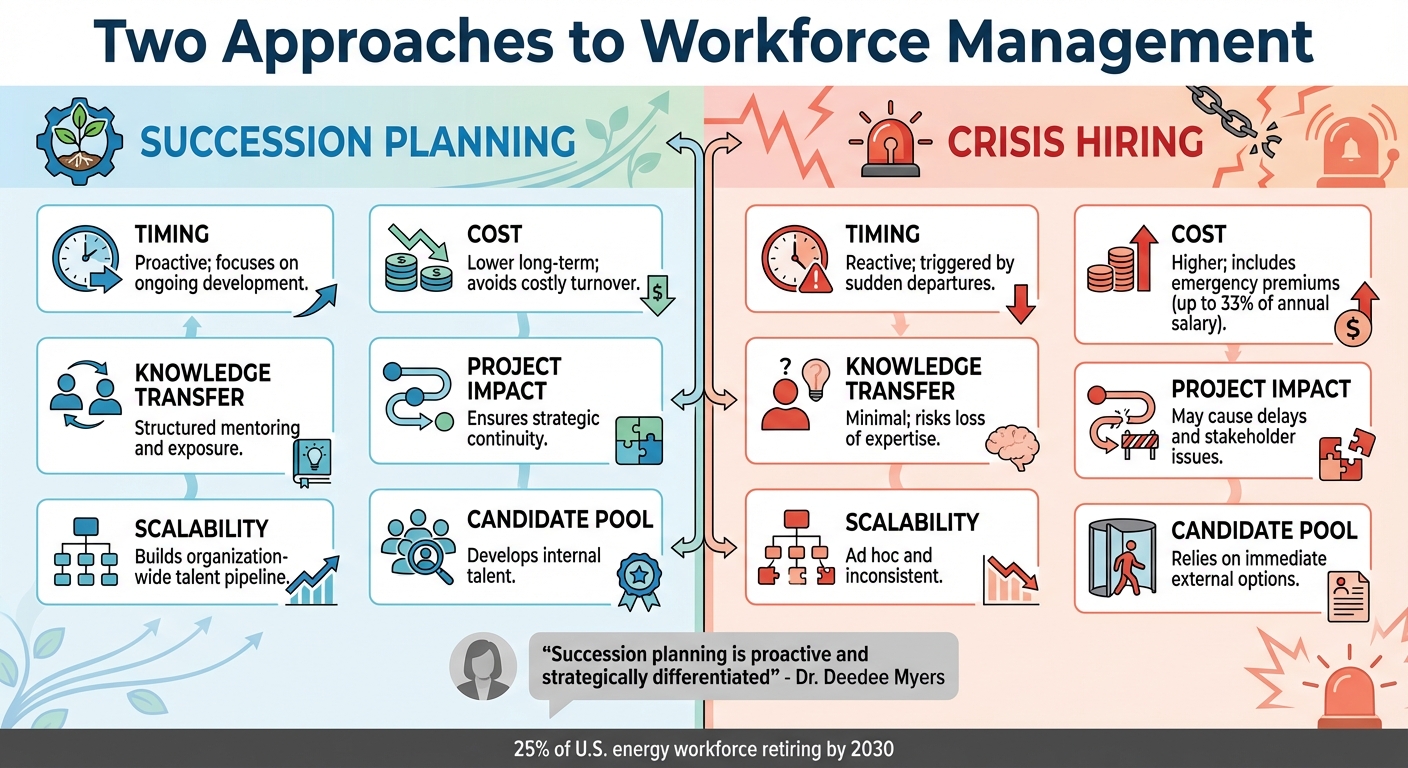
Succession Planning vs Crisis Hiring in Energy Sector Comparison
Let’s dive into the contrasting philosophies behind succession planning and crisis hiring, especially in the context of energy infrastructure. While both aim to address workforce needs, their approaches couldn’t be more different.
Succession planning is all about long-term strategy. It focuses on building a leadership pipeline that aligns with a company’s vision for the future. Crisis hiring, on the other hand, is a short-term fix, designed to meet immediate operational demands.
"Replacement planning is reactive and a narrow approach to filling an immediate need… Succession planning is a proactive process and is strategically differentiated."
– Deedee Myers, PhD, CEO, DDJ Myers
A key distinction lies in who takes responsibility. Succession planning involves senior leaders and the board, ensuring it’s tied to the company’s broader goals. Crisis hiring, however, often falls to HR and relies on outdated role definitions, missing the chance to build a cohesive strategy.
When it comes to preparing candidates, succession planning focuses on internal growth. It uses tools like stretch roles, rotations, and mentoring to create a well-rounded talent pool. Crisis hiring, however, often scrambles for external candidates or interim internal hires, typically without proper transition plans. This reactive approach can be costly – up to 33% of an employee’s annual salary for replacement expenses.
Comparison Table
Here’s a side-by-side look at these two approaches:
| Aspect | Succession Planning | Crisis Hiring |
|---|---|---|
| Timing | Proactive; focuses on ongoing development | Reactive; triggered by sudden departures |
| Cost | Lower long-term; avoids costly turnover | Higher; includes emergency premiums |
| Knowledge Transfer | Structured mentoring and exposure | Minimal; risks loss of expertise |
| Project Impact | Ensures strategic continuity | May cause delays and stakeholder issues |
| Scalability | Builds an organization-wide talent pipeline | Ad hoc and inconsistent |
| Candidate Pool | Develops internal talent | Relies on immediate external options |
These contrasting approaches highlight the importance of prioritizing succession planning to ensure a stable and forward-looking workforce in the energy sector.
sbb-itb-aa28329
Using Flexible Staffing Platforms like ABLEMKR for Hybrid Success
Balancing long-term talent development with the need for quick, reactive hiring is a challenge for today’s energy projects. But companies don’t have to choose one over the other. Platforms like ABLEMKR offer a middle ground by blending strategic workforce planning with on-demand access to skilled, pre-vetted workers. This hybrid approach allows firms to scale their workforce as needed without committing to full-time hires, all while retaining essential institutional knowledge.
ABLEMKR’s automated matching system connects skilled workers to projects in real-time by factoring in certifications, safety training, availability, and location. For succession planning, this could involve pairing experienced near-retirees with internal successors for mentoring and hands-on training. In urgent situations – like an unexpected pipeline repair or an unplanned shutdown – the platform can deploy crews within 24–72 hours, avoiding the chaos of last-minute hiring.
The platform also offers real-time compliance tracking, flagging expired credentials (like OSHA certifications) before workers even arrive on-site. This feature not only reduces risks during leadership transitions but also helps prevent project delays when staffing needs arise unexpectedly.
Another key benefit is the real-time workforce visibility provided by ABLEMKR. Energy companies gain clear insights into worker status, payroll integration, and deployment across multiple project sites. This enables project managers to assess talent pipelines for succession readiness while quickly responding to emergencies. The result? Reduced downtime and better continuity in roles essential to safety and operations.
For example, in the event of a remote pipeline emergency, ABLEMKR can instantly match certified workers nearby while assigning seasoned near-retirees to mentor their successors. This approach safeguards critical knowledge and ensures fast mobilization – all without the long-term hiring commitments that can weigh down energy projects. Companies that adopt such robust succession strategies have seen a 19% increase in productivity, thanks to lower turnover and minimized downtime.
Best Practices for Energy Workforce Management
Conduct Regular Knowledge Audits
Don’t let a retirement or unexpected departure catch you off guard. Regular knowledge audits can identify expertise gaps before they turn into emergencies. Start by creating a spreadsheet to track critical skills, who holds them, and a risk score (1 to 5). For any capability with fewer than two designated holders, schedule 30-minute weekly knowledge transfer sessions to mitigate risks.
Capture specialized processes in concise technical one-pagers and supplement them with smartphone video recordings of expert demonstrations. These videos can act as on-demand training resources. For field operations, ride-along shadowing is a practical way to ensure hands-on knowledge is passed to potential successors. These steps can help avoid costly disruptions caused by sudden departures.
By conducting these audits regularly, you’ll establish a strong foundation for ongoing workforce readiness.
Establish Quarterly Succession Reviews
Workforce planning should be treated with the same urgency as project permits or scheduling. Waiting until mobilization to start hiring puts projects at risk. Quarterly succession reviews should focus on building capabilities rather than just filling roles, ensuring that technical expertise, industry knowledge, and operational skills remain intact.
Leadership must take the reins in succession planning – it’s too important to leave solely to HR. Aligning talent development with business goals requires active involvement from the entire leadership team.
Accountability matters, too. Tie succession planning to compensation metrics, rewarding managers who build strong teams and identify multiple successors. This is especially critical as nearly 25% of the U.S. energy workforce is expected to retire or transition out by 2030.
With a clear succession framework in place, advanced technology can take workforce optimization to the next level.
Use Technology for Workforce Optimization
Modern workforce platforms make proactive planning easier by identifying compliance risks and predicting gaps. For example, ABLEMKR’s real-time compliance tracking flags expired credentials – like OSHA certifications – helping companies avoid risks during leadership transitions and keeping projects on track. These platforms also provide workforce visibility tools, enabling project managers to assess talent pipelines and ensure succession readiness while maintaining flexibility for emergencies.
Beyond immediate needs, technology can also leverage predictive analytics. By factoring in retirement eligibility, historical turnover, market compensation, and social considerations (like spousal employment in remote areas), companies can foresee potential gaps before they arise. For rural battery storage or transmission jobs, early screening for location readiness can help avoid delays caused by travel or housing challenges.
The benefits are tangible – organizations using comprehensive talent platforms have reported saving $2 million annually through reduced turnover and improved productivity.
Conclusion: Building Resilient Energy Workforce Strategies
Deciding between succession planning and crisis hiring goes beyond simply filling vacancies – it’s about ensuring continuity in an industry grappling with an $8.5 trillion global talent gap. With 25% of the U.S. energy workforce projected to retire or transition by 2030 and global clean energy investments hitting $2 trillion in 2024, the stakes are high, and the need for action is urgent.
Succession planning shifts the focus from reactive hiring to proactive talent management, forecasting workforce needs 6–12 months in advance. This approach prioritizes retaining institutional knowledge and expertise, avoiding the pitfalls of crisis hiring where candidates might look qualified on paper but lack the hands-on experience needed to perform under pressure. The result? Fewer missed deadlines, enhanced safety, and stronger operational stability.
"In today’s energy market, the most significant project risk may not be obtaining permits or securing procurement, but rather assuming the right people will still be available when you finally need them." – Footbridge
To address these challenges, leveraging technology becomes essential. Tools like ABLEMKR combine long-term workforce planning with the flexibility to meet immediate staffing demands. By maintaining a network of pre-vetted professionals ready to step in within 24–72 hours, and offering features like real-time compliance tracking and geo-location matching, companies can bridge the gap between proactive planning and reactive needs. This ensures critical projects stay on track, even amid retirements and tight deadlines.
The solution is straightforward: treat workforce planning with the same urgency as equipment procurement. By integrating succession planning with agile staffing technologies, energy companies can reduce turnover costs, maintain project momentum, and build resilient teams capable of driving the next phase of energy development.
FAQs
Which roles should we prioritize for succession planning?
When it comes to succession planning, it’s essential to target roles that are crucial for maintaining organizational stability, steering strategic goals, and ensuring smooth operations. These key positions typically include:
- Executive leadership: Roles like CEO or President are pivotal for shaping the organization’s vision and driving long-term strategies.
- Technical experts: Specialists such as engineering experts or project managers play a vital role in executing complex projects and maintaining technical excellence.
- Senior managers: These individuals often carry deep institutional knowledge, making them indispensable for continuity and decision-making.
By prioritizing these roles, organizations can maintain leadership stability, reduce risks tied to retirements, and ensure the successful execution of large-scale energy infrastructure projects – especially in the face of ongoing talent shortages.
How is ROI for succession planning measured?
Succession planning delivers measurable returns by focusing on cost savings, smoother transitions, and stronger organizational stability. Some core metrics to evaluate its impact include reduced leadership transition expenses, quicker filling of key roles, and maintained business continuity during changes.
Beyond these, there are other advantages that make a big difference. For instance, it boosts employee engagement, helps retain top performers, and ensures institutional knowledge stays within the company. When you consider all these factors together, it becomes clear how succession planning contributes to long-term success and adaptability.
How can ABLEMKR support both planning and emergencies?
ABLEMKR offers a real-time workforce management platform designed to handle both planned scheduling and urgent staffing needs. When it comes to planning, the platform allows businesses to organize teams ahead of time by providing insights into worker availability, certifications, and their locations. For emergencies, it excels at quickly deploying pre-vetted workers – often within just a few hours – making it invaluable for handling situations like shutdowns, storm recovery, or equipment breakdowns. This combination helps minimize downtime and mitigates operational risks effectively.


