
The U.S. construction industry faces uneven workforce participation across states, impacting job availability, wages, and project timelines. Here’s a quick breakdown based on the latest data:
- National Trends: Construction employment reached 8.3 million by mid-2025, but job growth slowed significantly, with only 15,000 jobs added in 2025. December alone saw a loss of 11,000 jobs, pushing the sector’s unemployment rate to 5.3%, compared to the national rate of 4.4%.
- Top States for Job Growth: Texas added 24,000 construction jobs, leading the nation, followed by North Carolina (+14,500) and Ohio (+12,600). California and New York saw the steepest losses, shedding 15,900 and 18,100 jobs, respectively.
- Wage Disparities: Median construction wages nationally stand at $58,360, 18% higher than the U.S. median wage. Adjusting for cost of living, Illinois workers earn $79,328, while Florida workers earn just $46,843.
- Labor Shortages: 92% of firms report hiring difficulties, with nearly half delaying projects due to worker shortages. States like Wyoming have only 41 workers available per 100 jobs, while California shows a labor surplus but lacks skilled workers.
- Highs and Lows in Unemployment: South Dakota recorded the lowest unemployment rate at 2.1%, while the District of Columbia had the highest at 6.5%.
The construction industry must address labor shortages, skill gaps, and regional disparities to meet growing demand. Emerging technologies like workforce deployment platforms are helping firms connect with qualified workers faster, reducing delays.
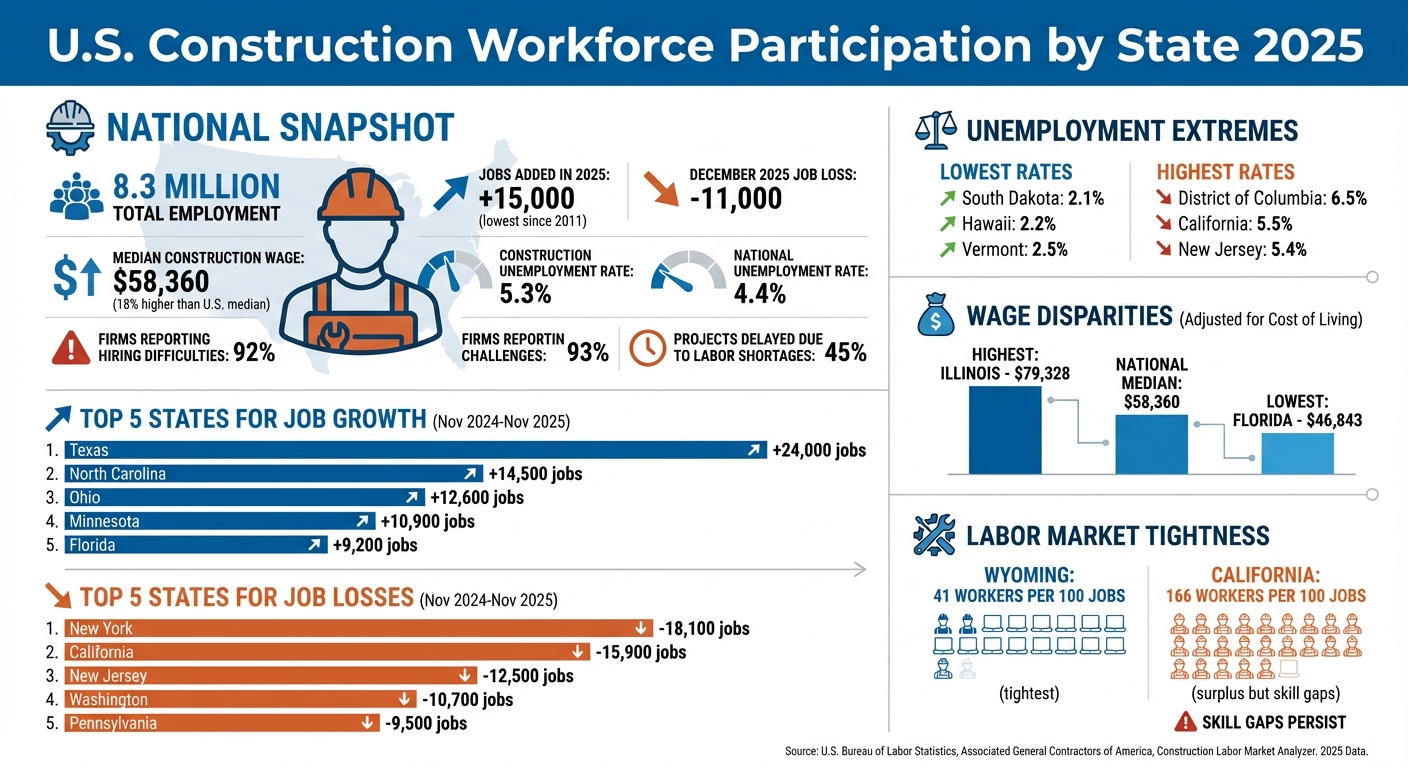
U.S. Construction Workforce Participation by State 2025: Job Growth, Unemployment Rates, and Labor Shortages
National Construction Workforce Trends
Unemployment and Employment Growth Numbers
The construction industry hit some rough patches in 2025. In December alone, the sector lost 11,000 jobs, pushing the unemployment rate in construction to 5.3%. This was notably higher than the national unemployment rate, which dipped slightly to 4.4%.
Over the course of the year, construction added just 15,000 jobs – a number that hasn’t been this low since 2011, aside from the early pandemic days. Anirban Basu, Chief Economist at Associated Builders and Contractors, summed it up:
Excluding the first year of the COVID-19 pandemic, that’s the worst 12-month performance since 2011, when the construction industry was still spiraling from the Great Recession.
Zooming out to the overall labor market, only 584,000 nonfarm jobs were added in 2025, marking the slowest growth outside of a recession since 2003.
The labor force participation rate also took a slight hit, dropping to 62.4% in December 2025. For workers in their prime (ages 25–54), the participation rate stood at 83.8%. Within construction, nonresidential jobs fell by 7,800, residential construction dropped 3,100, but heavy and civil engineering contractors managed to add 2,300 positions.
These national trends, however, don’t tell the whole story. State-level data reveals a much more complex picture.
How Workforce Metrics Differ Between States
While national numbers provide a snapshot, the state-level breakdown shows just how uneven the construction job market was. Between November 2024 and November 2025, Texas stood out, adding 24,000 construction jobs, the most in the country. On the flip side, New York lost 18,100 positions, the largest decline during the same period. Other states making gains included North Carolina with 14,500 new jobs, Ohio with 12,600, and Minnesota, which added 10,900.
As for states losing ground, California shed 15,900 jobs, New Jersey dropped 12,500, and Washington saw a decrease of 10,700 positions.
Unemployment rates also painted a diverse picture. South Dakota boasted the lowest rate at 2.1% in November 2025, while the District of Columbia recorded the highest at 6.5%, followed by California at 5.5% and New Jersey at 5.4%. Some states saw notable shifts: Hawaii’s unemployment rate improved dramatically, dropping from 3.0% to 2.2%, a decrease of 0.8 percentage points between November 2024 and November 2025. On the other hand, Delaware experienced the largest increase, with its unemployment rate climbing by 1.3 percentage points.
State-by-State Workforce Participation Data
10 States with the Lowest Unemployment Rates
Here’s a look at states where labor markets are especially tight. As of September 2025, South Dakota led the nation with the lowest unemployment rate at 2.0%, followed by Hawaii and Vermont, both at 2.5%. North Dakota ranked fourth at 2.6%, while Alabama rounded out the top five at 2.8%. Other states in the top 10 included Montana, Nebraska, and New Hampshire (all tied at 3.0%), with Wisconsin at 3.1% and Maine at 3.2%. By November, South Dakota’s rate ticked up slightly to 2.1%, while Hawaii improved to 2.2%, marking a 0.8-point drop compared to the previous year.
These low unemployment rates are tied to strong regional economies. For instance, North Dakota’s oil and gas boom continues to drive demand for workers, while Nebraska’s agricultural powerhouse – corn, livestock, and ethanol production – keeps participation rates high. Similarly, Utah and Colorado benefit from expanding tech industries and military installations.
10 States with the Highest Unemployment Rates
On the other end of the spectrum, the District of Columbia reported the highest unemployment rate at 6.2% in September 2025, which climbed to 6.5% by November. California followed at 5.6%, with Nevada at 5.3%, and both New Jersey and Oregon at 5.2%. Michigan came in at 5.1%, while Kentucky, Massachusetts, and Alaska each reported 4.7%. Delaware rounded out the top 10 at 4.5% in September, but by November, its rate had risen to 4.9%, marking the nation’s largest increase at 1.3 percentage points.
Regional Patterns and Economic Factors
These unemployment trends highlight how regional economies influence workforce dynamics. States with strong agricultural bases and rural populations, like South Dakota and Iowa, often maintain lower unemployment rates compared to urbanized areas. On the flip side, states with rapid wage growth – such as Nevada (10.6%), Mississippi (around 10%), and Alaska (around 10%) – face tighter construction labor markets.
As of April 2025, construction wages reflect these trends. Fourteen states reported average earnings above $40 per hour, with the national average reaching $39.30 – a 3.6% year-over-year increase. Alaska and Massachusetts topped the list with wages exceeding $50 per hour, while Arkansas had the lowest at $29.30 per hour. Adjusted for cost of living, Illinois emerged as the top state for contractors, with plumbers earning over $93,000 annually.
In terms of construction activity, Texas leads the nation with more than 74,000 active projects. New Jersey and Washington follow with over 11,000 and 10,500 projects, respectively. This surge in projects directly fuels workforce demand, with carpenters being the most sought-after trade in nearly 30 states. However, labor needs vary by region: welders are in high demand in Alaska and Arkansas, while HVAC technicians top the list in Florida, South Dakota, and Delaware.
Workforce Demand Challenges and Solutions
Labor Shortages and Project Delays
The construction industry is grappling with a workforce crisis that’s delaying projects nationwide. Recent data from the Associated General Contractors of America paints a stark picture: 92% of construction firms report difficulty filling open positions. Even more concerning, 45% of firms have had to delay at least one project due to labor shortages.
"Most firms are struggling to find enough workers to hire amid persistent labor shortages. These labor shortages are the number one cause for delayed construction projects, according to our recent survey." – Ken Simonson, Chief Economist, Associated General Contractors of America
Even in regions where job growth is strong, firms are still struggling to find qualified talent. State-level fluctuations in job availability only add to the complexity. On top of that, nearly one-third of firms report that immigration enforcement issues are affecting their workforce. Meanwhile, the lack of federal investment in construction education and vocational training programs continues to hinder the development of a skilled labor pipeline. These challenges highlight the urgent need for solutions to address worker shortages and qualifications.
Skill Gaps and Worker Training Needs
The shortage of skilled workers is another significant hurdle, further slowing down projects. Many firms are finding that applicants lack the qualifications needed to meet industry demands. This gap is especially pronounced in rapidly growing states, where local labor markets can’t keep up with the surge in demand for skilled workers.
"Workforce shortages aren’t just making life hard for construction firms. The lack of qualified workers is making it harder for the economy to expand." – Jeffrey D. Shoaf, CEO, Associated General Contractors of America
To tackle these issues, industry leaders are urging federal and state governments to increase funding for construction education and training programs. At the same time, many companies are stepping up with their own solutions, such as internal training initiatives that include mentoring, coaching, and cross-functional training. These efforts aim to equip employees with the skills needed for multiple roles. Standardizing training programs and validating professional credentials have also become key strategies to prepare the workforce for future demands.
How Technology Improves Workforce Deployment
Modern technology offers promising solutions to address both labor shortages and skill gaps. Workforce deployment platforms are transforming how firms connect with workers, making the hiring process faster and more efficient. For example, ABLEMKR‘s mobile-first platform matches pre-vetted workers to job sites based on certifications, safety training, availability, and location, enabling quick crew mobilization and reducing project delays.
The platform also provides real-time worker tracking, streamlined payroll, and built-in compliance features. For workers, it ensures flexible access to well-paying opportunities with guaranteed on-time payments. By automating job matching and verifying credentials upfront, these tools reduce the delays and inefficiencies that have traditionally slowed down labor deployment. As a result, companies can fill critical positions more quickly, keeping projects on track and minimizing disruptions.
sbb-itb-aa28329
Data ‘Distortions’ Affecting Jobs Report, Says Labor Department’s Pollak
Conclusion: What This Means for Construction and Energy
The data paints a clear picture: workforce disparities vary widely across the U.S., creating unique challenges for construction and energy firms. While the national labor force participation rate hovers between 62% and 63%, states like West Virginia (54.6%) and Mississippi (55.6%) struggle with smaller labor pools. Meanwhile, states like Colorado (67.0%) and Iowa (67.5%) boast higher participation rates. These gaps make it difficult for companies to staff large-scale projects consistently across regions.
The Worker Shortage Index further highlights the issue. Wyoming, for example, has only 41 workers available for every 100 open jobs, and North and South Dakota fare only slightly better with 45 per 100. On the other hand, states like California (1.66) and New Jersey (1.48) show labor surpluses. But even in surplus states, hiring isn’t guaranteed – many workers lack the specialized skills or certifications needed for specific roles.
This shortage directly impacts operations:
"If businesses can’t hire the workers they need, they cannot grow or reach full productivity potential." – Stephanie Ferguson Melhorn, Executive Director, Workforce & International Labor Policy, U.S. Chamber of Commerce
The construction industry, in particular, faces a steep uphill battle. By 2025, an estimated 439,000 additional construction workers will be needed. Yet, as of November 2025, only 259,000 job openings were recorded. Solutions like ABLEMKR’s technology, which quickly matches pre-vetted workers to job sites, offer a way to address these regional labor challenges.
These findings emphasize the importance of strategic workforce planning. For companies operating across multiple states, understanding regional labor dynamics is no longer optional – it’s essential. Success will depend on efficient worker allocation, instant credential verification, and maintaining compliance. These factors will determine whether projects move forward smoothly or face costly delays.
FAQs
What are the main causes of labor shortages in the U.S. construction industry?
The construction industry is grappling with labor shortages due to a mix of challenges:
- Retirements outpacing new hires: Experienced workers are leaving the workforce faster than they can be replaced. The industry needs hundreds of thousands of new workers to bridge this gap, but attracting fresh talent has proven difficult.
- Lack of skilled labor: Many contractors are finding it tough to fill craft-worker positions. These roles often remain vacant for extended periods, slowing down projects.
- Economic pressures: High interest rates have dampened new-home construction, which traditionally creates job opportunities and draws workers into the sector.
- Policy and regulatory uncertainty: Fluctuating regulations, delayed funding, and proposed tariffs have led to project postponements and cancellations, further straining the labor market.
- Decline in union membership: With fewer workers joining unions, structured training programs have dwindled, leaving firms struggling to address skill shortages.
These factors – ranging from an aging workforce to economic and regulatory hurdles – are at the heart of the construction industry’s labor challenges today.
How do wage differences influence construction workforce participation across states?
Wage differences significantly influence construction workforce participation across the U.S. States offering higher wages, like California and New York, tend to draw and keep more workers, while lower-paying states such as Mississippi and West Virginia often face challenges with recruitment and high turnover. Several factors contribute to these wage disparities, including local demand for labor, union presence, housing costs, and federal funding for projects.
For instance, unionized workers earn about 12.8% more than their non-union peers. This wage advantage boosts participation rates in union-dense regions like the Northeast and Midwest. On the other hand, states with a stronger reliance on non-union labor, such as Texas and Florida, often contend with lower wages and higher rates of worker attrition.
Platforms like ABLEMKR are stepping in to address these challenges. By connecting skilled workers with better-paying opportunities, these tools help employers attract talent even in areas traditionally known for lower wages. With features like real-time job matching and transparent pay details, platforms like ABLEMKR make it easier for workers to secure higher-value projects quickly and efficiently.
What technologies are helping address labor shortages in construction?
Construction companies are increasingly turning to data-driven technologies such as analytics, machine learning, AI, and IoT to address labor shortages. When combined with mobile-first, cloud-based workforce platforms, these tools simplify critical tasks like hiring, scheduling, and ensuring compliance.
With these advancements, companies can efficiently match skilled workers to job sites, verify certifications and safety requirements, and optimize workforce deployment. This not only helps meet pressing labor demands but also boosts productivity over the long haul.


