
Hiring the right structural engineer for oil and gas projects is critical to ensure safety, regulatory compliance, and project success. These engineers handle everything from design and compliance to managing risks like fatigue damage and extreme loads. Here’s a quick breakdown of what you need to know:
- Key Qualifications: A bachelor’s in civil, structural, or petroleum engineering (master’s preferred), PE license, and offshore certifications like BOSIET or HUET.
- Skills to Look For: Proficiency in software like SACS, SESAM, and STAAD.Pro Offshore, plus experience in FEED, brownfield modifications, and marine operations.
- Industry Experience: Hands-on expertise in offshore structures, aging infrastructure, and safety compliance is a must.
- Where to Find Candidates: Use niche job boards like Rigzone, specialized recruitment agencies, and platforms like LinkedIn for targeted searches.
- Screening Process: Focus on technical interviews, scenario testing, and verifying certifications to ensure candidates meet project demands.
With an average hiring time of 36–42 days and growing demand for skilled professionals, using tools like ABLEMKR can simplify the process by automating credential verification and matching candidates to your needs.
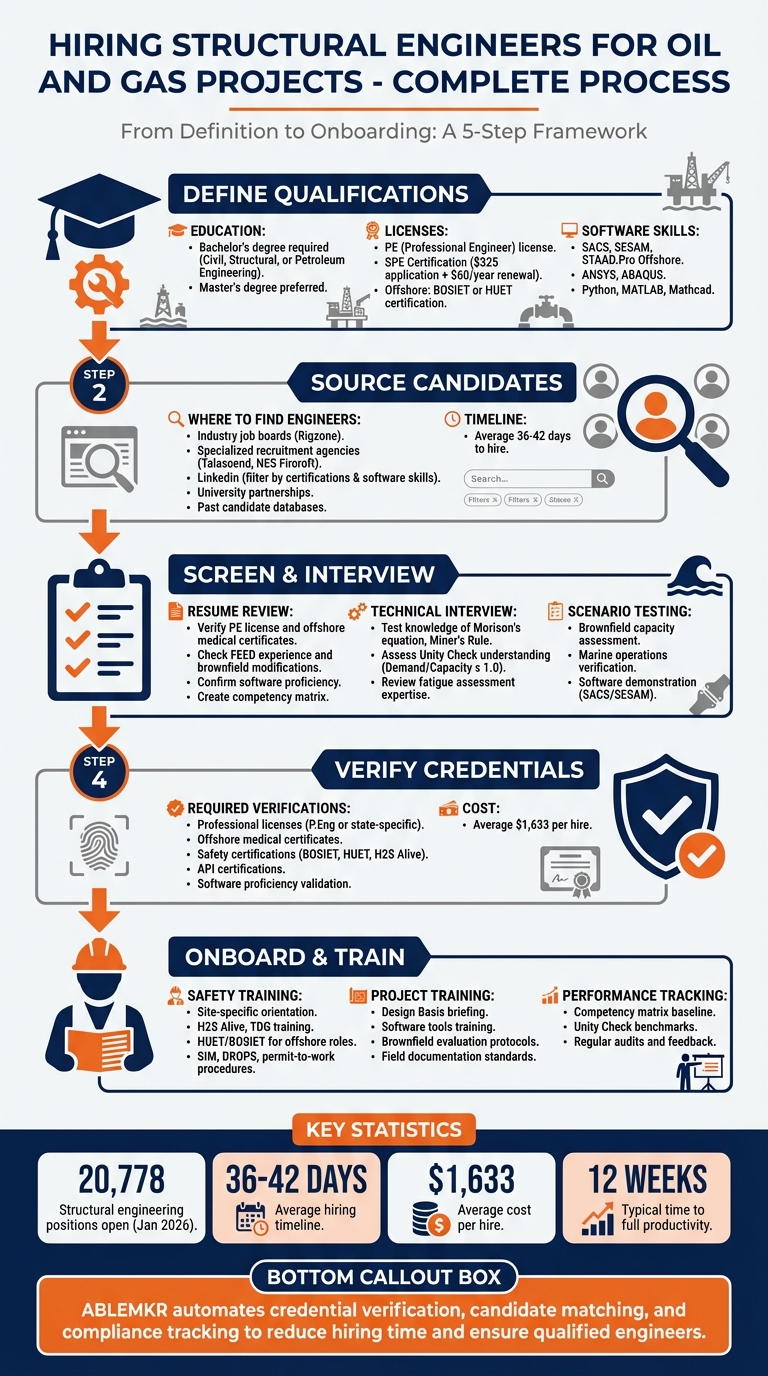
5-Step Process for Hiring Structural Engineers in Oil and Gas Projects
15 Oil & Gas Equipment Every Structural Engineer Must Know
sbb-itb-aa28329
Required Qualifications and Certifications
To excel in this role, candidates need to meet specific educational, professional, and industry-related qualifications.
Education Requirements
A bachelor’s degree in civil, structural, or petroleum engineering is the baseline requirement for structural roles in the oil and gas sector. However, many companies favor candidates with advanced degrees. A master’s in structural engineering is particularly valuable as it equips engineers with advanced skills in complex analysis methods – essential for designing offshore platforms and refinery structures. Proficiency with industry-standard software like SACS, SESAM, and STAAD.Pro Offshore is also expected.
Professional Licenses and Certifications
In addition to academic credentials, professional licensure is a must for leadership roles. The Professional Engineer (PE) license is legally mandated in most U.S. states for senior engineering positions. To earn this, candidates must pass the NCEES PE Structural Exam. In states such as California, engineers must first obtain a Civil Engineer license before pursuing the specialized SE title, which requires documented work experience across three projects.
For global recognition, the Society of Petroleum Engineers (SPE) Petroleum Engineering Certification is highly regarded. This credential comes with a $325 application fee and a $60 annual renewal fee. Applicants need at least four years of engineering experience and must complete 16 hours of professional development annually to maintain their certification.
"Having a recognized international professional body (SPE) providing the certification was of value to the credential. SPE succeeded in opening the minds of engineers to not focus only on one part of their job, but to develop additional skills." – Ali R. Al-Jarwan, CEO of ADMA
For offshore projects, additional certifications are non-negotiable. Engineers must hold valid offshore medical certificates and complete survival training programs like BOSIET (Basic Offshore Safety Induction and Emergency Training) or HUET (Helicopter Underwater Escape Training). Without these, access to offshore rigs or FPSOs is prohibited, regardless of technical qualifications.
Oil and Gas Industry Experience
Hands-on experience in the oil and gas sector is a critical differentiator. Engineers with a background in brownfield modifications – involving tasks like ultrasonic testing to assess structural integrity and managing corrosion allowances – are especially valuable for aging infrastructure projects. Progressing from Structural Engineer to Senior Structural Engineer typically requires completing 2–3 offshore projects from the concept phase through detailed design.
"For young engineers, the challenges are there, and we are relying on them to fill the experience gap. However, these SPE results show that our next generation of engineers has the skills and professional focus to meet the challenges." – Amin H. Nasser, CEO of Saudi Aramco
Candidates with experience in marine operations, such as sea fastening and lifting, demonstrate the kind of precise engineering judgment that only practical project involvement can develop. These qualifications and experiences form the foundation for evaluating a candidate’s readiness for advanced responsibilities.
Core Skills and Job Responsibilities
Structural engineers working on oil and gas projects face a variety of complex technical challenges. Their responsibilities range from analyzing offshore platforms subjected to extreme wave forces to ensuring aging infrastructure can safely handle upgrades. They also play a key role in coordinating marine operations to maintain structural integrity.
Technical Expertise for Oil and Gas Structures
Structural engineers rely on advanced analytical techniques to ensure the safety and durability of oil and gas structures. They perform linear, nonlinear, modal, and dynamic analyses to address metocean and operational loads. Key calculations include using Morison’s equation for wave loading, Euler’s formulas for column buckling, and Miner’s Rule for fatigue assessment, ensuring the Unity Check (Demand/Capacity) does not exceed 1.0.
To prevent structural failures, engineers conduct fatigue and fracture assessments, utilizing S–N curves and spectral methods to monitor crack growth in welded joints and schedule inspections accordingly. In brownfield projects, ultrasonic thickness (UT) data helps assess the current structural capacity, guiding modifications to prolong the life of aging assets. Engineers also address critical interfaces, such as pile-to-soil connections and the integration of topsides, substructures, and risers, ensuring the entire system remains stable. This technical precision is vital for upholding safety and regulatory standards.
Safety and Regulatory Compliance
Safety is a cornerstone of structural engineering in oil and gas. Engineers lead HAZID (Hazard Identification) sessions and structural risk workshops during the concept and FEED stages, ensuring potential risks are addressed early. They adhere to offshore structural design codes, apply partial safety factors, and collaborate closely with regulators and surveyors. Structural Integrity Management (SIM) encompasses setting inspection strategies, identifying critical joints, and grading anomalies to monitor fatigue damage and material loss over time.
Compliance with regional Occupational Health and Safety (OHS) regulations is another critical aspect of the job. These regulations vary by jurisdiction, covering topics like chemical exposure limits and confined space definitions. Offshore assignments often last between 3 and 21 days for surveys or installations, with construction rotations typically following 21/21 or 28/28 day schedules. During these rotations, engineers frequently work 12-hour shifts, including nighttime hours during high-priority campaigns. These tasks demand individuals who can seamlessly integrate safety and efficiency into their work.
Engineering Software Skills
Proficiency in specialized software is essential for structural engineers to manage the technical and compliance-related demands of their role. Tools like Python, MATLAB, and Mathcad are particularly valued for automating repetitive calculations, streamlining parametric studies, and improving overall project efficiency. Software expertise is often a key focus during candidate evaluations and interviews.
| Software Category | Common Tools | Primary Application |
|---|---|---|
| Offshore Analysis | SACS, SESAM, STAAD.Pro Offshore, USFOS | Global integrity checks, storm/seismic analysis, and jacket design |
| FEA & Detailing | ANSYS, ABAQUS | Weld hotspot stress, joint submodeling, and plate buckling analysis |
| Hydrodynamics | OrcaFlex, SIMO | Coupled wave load analysis and floating structure evaluations |
| Drafting & BIM | AutoCAD, E3D/PDMS, Navisworks, Tekla | 3D modeling, steel detailing, and clash detection |
| Calculation & Scripting | Mathcad, MATLAB, Python | Custom formulas, post-processing, and automation of engineering tasks |
Mastery of these tools not only enhances technical performance but also allows engineers to tackle projects efficiently, meeting the rigorous demands of the oil and gas industry.
Where and How to Find Qualified Engineers
Locating skilled structural engineers for oil and gas projects means tapping into resources tailored to this highly specialized field. With the complexity of offshore structures, subsea systems, and strict regulatory standards, it’s crucial to focus on professionals who bring relevant industry expertise – and knowing where to find them is half the battle.
Start with industry-specific job boards like Rigzone, which cater exclusively to energy sector roles. These platforms host job listings from major players such as Saudi Aramco, Halliburton, and Saipem. By targeting a niche audience, these boards help narrow the pool to candidates with the right skills, saving time during the initial screening process. Beyond job boards, there are other avenues that can yield excellent results.
Specialized recruitment agencies are another valuable resource. Agencies like Talascend and NES Fircroft maintain extensive networks of engineers with oil and gas experience. For instance, Talascend played a key role in staffing the Sabine Pass LNG receiving terminal from 2005 to 2009, sourcing contractors for liquefaction capabilities and production trains. They also supplied engineers for the Corpus Christi Liquefaction Project, the first greenfield LNG export facility built in the U.S. in nearly five decades. According to Talascend, their Oil & Gas Division connects employers with a vast pool of engineers experienced in upstream, midstream, and downstream projects.
To expand your reach, combine agency expertise with social media platforms like LinkedIn. Professional networks are invaluable for finding both active and passive candidates. Use advanced search tools to filter for specific certifications (such as IWCF) or software skills (like SACS and SESAM) to identify engineers with offshore or subsea experience. Additionally, partnering with universities and maintaining a database of past candidates can help build a long-term talent pipeline. This multi-faceted approach ensures you’re casting a wide net while still targeting the right talent.
Candidate Screening and Interview Methods
Once you’ve identified potential engineers, the next step is a thorough screening process. This ensures you’re selecting individuals who not only look good on paper but can also handle the technical and safety demands of your project – especially in high-stakes environments.
How to Review Resumes
Start by verifying key qualifications. Check for professional licensing (like P.Eng or state-specific credentials) and a relevant bachelor’s degree. For offshore roles, confirm they hold valid offshore medical certificates and have experience with helicopter or boat transfers.
Look for technical expertise that aligns with your project needs. Resumes should highlight experience in areas like Front-End Engineering Design (FEED), global structural analysis, and fatigue assessment. If your project involves brownfield modifications, prioritize candidates with experience in evaluating existing structures for as-is capacity, corrosion allowance, and managing change protocols. Software skills are equally important – check for proficiency in tools like SACS, SESAM, STAAD.Pro Offshore, or USFOS.
To streamline the process, create a competency matrix. This allows you to compare candidates’ certifications, software skills, and project experience side by side. For offshore roles, also look for "field-ready" indicators, such as experience with site visits, yard exposure, and on-call engineering support during offshore campaigns.
Technical Interview Questions
Your interview should focus on the specific challenges candidates will face in offshore and brownfield environments. Start by asking them to draw and interpret shear and moment diagrams to pinpoint maximum load points. For offshore projects, dive into topics like metocean loads, hydrodynamics, and the differences between Morison and diffraction effects.
Include questions that test their grasp of essential formulas and calculations. For example, ask them to explain the Morison wave loading equation or Miner’s rule for fatigue damage. Present a scenario where the Unity Check (Demand/Capacity ratio) exceeds 1.0 and ask how they would address it through design modifications. Assess their understanding of fatigue by discussing spectral and time-domain analyses, S-N curves, and hotspot stress extraction. For brownfield projects, explore their approach to capacity assessments using ultrasonic testing (UT) data and corrosion allowance.
Marine operations knowledge is another key area to probe. Ask about their approach to loadout, transport, lifting, and seafastening analyses. Additionally, ensure they understand regulatory standards, such as load/resistance factoring and offshore structural design codes.
"Structural engineers with experience researching, interpreting, and incorporating design codes into their work will be focused on limiting loss of life and liability for the company" – LinkedIn
These technical questions can be further complemented by practical scenarios to test their problem-solving skills.
Practical Scenario Testing
Scenarios based on real-world challenges are invaluable for evaluating a candidate’s ability to perform under pressure. For brownfield projects, present a scenario where they must assess structural capacity using corrosion data and UT results. Ask them to outline their process, from initial evaluation to recommending reinforcements, while adhering to management of change protocols.
For offshore roles, test their marine operations expertise. For example, have them verify rigging, padeyes, and spreader frames, then produce a method statement for installation. Provide a geotechnical report and ask how they would interpret soil test results to recommend ground improvements, particularly in relation to seismic activity and slope stabilization. To assess their software skills, ask them to demonstrate a global analysis using tools like SACS or SESAM, or perform a finite element analysis in ANSYS or ABAQUS.
Behavioral questions can also provide insight into their problem-solving styles. For instance, ask them to describe a time they faced a "seemingly insurmountable" technical challenge and how they resolved it. For field positions, confirm their ability to handle demanding conditions, such as 12-hour shifts, working at heights, and accessing confined spaces. This ensures they possess not only the technical knowledge but also the resilience needed for on-site work.
"Any oversight or error can lead to serious consequences, so precision is key" – The Amtec Team
Onboarding and Training Process
Once you’ve carefully selected your structural engineer, the next critical step is onboarding. This process sets the stage for how quickly and effectively the engineer can adapt to your project’s demands. A well-structured onboarding program ensures engineers are equipped with safety protocols, technical know-how, and clear performance expectations from the start. This foundation seamlessly transitions into ongoing project performance management, keeping operations smooth and efficient.
Safety and Compliance Training
Before stepping onto the work site, every engineer must complete a site-specific orientation. This training typically includes essential topics like entry protocols, fall protection, housekeeping, and emergency procedures. For roles in specialized industries like oil and gas, additional certifications are often required. For example, engineers may need H2S Alive for hydrogen sulfide awareness or Transportation of Dangerous Goods (TDG) training. Offshore roles often demand valid medical certificates and survival training, such as HUET (Helicopter Underwater Escape Training) or BOSIET (Basic Offshore Safety Induction and Emergency Training). Always verify these certifications directly with the issuing organizations to ensure compliance.
"Safety as a philosophy may not change much from place to place, but the devil is in the details. Different authorities disagree on minutiae like safe angles and distances, chemical exposure limits, yield limits for protective equipment, the definition of confined space, and every other imaginable criteria." – Pat Robinson, President, CQ Network
Local regulations can add complexity, especially if you’re hiring engineers from outside the area. Providing training on regional Occupational Health and Safety (OHS) standards is crucial, as these can vary widely. For offshore projects, include training on Structural Integrity Management (SIM), DROPS (Dropped Objects Prevention Scheme), and permit-to-work procedures to ensure safety and compliance.
Project-Specific Training
Kick off the onboarding process by briefing engineers on the Design Basis, which outlines environmental conditions, metocean data, and load cases specific to the project. Clearly define reporting lines and responsibilities across disciplines from the outset. For projects involving existing assets, such as brownfield developments, provide training on evaluating current conditions – this might include skills like ultrasonic testing to assess structural capacity – and managing structural integrity protocols.
It’s also vital to ensure engineers are comfortable with the project’s software tools and capable of producing clear, actionable documentation for field use. These steps help bridge the gap between engineering decisions and practical implementation.
Setting Up Performance Tracking
Once onboarding is complete, ongoing performance tracking becomes key to maintaining quality and compliance. Start by using a competency matrix to establish baseline requirements, including necessary training, professional credentials (such as P.Eng), and safety certifications. This matrix acts as a reference point for assessing both readiness and ongoing compliance.
Regular inspections and audits should follow, using benchmarks like the Unity Check (Demand/Capacity ≤ 1.0) to measure performance. Document all progress in a centralized system to ensure accountability and provide a clear overview of each engineer’s development.
Digital tools can simplify this process dramatically. For example, in September 2025, BHP partnered with MyPass Global to implement a Global Contractor System. This platform provides a centralized record of workforce credentials and compliance data, giving project managers real-time visibility while reducing manual administrative tasks. Similar systems allow engineers to self-manage their certifications, streamlining operations for everyone involved.
Beyond technical skills, it’s important to evaluate how effectively engineers handle interface leadership – their ability to manage handoffs and communicate with other teams. For offshore or yard-based roles, assess whether they can produce field-ready documentation that translates engineering decisions into clear guidance for installation crews. Regular feedback, paired with thorough documentation, fosters continuous improvement and ensures any performance issues are addressed promptly.
Using ABLEMKR to Simplify Hiring
ABLEMKR is transforming how structural engineers are hired for oil and gas projects, addressing the common hurdles faced in the industry. Traditionally, filling a single engineering role takes about 36–42 days and costs an average of $1,633 per hire. With 20,778 structural engineering positions open across the U.S. as of January 2026, competition for skilled professionals is fierce. ABLEMKR simplifies this process by automating repetitive hiring tasks while maintaining compliance standards. This approach speeds up hiring without compromising on quality.
Automated Matching for Engineering Roles
ABLEMKR’s mobile-first platform takes the guesswork out of finding the right candidates. It filters applicants based on certifications, industry experience, and location, eliminating the need for manual profile reviews. For instance, if you’re hiring a structural engineer with specific credentials like BOSIET, API certifications, or H2S Awareness, the system automatically identifies candidates with verified qualifications that match your criteria. This geo-location feature is particularly useful for time-sensitive projects, such as remote pipeline repairs or offshore operations, where assembling the right team quickly can prevent costly delays.
The platform is designed to adapt to various hiring needs, whether it’s short-term workers for shutdowns or long-term placements for ongoing projects. This flexibility ensures that as project requirements evolve, you can always find the right professionals while staying compliant.
Pre-Verified Profiles and Credentials
Every engineer on ABLEMKR undergoes a thorough vetting process. Certifications are verified directly with issuing authorities to ensure they’re legitimate. The platform maintains a Verified Skills Profile for each candidate, consolidating all essential documentation, including BOSIET, API certifications, and state-specific engineering licenses. Additionally, ABLEMKR’s vetting team conducts interviews tailored to your project’s unique requirements, ensuring that only the most qualified professionals are recommended.
To avoid disruptions, ABLEMKR also flags upcoming certification expirations. This proactive system ensures that engineers arrive on-site fully qualified, preventing delays caused by expired credentials – a common issue that can derail critical projects and inflate costs.
Real-Time Worker Status and Compliance Monitoring
Once an engineer is hired, ABLEMKR’s mobile app offers real-time workforce management tools. You can track worker locations, manage on-site schedules, and monitor certification statuses. Integrated payroll workflows and compliance tracking provide a clear view of every worker’s standing, all in one place.
This centralized approach is especially valuable for managing multiple projects across different states, each with its own licensing and regulatory requirements. Instead of scrambling to verify whether an engineer’s Well Control certification (valid for 2–5 years) is current, you’ll have instant access to all compliance data. By ensuring transparency and accountability throughout the hiring process, ABLEMKR reduces the risk of regulatory violations that could disrupt operations and lead to penalties.
Summary
Recruiting structural engineers for oil and gas projects requires a careful mix of technical expertise, adherence to safety standards, and operational efficiency. With 20,778 open positions and an average hiring timeline of 36–42 days, project managers face the challenge of speeding up recruitment without cutting corners. Success hinges on clearly defining technical needs – such as proficiency in tools like AutoCAD and RISA – and ensuring candidates hold critical certifications like IWCF. Structured screening processes that evaluate both technical abilities and qualities like resilience and problem-solving are crucial.
Beyond identifying the right talent, verifying licenses, API certifications, and safety training is a must before engineers can begin work. Traditional hiring methods often fall short in managing these complexities, causing delays and risking compliance issues. As Darcy Pashak, Director of Operations at NES Global Talent, points out:
"Hiring competent staff members with the necessary talent, skills, knowledge and desire will reduce incidents, operating costs, injuries and equipment damage".
These challenges align with earlier discussions about the importance of effective screening and onboarding practices.
ABLEMKR addresses these hurdles by automating credential verification, matching engineers by location and certifications, and offering real-time compliance tracking. This automation ensures that every engineer is fully qualified, building on earlier points about efficient candidate screening. For project managers overseeing multiple sites in different states, this centralized system prevents disruptions caused by expired certifications or overlooked requirements.
Additionally, ABLEMKR’s integrated payroll and performance tracking tools streamline onboarding, cutting down the typical 12-week period it takes for new hires to reach full productivity. By reducing administrative bottlenecks and ensuring transparency throughout the hiring process, ABLEMKR helps oil and gas companies deploy qualified structural engineers more quickly – whether for emergency shutdowns, remote pipeline repairs, or major infrastructure projects.
FAQs
What qualifications should I look for when hiring a structural engineer for oil and gas projects?
When hiring a structural engineer for oil and gas projects, start by confirming they have a bachelor’s degree in civil or structural engineering from an accredited institution and hold a Professional Engineer (PE) license in the state where the project will take place. This license ensures they meet the necessary legal and professional standards to design and approve structural work.
It’s important to find candidates with specialized experience in oil and gas projects. They should be skilled in addressing gravity, live, lateral, and environmental loads and have a solid understanding of state and federal building codes as well as industry standards like API and ASME. For offshore or high-risk projects, expertise in fatigue analysis, marine operations engineering, and metocean load assessment is especially valuable.
The ideal candidate will also have practical experience working on pipelines, platforms, FPSO topsides, and decommissioning projects, demonstrating their capability to handle the full lifecycle of oil and gas infrastructure.
How can I verify that a structural engineer’s certifications and licenses are valid and up to date?
To verify that a structural engineer’s certifications and licenses are up to date, start by asking for their license number and engineering discipline (such as PE-Civil or PE-Structural). Then, head to the appropriate state licensing board’s website and use their online lookup tool. This will let you confirm that the license is active and hasn’t expired. While you’re there, check for any disciplinary actions or enforcement records associated with the license. If anything seems unclear, you can always reach out to the licensing board directly for more details.
For other certifications, like OSHA or API, request documentation from the engineer and verify their authenticity with the organization that issued them. If you’re looking for a more streamlined way to handle this, platforms like ABLEMKR can help. They pre-verify certifications and monitor compliance in real time, making it easier to ensure that all hires meet the necessary regulatory standards for oil and gas projects.
What’s the best way to quickly hire a qualified structural engineer for an oil and gas project?
To quickly bring a skilled structural engineer on board, start by crafting a clear and detailed job description. Be specific about the project scope, required state licensure, and any relevant industry experience, such as expertise in offshore or pipeline structures. Make sure to emphasize critical technical certifications, safety training, and soft skills like the ability to solve problems under pressure. It’s also important to verify credentials – check licenses, insurance coverage, and portfolios, and ask for references or case studies to confirm their reliability.
You can speed up the hiring process by leveraging specialized platforms like ABLEMKR. These platforms connect you with pre-screened engineers who already meet your certification, safety, and location criteria. They simplify tasks like sourcing, onboarding, compliance checks, and payroll, enabling you to assemble a team in just days rather than weeks. Lastly, involve senior project staff in the interview process to assess the candidate’s communication and problem-solving abilities. This ensures the engineer can integrate seamlessly into your team and keep your project running smoothly.


