
The Inflation Reduction Act (IRA) and Bipartisan Infrastructure Law (BIL) are reshaping the U.S. job market by injecting $370 billion into clean energy initiatives. These investments have sparked rapid growth in green jobs, with the energy sector adding 250,000 roles in 2023 alone – 58% of which were in renewable energy. This trend is expected to create up to 9 million green jobs over the next decade.
However, the surge in demand for skilled workers is exposing challenges like regional workforce shortages, skill gaps, and compliance hurdles tied to federal tax credits. Companies are struggling to find qualified electricians, technicians, and apprentices to meet labor requirements.
Platforms like ABLEMKR are stepping in to solve these issues by automating workforce deployment. They match pre-vetted workers to projects, track compliance in real time, and ensure projects meet federal standards efficiently. This technology helps speed up hiring and keeps projects on schedule, ensuring the green energy transition stays on track.
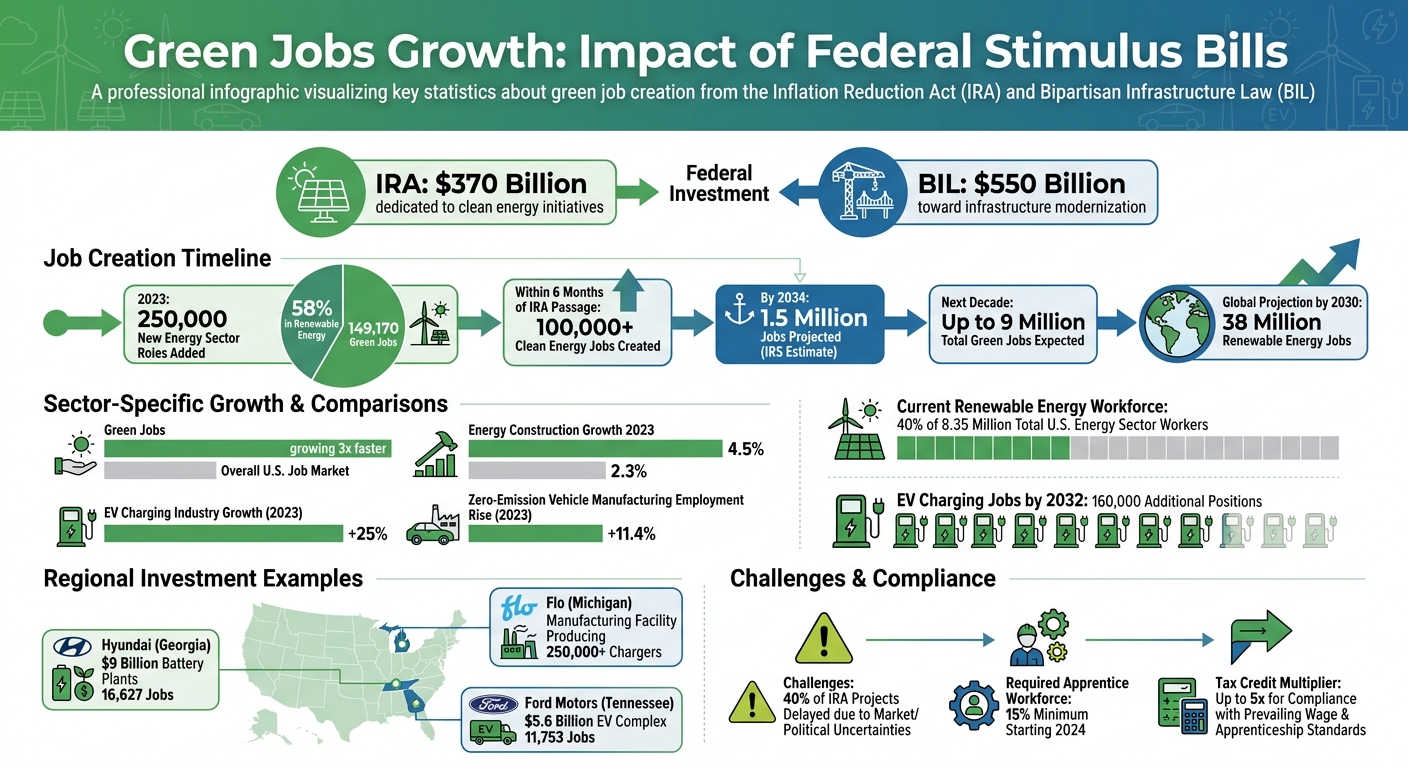
Green Jobs Growth Statistics from IRA and BIL Stimulus Bills 2023-2034
How Stimulus Bills Drive Green Job Growth
Infrastructure Grants and Tax Credits
The Inflation Reduction Act (IRA) and the Bipartisan Infrastructure Law (BIL) are channeling massive funding into green initiatives. The IRA is dedicating $370 billion to renewable energy tax credits, while the BIL is putting $550 billion toward modernizing infrastructure.
New provisions, such as "elective pay" and "transferability", make it easier for tax-exempt organizations to claim full clean energy credits. Projects adhering to prevailing wage and apprenticeship (PWA) standards can qualify for tax credits that are up to five times higher. Starting in 2024, projects must ensure apprentices make up at least 15% of the workforce, which is expected to boost training opportunities and open up more career paths.
These funding tools are not just theoretical – they’re already driving job creation across emerging green industries.
Expected Job Growth in Green Sectors
The impact of the IRA is already visible. Within just six months of its passage, more than 100,000 clean energy jobs were created. The IRS predicts that projects linked to the IRA will result in over 1.5 million jobs by 2034. Some estimates suggest that green jobs could total as many as 9 million over the next decade.
Certain sectors are seeing especially rapid growth. For example, the electric vehicle (EV) charging industry grew by 25% in 2023 and is projected to add another 160,000 jobs by 2032. Solar and wind energy installations remain dominant forces, with renewable energy now employing over 40% of the 8.35 million people working in the U.S. energy sector. Manufacturing is also expanding. According to investment bank Evercore, by 2028, the market for manufacturing tax credits may rival that of clean energy production credits.
Regional investments highlight the scope of this growth. Hyundai has committed $9 billion to battery plants in Georgia, a move expected to create 16,627 green jobs. Ford Motors is building a $5.6 billion EV manufacturing complex in Tennessee, projected to add 11,753 jobs. Meanwhile, in Michigan, EV charging company Flo has opened its first U.S. manufacturing facility, aiming to produce over 250,000 chargers.
"This is only the beginning – we’re months after the passage of the Inflation Reduction Act and we’re already at the precipice of a renewed manufacturing, Made in America boom."
– Lori Lodes, Executive Director, Climate Power
sbb-itb-aa28329
Challenges in Meeting Green Job Demand
Skill Gaps and Training Needs
The rapid expansion of the green energy sector has exposed a major shortage of workers with the expertise needed for specialized roles. Industries are scrambling to find electricians, technicians, mechanics, and construction workers with the qualifications to handle modern installations. These include advanced systems like heat pumps, geothermal setups, EV chargers, and battery storage units – projects that demand a higher level of technical proficiency.
"Inefficient or outdated electric panels cannot supply power to new appliances when existing circuits cannot handle the additional load."
– U.S. Representative Paul Tonko
The Inflation Reduction Act has added more layers of complexity. To unlock full tax credits – up to five times the base incentive – projects starting in 2024 must meet specific labor conditions. For instance, at least 15% of total labor hours must be performed by qualified apprentices. This has created a surge in demand for apprenticeship programs, but many regions lack the infrastructure to support this growth.
"The cost of complying with various conditions attached to the credits (e.g., prevailing wage requirements) diminishes the law’s investment impacts."
– William McBride, Chief Economist at the Tax Foundation
These challenges are amplified by the uneven distribution of skilled workers, further complicating green job deployment.
Regional Workforce Imbalances
The boom in green jobs hasn’t been evenly spread across the country. States like Georgia and Tennessee have seen massive investments, but these concentrated efforts often outpace the availability of skilled workers in the area. This mismatch leaves many projects struggling to find the workforce they need.
The problem is even more pronounced in low-income and rural areas. Programs like the Alternative Fuel Vehicle Refueling Property Credit (30C) aim to encourage green energy development in these regions. However, these areas often lack apprenticeship programs and contractors experienced with federal wage compliance, creating significant barriers to progress. Without the right workforce in place, these gaps slow the rollout of critical green energy projects.
Slow Crew Deployment for High-Risk Projects
Deploying skilled crews quickly has become a significant hurdle for time-sensitive projects. Federal requirements for strict recordkeeping, apprentice qualification verification, and compliance with wage regulations add layers of complexity. These obligations delay the rapid mobilization of crews, especially for high-stakes projects.
"Big manufacturing facilities don’t turn on overnight, and IRA is still only two years old."
– Jack Conness, Policy Analyst at Energy Innovation
The challenge is particularly severe for projects requiring workers with specialized safety certifications and technical credentials. Traditional hiring processes can’t keep up with the demand for pre-vetted, compliant workers, creating bottlenecks that hinder progress on critical infrastructure projects.
Technology Solutions for Workforce Deployment
Automated Job Matching and Pre-Vetted Workers
The Inflation Reduction Act has introduced strict requirements that go beyond what traditional hiring methods can handle. Contractors need workers who already possess the necessary certifications, apprenticeship status, and safety credentials – and they need them fast. ABLEMKR’s platform simplifies this by automating the process of matching pre-vetted workers to projects based on their qualifications, training records, and location.
With this system, contractors can filter workers by certifications and apprenticeship status to meet the 15% labor requirement. This eliminates the tedious task of manually verifying credentials and searching across regions for qualified workers. For projects aiming to secure the 5x tax credit multiplier, having immediate access to workers who meet prevailing wage and apprenticeship standards isn’t just helpful – it’s financially essential. This automated approach also lays the groundwork for smooth compliance tracking and quick crew mobilization.
Real-Time Compliance and Crew Mobilization
Given the IRS’s focus on enforcing IRA tax credit compliance, keeping accurate records is a must. ABLEMKR tackles this challenge with real-time tracking of worker hours, wages, and apprenticeship qualifications. This level of transparency ensures contractors have the documentation they need to claim tax credits while avoiding costly penalties for noncompliance.
The platform also includes geo-location features to speed up crew deployment. Whether it’s a solar project in Georgia or an EV charging station in Tennessee, pre-verified crews can be mobilized instantly, cutting down on delays and keeping projects on schedule.
Benefits for Employers and Workers
By combining efficient job matching and real-time compliance, ABLEMKR delivers clear advantages for both employers and workers. For employers managing projects funded by the $370 billion allocated under the IRA, the platform simplifies complex federal compliance requirements while speeding up the hiring process. Integrated payroll workflows ensure prevailing wages are met, and real-time updates make crew availability crystal clear.
Workers, on the other hand, gain access to well-paying opportunities through a transparent and user-friendly process. The mobile-first platform helps them find jobs that align with their certifications and location preferences. With W2 employment and workers’ compensation coverage, they also enjoy added stability. By removing traditional hurdles in workforce deployment, ABLEMKR creates a direct, efficient connection between skilled workers and the green energy projects that urgently need them.
Future Outlook: Scaling Green Jobs and Workforce Solutions
Long-Term Job Market Shifts
The shift toward green energy is reshaping the U.S. job market in ways that go beyond temporary hiring spikes. Thanks to initiatives like the IRA, industries such as construction, manufacturing, and energy are undergoing lasting changes in how they operate.
In 2023, energy construction grew by 4.5%, nearly doubling the overall construction growth rate of 2.3%. The transformation is even more striking in zero-emission vehicle manufacturing, which saw an 11.4% rise in employment that same year.
"The data clearly show that clean energy means jobs – good jobs, union jobs, and jobs retained – in communities across the country as we race to dominate the global clean energy economy."
– U.S. Secretary of Energy Jennifer M. Granholm
Globally, renewable energy employment is expected to hit 38 million jobs by 2030. For the U.S. to claim its share of this growth, workforce infrastructure must expand as quickly as the physical infrastructure being built. This involves not only increasing the number of workers entering the field but also ensuring they’re ready to meet federal compliance standards and tight project deadlines. As these changes take hold, digital tools will play a key role in aligning workforce capabilities with industry needs.
Technology’s Role in Meeting Labor Demands
Digital platforms are becoming essential in managing the complexities of workforce deployment in the green energy sector. The IRS has prioritized enforcing clean energy tax credit obligations, which come with strict documentation and compliance requirements. Relying on manual systems to handle these demands is no longer practical.
Platforms like ABLEMKR are stepping in to bridge this gap. Their workforce deployment technology automates compliance tracking, streamlines crew assignments, and ensures contractors can meet federal requirements without delays. Features like geo-location tools and pre-vetted worker pools allow projects to scale efficiently across energy corridors and manufacturing hubs. This technology not only addresses immediate labor challenges but also helps build a long-term pipeline of skilled green energy workers across the country.
Green Skills in Demand: The Jobs Shaping a Sustainable 2025
Conclusion
Federal stimulus programs have significantly influenced the U.S. labor market, directing substantial funding toward the green energy sector. Over the next decade, this could lead to the creation of 9 million green jobs. In 2023 alone, green jobs made up 58% of new roles in the energy sector – totaling 149,170 positions.
However, creating jobs is only part of the equation. The industry is grappling with major hurdles in workforce readiness and deployment. For example, 40% of IRA projects have experienced delays due to market and political uncertainties. With green energy employment growing three times faster than the overall U.S. job market, traditional hiring approaches are struggling to keep up. This highlights the pressing need for new workforce strategies.
Digital platforms are stepping in to address these challenges. ABLEMKR, for instance, offers solutions like automated job matching, access to pre-vetted worker pools, and real-time compliance tracking. By connecting skilled laborers with critical projects across the country, it helps mobilize crews quickly while ensuring federal compliance.
The momentum of the green economy shows no signs of slowing. With global renewable energy jobs projected to reach 38 million by 2030, platforms that streamline hiring, compliance, and workforce mobilization will play a key role in scaling the U.S. green workforce and keeping projects on schedule.
FAQs
Which green jobs are growing fastest under the IRA and BIL?
The job market is seeing rapid growth in roles tied to environmental initiatives, thanks to the IRA and BIL. Positions like solar photovoltaic installers, wind turbine technicians, and energy-efficiency consultants are leading the charge. There’s also rising demand for experts in retrofitting and renewable energy projects. Some of these jobs come with salaries reaching up to $115,000 per year, highlighting the need for skilled workers in this expanding sector.
How do prevailing wage and apprenticeship rules affect tax credits?
The Inflation Reduction Act (IRA) ties prevailing wage and apprenticeship rules directly to tax benefits, offering a major incentive for compliance. By meeting these labor standards, projects can unlock tax credits and deductions that are up to five times higher than those available otherwise. This creates a strong financial motivation for adhering to these requirements.
How can ABLEMKR help crews deploy faster and stay compliant?
ABLEMKR simplifies crew deployment by connecting pre-screened workers to job sites, considering factors like certifications, safety training, and location. The platform also supports compliance with tools for real-time worker status updates, integrated payroll processes, and built-in compliance features, enabling companies to assemble teams quickly and effectively.


