
The U.S. faces an infrastructure crisis – not from lack of funding, but from a severe labor shortage. With 500,000 new workers needed by 2026 and 41% of the workforce retiring by 2031, states are struggling to complete critical projects. Federal programs like the Bipartisan Infrastructure Bill are creating jobs, but 66% of construction firms report delays, and 58% have had to cancel or scale back projects.
Key challenges include:
- California: $295 billion in maintenance backlogs, high costs, and retention issues despite strong training programs.
- Texas: Rapid population growth and a 47.6 labor gap score, the worst nationally.
- Florida: Hurricane recovery and grid upgrades stretch an already limited workforce.
The labor shortage drives costs up by 20–30% and delays projects nationwide. Platforms like ABLEMKR are stepping in, connecting contractors with certified workers in 24–48 hours and streamlining hiring processes to address this growing issue.
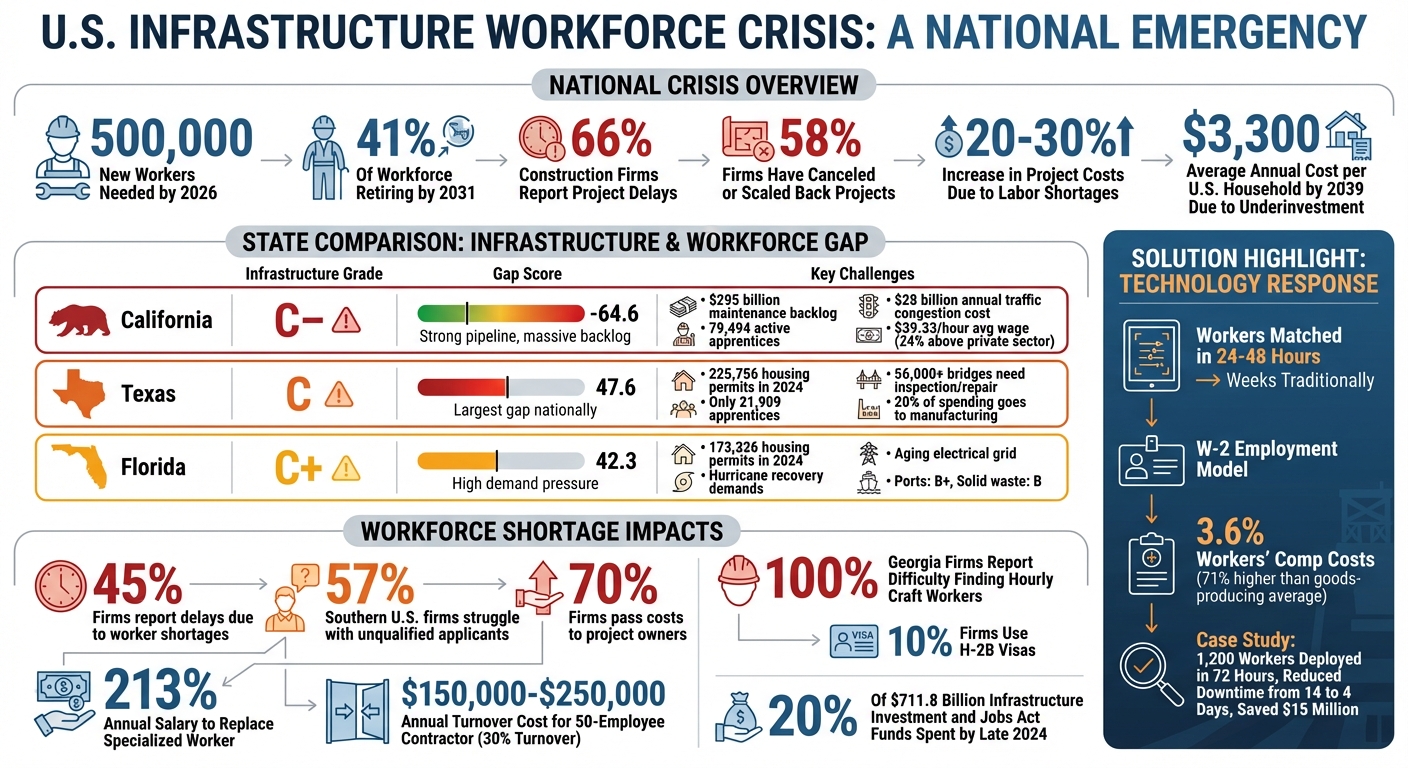
U.S. Infrastructure Workforce Crisis: Key Statistics and State Comparisons 2024-2031
Building Skills from the Ground Up: Solving the U.S. Construction Workforce Crisis
sbb-itb-aa28329
State-Level Infrastructure Spending and Workforce Gaps
California, Texas, and Florida each face unique workforce challenges as they grapple with infrastructure demands. Variations in state budgets and labor availability have a direct impact on how these regions address pressing infrastructure needs.
California: A $295 Billion Maintenance Shortfall
California is staring at a massive $295 billion shortfall in maintenance funding for its roads and bridges over the next decade. Despite having 79,494 active apprentices, the state struggles to keep up with its infrastructure demands, earning a C– grade overall. Traffic congestion alone costs Californians a staggering $28 billion annually.
"If we wait until something breaks, then it’s 5-10 times more expensive to fix it than if you continually invest in its maintenance and renewal." – Yaz Emrani, P.E., Chair of California Infrastructure Report Card Committee
Although wages in California’s construction sector average $39.33 per hour, which is 24% higher than the private-sector average, high living costs make retention a persistent issue. The state’s formal training capacity is strong, as shown by its Gap Score of –64.6, but the sheer scale of deferred maintenance remains a daunting hurdle.
Texas: Balancing Growth and Workforce Gaps
Texas presents a stark contrast, with 225,756 housing permits issued in 2024 but only 21,909 apprentices registered, highlighting a significant shortfall in training capacity. The state has the highest Gap Score in the nation at 47.6, reflecting a growing mismatch between demand and the available workforce. With over 56,000 bridges requiring inspections and repairs, the situation is worsened by rapid population growth.
"Many relocate to Texas, yet they do not come with the accompanying infrastructure." – Austin Messerli, P.E., Co-chair of the Texas Infrastructure Report Card
Texas also faces stiff competition for labor from its booming manufacturing sector. More than 20% of nonresidential construction spending now goes toward manufacturing projects, pulling workers away from infrastructure roles. The state’s overall infrastructure grade of C, with aviation earning a B, underscores the challenges it faces.
Florida: Labor Shortages Amid Resilient Infrastructure
Florida, despite receiving a relatively strong C+ infrastructure grade, is grappling with significant labor shortages. In 2024, the state issued 173,326 housing permits, and its Gap Score of 42.3 highlights the strain on its workforce. The need for specialized labor has surged due to hurricane recovery efforts and resilient rebuilding projects.
"We have some very critical needs: our aging infrastructure, our growing population, and our vulnerability to extreme events." – Kathi Ruvarac, P.E., Chair of Florida’s Infrastructure Report Card Committee
While Florida’s ports earned a B+ and solid waste systems a B, challenges like an aging electrical grid and exposure to extreme weather are driving demand for skilled tradespeople such as electricians, HVAC technicians, and heavy equipment operators. The state has also seen some of the fastest wage growth in the country as it competes to attract and retain workers. These pressures are likely to affect project timelines significantly.
| State | Infrastructure Grade | Key Challenges | Gap Score (Demand vs. Pipeline) |
|---|---|---|---|
| California | C– | Maintenance backlog; retention issues | –64.6 (Strong pipeline, massive backlog) |
| Texas | C | Bridge repairs; population surge | 47.6 (Largest gap) |
| Florida | C+ | Resilient rebuilding; grid upgrades | 42.3 (High demand pressure) |
How Workforce Shortages Affect Infrastructure Projects
Workforce shortages are creating major challenges for infrastructure projects across the country. Nearly 45% of construction firms report delays because they simply can’t find enough workers. But it’s not just about filling positions – it’s about finding people with the right skills, certifications, and licenses. In the Southern U.S., for instance, 57% of firms struggle to hire because applicants lack the necessary qualifications.
The financial impact of these shortages is massive. Around 70% of construction firms have passed rising labor and material costs directly to project owners, while 58% of firms report that owners have canceled, postponed, or scaled back projects due to these higher expenses. Replacing a specialized construction worker can cost as much as 213% of their annual salary. For a contractor with 50 employees and a 30% turnover rate, this adds up to $150,000–$250,000 annually. These costs pile on top of delays, compounding the challenges of completing projects on time.
"Workforce shortages are not a passing challenge but a structural issue that continues to drag on project delivery." – Caitlin R. Kicklighter, Associate, Jones Walker
The problem doesn’t stop with individual firms. When subcontractors face staffing issues, projects stall even if the primary contractor is ready to move forward. High employee turnover only makes things worse, as many new hires leave shortly after starting. In Georgia, every single surveyed firm reported difficulty finding hourly craft workers like electricians and truck drivers. On top of that, underinvestment in infrastructure – exacerbated by labor shortages – is expected to cost the average U.S. household $3,300 per year by 2039.
Federal policies also play a role. Current funding tends to favor four-year college programs over trade training, worsening the gap between available jobs and qualified workers. Only 10% of firms use H-2B or similar visas to address labor shortages, and immigration enforcement uncertainty has disrupted worksites, with some workers leaving projects due to actual or rumored enforcement actions.
"Without significant shifts in policy and training, contractors will remain caught between rising demand and a shrinking pool of qualified labor." – Caitlin R. Kicklighter, Associate, Jones Walker
ABLEMKR: Connecting Workers to Infrastructure Projects
ABLEMKR tackles the growing labor shortage by linking contractors with pre-vetted, certified workers in construction, mining, and oil and gas. The platform streamlines the traditionally lengthy process of verifying certifications, running background checks, and confirming credentials. Instead of taking weeks, contractors can post job requirements and find qualified workers within 24–48 hours. By automating these steps, ABLEMKR transforms staffing into a quick and efficient process.
Fast Workforce Deployment Through Technology
ABLEMKR’s automated matching system searches its worker database based on factors like trade experience, certifications (e.g., OSHA 10/30), location, and performance ratings. Once matched, workers get job confirmations instantly via the app or SMS, complete with site locations, map directions, and contact details. GPS-verified time tracking ensures workers are on-site, eliminating the need for manual timesheets. A two-way rating system allows employers to evaluate workers on punctuality, skills, and safety compliance, ensuring top performers are prioritized for future roles.
The platform also integrates essential workforce management tools – timekeeping, payroll, and invoicing – directly into the app, simplifying administrative tasks. Workers are employed as W-2 employees, with ABLEMKR providing workers’ compensation and general liability insurance to minimize employer risk. This is a significant benefit, as construction companies typically allocate 3.6% of compensation costs to workers’ compensation insurance – 71% higher than the average across goods-producing industries.
Beyond its rapid matching capabilities, ABLEMKR enhances the worker experience with meaningful benefits.
Worker Benefits: Flexibility and Guaranteed Payment
Through the app, workers can book jobs, communicate with supervisors, access real-time project maps, and receive updates. The W-2 employment model ensures they’re covered by workers’ compensation and liability insurance, while also guaranteeing on-time payments – resolving common issues like delayed paychecks.
The platform connects workers to high-demand industries like clean energy and semiconductor manufacturing, where wages in construction climbed to an average of $39.33 per hour in early 2025, 24% higher than the private-sector average.
"The construction industry isn’t short on projects; it’s short on people." – ABLEMKR
For workers with up-to-date certifications – such as OSHA, state licenses, and equipment credentials – ABLEMKR provides access to higher-paying infrastructure projects. The transparent hiring process, based on verified skills and ratings, ensures fair opportunities. This is especially crucial as the industry faces a projected need for 499,000 new workers by 2026 to meet demand.
Conclusion
The shortage of skilled workers is creating serious roadblocks for infrastructure projects across the United States. California’s $180 billion infrastructure plan is hindered by a 500,000-worker gap. Texas, with its $100 billion energy projects, needs an additional 200,000 workers, while Florida’s $12 billion transportation budget is constrained by a shortage of 150,000 workers. These workforce gaps are not just causing delays – they’re also driving up project costs by 20–30%.
This labor crisis reflects a deeper issue within the construction industry. By 2026, the sector will need 499,000 more workers to meet demand, and nearly half of firms already report project delays due to workforce shortages. Anirban Basu, Chief Economist at Associated Builders and Contractors, highlights the urgency of the situation:
"Failure to attract needed workers will ‘accelerate industrywide labor cost escalation, exacerbating already high construction costs and reducing the volume of work that is financially feasible’".
Some companies are finding ways to adapt. For instance, in Q1 2025, Bechtel Corporation managed to deploy 1,200 pre-vetted workers in just 72 hours for a Texas pipeline project. This quick response reduced downtime from 14 days to just 4, saving $15 million in penalties.
To address these challenges, technology is stepping in as a game-changer. Platforms like ABLEMKR are helping contractors connect with certified workers in as little as 24–48 hours. Using geo-location, automated compliance checks, and a W-2 model, ABLEMKR ensures workers are properly vetted and paid on time. With only 20% of the $711.8 billion Infrastructure Investment and Jobs Act funds spent by late 2024, tools like these are crucial for states striving to meet their ambitious infrastructure goals.
FAQs
Why isn’t infrastructure funding enough to finish projects?
The construction industry is grappling with a major labor shortage, which makes infrastructure funding less effective on its own. Even with increased investments, the sector is projected to need up to 500,000 more workers by 2025. The problem stems from an aging workforce, a decline in skilled newcomers, and a significant number of unfilled positions. These challenges lead to project delays and rising costs. Unless workforce gaps are tackled with practical deployment strategies, many projects will struggle to move forward, no matter how much funding is available.
Which construction trades are in shortest supply right now?
Skilled trades, such as electricians, plumbers, and heavy equipment operators, are experiencing a major shortage. This is largely due to the surge in infrastructure projects combined with persistent workforce gaps in numerous states.
How can ABLEMKR help contractors staff jobs faster?
ABLEMKR simplifies the hiring process for contractors by making it easier to staff jobs quickly. The platform connects pre-vetted workers to job sites, considering factors like certifications, safety training, availability, and location. This approach allows contractors to mobilize crews efficiently, even for urgent or hard-to-reach projects. The result? Fewer delays and smoother workforce management.


