
Starting a career in oil and gas can lead to well-paying and stable opportunities, even with minimal experience. Here’s what you need to know:
- Entry-Level Jobs: Roles like roustabouts, field technicians, and truck drivers are common starting points requiring a high school diploma or GED. Physical fitness and a valid driver’s license are key.
- Work Environments: Options include onshore fields, offshore rigs, refineries, and pipelines, each offering different schedules and challenges.
- Certifications: Basic safety certifications like OSHA 10-Hour Training, H2S Awareness, and First Aid/CPR can boost your employability.
- Job Locations: High-demand regions include Texas, Louisiana, North Dakota, and Pennsylvania, with major employers like ExxonMobil, Halliburton, and Kinder Morgan.
Focus on safety, physical readiness, and learning on the job to build a long-term career in this growing industry.
How to Start and Grow a Career in the Oilfield l EP. 58
Entry-Level Roles and Requirements
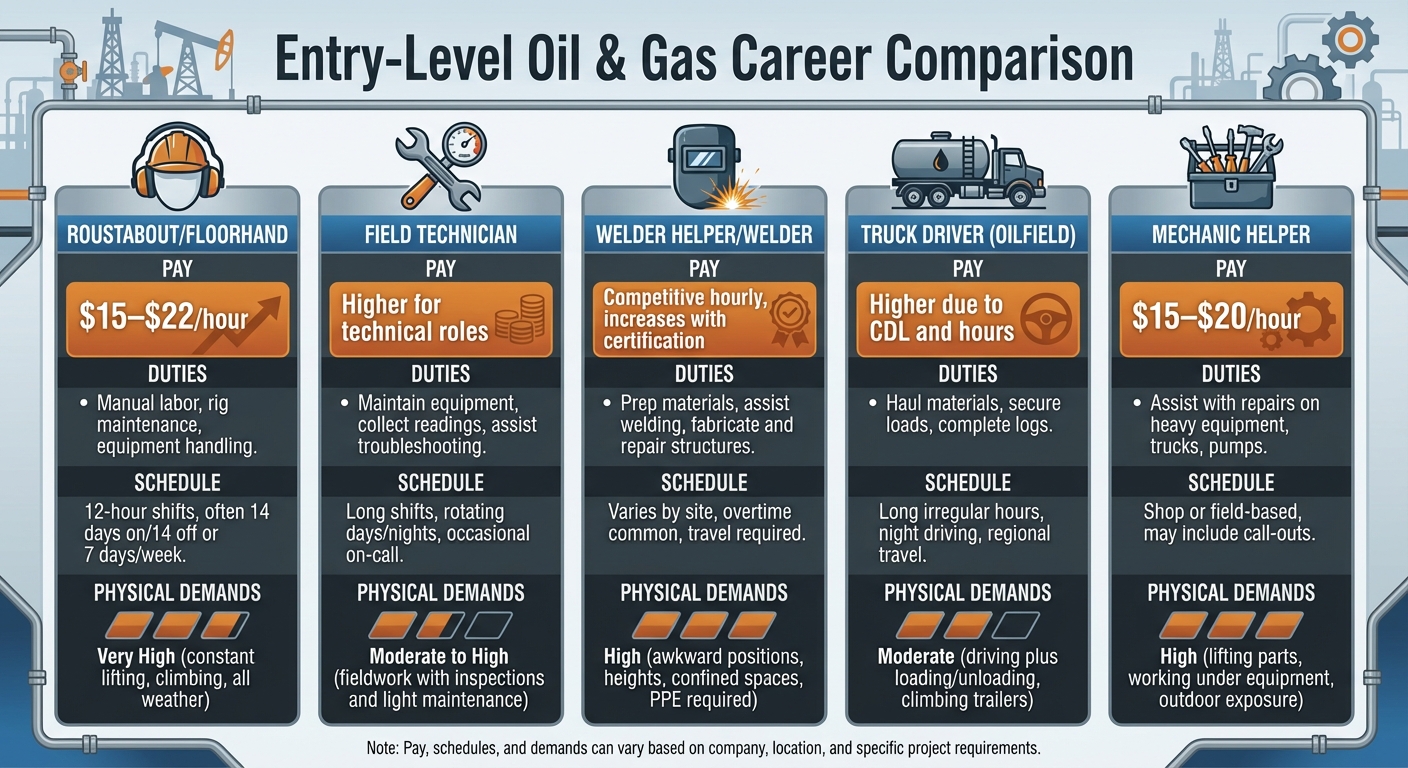
Entry-Level Oil and Gas Jobs: Pay, Duties, and Physical Demands Comparison
If you’re just stepping into the oil and gas industry, there are plenty of opportunities to get started. Here’s a look at some common entry-level roles and the basic qualifications you’ll need to meet.
Common Starting Positions
The oil and gas sector offers a variety of entry-level jobs that don’t require prior experience, making them ideal for those eager to jump in and learn. These roles serve as stepping stones for building a long-term career.
- Roustabouts and oilfield laborers: These roles involve hands-on manual work at drilling rigs and production sites. Tasks include setting up and tearing down rigs, cleaning equipment, and moving heavy materials – often outdoors in all kinds of weather.
- Field technicians: A more technical position, field technicians assist with installing, monitoring, and maintaining production equipment like pumps, meters, and gauges. This job requires traveling between sites, inspecting equipment, and troubleshooting issues, so a basic understanding of mechanics is helpful.
- Welder helpers: Working alongside welders, these helpers prepare materials, clean work areas, and handle tasks like cutting and grinding. Over time, they gain skills in fabricating and repairing pipes, metal structures, and equipment used in oil and gas operations.
- Oilfield truck drivers: These drivers transport water, sand, chemicals, and equipment to and from well sites, often in remote areas. Driving large trucks in challenging conditions is part of the job, and a Commercial Driver’s License (CDL) is usually required.
- Mechanic helpers and diesel mechanic assistants: These roles involve assisting experienced mechanics with maintaining and repairing diesel engines, pumps, and heavy machinery. Tasks include oil changes, part replacements, and troubleshooting under supervision – perfect for those with a knack for mechanical work.
Basic Qualifications
To land most entry-level positions, you’ll need to meet a few key requirements:
- Age and education: You must be at least 18 years old, and a high school diploma or GED is typically required. Some labor-intensive roles may be flexible on education if you show a strong work ethic and physical capability.
- Driver’s license: A valid driver’s license is essential, and a CDL is necessary for truck driving roles. Employers also check your driving record during the hiring process.
- Drug tests and background checks: Passing pre-employment drug tests and background checks is mandatory, and random drug testing continues on the job.
- Physical fitness: These jobs are physically demanding. You’ll need to lift at least 50 pounds repeatedly, work 12-hour shifts on your feet, and handle tasks in extreme weather conditions, from summer heat over 100°F to freezing winter temperatures.
Employers also value reliability, safety awareness, and teamwork. You’ll need to follow safety protocols, communicate effectively with your team, and adapt to long, irregular hours, including nights, weekends, and rotational schedules. Many roles require living on-site for weeks at a time, so flexibility is just as important as technical skills.
Entry-Level Role Comparison
Here’s a quick breakdown of the key entry-level positions to help you compare.
| Position | Typical Pay Range | Primary Duties | Schedule Type | Physical Demands |
|---|---|---|---|---|
| Roustabout/Floorhand | $15–$22/hour | Manual labor, rig maintenance, equipment handling | 12-hour shifts, often 14 days on/14 off or 7 days/week | Very high – constant lifting, climbing, all weather |
| Field Technician | Higher for technical roles | Maintain equipment, collect readings, assist troubleshooting | Long shifts, rotating days/nights, occasional on-call | Moderate to high – fieldwork with inspections and light maintenance |
| Welder Helper/Welder | Competitive hourly, increases with certification | Prep materials, assist welding, fabricate and repair structures | Varies by site, overtime common, travel required | High – awkward positions, heights, confined spaces, PPE required |
| Truck Driver (Oilfield) | Higher due to CDL and hours | Haul materials, secure loads, complete logs | Long irregular hours, night driving, regional travel | Moderate – driving plus loading/unloading, climbing trailers |
| Mechanic Helper | $15–$20/hour | Assist with repairs on heavy equipment, trucks, pumps | Shop or field-based, may include call-outs | High – lifting parts, working under equipment, outdoor exposure |
These roles provide a great starting point for anyone looking to build a career in oil and gas. Whether you’re interested in technical work, driving, or hands-on labor, there’s a position to match your skills and interests.
Skills and Certifications
Core Skills Needed
Employers in the oil and gas industry prioritize several key skills: mechanical know-how, safety awareness, teamwork, communication, basic math abilities, and physical fitness. At the forefront is mechanical aptitude – you should feel comfortable handling tools like wrenches and hammers, troubleshooting equipment like pumps and valves, and understanding how motors and machinery operate. For example, a roustabout might calculate pipe lengths, secure connections with tools, and work alongside crane operators while adhering to lockout/tagout protocols.
Safety awareness is another top priority. Working with high-pressure systems, flammable gases, confined spaces, and heavy equipment demands a strong understanding of potential hazards and strict adherence to safety protocols. Employers also expect excellent teamwork and communication skills. Since you’ll often work in small crews on long shifts, clear communication is crucial to avoid accidents and ensure smooth operations. Additionally, basic math skills – such as fractions, unit conversions, and gauge reading – are essential for tasks like measuring pipe lengths, calculating tank volumes, or checking pressure levels.
Physical fitness and reliability round out the list of must-haves. You’ll need to repeatedly lift over 50 pounds, endure 12–14 hour shifts in extreme conditions, and maintain punctuality and flexibility for irregular schedules.
Required Certifications for Entry-Level Work
For entry-level roles, a four-year degree isn’t typically required, but earning the right certifications can significantly increase your chances of getting hired and may even lead to higher starting pay. Some of the most valuable certifications include:
- OSHA 10-Hour Training: This course covers essential safety topics like fall protection, electrical safety, hazard communication, and proper use of personal protective equipment (PPE). It takes about 10 hours (1–2 days) to complete and costs between $60 and $150.
- H2S Awareness (or H2S Clear): Vital for roles in drilling, production, or midstream operations where hydrogen sulfide gas may be present. This 4–8 hour course teaches you to detect H2S, respond to alarms, use self-contained breathing apparatus (SCBA), and follow emergency procedures.
- TWIC Card: Required for offshore rig workers, dock and terminal employees, and anyone accessing secure port facilities. Issued by the TSA, this credential costs approximately $125.25 for five years and takes 2–6 weeks to process, including fingerprinting and a background check.
- First Aid/CPR/AED Certification: Often expected for remote field workers, truck drivers, and lead hands. These courses, offered by the Red Cross or American Heart Association, take 4–8 hours to complete.
- OSHA 30-Hour Training: A more advanced course ideal for those moving into supervisory roles. It covers safety management and incident investigation over 30 hours (3–5 days) and costs between $150 and $350.
Some employers or community colleges may offer assistance with certification costs, so it’s worth asking about available training programs.
Certification Comparison
Here’s a quick guide to help you decide which certifications align with your goals, budget, and time availability:
| Certification | Main Content Focus | Duration | Typical Cost | Best Suited Roles |
|---|---|---|---|---|
| OSHA 10 | General safety, hazard recognition, PPE, fall/electrical safety | 10 hours (1–2 days) | $60–$150 | Roustabouts, floorhands, lease operators, helpers, construction laborers |
| OSHA 30 | Advanced safety management, incident investigation, supervisory topics | 30 hours (3–5 days) | $150–$350 | Foremen, lead hands, field supervisors, safety coordinators |
| H2S Awareness | Hydrogen sulfide hazards, detection, SCBA use, emergency response | 4–8 hours | $75–$200 | Drilling crews, production operators, workover crews, pipeline roles |
| TWIC Card | TSA background check for secure maritime facility access | 2–6 weeks (processing) | ~$125.25 (5 years) | Offshore rig workers, dock/terminal workers, marine construction crews |
| First Aid/CPR/AED | Emergency medical response, bleeding control, cardiac arrest, shock | 4–8 hours | $60–$150 | Remote field workers, truck drivers, leads, rig and pipeline crews |
If you’re just starting out and working with a tight budget, OSHA 10 is a great first step because it’s applicable to a wide range of roles. Adding First Aid/CPR certification can further demonstrate your commitment to safety. If you’re aiming for jobs in drilling, production, or areas with sour gas exposure, prioritize H2S Awareness as well. For offshore or port-related roles, consider obtaining a TWIC card once you know your target employer or project location.
Uploading these certifications to your ABLEMKR profile can streamline job matching and boost employer confidence. ABLEMKR connects skilled workers with oil and gas projects across the U.S., allowing operators to quickly mobilize crews for tasks like shutdowns or pipeline repairs. Once your certifications are uploaded, they’re stored in the system for use with multiple employers, cutting down on paperwork and speeding up the hiring process.
Choosing Your Path and Getting Experience
Once you’ve acquired the essential skills and certifications, it’s time to focus on selecting your specific role and gaining hands-on experience.
Selecting Your Starting Role
Deciding where to start depends on your interests and strengths. If you enjoy hands-on problem-solving and physical work, consider roles like roustabout, floorhand, or technician. These jobs often involve outdoor tasks, heavy lifting, and mechanical troubleshooting. On the other hand, if you’re detail-oriented and prefer focusing on safety and organization, roles like HSE assistant or safety watch might suit you better, as they emphasize inspections and documentation.
Your lifestyle preferences also play a big role. Field positions often require extended travel and rotational schedules, such as 14 days on and 14 days off. Meanwhile, support roles typically offer more regular hours and are closer to home. Consider the physical demands of the job as well – upstream drilling jobs often pay more but come with challenging conditions, while downstream refinery positions usually provide more predictable schedules in urban settings.
Think about your long-term goals, too. If you aim to move up the ranks, starting as a roustabout or general laborer can lead to roles like operator or driller, especially if you’re physically fit. For those with vocational training, technician roles can pave the way to becoming a specialist or supervisor. If you’re transitioning from construction, highlight your experience with tools, jobsite safety, and PPE to qualify for roles like pipefitter helper or scaffold builder.
Ways to Gain Experience
Entry-level roles such as general laborer, helper, or equipment operator are great for getting your foot in the door. Many companies are eager to hire workers who show reliability, physical stamina, and a strong work ethic. If you have a background in construction, utilities, or manufacturing, make sure to emphasize skills like OSHA training, lockout/tagout knowledge, and experience with technical drawings or forklift operation.
Structured programs like internships, co-ops, and apprenticeships can also provide a clear path into the industry. Many community colleges and trade schools offer programs in petroleum technology or process operations, often partnering with employers in states like Texas, Oklahoma, and Louisiana. Apprenticeships, whether through unions or employer-sponsored programs, combine paid work with on-the-job training for roles like welder, electrician, or instrumentation technician. Tools like ABLEMKR can help match your certifications and skills to available field roles, speeding up your placement on important projects.
sbb-itb-aa28329
Finding Jobs in the U.S. Oil and Gas Industry
High-Demand Regions and Employers
The Permian Basin, stretching across West Texas and southeastern New Mexico, stands out as the largest oil-producing region in the U.S., offering plenty of entry-level roles. Cities like Midland, Odessa, and Carlsbad are key hiring centers for jobs in drilling, completions, and production. On the Gulf Coast, areas like Houston, Corpus Christi, and Louisiana’s industrial corridor are home to major refineries, petrochemical plants, and offshore operations. Other active regions include the Eagle Ford in South Texas, the Bakken in North Dakota and Montana, the DJ/Niobrara in Colorado and Wyoming, and the Marcellus/Utica shale plays in Pennsylvania, Ohio, and West Virginia.
When it comes to employers, there are several categories to consider:
- Large operators: Companies like ExxonMobil, Chevron, ConocoPhillips, Occidental, and EOG Resources manage wells and facilities.
- Oilfield service contractors: Firms such as Schlumberger, Halliburton, Baker Hughes, and Weatherford specialize in services like drilling, completions, and wireline operations.
- Midstream companies: Kinder Morgan and Williams are examples of companies focused on pipelines and gas processing.
- Construction and maintenance contractors: These companies handle rig staffing, pipeline construction, and plant maintenance.
If you’re open to relocating, targeting these regions and employer types can significantly increase your chances of landing a job.
Creating Your Resume and Application
When crafting your resume, make sure to emphasize your safety certifications and training by placing them prominently at the top. Use keywords that match job postings, such as "pipeline laborer" or "frac crew", to increase your chances of getting noticed.
Highlight your physical capabilities and schedule flexibility. For instance, mention your ability to lift at least 50 pounds repeatedly, work 12-hour shifts, manage 14-day rotations, and endure extreme weather conditions. If you have experience in outdoor or manual labor – whether it’s in construction, farming, or warehouse work – be specific. For example, you could write, "Two years of experience with zero recordable safety incidents" or "Operated forklifts and winch trucks on over 15 projects." Also, include your valid driver’s license (especially if it’s a CDL) and state your willingness to relocate. Tailor each application to the specific job and region to make your resume stand out.
Using ABLEMKR to Find Work
ABLEMKR is a mobile-first platform designed to connect skilled laborers with oil and gas projects across key U.S. energy regions. The app matches workers to job sites based on their certifications, safety training, availability, and location. Whether it’s a last-minute job in the Permian Basin, a remote pipeline repair in the Bakken, or scheduled maintenance along the Gulf Coast, ABLEMKR helps you find opportunities that suit your skills.
Getting started is simple: download the free ABLEMKR app, upload your certifications, and let the platform match you with relevant projects. Candidates are pre-vetted to ensure they meet role requirements, streamlining the hiring process for both workers and employers. The platform offers benefits like real-time job updates, guaranteed on-time payments, and easy access to well-paying field positions. For entry-level workers, ABLEMKR simplifies the entire job search process, helping you quickly connect with opportunities where your skills are in demand.
Succeeding in Your First Oil and Gas Job
What to Expect Your First Days
Your first days on the job will kick off with a safety orientation. This session is crucial and will cover location-specific hazards, emergency procedures, communication methods like radio channels and hand signals, and reporting protocols. You’ll also learn the locations of emergency shutoffs, eyewash stations, fire extinguishers, and muster points – details that could be lifesaving in an emergency.
Most employers supply essential personal protective equipment (PPE), such as hard hats, safety glasses, hearing protection, flame-resistant (FR) clothing, and gloves. However, you’ll typically need to bring your own steel-toe boots that meet safety standards. Make sure to confirm with your supervisor exactly what you need to provide.
Expect to start with tasks like housekeeping, cleaning equipment, and assisting experienced crew members. Use this time to observe and learn from seasoned team members – watch how they operate, ask questions when appropriate, and volunteer for straightforward tasks like handling hoses or staging tools. These early responsibilities not only teach you the basics but also lay the groundwork for safe work habits and more complex duties down the road.
Staying Safe and Performing Well
Working in oil and gas comes with inherent risks, including struck-by and caught-in incidents, falls, vehicle accidents, high-pressure lines, toxic or flammable gases, and confined spaces. According to the U.S. Bureau of Labor Statistics, the fatal injury rate for oil and gas extraction and support activities was 13.5 per 100,000 workers in 2020. While these numbers highlight the dangers, most incidents can be avoided by strictly following safety protocols and training.
One key principle is Stop Work Authority – you have the right to stop any task if you notice unsafe conditions. Never bypass critical safety systems like lockout/tagout procedures, hot work permits, or confined-space permits; these safeguards exist because of past accidents. Always communicate clearly, whether through radios or hand signals, and confirm instructions by repeating them back. Before entering areas with moving equipment, check in to ensure it’s safe.
Managing fatigue is also essential. Shifts often last 12 hours or more, with rotations like 14 days on and 14 days off being common. Fatigue is a major factor in vehicle accidents, which OSHA identifies as a leading cause of fatalities in this industry. To stay sharp, prioritize rest, hydration, and proper nutrition during your off hours. Show up on time, follow instructions, ask questions when unclear, and maintain a positive attitude. Keeping your work area tidy can also prevent common hazards like slips, trips, and falls.
Growing Your Career
Once you’ve gained some experience and completed your initial safety training, it’s time to think about advancing your career. Start by earning additional certifications. Update your ABLEMKR profile as you achieve new credentials and gain experience. Within your first 6–12 months, aim for certifications like H2S awareness (important for working in sour gas areas), First Aid/CPR, Basic Well Control (for drilling or completions), forklift or crane rigger licenses, and NCCER craft certifications. Talk to your supervisors about potential career paths, such as moving from roustabout to floorhand, derrickhand, driller, and eventually toolpusher. Find out which skills or certifications are necessary for each step.
As you master the basics, you can transition from physically demanding roles to higher-paying positions like driller, toolpusher, supervisor, safety specialist, or technical expert. Keep a detailed log of your training sessions, safety meetings, and completed tasks. This record will be invaluable for promotions and future job opportunities. Seek out mentors among experienced crew members, safety representatives, or lead hands, and ask them for constructive feedback to help you improve.
Platforms like ABLEMKR can be a game-changer for your career. By keeping your certifications, safety training, and work history up to date, you’ll increase your chances of landing higher-paying assignments in key U.S. energy regions. The platform also offers real-time job updates and ensures on-time payments, helping you stay consistently employed while building the experience and reputation needed to move into supervisory or specialized roles.
Conclusion
Breaking into the oil and gas industry begins with meeting a few essential requirements: being of legal working age, having a high school diploma or equivalent, maintaining physical fitness, and holding a valid driver’s license. Once you’ve checked these boxes, obtaining basic safety certifications is the next step. These qualifications not only make you employable but also set the stage for a career in this demanding yet rewarding field.
Entry-level positions like floorhand, roustabout, or field technician are excellent starting points. These roles typically pay between $20 and $40 per hour, depending on your experience and location. While prior experience isn’t always necessary, you’ll need physical endurance, dependability, and a strong work ethic. If you’re targeting high-demand areas such as the Permian Basin in Texas, the Gulf Coast, or North Dakota, you’ll find plenty of opportunities with drilling contractors, service companies, and midstream operators actively seeking workers.
When applying, your resume should emphasize relevant certifications, any prior physical labor experience, and your commitment to safety. Tailor your applications to highlight transferable skills and your ability to handle long, physically demanding shifts. Platforms like ABLEMKR can simplify your job search by connecting pre-vetted workers with job sites based on certifications, safety training, and availability. This platform not only eliminates common hiring hurdles but also provides real-time job updates, ensures timely payments, and opens doors to projects in key U.S. energy regions.
Once you’ve secured a position, focus on safety, absorb knowledge from seasoned crew members, and keep your certifications up to date. Updating your ABLEMKR profile with new credentials can help you qualify for more advanced opportunities. In this industry, technical skills, safety awareness, and reliability are key to building a successful and lasting career.
FAQs
What certifications do I need to start a career in the oil and gas industry?
To launch a career in the oil and gas industry, earning the right certifications is a crucial first step. Certifications such as OSHA safety training, HAZWOPER (Hazardous Waste Operations and Emergency Response), and TWIC (Transportation Worker Identification Credential) highlight your dedication to safety and regulatory compliance – both essential in a high-risk industry like this.
If you’re aiming for more specialized roles, certifications like Welding Certifications (AWS), Rigging and Crane Operator Certification (NCCCO), or API (American Petroleum Institute) Certifications can give you a competitive edge. Combining these credentials with industry-specific training programs and practical experience can make you a standout candidate when applying for jobs.
To make your job search even smoother, platforms like ABLEMKR can help you find opportunities that align with your certifications, training, and location, giving you a head start in this competitive field.
What can I do to improve my chances of getting hired in major oil and gas regions like Texas or North Dakota?
To improve your chances of landing a job in high-demand areas such as Texas or North Dakota, prioritize earning certifications relevant to the oil and gas industry and completing specialized safety and technical training tailored to these roles. If you’ve worked in these regions before, make sure to emphasize that experience – being familiar with local work conditions can give you a noticeable edge.
Platforms like ABLEMKR can be a great resource, connecting you with employers by aligning your skills and certifications with their job requirements. Also, keep an open mind for opportunities, including remote work or last-minute projects, to boost your visibility and attract potential employers.
What can I expect during my first days working in the oil and gas industry?
When starting out in the oil and gas industry, your first few days will usually include a safety orientation to help you understand workplace risks and emergency protocols. You’ll also go through job-specific training to get acquainted with the tools, equipment, and procedures you’ll be using.
You’ll likely spend time shadowing seasoned team members, giving you a chance to gain practical experience while adjusting to the physical demands of the role. From the start, clear communication, following safety rules to the letter, and working well with your team are critical. Don’t hesitate to ask questions and stay engaged as you navigate this fast-paced and demanding industry.


