
Balancing staffing costs and compliance is a growing challenge for industries like construction, energy, and extractives. Cutting expenses by reducing staff or bypassing regulations may save money in the short term but leads to expensive fines, project delays, or even business closures. On the other hand, compliance ensures predictable costs and protects businesses from legal and operational risks.
Here’s the key takeaway: Investing in compliance reduces long-term costs and secures access to high-value projects. Ignoring it risks audits, penalties, and reputational harm.
Key Points:
- Short-term savings vs. long-term risks: Understaffing or hiring unqualified workers leads to inefficiencies, safety issues, and higher costs later.
- Compliance costs: Average 1.34% of wage bills but prevent unpredictable fines and penalties.
- Industries most affected: Construction, energy, and extractives face strict labor laws, safety requirements, and risks from subcontractor violations.
- Technology as a solution: Tools like ABLEMKR simplify compliance tracking, reduce admin tasks, and ensure access to skilled, certified workers.
Bottom line: Cutting corners on staffing and compliance is costly. Using modern tools to manage both can save money, improve safety, and protect your business.
The Real Costs of Cutting Staffing Expenses
Short-Term Savings vs. Long-Term Expenses
Reducing staffing expenses might seem like a quick way to save money, but those savings often come at a steep price later on. When critical roles are left unfilled, the result is often inaccurate reporting, scheduling mistakes, and flawed forecasts – all of which lead to inefficiencies and costly change orders. Projects that start without enough personnel during the scoping phase tend to suffer from incomplete definitions, setting off a domino effect of problems during execution.
Research shows that 55% of professionals in North America lose an average of seven hours every week due to poor collaboration. That adds up to nearly nine weeks of lost productivity per year. Understaffing disrupts communication, delays deadlines, and lowers the overall quality of work. Currently, 54% of project deadlines across industries are missed, and almost half of project managers report being dissatisfied with project visibility. These inefficiencies not only increase costs but also take a toll on employee morale and performance.
"In capital projects, safety is paramount and is a non-negotiable component that outlives the project life cycle and should never be compromised." – H+M Industrial EPC
Effects on Worker Quality and Morale
Cutting staffing costs by offering low pay, overloading employees, or hiring unqualified workers sets off a damaging cycle. Employees who feel overworked or undervalued are more likely to produce lower-quality work, call in sick more often, or leave their jobs entirely. In high-risk industries like energy and extractives, these issues go beyond productivity – they can directly threaten safety. Temporary workers, in particular, face greater safety risks and are more vulnerable to retaliation.
Choosing the cheapest staffing options often leads to poor-quality deliverables, increased rework, and a tarnished reputation. While it might seem like a cost-saving measure upfront, it creates knowledge gaps and inefficiencies, especially during the construction phase, which accounts for 7% to 10% of a building’s total embodied energy. These staffing issues don’t just drive up costs – they also threaten compliance and safety standards, which are already under pressure in many projects.
Identifying and Managing Contingent Workforce Program Risk
How Non-Compliance Increases Costs
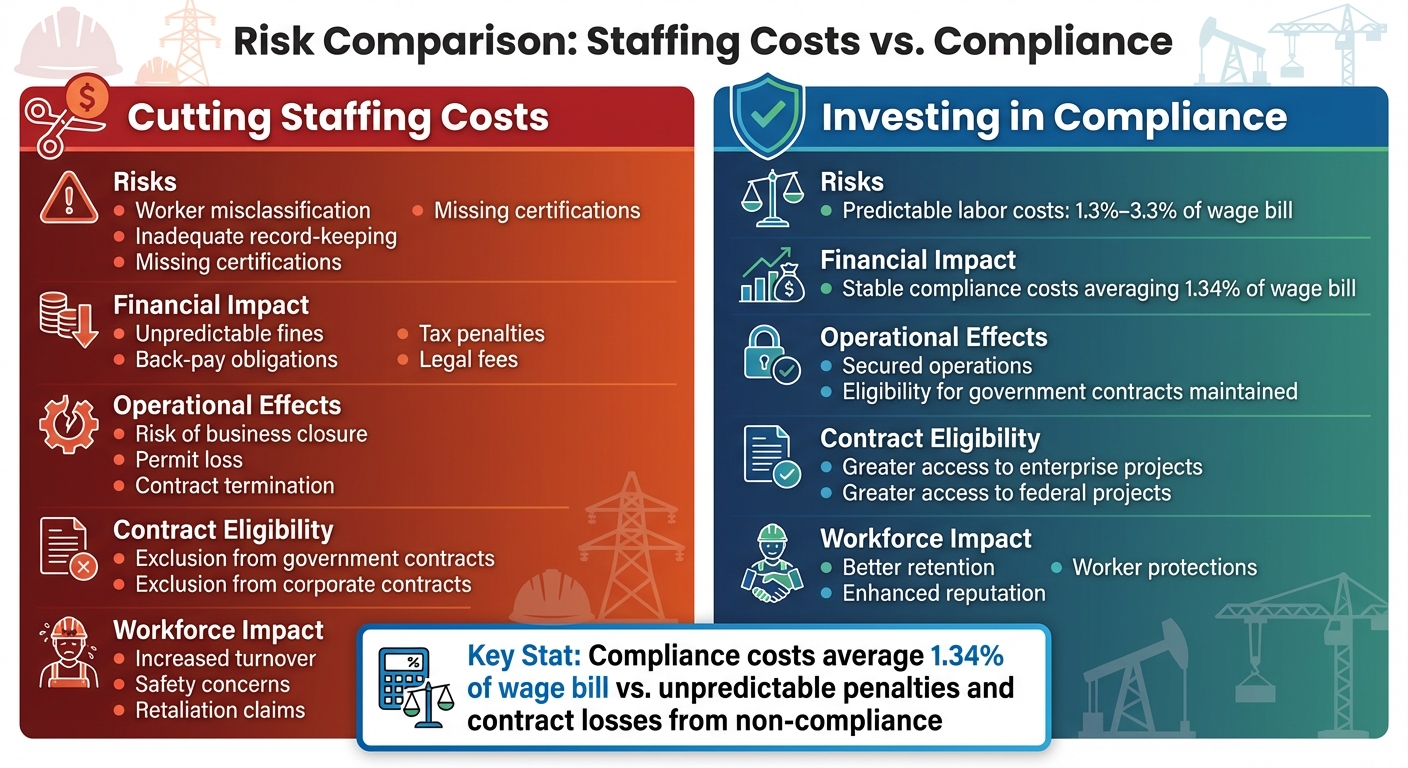
Staffing Cost Cuts vs Compliance Investment: Risk and Impact Comparison
Frequent Compliance Problems in Staffing
When businesses attempt to cut costs by skimping on compliance, they often end up facing much larger expenses down the line. A prime example of this is worker misclassification – mislabeling employees as independent contractors, which violates the Fair Labor Standards Act (FLSA). Another common issue is poor record-keeping. Failing to accurately track hours and wages for non-exempt workers can trigger Department of Labor audits and result in hefty fines.
In industries like construction and energy, ignoring prevailing wage rules can be particularly damaging. Companies working on federally funded projects are required to pay prevailing wages. Failing to do so can lead to severe consequences, such as contract termination or being barred from future government projects. Beyond external penalties, companies also face internal operational risks. Greg DiDonna, President and Partner at Viva Capital, emphasizes the stakes: "If your company misses the mark, the government may force your business to dissolve". This is why large corporations and government entities insist on partnering only with businesses that can document compliance.
The costs of compliance are undeniably real. Studies reveal that regulatory compliance expenses make up an average of 1.34% of a company’s total wage bill, with most U.S. firms spending between 1.3% and 3.3% on compliance-related efforts. However, these predictable costs pale in comparison to the unpredictable financial toll of non-compliance. Fines, back wages, legal fees, and lost contracts can quickly spiral out of control, creating a stark contrast between the risks of cutting corners and the benefits of proactive compliance.
Risk Comparison: Staffing Costs vs. Compliance
When weighing short-term savings against long-term stability, the difference in risk is stark. Companies prioritizing immediate cost savings by ignoring compliance expose themselves to financial penalties, potential loss of operating licenses, and exclusion from government contracts. On the other hand, investing in compliance ensures predictable costs, legal protection, and access to high-value projects.
| Aspect | Focus on Cutting Staffing Costs | Focus on Compliance |
|---|---|---|
| Risks | Misclassification, inadequate record-keeping, missing certifications | Predictable labor costs (1.3%–3.3% of wage bill) |
| Financial Impact | Unpredictable fines, back-pay obligations, tax penalties, legal fees | Stable compliance costs averaging 1.34% of wage bill |
| Operational Effects | Risk of business closure, permit loss, contract termination | Secured operations and eligibility for government contracts |
| Contract Eligibility | Exclusion from government and corporate contracts | Greater access to enterprise and federal projects |
| Workforce Impact | Increased turnover, safety concerns, retaliation claims | Better retention, worker protections, enhanced reputation |
"Companies that accept government contracts or work with many large companies are expected to have and follow corporate compliance policies. They won’t work with any entity that doesn’t have them".
Losing access to major contracts often results in far greater costs than the investment in compliance itself. By committing to compliance, businesses gain predictable costs and safeguard their operations, reinforcing the broader theme of balancing expenses with adherence to regulations.
sbb-itb-aa28329
How to Balance Staffing Costs and Compliance
Finding the right balance between staffing costs and compliance can be tricky, but advanced technology offers a way to tackle both challenges at once.
Using Technology for Compliance and Cost Control
Automation is a key tool for managing staffing costs while meeting compliance requirements. Modern workforce platforms simplify staffing operations by directly linking businesses with verified worker profiles. This reduces administrative tasks and ensures that workers meet all necessary industry regulations. For example, digital marketplaces showcase workers’ skills, certifications, and documentation in a centralized profile. ABLEMKR takes this a step further by combining workforce management software with a pool of pre-vetted workers. This setup not only allows for easy compliance tracking but also provides on-demand access to skilled labor. Additionally, services like ABLEMKR include insurance coverage – such as workers’ compensation and general liability – helping businesses maintain predictable costs without the worry of unexpected liabilities. By blending cost efficiency with compliance, this technology addresses two major concerns simultaneously.
Real-Time Monitoring and Clear Cost Structures
Real-time mobile logging is another game-changer. It enables immediate identification of discrepancies, offers clear cost tracking, and ensures adherence to labor laws regarding overtime, breaks, and Fair Workweek requirements.
"ABLEMKR workers log hours in the App, viewable in real-time by ABLEMKR customers. Issues or discrepancies? Easily identify where things are right or wrong, and keep going at the speed of work." – ABLEMKR
Employers also benefit from the ability to review worker experience, ratings, and costs before hiring. By setting rates, specifying required gear, and outlining certifications during the job creation process, businesses can sidestep unexpected expenses and compliance issues. With transparent monitoring in place, automation further simplifies the hiring process and ensures certifications are up to date.
Automated Matching and Certification Tracking
Automation takes the guesswork out of staffing. Companies can connect with workers whose verified credentials, certifications, and locations meet compliance standards right from the start. AI-driven scheduling tools optimize workforce levels, reducing costly overtime while maintaining smooth operations. Digital worker profiles act as quick-reference tools, allowing employers to instantly verify experience, ratings, and certifications. This not only speeds up recruitment but also lowers administrative costs and keeps compliance in check. By automating these processes, businesses can achieve both efficiency and regulatory compliance with minimal effort.
Conclusion: Finding the Right Balance
Key Points for Employers
Cutting staffing costs today can lead to much bigger expenses down the road. For example, replacing a skilled construction worker can cost anywhere from 50% to 150% of their annual salary. On top of that, employment costs often rise by 24% to 70% beyond base wages. Even small compliance mistakes can result in hefty financial hits.
Prioritizing compliance is essential to avoid costly penalties. A smart approach is to integrate compliance checkpoints – like licenses, workers’ compensation, and OSHA training – into your project timelines. This strategy not only prevents penalties but also keeps your projects on track. A great example comes from 2023 when a Florida construction company partnered with an Employer of Record (EOR) to expand into Texas. Within weeks, they hired a fully compliant workforce and managed to cut labor costs by 25% thanks to streamlined payroll processes. The secret? Using technology to handle administrative tasks while ensuring compliance with state labor laws.
In today’s high-risk industries, balancing costs with compliance isn’t optional – it’s a must. Modern digital tools, like real-time monitoring and automated certification management, help reduce manual mistakes and lower operational expenses. Companies that adopt these proactive compliance measures often see productivity gains of 15% to 25% due to improved workforce stability. These tools provide transparency, from verified worker skills to clear cost breakdowns, allowing you to focus more on your projects and less on paperwork. By embracing technology, you can cut hidden costs and boost your team’s overall efficiency.
How ABLEMKR Helps
Leveraging technology is key to managing costs while staying compliant, and ABLEMKR delivers exactly that. Designed for industries like construction, oil & gas, and mining, ABLEMKR’s mobile-first platform connects you with pre-vetted workers based on certifications, safety training, and location – ready to meet your immediate operational needs. Worker profiles include verified skills and all required documentation in one place.
With real-time visibility and built-in compliance tracking, you’ll always know who’s on-site, what they’re qualified to do, and how much it’s costing you. Integrated payroll systems and guaranteed on-time payments eliminate the usual delays in deploying labor. Whether you’re ramping up for a large infrastructure project or need skilled workers for urgent jobs, ABLEMKR equips you with the tools to achieve cost efficiency and compliance – without cutting corners.
FAQs
How does focusing on compliance help businesses save money in the long run?
Investing in compliance isn’t just about avoiding trouble – it’s a smart way to save money in the long run. By reducing workplace injuries, steering clear of hefty fines, and simplifying administrative tasks, businesses can protect both their employees and their bottom line. Prioritizing safety and following regulations also helps prevent payroll mistakes and keeps budgets on track.
Using tools with real-time tracking and automated compliance management can make a big difference. They help eliminate inefficiencies, cut down on downtime, and keep projects running smoothly, on time, and within budget. While there’s an upfront cost to implementing these measures, the long-term savings and operational benefits can easily make it worthwhile.
What are the dangers of reducing staffing costs in high-risk industries?
Reducing staffing costs in industries like construction, oil & gas, or utilities might seem like a quick way to save money, but it often comes with serious consequences. Understaffing can compromise essential safety measures, leading to an increased risk of accidents such as falls, equipment-related injuries, or heat-related illnesses. It also opens the door to potential violations of OSHA regulations, workers’ compensation claims, and lawsuits – especially if incidents are linked to insufficient staffing levels.
The problems don’t stop there. When crews are stretched too thin, projects are more likely to face delays, quality can take a hit, and employee turnover tends to rise. These issues not only hurt profitability but can also damage a company’s reputation. Instead of cutting staff, businesses can benefit from smarter staffing solutions. For example, platforms like ABLEMKR help companies efficiently match the right number of qualified workers to their needs. This ensures compliance, minimizes risks, and keeps costs manageable – all without compromising safety or productivity.
How can ABLEMKR help businesses balance staffing costs and compliance requirements?
ABLEMKR takes the headache out of workforce management with its data-driven, mobile-first technology that helps businesses cut staffing costs while staying compliant. By leveraging real-time analytics and automated tools, the platform helps reduce unnecessary expenses like overtime, overstaffing, and idle time – saving companies up to 15% on labor costs. On top of that, it simplifies administrative tasks by syncing worker hours, GPS-tagged locations, and payroll, which can slash administrative costs by 30% and cut payroll errors by 40%.
The platform also prioritizes compliance, ensuring worker certifications, safety training, and licenses are up to date for high-risk projects. With a compliance dashboard that tracks training records and flags any gaps, ABLEMKR helps businesses meet OSHA and industry standards without the hassle of manual audits. By combining these tools, ABLEMKR empowers companies to deploy crews efficiently, control labor costs, and stay compliant – all through a single, easy-to-use interface.


