
The solar energy industry offers diverse career opportunities, from hands-on roles like installers to leadership positions in project management. With over 280,000 workers as of 2024 and projected 42% job growth for solar installers by 2034, this sector is expanding rapidly. Entry-level roles often require a high school diploma and basic certifications, while mid-level and advanced positions demand specialized training, certifications like NABCEP, and experience. Key sectors include manufacturing, system design, project development, installation, and research. Federal programs and platforms like ABLEMKR support workers with training, job placement, and career advancement. Whether starting or advancing, the solar field offers clear pathways for growth.
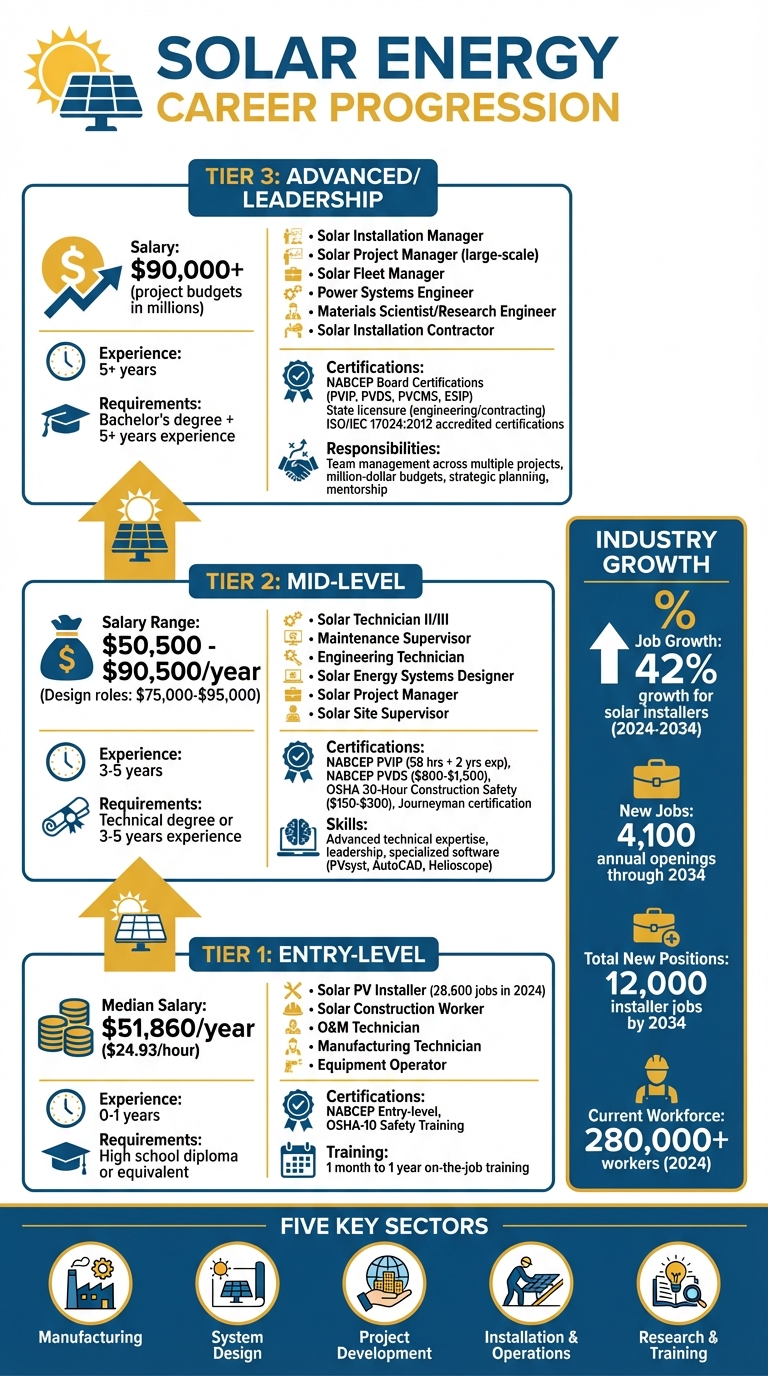
Solar Energy Career Progression Path from Entry-Level to Leadership
Interested in Starting a Career in Solar? Here’s a free Solar Career Pathways Course on HeatSpring

The Solar Energy Industry Explained
The solar energy industry is like a well-oiled machine, where different sectors work together seamlessly to take solar projects from an initial idea to long-term operation. Understanding how these sectors connect can help you identify where your skills fit and how you can grow within the industry.
Main Industry Sectors
The solar industry is divided into five key sectors, each playing a unique role:
- Manufacturing: This sector focuses on creating solar components like panels, inverters, and racking systems. Workers here are involved in research, prototyping, and rigorous quality testing. Common roles include materials scientists, CNC operators, and quality assurance specialists.
- System Design: This area revolves around the technical engineering of solar systems. Professionals design and configure photovoltaic (PV) or thermal components to meet safety and performance standards. Typical positions include residential PV system designers, electrical engineers, and structural engineers.
- Project Development: This sector manages the business side of solar projects, covering sales, marketing, site assessments, procurement, and regulatory compliance. It’s where commercial, legal, and financial aspects come together.
- Installation & Operations: This involves the physical construction and maintenance of solar systems. Tasks include site preparation, equipment installation, performance monitoring, and repairs. With the growing integration of solar-plus-storage solutions, there’s also a rising demand for energy storage installers.
- Research & Training: This sector focuses on advancing solar technology and equipping the workforce with the latest skills and knowledge.
How Career Paths Connect Across Sectors
These sectors don’t operate in isolation – they overlap and create opportunities for career growth and transitions. Whether you choose to climb the ladder within one sector or acquire new skills to shift into another, the possibilities are vast. For instance, a solar construction worker might advance to a lead PV installer role or, with additional training, move into an engineering technician position.
"An ambitious worker could progress within any of these solar-related occupations, or seek the skills and credentials to advance between them." – Interstate Renewable Energy Council
The interconnected nature of these sectors also opens doors for cross-sector transitions. A lead PV installer, for example, already has a solid understanding of wiring and system layouts, making it easier to move into operations, maintenance, or even system design. Similarly, project developers often collaborate with system designers and installers to ensure projects meet codes and are feasible, creating a natural pathway for career evolution. These overlapping roles highlight the growing opportunities in the solar energy industry and the potential for lifelong learning and development.
Entry-Level Roles in Solar Energy
Typical Starting Positions
Getting started in the solar energy field often requires just a high school diploma or equivalent, making it accessible to many. Whether you’re interested in hands-on work or technical tasks, there are plenty of entry points to explore.
One of the most common roles is Solar Photovoltaic (PV) Installer, with around 28,600 jobs projected in 2024 and a median annual wage of $51,860 ($24.93 per hour). These professionals handle the assembly and installation of solar panels, whether on rooftops or ground-mounted systems, and connect them to electrical grids. Nearly half of these workers are employed by electrical contractors, while utilities account for 14% of the workforce.
Solar Construction Workers, sometimes called solar general laborers, tackle the physical aspects of preparing sites and assembling modules. They use tools to align installations with design plans and handle tasks like site cleanup and building support structures. Meanwhile, Equipment Operators manage heavy machinery for site preparation, working across residential, commercial, and utility-scale projects.
For those drawn to technical work, Manufacturing Technicians oversee the setup, testing, and adjustment of machinery that produces solar components like panels and inverters. Similarly, Entry-Level O&M Technicians (Operations and Maintenance) work on utility-scale solar farms, performing visual inspections, managing wiring, and assisting with equipment replacements under supervision. These jobs often involve physical demands, such as lifting up to 60 pounds and working in tight spaces or at heights.
| Entry-Level Role | Primary Work Setting | Key Responsibilities |
|---|---|---|
| Solar PV Installer | Outdoor settings | Assembling support structures, installing modules, and testing systems |
| Solar Construction Worker | Utility-scale and commercial sites | Site cleanup, physical labor, and assembling supporting structures |
| O&M Technician | Utility-scale solar farms | Visual inspections, maintaining service logs, and wire management |
| Manufacturing Technician | Factory/Plant | Testing and adjusting solar component production machinery |
| Equipment Operator | Construction sites | Operating heavy machinery for site preparation and installation |
These roles provide a variety of experiences, from physical labor to technical problem-solving, offering a solid foundation for skill growth.
Education and Certification Requirements
Most entry-level positions in solar energy require a high school diploma or equivalent. A basic understanding of algebra, geometry, and trigonometry is helpful for calculating angles and measurements. Additionally, a valid driver’s license is often necessary, as many jobs involve traveling to different work sites.
Certifications can boost employability. For example, the NABCEP (North American Board of Certified Energy Practitioners) certification is well-regarded for PV installation, and OSHA-10 safety training is highly recommended due to workplace risks like falls, electrical shocks, and burns. Many manufacturers also provide training specific to their products, ensuring correct installation techniques.
Some candidates choose to expand their qualifications by attending technical schools or community colleges, which offer short-term courses covering topics like safety, PV systems, and basic design principles. Veterans have additional opportunities through programs like the Solar Ready Vets Network, which provides tailored training and job placement. Prior experience in trades like construction, roofing, or electrical work can reduce training time and make candidates more competitive.
Training Programs and Career Growth
Most entry-level workers receive moderate on-the-job training, typically lasting one month to a year. This training covers safety procedures, tool handling, and installation techniques. Many also enter through apprenticeships in related fields, such as electrical work or roofing, which often incorporate solar-specific training. For roles like utility-scale O&M technicians, apprenticeships may include about 144 hours of Related Technical Instruction (RTI).
"Solar O&M technicians are expected to perform a wide variety of tasks, mechanical and electrical, which contain intrinsic hazards. Without the proper training, these tasks would be considered very dangerous." – American Clean Power Association (ACP)
The solar industry offers strong growth potential. Employment for solar PV installers is expected to grow by 42% between 2024 and 2034, significantly outpacing the average for other occupations. This translates to approximately 4,100 job openings annually over the next decade. With 1–3 years of experience and additional certifications, entry-level workers can advance to roles like Solar Site Supervisor, Lead PV Installer, or Project Manager.
The combination of accessible entry points, robust job growth, and clear pathways for advancement makes solar energy an appealing career choice for workers at all levels. These early roles provide the skills and experience needed to move into more specialized and higher-paying positions.
Mid-Level Positions and Specializations
After spending 3–5 years in the solar energy industry, professionals often qualify for mid-level roles. These positions require a stronger grasp of technical concepts, enhanced leadership abilities, and, in many cases, advanced certifications. Salaries for mid-level professionals typically range from $50,500 to $90,500 annually. While solar technicians generally fall within this range, specialized roles can command even higher wages. This career stage builds on entry-level experience, offering opportunities to dive deeper into technical expertise and leadership.
Operations and Maintenance Positions
In mid-level operations and maintenance (O&M) roles, Solar Technician II/III positions take center stage. These technicians handle utility-scale photovoltaic (PV) system layouts, installations, and maintenance. Their responsibilities include performing corrective, preventive, and emergency repairs, testing system performance, and mentoring junior technicians. They rely on advanced tools and controls to monitor systems and diagnose performance issues. Typically, a Solar Technician II needs 1–2 years of experience paired with either a 2-year technical degree or over 2 years of fieldwork. A Journeyman certification is often preferred for these roles.
Maintenance Supervisors, on the other hand, oversee entire O&M teams. They manage schedules, enforce quality standards, and ensure smooth operations across commercial and utility-scale projects. These roles demand hands-on expertise with specialized tools like thermal imaging cameras, crane rigging, and power whips. Additionally, knowledge of emerging technologies such as battery storage systems, EV charging infrastructure, and high-voltage switching is becoming increasingly important. For those aiming to excel, the NABCEP PV Installation Professional (PVIP) certification is a widely recognized credential. Achieving this certification requires 58 hours of solar-specific training and at least 2 years of relevant experience.
"Solar technicians are the backbone of any successful solar installation business… ensuring every solar panel is installed perfectly and every system runs smoothly." – SiteCapture
System Design and Engineering Positions
With growing technical expertise, many professionals transition into system design roles. Engineering Technicians play a key role in planning, designing, and optimizing solar equipment and processes. These positions often require an associate degree in an engineering field. Similarly, Solar Energy Systems Designers focus on site-specific engineering analyses for commercial or utility-scale projects, creating large-scale PV or thermal systems. Mid-level designers typically earn between $75,000 and $95,000 annually and need to be proficient in industry-standard software like PVsyst, Helioscope, and AutoCAD.
To advance in this field, the NABCEP PV Design Specialist (PVDS) certification is highly recommended, with costs ranging from $800 to $1,500. Professionals with installation experience can accelerate their transition into design roles by completing 3–6 month bootcamps and obtaining NABCEP certification. Strong communication skills are essential for managing stakeholder expectations, while meticulous attention to detail ensures the durability and efficiency of the systems they design.
Construction and Manufacturing Management
For those looking to combine technical know-how with leadership, management roles in construction and manufacturing offer a natural next step. Solar Project Managers are responsible for coordinating teams, managing budgets and timelines, and acting as a bridge between engineers, designers, and installers. These roles typically require 3–5 years of field experience, along with training in solar system design and construction management.
Solar Site Supervisors, meanwhile, focus on leading installation crews, scheduling tasks, enforcing safety protocols, and ensuring quality control. Certifications like the OSHA 30-Hour Construction Safety certification (costing $150–$300) and project management credentials can significantly enhance career prospects. Moving from an installer to a supervisory role often involves developing soft skills such as conflict resolution and team motivation.
To address the skilled labor shortage, many companies are investing in upskilling initiatives, including manufacturer-specific training and formal certification programs. Additionally, the U.S. Department of Energy’s Upskill Prize for the Solar Manufacturing Workforce offers specialized training opportunities for workers aiming to enter the growing manufacturing sector.
sbb-itb-aa28329
Advanced Roles and Leadership Positions
To step into advanced roles, professionals typically need at least five years of experience and a bachelor’s degree or higher. At this stage, individuals take on responsibilities that influence entire projects, teams, and even the broader direction of a company. These roles require not only technical expertise but also the ability to lead effectively. As professionals advance, they move toward senior positions where strategic vision and leadership become essential.
Senior-Level Positions
Senior-level roles come with a mix of autonomy and accountability. For example, 76% of solar installation managers make daily decisions independently, and 70% report enjoying significant freedom in their roles. However, this freedom comes with weighty responsibilities – 64% of these managers are accountable for overall outcomes, and 48% note that their decisions have a significant impact on their colleagues.
Solar Project Managers are at the heart of solar installations, coordinating workers, managing materials, overseeing budgets worth millions, and acting as the key link between engineers and field installers. Meanwhile, Solar Fleet Managers focus on logistics, managing existing installations and vendor relationships. On the technical side, Power Systems Engineers research and analyze how to integrate solar technology into the grid, while Solar Energy Systems Designers conduct engineering analyses tailored to specific sites for large-scale systems. Additionally, Materials Scientists and Research Engineers work on developing new materials and processes to improve solar products.
"Solar Project Managers coordinate all of the workers and materials involved in a solar installation, managing time and budgets, and translating between engineers, system designers, and installers in the field." – Interstate Renewable Energy Council (IREC)
Solar Installation Managers lead crews, ensure compliance with building codes, and estimate project materials. They focus on reducing costs, minimizing risks, and improving operational efficiency. Their responsibilities also include developing systems for safety and quality assurance, as well as monitoring subcontractors to ensure adherence to specifications and budgets. Managing and leading others is a key part of the job, with 63% of managers rating it as extremely important to their role.
Advanced Education and Professional Credentials
As professionals take on senior responsibilities, further education and certifications become essential to validate their expertise and drive advancements in their field.
For roles like Power Systems Engineers and Structural Engineers, an engineering degree is often required, while Solar Project Developers benefit from finance or business backgrounds. Many of these positions also require state licensure or NABCEP Board Certifications to establish credibility. For those pursuing Solar Installation Contractor roles, advanced training in construction management and state licensure are necessary. Similarly, aspiring Fleet Managers should consider additional logistics training paired with a degree in management or business.
The NABCEP Board Certifications are widely recognized as the gold standard in the solar industry. The PV Installation Professional (PVIP) certification, accredited since 2007 under ISO/IEC 17024:2012, is especially valued for its focus on design, installation, operations, and commissioning. Other certifications, such as the PVDS for system design, PVCMS for commissioning and maintenance, and ESIP for energy storage installation, also enhance professional credentials.
"NABCEP Board Certifications are earned by demonstrating your training, experience, and passing a rigorous exam. Board Certifications positively impact your career by giving you: Increased marketability, validation of knowledge, and enhanced reputation." – NABCEP
Leadership Responsibilities
Senior roles demand mastery of advanced skills like Management of Personnel Resources, Systems Evaluation, and Complex Problem Solving to tackle challenges in large-scale solar projects. Leaders in these positions must also be proficient in using specialized software such as PVsyst, Oracle Primavera, Procore, AutoCAD, and Revit.
At this level, leadership involves managing teams across multiple projects, overseeing budgets that can reach millions of dollars, and devising strategies to boost efficiency and cut costs. These professionals act as a bridge between technical teams and business stakeholders, ensuring that projects stay on track while maintaining safety and quality standards. Additionally, they play a mentorship role, guiding mid-level professionals and nurturing the next generation of solar industry leaders. These leadership skills are critical for meeting the evolving demands of the industry.
Job Growth and Future Demand in Solar Energy
Job Growth Statistics
Jobs for solar photovoltaic installers are expected to grow by a staggering 42% between 2024 and 2034, far outpacing the 3% average growth rate for all occupations. This translates to roughly 4,100 job openings each year through 2034, with the industry adding 12,000 new installer positions during this period.
In 2024, the U.S. had 28,600 solar photovoltaic installer jobs, with a median annual wage of $51,860. Several factors are fueling this growth. The decreasing cost of solar panels and shingles has made solar energy more accessible to homeowners, while solar leasing programs reduce the burden of upfront costs. State and local government incentives further encourage adoption, and the construction of large-scale utility solar plants ensures a steady demand for installation and maintenance workers. Currently, about 20% of electricity in the U.S. comes from renewable sources like solar, wind, and hydro.
This rapid growth highlights the importance of ongoing skill development for solar professionals.
Continuing Education and Skill Development
With technology advancing rapidly, solar professionals need to stay current by pursuing ongoing education. This includes training in areas like battery storage, advanced power electronics, and LiDAR site assessment. The industry’s shift toward solar-plus-storage systems has also created a growing demand for workers skilled in energy storage integration.
Professionals can sharpen their expertise by attending industry conferences, earning additional NABCEP certifications in areas like energy storage, and participating in hands-on training programs. For those moving into leadership roles, understanding infrastructure modernization and capital upgrades is becoming increasingly essential as the industry matures. Workers with experience in construction, roofing, or electrical work may have a head start, but they still need to invest in ongoing education to master emerging solar technologies.
How ABLEMKR Supports Solar Energy Workers

With the solar industry expanding across residential, commercial, and utility-scale sectors, efficiently connecting skilled workers to job opportunities is crucial. ABLEMKR’s platform steps in to meet this need by matching pre-vetted solar professionals with job sites based on their certifications, safety training, availability, and location. This mobile-first solution allows solar companies to quickly deploy crews for installations, emergency repairs, or utility projects.
For solar workers, ABLEMKR offers flexible access to well-paying opportunities in major U.S. cities and energy hubs, with the added benefit of guaranteed on-time payments. Employers gain real-time visibility into worker status, streamlined payroll processes, and built-in compliance tracking, which is essential for meeting safety and regulatory standards in solar installations. As the industry continues to grow, platforms like ABLEMKR play a vital role in ensuring that skilled professionals are ready to meet the rising demand for solar expertise.
Conclusion
The solar energy industry offers exciting career paths for professionals at all stages of their journey. Whether you’re stepping into the field as a Solar Construction Worker or managing large-scale projects as a seasoned Solar Project Manager, there’s room to grow and specialize in this rapidly evolving sector.
One of the key strengths of solar careers is the emphasis on transferable skills and continuous learning. You don’t need extensive credentials to get started – many professionals begin in roles like Solar PV Installer and, with the right training and experience, advance into specialized positions such as Utility Interconnection Engineer. This progression highlights the industry’s commitment to skill development and career mobility.
Success in the solar field often depends on aligning your abilities with emerging opportunities. Platforms like ABLEMKR make this process seamless by connecting pre-vetted solar professionals with projects that match their certifications, location, and availability. Whether you’re taking your first steps in installation or transitioning to a specialized engineering role, ABLEMKR provides access to well-paying jobs in major U.S. energy hubs, with guaranteed payments and simplified compliance processes.
With the solar industry expanding at an incredible pace, there’s no better time to build or advance your career. By combining training, certification, and strategic job placement, solar professionals can secure fulfilling roles that not only support their financial goals but also contribute to America’s energy transformation. ABLEMKR bridges the gap between your expertise and cutting-edge projects, helping you grow your career while playing a vital role in the nation’s energy future.
FAQs
What certifications can help me advance in a solar energy career?
Certifications play a crucial role in showcasing your skills and opening doors to higher-paying roles within the U.S. solar industry. One of the most respected organizations offering certifications is the North American Board of Certified Energy Practitioners (NABCEP), which provides credentials tailored to various career stages.
For those just starting out, the NABCEP PV Associate certification is an excellent entry point. It covers the fundamentals of photovoltaic (PV) systems, giving you a solid foundation. As you gain hands-on experience, advancing to the NABCEP PV Installation Professional certification demonstrates your expertise in designing, installing, and commissioning solar systems.
If you’re aiming for specialized or leadership roles, certifications like PV Design Specialist, PV Technical Sales, and Energy Storage Installation Professional (ESIP) can significantly boost your professional standing. These advanced credentials typically require documented experience and passing a challenging exam. However, they open doors to senior-level positions in engineering, project management, or leadership roles. By following this certification pathway, you can steadily climb the ranks in the rapidly expanding solar energy industry.
What steps can help someone move from an entry-level job to a mid-level role in the solar industry?
Advancing from an entry-level job, like a solar installer or construction worker, to a mid-level position, such as a site supervisor or lead technician, requires a mix of certifications, practical experience, and building connections.
Start by earning certifications that are well-regarded in the solar industry, like the NABCEP PV Associate certification. This credential can help prove your expertise and commitment to potential employers. Then, focus on taking on roles or tasks that help you grow your skill set – whether it’s leading a small team, handling permitting processes, or conducting system testing. Keep track of these achievements to strengthen your professional profile.
To connect with larger, more visible solar projects, consider using platforms like ABLEMKR. These tools can open doors to opportunities where you can demonstrate your leadership abilities and technical know-how. By staying current with certifications, gaining hands-on experience, and using workforce tools effectively, you can confidently step into mid-level roles in the expanding solar industry.
What skills are essential for success as a solar project manager?
To thrive as a solar project manager, you’ll need a blend of technical know-how, financial savvy, and strong leadership abilities. Your responsibilities will revolve around crafting detailed project plans, juggling schedules and resources, and ensuring installations are completed on time, within budget, and up to quality standards.
Clear and effective communication is a must when working with engineers, designers, field teams, and stakeholders. Having a deep understanding of solar PV systems, safety protocols, and electrical codes is crucial for maintaining safety and ensuring the quality of on-site work. And when unexpected issues like schedule delays or design conflicts arise, sharp problem-solving and decision-making skills will help you navigate them smoothly.
On the financial side, skills in budgeting and cost control play a big role in keeping expenses in check and minimizing risks. With this mix of expertise, solar project managers can successfully oversee installations while keeping everyone informed and working toward shared goals.


