
In today’s fast-changing job market, moving between industries has become common. To make these transitions smoother, mastering key soft skills is crucial. These skills aren’t tied to a specific field, making them useful whether you’re in construction, energy, mining, or any other industry. Here are the five most important ones:
- Adaptability: Adjusting to new challenges and learning quickly in unfamiliar environments.
- Communication: Clearly expressing ideas, listening actively, and resolving conflicts effectively.
- Problem-Solving: Identifying issues, analyzing root causes, and implementing practical solutions.
- Teamwork: Collaborating with others to achieve shared goals and overcome challenges.
- Work Ethic: Being reliable, punctual, and focused on delivering high-quality results.
Employers value these skills because they show you can handle new roles, contribute positively, and succeed in different settings. Whether you’re switching industries or looking to grow in your current field, these skills will help you stand out and thrive.
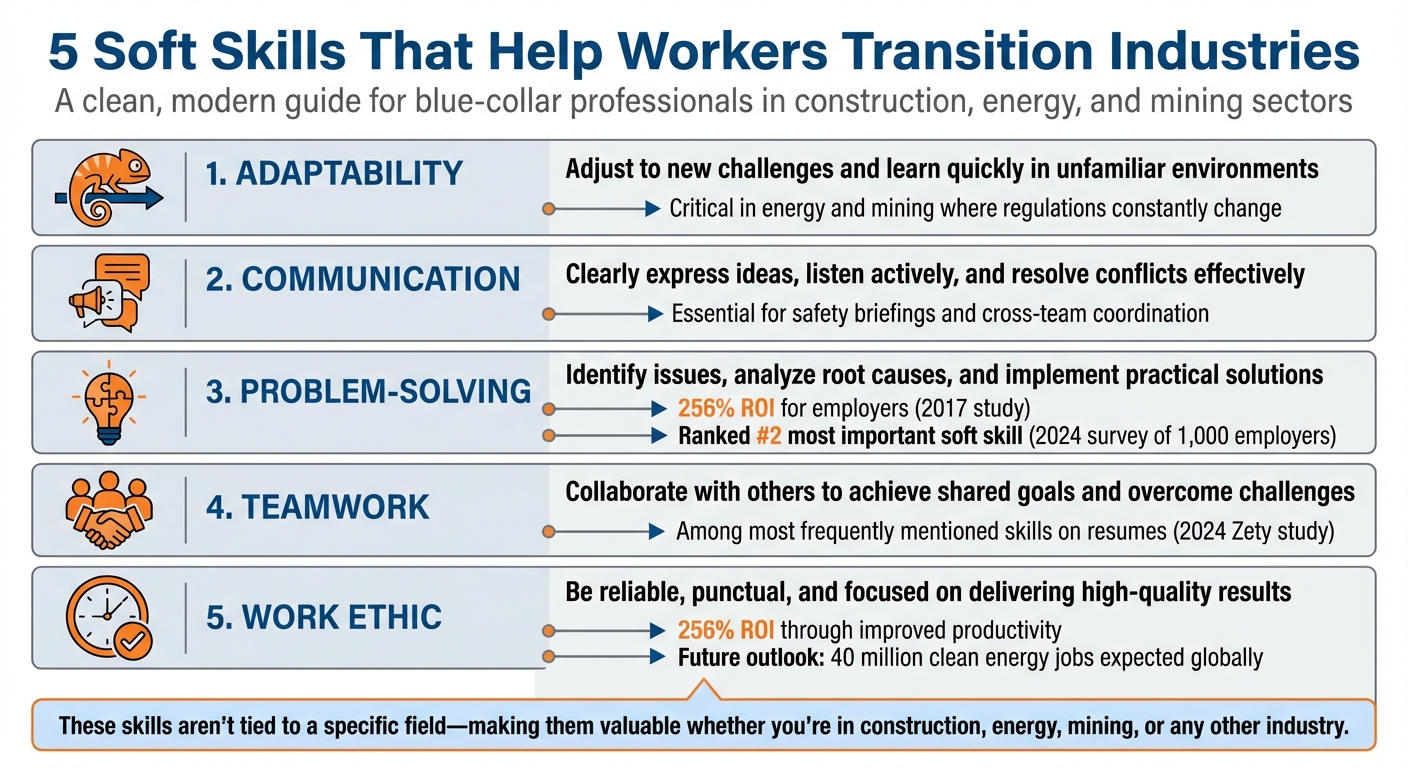
5 Essential Soft Skills for Industry Transitions
1. Adaptability
Transferability across industries
Being adaptable allows you to move between industries with ease, connecting your past experiences to new opportunities. Take, for instance, a construction worker who’s accustomed to adjusting to unpredictable site conditions – this ability to adapt can be just as valuable in energy or mining roles. Skillsoft captures this idea perfectly:
"Adaptability means the ability to pivot quickly in response to new challenges or opportunities is highly valued by employers and can significantly boost your career prospects".
This ability to carry over skills and experiences into different fields can directly improve your performance in new roles.
Impact on job performance
Adaptable employees keep things running smoothly, even when the unexpected happens. In industries like manufacturing, for example, being flexible ensures production doesn’t grind to a halt when processes change or equipment gets upgraded. Employers highly value workers who can quickly pick up new skills and adjust to shifting circumstances. This ability not only ensures tasks are completed efficiently but also helps maintain a positive and proactive work environment. When you can adapt to challenges or uncertainties, you help minimize risks – an essential trait in demanding and unpredictable workplaces.
Importance in high-demand industries like construction, energy, and mining
For blue-collar workers, adaptability isn’t a bonus – it’s a necessity. In fields like energy and mining, the ability to adjust is critical. Energy professionals, for example, must stay on top of evolving technologies and ever-changing regulations. Similarly, mining operations regularly face shifts in regulations and economic conditions.
Building adaptability isn’t out of reach. You can enhance this skill by leading safety meetings, managing cross-team projects, or seeking feedback to improve. Taking on internal projects that push you to learn new tools or collaborate with unfamiliar teams can also demonstrate your ability to thrive in new environments. These experiences show employers that you’re ready to succeed, no matter the challenge.
2. Communication
Transferability across industries
No matter the industry, communication is a skill that carries immense value. Whether you’re a welder, operator, or coordinator, the ability to express ideas clearly and effectively remains essential. As Virginia Community Colleges puts it:
"Whether you’re working as a welder, nurse, teacher or tech specialist, having the ability to clearly and effectively convey ideas through verbal and written communications is extremely valuable".
This skill isn’t tied to any specific tools or technologies, making it highly adaptable when transitioning to a new field. For example, moving from construction to energy or mining requires more than technical know-how – it demands active listening, constructive feedback, and conflict resolution. These abilities can ease the transition and help you hit the ground running in any industry.
Impact on job performance
Strong communication directly influences how effectively work gets done. On industrial sites, it can mean accurately interpreting body language during safety briefings, asking the right questions to clarify tasks, or tailoring your communication style to fit different audiences.
Good communication doesn’t just prevent delays or safety issues – it also boosts your reputation as a team player. Supervisors often notice those who can bridge gaps between teams, especially when simplifying complex technical details for both field crews and office staff. This ability to connect and clarify can set you apart in environments where clear direction is critical.
Importance in high-demand industries like construction, energy, and mining
In high-stakes industries, clear communication becomes even more critical. Whether you’re on a construction site, in an energy plant, or at a mining operation, precise instructions and attention to nonverbal cues can mean the difference between smooth operations and serious risks.
For technical roles, it’s helpful to quantify how your communication skills contribute to success. For instance, you might highlight accomplishments like "resolved team conflicts during a shutdown" or "improved reporting efficiency across shifts." These examples show how your skills translate into real-world impact.
Modern tools like ABLEMKR highlight the importance of communication by enabling real-time updates and seamless coordination on job sites. Platforms like this reinforce how critical strong interpersonal skills are in industries where safety and efficiency are paramount.
3. Problem-Solving
Transferability across industries
Problem-solving is a skill that works across all industries. The process is straightforward: figure out the issue, identify its root cause, come up with a solution, and put it into action. Whether it’s fixing issues on construction sites or tackling delays in mining operations, this method fits seamlessly.
As Anderson Trucking Service puts it:
"An individual with these skills has the opportunity to succeed in practically every industry".
What makes this skill so versatile is its reliance on analytical thinking rather than deep, industry-specific knowledge. This quality makes it especially useful for professionals moving between fields like construction, energy, and mining.
Impact on job performance
Strong problem-solving skills help workers hit the ground running in new roles. Employers see candidates with a track record of solving problems as safer bets – they’re able to adapt quickly and work independently, reducing the need for constant oversight. For instance, a 2017 study on garment workers who received soft skills training, including problem-solving, showed they became much more productive, delivering a 256% return on investment for their factory.
As automation continues to rise, roles requiring advanced cognitive abilities are expected to increase by 8% by 2030. Problem-solving will play a key role in ensuring job security in this evolving landscape. In high-pressure environments, this skill keeps operations running smoothly, even when challenges arise.
Importance in high-demand industries like construction, energy, and mining
In industries like construction, energy, and mining, where risks and complexities are part of daily operations, problem-solving is indispensable. These sectors often face unpredictable challenges – whether it’s dealing with a pipeline repair that hits a snag or addressing geological surprises during mine development. Workers who can resolve such issues quickly help keep projects moving forward.
In fact, problem-solving ranked as the second most important soft skill in a 2024 survey of 1,000 employers and employees. In production-heavy environments, this ability helps identify bottlenecks, streamline processes, and prevent minor issues from escalating into major setbacks. Platforms like ABLEMKR play a vital role in connecting skilled workers to critical projects where quick thinking and independent action are essential – whether it’s handling an unexpected shutdown or managing a remote repair under tight deadlines.
4. Teamwork
Transferability across industries
Teamwork is one of those skills that fits just about anywhere, making it an essential asset for anyone moving between industries. Whether you’re shifting from retail to construction or hospitality to energy, the ability to collaborate effectively can make that transition smoother. A 2024 study by career platform Zety revealed that teamwork and collaboration are among the most frequently mentioned skills on resumes.
City University of Seattle highlights that transferable skills like teamwork showcase your ability to contribute to an organization’s success, no matter where you picked them up.
What makes teamwork so versatile is that it doesn’t hinge on technical knowledge specific to one field. For instance, if you’ve honed your ability to coordinate tasks or support colleagues in a restaurant setting, you can apply those same principles in a manufacturing plant or on a construction site. These skills don’t just fill out a resume – they actively enhance workplace efficiency and effectiveness.
Impact on job performance
Teamwork doesn’t just help you get the job done; it can also elevate your performance. According to Charles Sturt University:
"Collaborating in a team allows individuals to tap into each other’s strengths and combine expertise to solve complex problems and make informed decisions".
Employers in high-demand industries view teamwork as a critical skill. When paired with technical training and peer mentorship, it can significantly boost job performance. Peer mentorship, in particular, lets workers share knowledge from past roles while learning new processes from their teammates, creating a two-way street for growth and productivity.
Importance in high-demand industries like construction, energy, and mining
In industries like construction, energy, and mining – where stakes are high and challenges are complex – teamwork is more than just helpful; it’s essential. These environments often involve managing risks, solving intricate problems, and working under tight deadlines. Team members rely on each other’s strengths to handle tasks that no one person could tackle alone.
Skills like conflict resolution, active listening, and relationship building play a huge role in these settings. Whether it’s coordinating with stakeholders, managing supply chains, or meeting regulatory requirements, effective teamwork ensures everything runs smoothly.
When showcasing your teamwork experience, use action-oriented language like "coordinated", "systematized", or "facilitated" to emphasize results. For example, you might highlight how you helped complete a project ahead of schedule or improved team safety. In interviews, the STAR method (Situation, Task, Action, Result) can be a powerful way to illustrate how your interpersonal skills made a measurable difference.
Platforms such as ABLEMKR connect workers with projects where teamwork is non-negotiable – like mobilizing crews for urgent shutdowns or managing remote pipeline repairs that require flawless coordination. These scenarios showcase how teamwork remains a foundational skill that drives success, no matter the industry.
sbb-itb-aa28329
5. Work Ethic
Transferability across industries
Work ethic is a skill that travels well across different industries. It includes qualities like punctuality, reliability, diligence, and a focus on achieving results. As Indeed puts it:
"Every employer seeks candidates who can be trusted to accomplish tasks well and in a timely manner".
This is especially true in fields like construction, energy, and mining, where safety is a top priority. In these high-risk environments, a strong commitment to Health, Safety, and Environmental (HSE) standards is non-negotiable. Ellaway Blues Consulting highlights this by saying:
"Ensuring safe working conditions and compliance with environmental regulations is critical, whether in the high-risk environments of oil and gas or the innovative spaces of clean tech and renewable energy".
The discipline required to follow safety protocols in one industry easily applies to others, making work ethic a universally valuable trait. It’s a foundation for consistent, high-quality performance no matter the field.
Impact on job performance
A solid work ethic directly boosts productivity and reliability. For instance, a 2017 study revealed that training employees in soft skills like time management and problem-solving led to a 256% return on investment for employers, thanks to improved productivity. City University of Seattle underscores this by stating:
"Time management… improves people’s motivation and effort at work and helps employees get better performance reviews".
One real-world example involves a retail logistics manager who transitioned to construction. By applying meticulous planning skills, they streamlined supply chains, cutting costs and improving efficiency. This demonstrates how focused effort and planning can deliver tangible results.
Importance in high-demand industries like construction, energy, and mining
In high-pressure industries such as construction, energy, and mining – where tight deadlines, complex logistics, and strict regulatory compliance intersect – a strong work ethic is essential. Workers who pay close attention to detail help maintain quality and avoid costly errors.
The energy sector, in particular, is grappling with a skills shortage, increasing the need for professionals from other high-risk fields who bring strong work habits to the table. As clean energy jobs are expected to reach 40 million globally, while fossil fuel roles decline, the demand for adaptable workers with solid work ethics is growing. For example, a mechanical engineer experienced in drilling could transition into green energy by learning wind turbine technology, highlighting the value of continuous upskilling.
When showcasing your work ethic, focus on measurable achievements. Instead of simply listing "work ethic" on a resume, provide specific examples like maintaining a "100% attendance record" or consistently completing projects ahead of deadlines by 10%. Platforms like ABLEMKR emphasize this by connecting pre-vetted workers to job sites based on certifications, safety training, and proven reliability. This demonstrates why a strong work ethic is a cornerstone for success in industries like construction, energy, and mining.
Mastering Soft Skills for a Successful Career Change
Conclusion
Skills like adaptability, communication, problem-solving, teamwork, and a strong work ethic empower workers to transition seamlessly between industries like construction, energy, and mining. As Indeed puts it, these transferable skills "remain relevant no matter the role or industry" and "support your ability to adapt, solve problems and contribute effectively in new environments". They act as a bridge, connecting past experiences to future opportunities.
To stand out, actively work on developing and showcasing these abilities. Take on tasks beyond your usual responsibilities – like leading a safety meeting or managing a small project – and seek feedback from colleagues and supervisors to refine your approach. When applying for roles in a new field, tailor your resume to highlight specific achievements that demonstrate how you’ve applied these skills effectively. This not only strengthens your resume but also boosts your ability to compete in fast-changing industries.
In a job market that’s constantly shifting, refining your soft skills is a smart strategy for staying ahead. Employers in high-demand sectors value candidates who can quickly adapt to new systems and solve problems with a positive mindset. Treat these skills as you would any technical expertise – practice them regularly, and they’ll become a key asset in your career toolkit.
Platforms like ABLEMKR make it easier to put these skills into action. By connecting pre-vetted workers with projects in construction, energy, and mining, ABLEMKR ensures that your certifications, safety training, and availability are matched to the right job opportunities. The platform simplifies the hiring process, offering well-paid roles and reliable, on-time payments, so you can focus on demonstrating your teamwork, dependability, and adaptability where it matters most.
Whether you’re moving from construction to energy or exploring opportunities in mining, these five essential soft skills lay the groundwork for success. By honing them, showcasing their impact through real-world examples, and applying them in new environments, you’ll be ready to tackle whatever challenges come your way. These skills are your ticket to thriving in today’s dynamic workforce.
FAQs
What can I do to adapt more easily when switching industries?
Switching to a new industry begins with honing transferable soft skills such as communication, teamwork, leadership, and problem-solving. These abilities are essential in fields like construction, energy, and mining, demonstrating to employers that you can thrive in different settings, even when technical specifics differ. Strengthening creativity and critical thinking can also prepare you to tackle fresh challenges and adapt to shifts in technology or market trends.
Take an active approach by staying informed about industry developments and seeking certifications or training to broaden your expertise. Platforms like ABLEMKR can be a valuable resource, connecting skilled workers to a variety of projects and providing hands-on experience that builds versatility. By blending strong soft skills, ongoing education, and exposure to diverse roles, you’ll position yourself for smoother transitions between industries.
Why is effective communication essential in industries like construction and energy?
Effective communication plays a crucial role in industries like construction, energy, and mining, where teams often face remote work sites, tight schedules, and high-risk conditions. Clear communication keeps everyone on the same page when it comes to safety protocols, project objectives, and compliance standards, reducing the chances of errors and accidents that can be both dangerous and expensive.
Good communication also supports faster decision-making and real-time updates – whether it’s managing crews, addressing equipment problems, or monitoring progress. Mobile-first platforms are particularly valuable in these environments, offering instant messaging, safety alerts, and real-time status updates, even in tough conditions. These tools not only improve productivity but also create a safer, more efficient workplace, which is essential for retaining skilled workers in such demanding fields.
How does having a strong work ethic help workers succeed in a new industry?
A strong work ethic – characterized by reliability, dedication, and a proactive mindset – can make a huge difference when stepping into a new industry. Employers highly value qualities like punctuality, consistent effort, and a genuine eagerness to learn. These traits signal that an employee can quickly adapt, meet deadlines, and uphold safety standards, even as they pick up new skills.
In fast-paced sectors such as construction, energy, and mining, having a dependable work ethic brings real advantages. It can lead to fewer safety incidents, better-quality results, and quicker mastery of new tasks. Workers who consistently show diligence not only improve project outcomes but also help lower turnover rates and keep operations running smoothly. Platforms like ABLEMKR play a key role in this process, connecting pre-screened workers with essential jobs. This ensures teams are equipped and ready to deliver from day one.


