
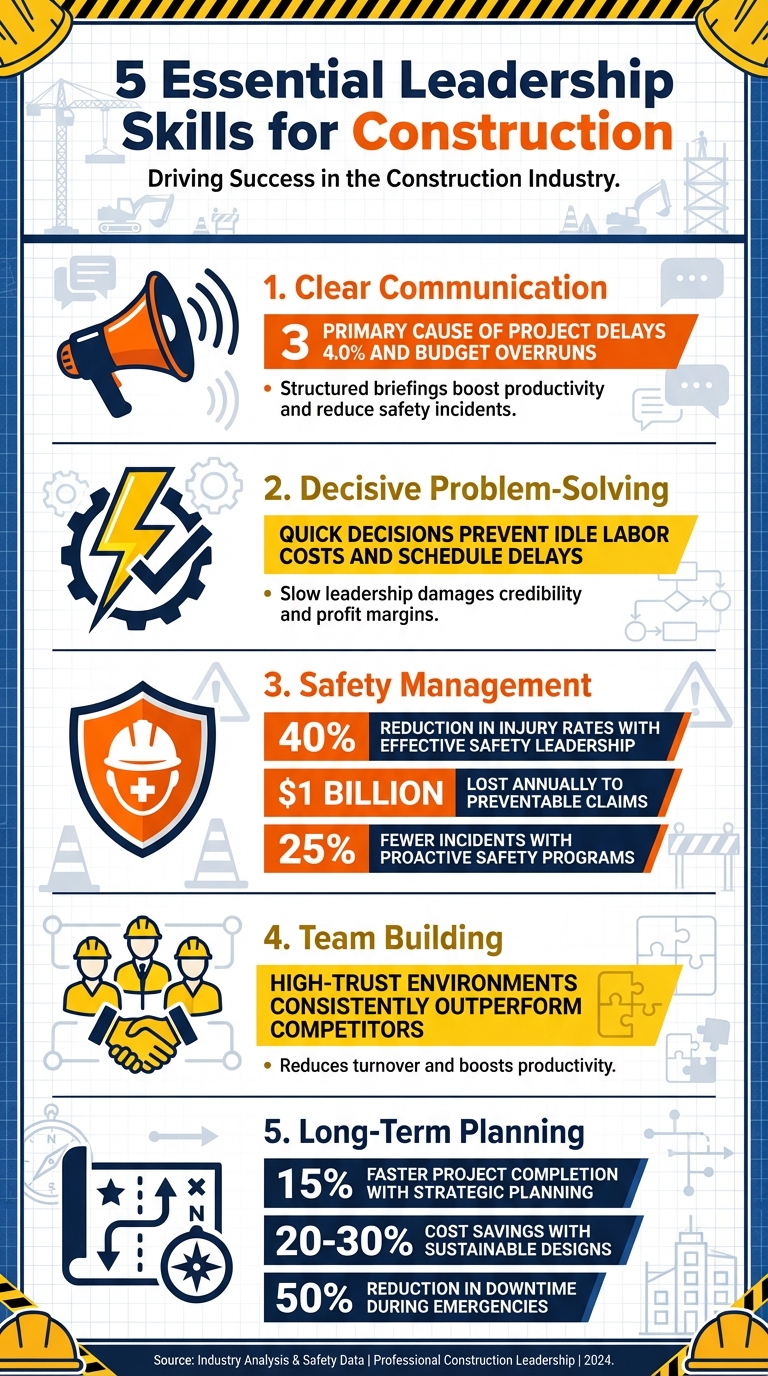
Being a leader in construction isn’t just about technical skills – it’s about managing people, making decisions under pressure, and ensuring safety on every jobsite. Whether you’re a foreman, superintendent, or project manager, these five skills are critical to keeping projects safe, efficient, and on schedule:
- Clear Communication: Miscommunication leads to costly delays. Great leaders ensure everyone understands tasks, timelines, and safety protocols.
- Decisive Problem-Solving: Quick, informed decisions help navigate challenges like weather delays or material shortages.
- Safety Management: Strong safety leadership reduces injuries and prevents shutdowns, saving time and money.
- Team Building: Building trust and resolving conflicts create motivated, productive teams.
- Long-Term Planning: Thinking ahead helps leaders prepare for market shifts, labor shortages, and future demands.
Master these, and you’ll not only run smoother projects but also position yourself for career growth in a competitive industry.
5 Essential Leadership Skills for Construction Project Success
1. Clear Communication
Impact on Project Outcomes
When construction leaders fail to provide clear instructions, the consequences are immediate and costly. Misunderstandings about scope, sequence, or quality expectations can lead to rework, delays, and a flood of change orders. Effective communication ensures that every trade – whether electricians, plumbers, or carpenters – understands what needs to be done, when it needs to happen, and to what standard. This clarity allows teams to get it right the first time. Structured briefings have been shown to boost productivity and reduce safety incidents. Studies consistently highlight communication failures as one of the primary reasons for project delays and budget overruns.
On the other hand, leaders who give precise instructions, confirm understanding, and maintain feedback loops – through methods like daily huddles and written change directives – experience fewer coordination errors and less downtime. This approach not only prevents costly mistakes but also prepares leaders to handle the unique communication challenges of construction projects.
Relevance to Construction Leadership
Construction leaders face a tough task: turning detailed plans into actionable steps for teams operating under tight deadlines, unpredictable weather, and hazardous conditions. They must simplify complex blueprints, specifications, and regulations for crews with varying experience levels, language barriers, and subcontractor dynamics. It’s no wonder many supervisors prioritize communication skills over technical knowledge when managing trades and clients.
Industry reports repeatedly point to poor communication and documentation as leading causes of disputes, often tied to unclear instructions or scope changes. Leaders who actively listen, adapt plans to on-the-ground realities, and tailor their messages to different audiences – whether owners, inspectors, union reps, or workers – build trust and reduce friction throughout the project.
Practical Application in High-Risk Environments
In high-risk environments like heavy civil construction, energy projects, or industrial shutdowns, ambiguity can be dangerous. Leaders must use standardized safety language, implement repeat-back protocols, and establish clear stop-work authority to ensure everyone understands hazards, controls, and who has the authority to halt operations. Briefings should be concise and supported by visual aids – like marked-up drawings, signage, and color-coded systems – to help workers retain critical information despite noise, fatigue, or shifting conditions.
Tools like ABLEMKR’s mobile-first platform simplify communication by matching pre-qualified workers based on certifications and safety training, ensuring the right instructions reach the right people – even during last-minute mobilizations. Digital solutions that deliver shift details, updated drawings, and safety alerts directly to workers’ phones help prevent outdated plans from being used and confirm that vital messages are received and understood. This real-time communication reduces risks and ensures everyone stays on the same page.
2. Making Decisions Under Pressure
Impact on Project Outcomes
Decisive leadership keeps projects on track when unexpected challenges – like weather delays, material shortages, or equipment breakdowns – threaten progress. Acting quickly to choose workable alternatives helps avoid idle labor costs, keeps schedules intact, and prevents expenses from spiraling. Clear, timely decisions also reduce the need for rework. When teams have clear instructions, they’re less likely to improvise, which helps maintain both quality and safety standards. This kind of decisiveness lays the foundation for smooth and safe operations, even on unpredictable job sites.
On the flip side, slow or indecisive leadership can lead to serious setbacks. Idle crews, missed inspections, and delayed schedules chip away at profit margins and damage credibility with project owners. In practical terms, this might look like delayed approvals for change orders, unanswered RFIs, or foremen improvising solutions to unresolved issues. These missteps can result in safety violations, rework, and further delays. Over time, such patterns can tarnish a firm’s reputation – especially in U.S. markets where repeat business and referrals are key to securing future projects.
Relevance to Construction Leadership
In construction, leaders often have to make quick decisions in fast-changing environments. Job sites are constantly evolving due to factors like weather, site conditions, labor availability, and supply chain disruptions, which means leaders rarely have all the information they’d like before making a call. The ability to act decisively under pressure is what separates effective leaders from the rest, ensuring safety and timelines stay on track.
Common challenges include equipment failures during critical tasks, delayed material deliveries for essential operations like slab pours, design conflicts discovered mid-layout, or severe weather threatening exterior work. Strong leaders respond by resequencing crews to focus on other areas, approving alternate materials, or halting work temporarily to secure the site ahead of a storm. All of this happens while keeping key stakeholders – owners, inspectors, and subcontractors – in the loop.
Practical Application in High-Risk Environments
Quick decision-making is just as important as clear communication in high-risk construction environments. Leaders who act swiftly to stop work when conditions become hazardous – such as high winds on elevated platforms, unprotected trenches, or missing fall protection – can prevent accidents and avoid OSHA violations that could shut down a site and harm the company’s reputation. Addressing near-miss reports promptly by adjusting methods, schedules, or crew assignments reinforces the principle that safety comes first. Many supervisors rely on playbooks to guide their responses to common disruptions, ensuring consistency and speed.
Tools like ABLEMKR, which matches pre-vetted workers to projects based on certifications and availability, help leaders make fast staffing decisions during emergencies or urgent repair needs without compromising safety or compliance. Similarly, mobile project-management platforms and daily reports provide real-time insights into productivity, weather, inspections, and safety incidents. These tools enable supervisors to make informed decisions about manpower adjustments, task resequencing, or overtime needs. When leaders combine quick actions with clear communication – like toolbox talks, updated plans, and documented directives – they keep teams aligned and minimize risks.
3. Safety and Compliance Management
Impact on Project Outcomes
Strong safety and compliance management can significantly reduce delays and costs in construction projects. For instance, sites with effective safety leadership often see injury rates drop by as much as 40%. Fewer injuries mean fewer disruptions, reduced insurance expenses, and smoother workflows overall. The construction industry loses approximately $1 billion annually to preventable claims. By reinforcing safety standards daily, leaders foster a culture of accountability that aligns teams with changing regulations and best practices, building trust and keeping projects on track.
On the flip side, poor safety oversight can lead to catastrophic consequences. Take the 2023 scaffolding collapse, for example. Ignoring inspection protocols led to fatalities, fines exceeding $10 million, and a complete project shutdown. Neglecting safety can turn minor violations into major setbacks, including reputational harm – especially in markets dependent on repeat business. In contrast, companies with proactive safety programs report 25% fewer incidents and a stronger track record of delivering projects on time.
Relevance to Construction Leadership
Safety and compliance management is often regarded as one of the most critical leadership skills in construction. The U.S. construction industry remains one of the most hazardous sectors, with OSHA’s "Fatal Four" – falls, struck-by incidents, caught-in/between accidents, and electrocutions – accounting for a significant portion of workplace fatalities. Leaders play a pivotal role in managing OSHA compliance, conducting hazard analyses, enforcing PPE usage, and delivering ongoing training across dynamic and complex job sites. This responsibility goes beyond delegating tasks to safety officers; it requires leaders to integrate safety into every decision, ensuring that production demands never outweigh the importance of worker protection.
Effective safety leadership not only ensures compliance but also boosts team morale. When leaders prioritize worker well-being over tight schedules, teams tend to perform better and experience lower turnover. Setting an example – such as consistently wearing PPE and halting unsafe practices – reinforces a culture of safety. Conversely, inconsistent behavior from leaders can quickly undermine compliance efforts and erode trust.
Practical Application in High-Risk Environments
Applying these principles becomes even more critical in high-risk sectors like oil and gas, utilities, and heavy infrastructure. These environments often require adherence to additional regulations, client-specific safety protocols, and unique site challenges. Leaders in such settings conduct daily toolbox talks, perform site audits to identify hazards like unstable scaffolding or unprotected trenches, and enforce strict PPE requirements. They rely on written checklists and pre-task plans for high-risk activities, such as working at heights, crane operations, and confined spaces. When supply chain disruptions or severe weather jeopardize safety, leaders may adapt plans or even pause work to provide quick training on new equipment or procedures.
Digital tools have become essential for streamlining these efforts. For example, ABLEMKR’s mobile-first platform connects pre-vetted workers to job sites based on their certifications and training, ensuring that only qualified personnel handle critical or remote tasks. Supervisors can instantly verify credentials and monitor compliance in real time, enabling swift crew mobilization. By tracking key indicators like near-miss reports, safety observations, and training participation, leaders can adjust their strategies proactively to prevent incidents before they happen.
4. Building and Supporting Teams
Impact on Project Outcomes
Strong leadership is key to keeping projects on track, both in terms of deadlines and budgets. Leaders who prioritize building solid relationships across different trades create teams that work well together. This kind of teamwork leads to higher engagement, greater productivity, and timely completion of tasks. By addressing conflicts openly, recognizing team members’ efforts, and offering opportunities for growth, leaders can create an environment where collaboration thrives. This approach not only streamlines day-to-day operations but also equips teams to handle the unexpected challenges that often arise on-site.
On the flip side, poor leadership can derail projects. Mismanagement can lead to friction among team members, escalating disputes, lower morale, and even the departure of skilled workers – all of which can slow progress and inflate costs.
Relevance to Construction Leadership
Construction leaders often face the tough task of bringing together crews with varying goals, communication styles, and levels of technical expertise. What sets the best leaders apart is their ability to build trust and foster collaboration. As David Horsager from the Trust Edge Leadership Institute puts it, trust isn’t just a "soft skill" – it’s a critical element. High-trust environments consistently outperform their competitors.
Today’s construction leadership emphasizes a people-first approach. Leaders who combine technical know-how with interpersonal skills like empathy, active listening, and conflict resolution create teams that perform at their best. This involves more than just managing from a distance. It means being present – walking the job site, asking questions, listening to workers’ concerns, and addressing issues quickly and fairly.
Practical Application in High-Risk Environments
In high-risk industries such as oil and gas, utilities, and heavy infrastructure, teamwork becomes even more essential. Leaders in these settings go beyond basic team-building by emphasizing safety and clear communication. Regular safety meetings, visual aids, and standardized procedures help keep everyone on the same page. Leading by example is also crucial – whether it’s showing up on time, using proper protective equipment, or maintaining respectful communication.
When conflicts arise, whether over delays or safety concerns, effective leaders step in to mediate with a focus on facts and shared goals. They don’t just resolve issues; they ensure the team stays aligned and motivated.
Technology plays a growing role in supporting these efforts. Platforms like ABLEMKR simplify crew management by matching pre-vetted workers to job sites based on certifications, safety training, availability, and location. These tools provide real-time insights into crew status, making it easier to deploy teams quickly and ensure compliance with safety and training requirements. This combination of leadership and technology helps create efficient, well-coordinated teams.
sbb-itb-aa28329
5. Planning for Long-Term Success
Impact on Project Outcomes
Strategic planning is what sets great construction leaders apart from the rest. While managing daily tasks like scheduling and resource allocation is vital, long-term planning takes things a step further. It involves preparing for market changes, economic challenges, and sustainability goals – factors that directly shape future competitiveness. For instance, projects with well-thought-out strategic plans can finish up to 15% faster, while incorporating sustainable designs can lead to 20–30% cost savings over a project’s lifecycle.
On the flip side, when strategic alignment is missing, cost overruns and delays become far more likely. A lack of clear vision connecting immediate goals to broader business objectives can leave teams unprepared for unexpected challenges, whether it’s a supply chain issue, labor shortage, or new regulatory requirements.
Relevance to Construction Leadership
Great construction leaders don’t just manage what’s happening now – they anticipate what’s coming next. Strategic planning builds on the foundation of strong communication and decisive action, ensuring projects succeed over the long haul. To do this, leaders need to stay ahead of trends like energy transitions, shifting workforce demographics, and the adoption of new technologies. Developing three- to five-year roadmaps that identify risks and opportunities helps organizations maintain their edge. This might include preparing for labor shortages through cross-training, planning for leadership succession, or adopting tools that improve efficiency.
A clear company vision that resonates across all levels can boost resilience. When everyone understands the company’s direction and why their roles matter, teams stay aligned – even in uncertain times. Strategic thinking also involves continuous learning. Staying informed about market trends, financial forecasting, and risk assessment tools equips leaders to make smarter decisions. Combining these roadmaps with efficient team management and quick-response systems is key to achieving long-term success.
Practical Application in High-Risk Environments
In high-risk industries like oil and gas, mining, and heavy infrastructure, long-term planning isn’t optional – it’s essential. Leaders in these sectors must prepare for disruptions such as severe weather, regulatory shifts, or equipment breakdowns. This means creating systems that ensure projects can move forward, no matter the challenge. For example, rigorous processes for vetting skilled labor, verifying certifications, and stabilizing the workforce through strategic hiring models like flex-to-hire or direct placement are crucial.
Tools like ABLEMKR make a big difference here. By offering features like certifications, safety training, and geo-location tracking, ABLEMKR helps reduce downtime by up to 50% during emergencies. Real-time visibility into worker status, paired with compliance tracking, enables leaders to make informed decisions about team composition and resource allocation. This ensures projects remain on schedule, even when conditions take an unexpected turn.
4 Must-Have Skills for Construction Leaders
Conclusion
Success in construction leadership today depends on mastering a few key skills: clear communication, decisive action, strict adherence to safety protocols, team support, and thoughtful planning. Leaders who excel in these areas can align their crews seamlessly, tackle disruptions head-on, and build the trust necessary to retain top talent in a competitive labor market. These abilities form the backbone of a strong leadership approach, ensuring projects stay on track and avoid costly setbacks.
On the flip side, poor leadership – whether through unclear communication or lack of decision-making – can turn small challenges into major delays, budget overruns, and safety hazards. But those who communicate effectively, make sound decisions under pressure, prioritize safety, support their teams, and plan with foresight create high-performing organizations that consistently stay ahead of the competition.
Modern tools like ABLEMKR make it easier for construction leaders to put these skills into practice. This platform connects you with a pool of pre-vetted, skilled workers whose certifications, safety training, and availability are already verified. By streamlining administrative tasks, ABLEMKR allows leaders to focus on what matters most: coordinating in the field and maintaining quality. Features like real-time worker status updates, built-in compliance tracking, and integrated payroll workflows ensure you can staff critical tasks – whether for last-minute needs or planned projects – without jeopardizing safety or timelines.
For leaders overseeing multiple sites or managing high-risk operations in industries like construction, oil and gas, utilities, or mining, ABLEMKR’s centralized compliance data and geo-location matching help reduce non-compliance risks and speed up crew mobilization. This operational support ties directly into long-term goals, enabling you to forecast labor demands, refine staffing models, and expand into new regions or sectors with confidence.
FAQs
How does effective communication impact construction project success?
Effective communication plays a key role in the success of construction projects. It ensures everyone on the team is on the same page when it comes to project goals, safety protocols, and individual tasks, which helps minimize misunderstandings and avoid expensive mistakes.
When communication is clear, it builds collaboration and trust among team members. This not only makes it easier to address problems quickly but also keeps projects on track and improves safety management. The result? Smoother workflows and a more efficient path to project completion.
Why is decisive problem-solving essential for construction leadership?
Decisive problem-solving plays a key role for leaders in construction. It empowers them to assess challenges quickly, make informed decisions, and implement solutions efficiently. This approach helps avoid delays, improves safety, and keeps projects running smoothly.
In an industry as fast-paced as construction, acting swiftly and with confidence can stop minor problems from growing into expensive setbacks, safeguarding both schedules and budgets.
Why is safety management so important for leaders in construction?
Safety management plays a crucial role in construction leadership by safeguarding workers, minimizing accidents, and ensuring projects stay on schedule. When safety is prioritized, leaders can steer clear of expensive delays, legal complications, and harm to the company’s reputation.
Beyond compliance, effective safety management builds trust and accountability within teams. Workers feel supported and valued, which is essential on demanding, high-risk projects. It’s about more than just following rules – it’s about fostering a safer and more productive environment for everyone involved.


