
The construction industry is rapidly integrating robotics to address labor shortages and improve efficiency. However, there’s a growing skills gap as the workforce struggles to meet the demands of these new technologies. Here’s the key takeaway: nearly 69% of construction professionals report challenges finding qualified workers, with 439,000 new roles needed by the end of 2025.
Key Points:
- Robotics in Construction: Robots now perform tasks like drilling, bricklaying, and demolition, reducing time and improving safety.
- Skills Gap: Many workers lack training in robotics, leading to delays and underutilized systems.
- Employer Challenges: Training workers in robotics is time-intensive, and hybrid teams require adjustments in workflows and safety protocols.
- Emerging Roles: New positions like robot operators and robotics technicians combine mechanical skills with digital proficiency.
- Training Solutions: Apprenticeships, higher education, and platforms like ABLEMKR are helping bridge the gap by connecting skilled workers with tech-driven roles.
This shift is reshaping job roles, with an emphasis on digital tools, safety protocols, and robotics operations. Employers and workers must adapt quickly to meet the increasing demand for a robotics-enabled construction workforce.
How Are Robotics Changing On-site Construction Training? – Construction Jobs
Key Findings: Evidence of the Skills Gap
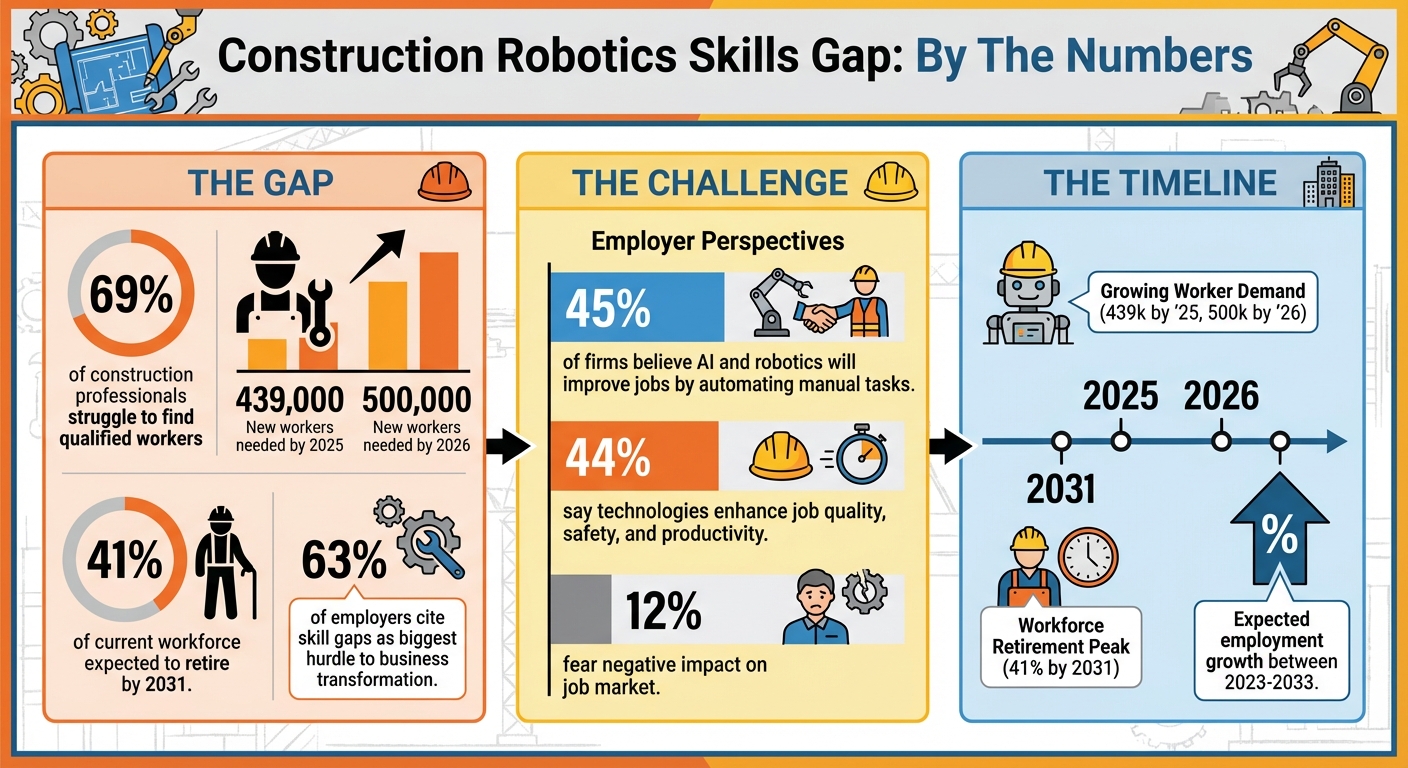
Construction Robotics Skills Gap Statistics 2025-2031
Data and Numbers
The numbers paint a clear picture of a growing skills gap in the construction industry. According to Trimble‘s 2025 Geospatial Industry Report, 69% of construction professionals are struggling to find qualified workers. By 2026, nearly 500,000 new workers will be needed, with 439,000 required as early as 2025. Adding to this challenge, 41% of the current workforce is expected to retire by 2031, taking decades of hands-on expertise with them.
This shortage is even more pronounced as new technologies emerge. Companies don’t just need more workers – they need workers with a whole new set of skills. The World Economic Forum‘s Future of Jobs Report 2025 highlights that 63% of employers see skill gaps as the biggest hurdle to business transformation. While construction employment is expected to grow 7% between 2023 and 2033, many employers are finding it difficult to recruit workers equipped to handle technology-driven roles. This has prompted businesses to rethink how they approach training and redefine job roles to align with evolving demands.
What Employers Are Saying
Employers are finding that training their existing workforce to manage, program, and maintain robotics is a time-consuming and highly structured process. But the challenge isn’t just technical – it’s about reimagining entire workflows and team dynamics. Many companies are transitioning from fully manual crews to hybrid teams where fewer workers oversee robots performing repetitive or physically demanding tasks. This shift can lead to coordination issues and even downtime as teams adjust.
Safety is another major concern. To ensure human-robot collaboration runs smoothly on busy job sites, companies need to implement new safety protocols, conduct hazard assessments, and align with OSHA-approved training programs. That said, when robotics are integrated effectively, they can significantly enhance safety by taking on dangerous tasks and reducing workplace injuries. The AGC 2025 Workforce Survey reveals that 45% of firms believe AI and robotics will improve jobs by automating manual tasks, while 44% say these technologies enhance job quality, safety, and productivity. Only 12% fear a negative impact on the job market.
Old Roles vs. New Roles
As the industry evolves, so do the roles within it. The shift toward technology-integrated roles isn’t about replacing workers, but rather reshaping their responsibilities. For example, equipment operators are now transitioning to tele-operated roles, layout workers are becoming robot-assisted technicians, and masons are taking on tasks that involve supporting robotic systems.
While traditional construction knowledge – like understanding materials, sequencing, and site safety – remains critical, these new roles demand additional skills. Workers now need to be digitally savvy, able to work with tools like 3D models, digital twins, and robot task plans. They must also monitor systems, set machine parameters, and, in some cases, perform basic programming. Although the physical workload may decrease, the mental demands are higher. Workers need to stay alert, make decisions based on data, and understand the limitations of the machines they oversee. Often, one operator is responsible for managing multiple machines, which increases accountability for both quality and overall productivity.
Skills Employers Want in Construction Robotics
Technical Skills for Robotics Operations
Employers in construction robotics are on the lookout for workers who can operate, program, and maintain robots designed for tasks like layout, drilling, bricklaying, and material handling – a shift from traditional construction roles. The most sought-after skills include experience with robotic total stations, automated layout tools, and semi-autonomous machinery. Workers need to handle machine setup, interpret task plans, adapt to site conditions, and troubleshoot issues directly on-site.
While basic programming knowledge can help, a strong mechanical aptitude combined with trade experience is often sufficient, especially when paired with low-code tools. Familiarity with industrial control concepts like PLC logic, motion control, and safety interlocks is helpful but not always required. The real focus is on customizing tasks through user-friendly interfaces and performing preventive maintenance – checking sensors, drives, and other components to minimize downtime and ensure the robot’s cost-effectiveness.
Because construction sites are dynamic, sensor calibration, spatial alignment, and system diagnostics are critical skills. Workers must recalibrate robots for different wall dimensions, materials, and layouts, ensuring tasks like drilling or cutting align with real-world conditions rather than idealized CAD models. This requires knowledge of tools like LiDAR, total stations, cameras, and IMUs, as well as techniques to align robot coordinates with site control points and BIM models. Diagnostic expertise includes identifying whether issues stem from environmental factors (dust, vibration, lighting), data errors (outdated drawings, bad models), or hardware problems (sensor failures, misalignment) and implementing practical fixes to keep projects on track.
Digital Tools and Data Skills
Modern construction roles demand more than just technical know-how – digital proficiency is becoming equally important. Workers need to navigate BIM models, interpret 3D layouts, and work with digital twins that provide instructions to robots. For example, those operating layout or drilling robots must import and verify BIM-derived coordinate sets, understand wall types and material properties, and ensure the digital plan matches on-site conditions before starting work. This makes skills in BIM platforms, clash detection, and revision tracking increasingly essential – not just for VDC specialists but also for foremen and robot operators.
Data skills are another key area. Workers are expected to capture as-built data using tools like drones, scanners, and robot logs, flag any deviations, and interpret analytics dashboards that track productivity, quality, and safety metrics. These dashboards often break down performance in terms of U.S. labor costs, rework, overtime, and scheduling impacts. At higher levels, such as superintendents and project managers, the role expands to include comparing robot and manual productivity, calculating cost benefits in U.S. dollars, and analyzing dashboards that integrate data across multiple crews and robots.
Safety and Risk Management
Technical and digital expertise aside, safety remains a cornerstone of construction robotics. Employers prioritize OSHA-aligned safety training, which includes hazard recognition, lockout/tagout procedures, machine guarding, and understanding safe operation zones around robots. Workers must grasp how human-robot collaboration hazards – like pinch points, unexpected movements, and energy isolation – tie into OSHA’s general duty clause and other machinery standards. Key responsibilities include conducting risk assessments, setting up barrier systems and warning devices, following manufacturer safety guidelines, and documenting near misses or incidents in a structured format.
Adapting Job Hazard Analysis (JHA) processes for robotics is another growing requirement. Workers must update procedures to account for new energy sources, emergency stop protocols, and maintenance access points. Certifications like OSHA 10/30 and equipment-specific credentials are now standard for robotics roles, often tracked through centralized systems like ABLEMKR to ensure compliance across states and clients. Supervisors and safety managers are tasked with formal risk assessments, mapping robot paths, defining exclusion zones, and sequencing activities to minimize risks when robots are active.
Beyond technical and safety skills, employers emphasize the importance of adaptability, communication, and problem-solving. With tools and workflows evolving rapidly, workers need to embrace new software, interfaces, and equipment while providing constructive feedback to improve implementation. Clear communication between robot operators, foremen, VDC teams, and safety staff is crucial for resolving discrepancies between digital plans and field conditions, coordinating work schedules, and managing downtime without delaying the project.
sbb-itb-aa28329
Training and Workforce Development Solutions
To address the growing skills gap, industry leaders and educational institutions are reshaping training programs to meet new workforce demands.
Upskilling Through Apprenticeships and Education
Apprenticeships in trades are evolving to include robotics training, creating a bridge between high school programs and certifications that enhance job prospects. Trainees now gain hands-on experience with tools like robotic total stations, laser scanners, and 3D modeling software alongside traditional trade skills. The Academy of Craft Training (ACT) is taking proactive steps to meet the projected need for 439,000 new workers by 2025. ACT equips students with knowledge about robotics and automation, emphasizing how these technologies can improve efficiency without replacing the need for skilled labor.
Higher education is also stepping up. For instance, Trimble Technology Labs, first launched at the University of Massachusetts Amherst in 2015, now operates in over 30 labs across 14 countries. These labs have trained nearly 12,000 students in advanced tools like robotic total stations, laser scanning, augmented reality, and BIM modeling. By providing hands-on learning, these programs help students transition more easily into the workforce, with younger participants often excelling in digital skills. Similarly, San Diego State University is tackling the "skills gap" in construction engineering through an NSF-funded program that blends construction, civil engineering, and emerging technologies into interdisciplinary training.
On-the-Job Training and Industry Partnerships
In addition to formal education, on-the-job training plays a critical role in closing the skills gap. Many major contractors collaborate with schools, unions, and trade associations to deliver targeted robotics training through internal academies and practical workshops. These efforts often include teaching classes, participating in Skills USA events, and offering internships. Equipment manufacturers like Hilti and Trimble also contribute by providing hands-on training for their robotic tools, allowing workers to focus on more complex tasks.
This modular approach – combining vendor-led certifications with on-site mentoring – empowers employers to reskill their existing workforce rather than relying solely on new hires. This strategy not only addresses worker shortages but also ensures project continuity.
How Platforms Like ABLEMKR Can Help
Workforce platforms are simplifying the process of verifying skills and matching workers to roles that require robotics expertise. ABLEMKR, a mobile-first platform, connects certified workers to job sites based on their credentials, safety training, availability, and location. This streamlined system is particularly useful for construction and energy projects, where quick deployment is often critical [context]. The platform offers features like real-time worker tracking, integrated payroll, and compliance monitoring, enabling employers to efficiently mobilize skilled robotics operators for tasks such as facility shutdowns or urgent repairs [context].
Additionally, ABLEMKR centrally tracks verified credentials, including OSHA certifications, equipment-specific qualifications, and training completions, ensuring compliance across state lines. By reducing the challenges of hiring and deployment, this system helps contractors confidently staff high-risk, complex projects with the right talent.
What This Means for Employers and Workers
Impact on Employers
The growing skills gap in construction robotics is forcing U.S. contractors to rethink their approach to recruiting and retaining talent. Many firms now present construction as a tech-driven career, highlighting the use of robotics and digital tools to appeal to skilled workers. With fewer candidates experienced in robotics, employers are hiring individuals with related skills – like equipment operation, IT networking, or maintenance – and providing on-the-job robotics training. While this approach helps bridge the gap, it also extends hiring timelines and increases reliance on staffing agencies to supply pre-vetted candidates.
Pay structures are also evolving. The shortage of workers skilled in robotics has pushed roles such as robot operators and robotics technicians into higher pay brackets compared to traditional craft positions. Employers are offering hiring bonuses, retention perks, and faster career progression to attract and keep talent. Workers with expertise in configuring, maintaining, and optimizing robots are finding themselves in stronger positions to negotiate wages and earn performance-based bonuses.
In terms of project delivery, construction robots bring consistency and efficiency to tasks like layout, drilling, and demolition, often working longer shifts without interruptions. Beyond improving timelines, robots also enhance safety by taking on hazardous tasks, allowing human workers to focus on supervisory and problem-solving roles. These changes are reshaping job roles and career paths across the industry.
New Career Opportunities for Workers
As robotics becomes more common, workers are discovering new roles that combine technical skills with digital know-how. Positions like robot operator, robotics technician, and digital field engineer are emerging alongside traditional trades, complementing rather than replacing them. Robot operators handle tasks such as setup, programming, monitoring, and troubleshooting of field robots, blending conventional equipment operation with digital tools. Robotics technicians specialize in maintenance, calibration, firmware updates, networking, and diagnostics for fleets of robots and sensors. Digital field engineers and BIM specialists, on the other hand, connect design with field execution by integrating robot workflows into digital models, layout plans, and quality assurance processes.
These roles focus more on interpreting data, configuring systems, and collaborating with teams than on repetitive physical tasks. This shift makes construction careers more appealing to younger, tech-savvy individuals and provides sustainable options for aging workers or those with physical limitations. Career progression now includes clear pathways, such as advancing from robot operator to senior operator, robotics technician, or field automation lead, with certifications and pay steps similar to traditional journeyman-to-master tracks.
For craft workers, the journey often begins with learning basic digital skills, like using tablets and reading digital drawings. From there, they can pursue specialized training in robotics and automation through union programs, manufacturer courses, community college certificates, or industry partnerships. Employers prioritize credentials like OSHA safety certifications, manufacturer-specific qualifications, and training in areas like mechatronics or industrial maintenance. Platforms such as ABLEMKR help workers showcase these skills, connecting them to higher-paying robotics-related opportunities in construction, energy, and heavy infrastructure projects.
Long-Term Industry Trends
The adoption of robotics in construction is driving improvements in productivity, safety, and career sustainability. Robots are helping to close the industry’s long-standing productivity gap by standardizing repetitive tasks, supporting off-site and modular construction methods, and ensuring precise execution of digital plans. Safety is also improving as robots take on hazardous jobs like working at heights, heavy demolition, or tasks in confined spaces, aligning with stricter regulations and safety requirements from project owners.
These advancements are creating a more sustainable workforce. Older workers are transitioning into less physically demanding roles, while younger, tech-oriented individuals are drawn to higher-skilled positions that offer competitive wages and clear career growth. As sectors like energy, utilities, and heavy infrastructure grow – with projects such as grid upgrades, renewable energy installations, and pipelines – the demand for tech-savvy construction workers is expected to rise. Platforms like ABLEMKR are playing a vital role in matching skilled workers to these evolving opportunities, helping the workforce adapt to the industry’s changing needs.
Conclusion: Closing the Gap for a Robotics-Enabled Future
The growing robotics skills gap in construction signals a major shift in how work is done, requiring collaboration among employers, workers, training organizations, and platforms. As digital tools reshape the industry, they bring improvements in safety, productivity, and quality. To navigate these changes, employers must act quickly and strategically.
One way to start is by rolling out pilot programs and creating standardized workflows and safety procedures. Introducing hybrid job roles – like "robotics-enabled carpenter" or "field robotics coordinator" – can help blend technology into traditional trades without the need for entirely separate career paths.
For workers, the focus should be on building essential digital skills, such as using tablets and cloud-based tools. Earning certifications and gaining hands-on experience in the field can make them more competitive. Employers also value safety expertise and troubleshooting abilities, which further enhance a worker’s appeal.
Platforms like ABLEMKR play a critical role by connecting certified, safety-trained workers to tech-driven projects, speeding up the benefits of upskilling efforts.
As the construction industry moves forward, it’s clear that adopting technology and developing the workforce must go hand in hand. With construction jobs expected to grow 7% by 2033 and AI-driven employment projected to create 170 million jobs globally by 2030, companies that prioritize training programs, partnerships with educational institutions, and modern labor platforms will be better positioned to secure the skilled talent needed for a robotics-enabled future .
FAQs
What key skills do workers need for careers in construction robotics?
Workers in construction robotics must blend technical know-how with practical expertise to succeed in this dynamic field. Core skills include a solid grasp of robotics and automation systems, the ability to keep up with fast-changing technologies, and an unwavering commitment to safety standards.
Practical experience with digital tools is a must, as are certifications in equipment operation and safety. A deep understanding of construction workflows is equally critical. Beyond technical skills, problem-solving abilities and strong communication are key for tackling complex challenges and working effectively with teams on demanding projects.
What are the best ways to train employees for roles in construction robotics?
To prepare employees for roles in construction robotics, companies should prioritize practical, hands-on training that directly relates to the technologies and tasks they’ll encounter on the job. Offering specialized certifications, safety courses, and simulation-based learning can help workers develop both the technical know-how and the confidence they need to succeed.
Platforms like ABLEMKR make this process easier by matching workers with projects that align with their skills while ensuring they meet industry standards. Pairing these efforts with on-site mentorship and continuous learning opportunities helps employees stay equipped to handle the ever-changing demands of robotics in construction.
What new career paths are emerging in construction with the rise of robotics?
The use of robotics in construction is opening up a range of fresh career opportunities. These include positions such as robotics operators, automation specialists, maintenance technicians, and data analysts. There’s also an increasing need for experts in safety management and systems integration to help ensure these advanced technologies are implemented smoothly and effectively.
As the industry evolves, employers are seeking candidates skilled in automation, technical problem-solving, and data-driven decision-making. This trend is creating chances for workers to build specialized knowledge and play a role in cutting-edge, impactful projects.


