
Geo-targeting is transforming how companies recruit skilled trades workers by delivering job ads to specific locations like trade schools, industrial zones, and competitor sites. This approach focuses on workers within a realistic commute range, improving hiring speed, reducing costs, and increasing candidate quality. Here’s why it works:
- Targeted Reach: Ads are shown to candidates in specific geographic areas, ensuring relevance.
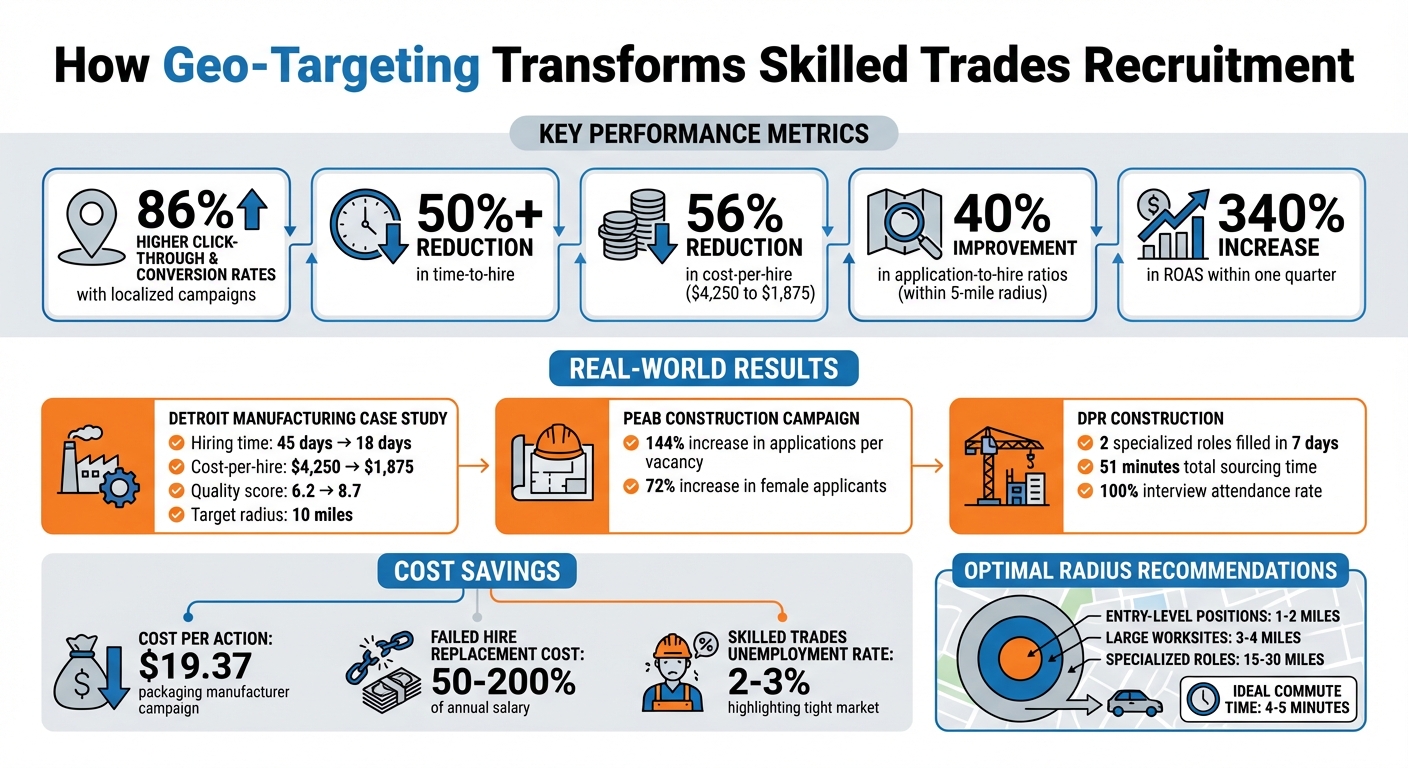
- Faster Hiring: Companies report reducing time-to-hire by over 50% using local campaigns.
- Lower Costs: Geo-targeting cuts cost-per-hire significantly compared to traditional methods.
- Reduced Turnover: Workers closer to job sites are more likely to stay long-term.
- Passive Talent Access: Reaches skilled workers not actively job hunting but open to better opportunities nearby.
For example, a Detroit manufacturing company reduced its hiring time from 45 to 18 days and halved its cost-per-hire by focusing on candidates within a 10-mile radius. Geo-targeting also helps build local referral networks, creating a sustainable talent pipeline over time.
This strategy is especially effective in industries like construction, manufacturing, and energy, where proximity to job sites is critical. By leveraging platforms like Google Ads and LinkedIn Recruiter, employers can fine-tune campaigns to attract the right candidates while saving time and money.
Geo-Targeting Impact on Skilled Trades Recruitment: Key Statistics and ROI
Research Data: How Geo-Targeting Improves Recruitment Results
Better Applicant Quality and Lower Turnover
Geo-targeting doesn’t just streamline recruitment – it also boosts the quality of candidates while slashing hiring costs and turnover rates. Data shows that localized recruitment campaigns achieve 86% higher click-through and conversion rates. Targeting specific areas, like neighborhoods or industrial hubs, consistently attracts stronger applicants.
Take the example of a Detroit manufacturing company in 2025. By focusing their recruitment efforts on candidates within a 10-mile radius of their plant, they saw candidate quality scores jump from 6.2 to 8.7. Even better, their average cost-per-hire plummeted from $4,250 to $1,875 – a 56% reduction. This approach not only improved the pool of applicants but also made the hiring process far more cost-effective.
"Micro-geo targeting pre-qualifies candidates based on location. That cuts down screening time." – dstribute.io
Localized hiring also helps reduce turnover. Workers who live closer to their jobs are more likely to stay, as they’ve already considered the commute before applying. In fact, focusing on candidates within a 5-mile radius improves application-to-hire ratios by 40%. A construction staffing agency in the Southeast demonstrated this in September 2019 by reallocating their budget to target skilled trade positions in specific states. By limiting general labor sponsorships to just three days and redirecting funds, they achieved 85 additional qualified applications – a 22% increase – without increasing their budget.
Local Hiring Builds Stronger Referral Networks
Geo-targeting does more than just fill positions – it creates robust referral networks within local communities. Workers who live near each other often share connections through trade schools, union halls, or previous job sites. A manufacturing facility in Roanoke, Virginia, leveraged this in 2026 by geofencing local technical colleges and competitor plants. Over six months, their campaign generated 3,529 clicks and 179 documented on-site visits from ad-engaged job seekers, enabling them to staff multiple shifts before the plant even opened.
These networks grow stronger over time. In 2022, a large packaging and plastics manufacturer used addressable geo-fencing to target 159 postal codes where blue-collar workers like auto mechanics and electricians lived. Their three-month campaign led to 634 total actions (online applications and in-person visits) at a cost per action of just $19.37. Many of the initial hires referred neighbors and former classmates, creating a self-sustaining talent pipeline that required minimal ongoing advertising. This demonstrates geo-targeting’s dual benefit: it not only improves immediate hiring results but also builds a long-term workforce network that reduces future recruitment costs.
How to Use Geo-Targeting for Skilled Trades Recruitment
Focus on Trade Schools and Industrial Areas
Geo-targeting works best when aimed at areas where skilled labor is concentrated. Trade schools, vocational programs, and technical colleges are excellent starting points since they attract individuals who are either in training or have recently earned certifications. Setting up geofences around these institutions allows you to connect with candidates who are about to graduate. Additionally, targeting competitor sites, industrial zones, and industry events can help you reach passive candidates who already have the skills and experience to thrive in demanding roles.
Getting the technical setup right is critical. Platforms like Google Ads, Facebook Ads Manager, Simpli.fi, and LinkedIn Recruiter can help you execute location-based campaigns effectively. For instance, when using Google Ads, choose the "Presence" setting instead of the default "Presence and Interest" option. This ensures your ads are shown only to people physically present in your target area. Pairing this with precise radius settings enhances your ability to focus on the right audience.
Set Your Radius Based on Commute Data
The radius you target should align with the role and realistic commute expectations. For entry-level positions, a 1–2 mile radius often works best. Larger worksites might require a 3–4 mile range, while specialized roles might justify extending to 15–30 miles. Aiming for a commute of about 4–5 minutes – whether by walking or driving – can help you attract truly local candidates. Campaigns that focus on such short commutes tend to reduce the likelihood of interview no-shows and early turnover. For roles in industrial districts, targeting specific bus routes or public transit corridors can be particularly effective.
To fine-tune your approach, run A/B tests with different radii, such as 5 miles versus 15 miles, and measure the impact on show-up rates. This type of refinement can yield impressive results. In fact, 78% of recruiters say geospatial mapping has improved their campaigns, with companies reporting a 35% boost in candidate quality and a 50% cut in time-to-hire.
Case Studies: Geo-Targeting Results in Skilled Trades
Data from Localized Recruitment Campaigns
Geo-targeting has proven to be a game-changer for recruitment in skilled trades, improving not just the speed of hiring but also the quality and diversity of applicants. Take PEAB, a Nordic construction and civil engineering giant with 16,000 employees, as an example. They launched an automated social media recruitment campaign to attract local talent across Sweden, Norway, Finland, and Denmark. Spearheaded by Anita Florén, Head of Recruitment, and powered by AI-driven targeting, the campaign achieved impressive results: a 144% increase in applications per vacancy and a 72% rise in female applicants compared to traditional job boards. Reflecting on this achievement, Florén shared:
"Since we started working with Adway we have more than doubled the number of candidates into our vacancies, and that is a fantastic result"
This example highlights how programmatic recruitment campaigns can deliver measurable results, setting the stage for similar successes in other construction firms.
Construction Companies Using Geo-Targeting
DPR Construction demonstrated the power of geo-targeting during a time-sensitive hiring challenge in May 2025. They needed to fill two specialized roles – a Heavy Equipment Operator in Denver, CO, and a Mechanical Drywaller in Atlanta, GA. Using a location-specific recruitment platform, their team managed to hire both workers in just seven days. The sourcing process was incredibly efficient, requiring only 51 minutes of total effort (about 25 minutes per hire). The results included a 100% interview attendance rate and a 25% interview-to-hire conversion rate. As Craft Recruiter Samir Montealegre described:
"The platform has revolutionized our hiring process for heavy equipment operators, commercial and mechanic drywallers, offering a significant improvement over traditional job boards"
These examples underscore that geo-targeting isn’t just about casting a wider net. It’s about connecting with the right candidates quickly, improving both hiring timelines and the quality of hires.
sbb-itb-aa28329
How ABLEMKR Uses Geo-Targeting for Workforce Deployment
Location-Based Matching for Skilled Workers
ABLEMKR uses GPS technology alongside certification data to connect skilled tradespeople with job sites based on their location, qualifications, and verified credentials. It doesn’t stop at proximity – ABLEMKR also filters workers by certifications like OSHA-10 cards and specialized equipment licenses. This ensures that nearby workers not only meet the location requirements but also possess the necessary skills for the job. Whether it’s an urgent pipeline repair or a planned mine development, this dual-layered system helps contractors quickly assemble the right crew.
Contractors can access detailed worker profiles, including location, background, and performance history, before making hiring decisions. This level of transparency removes uncertainty, allowing contractors to confidently select workers who are best suited for their job sites. Beyond matching, ABLEMKR upholds workforce reliability with strong compliance measures.
Compliance and Onboarding Through Geo-Targeting
Geo-targeting plays a key role in simplifying compliance and streamlining deployment processes. ABLEMKR handles the intricate compliance requirements often tied to deploying workers across various locations. Workers complete a one-time onboarding process that includes identity verification, background checks, and I-9 documentation, allowing for same-day or next-day deployment.
This onboarding system integrates seamlessly into daily operations. Using the platform’s mobile app, GPS verification ensures workers are physically present on-site when they clock in, which guarantees payroll accuracy. The platform also keeps digital records of worker certifications and automatically flags upcoming expiration dates. This prevents contractors from unknowingly deploying workers with expired OSHA cards or trade licenses. Operating under a W-2 employment model, ABLEMKR manages payroll taxes, unemployment insurance, and workers’ compensation, shielding contractors from costly penalties for worker misclassification – penalties that can reach up to $25,000 per worker.
Geofencing for Recruitment Marketing Explained
Conclusion
Geo-targeting helps employers focus their recruitment efforts on candidates who can realistically commute to the job site, cutting down on wasted ad spend. By concentrating budgets on high-intent local candidates, companies save money and see better returns on their ad investments. For example, one case study reported a 340% increase in ROAS within a single quarter by using a hyperlocal strategy. Beyond reducing costs, this approach eliminates relocation expenses and lowers both hiring and training expenditures.
Another advantage of geo-targeting is its ability to speed up the hiring process by reaching passive candidates – skilled professionals who aren’t actively job hunting but are already qualified and employed. Recent campaigns have shown a surge in qualified applications, with some employers filling roles even before their operations officially launched. This precise targeting ensures that ad dollars are spent on candidates who live within a realistic commuting distance.
Geo-targeting doesn’t just help with immediate hiring needs; it also supports long-term workforce development. By engaging with trade schools, vocational programs, and even local competitors, employers can build sustainable talent pipelines. With unemployment in skilled trades hovering around 2–3%, traditional job boards often fall short in reaching the right candidates. Hiring locally offers additional benefits: workers with short commutes and community ties are less likely to leave, reducing turnover. Considering that replacing a failed hire can cost between 50% and 200% of an employee’s annual salary, retention becomes a major factor in boosting recruitment ROI. Plus, satisfied local employees often recommend friends and former classmates, creating a self-sustaining talent network that lowers recruitment costs over time.
FAQs
What’s the best radius to target for skilled trades roles?
The best radius for finding skilled trades professionals usually falls between a few miles to 25 miles. This range often depends on the local job market and how close the candidates live to the worksite. For urgent hiring needs, focusing on a very local area tends to work best. Tailoring the radius to fit the specific demands of a project can make it easier to connect with the right talent quickly.
How do I effectively geo-target trade schools and industrial areas?
To connect with trade schools and industrial areas effectively, location-based strategies like geofencing and geotargeting are your go-to tools. Here’s how you can make the most of them:
- Pinpoint key spots: Focus on areas like trade school campuses, industrial hubs, or training centers where your target audience is likely to be.
- Leverage technology: Use GPS or RFID to identify devices within these zones, allowing you to tailor your outreach.
- Refine your audience: Narrow your focus by targeting specific demographics, such as individuals attending job fairs or those near training facilities.
These strategies help ensure your recruitment efforts connect with the right people, exactly when and where they’re most receptive.
How can I measure geo-targeting ROI beyond clicks and applications?
To gauge the success of geo-targeting beyond basic clicks and applications, focus on deeper metrics like conversion rates – how many candidates actually move forward in the hiring process after interacting with geo-targeted ads. Look at cost per hire or cost per qualified applicant within specific targeted areas, and compare these figures to the results of broader, non-targeted campaigns. You can also measure local engagement by tracking things like attendance at job fairs or how quickly positions are being filled in those areas. These insights can give you a clearer picture of how effective your location-based recruitment strategies are.


