
The U.S. is facing a growing skilled labor shortage in both the energy and construction industries. Aging workforces, insufficient vocational training, and increased demand from federal infrastructure projects and clean energy initiatives are driving the crisis. Here’s what you need to know:
- Construction needs: By 2026, 499,000 additional workers are required, with over half needed to replace retirees.
- Energy challenges: For every worker under 25, 2.4 are nearing retirement. Specialized roles like electricians and pipefitters are hardest to fill.
- Regional focus: Construction shortages are most severe in urban hubs (Texas, Arizona, Ohio, Georgia), while energy projects struggle in rural and coastal areas.
- Economic impact: Labor shortages delay projects, costing $10.8 billion annually in construction and slowing clean energy progress globally.
Both sectors compete for the same skilled trades, with electricians and mechanical workers in particularly high demand. Emerging solutions like workforce deployment platforms are helping bridge the gap by connecting pre-vetted workers to critical projects quickly.
Labor Shortages: Energy vs. Construction
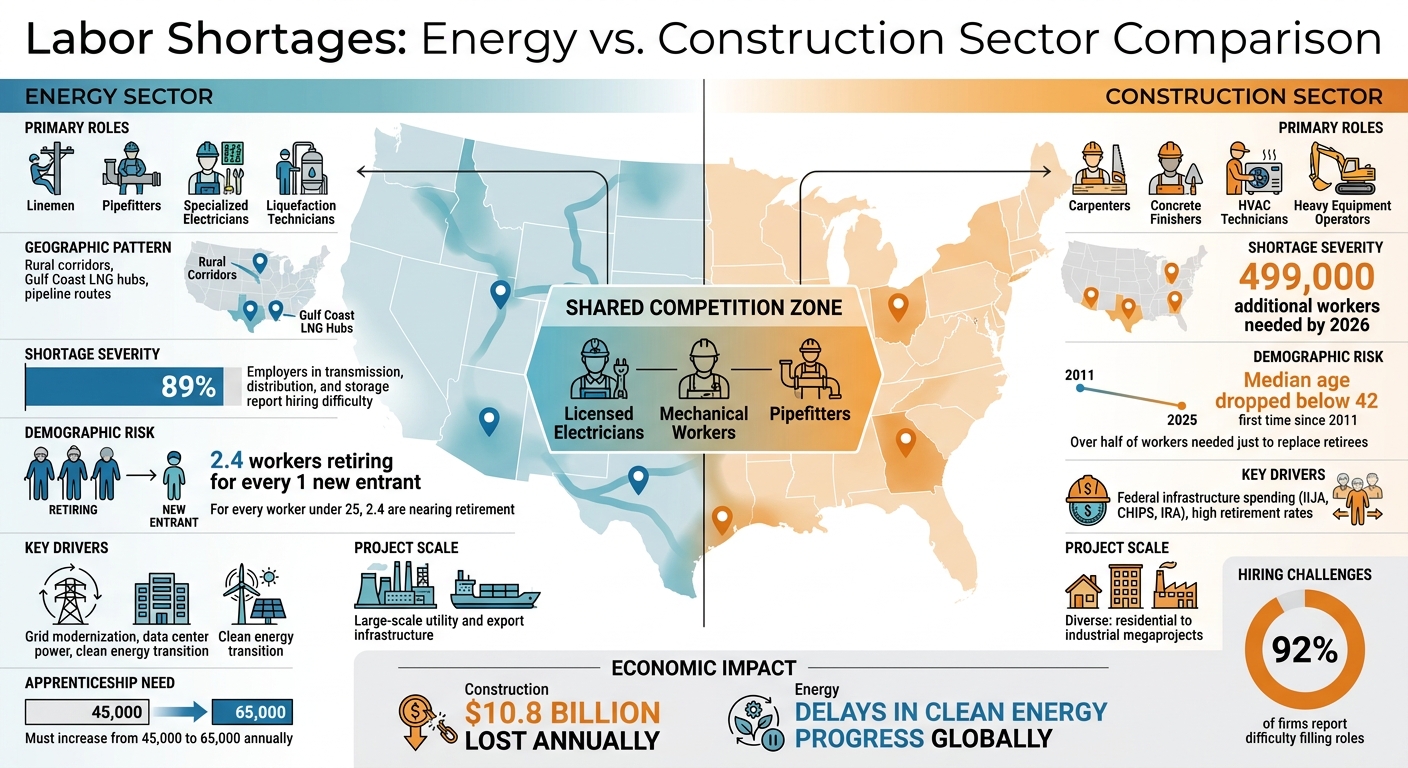
Energy vs Construction Sector Labor Shortage Comparison
The energy and construction sectors face unique labor challenges shaped by their differing demands and geographic focuses. Understanding these distinctions helps employers plan effectively and workers identify opportunities in high-demand areas. Each sector’s labor market reflects the pressures of regional economic growth in distinct ways.
Energy Sector: Specialized Roles and Regional Focus
The energy sector’s workforce challenges are rooted in the need for highly specialized roles. Positions like linemen, pipefitters, liquefaction technicians, and specialized electricians require advanced training and certifications, making them harder to fill as the industry expands projects like gas pipelines, power generation, and data center infrastructure. The demographic outlook is concerning: for every worker under 25 entering the energy workforce, 2.4 are nearing retirement. This imbalance is even more severe in nuclear and grid-related jobs, with ratios of 1.7 to 1 and 1.4 to 1, respectively.
Adding to the difficulty, energy projects are often concentrated in rural and coastal areas. These include pipeline routes in the Midwest, transmission lines in remote regions, and LNG facilities along the Gulf Coast, all driven by targeted economic growth in these areas. Energy Intelligence highlights this issue: "A shrinking pool of qualified workers nationwide is starting to vex other energy-related sectors as well, including pipelines and power generation, potentially driving up costs and delaying project completions". To meet growing demands, the transmission and distribution sector must increase apprenticeships from 45,000 to 65,000 annually, but 89% of employers report significant challenges in finding skilled workers.
Construction Sector: Diverse Trades and Urban Challenges
The construction industry, on the other hand, grapples with labor shortages across a wide range of trades. From carpenters and concrete finishers to HVAC technicians and heavy equipment operators, the need for workers is immense. Over half of these workers are required just to replace retirees, not to support new growth.
Unlike the energy sector’s rural focus, construction labor shortages are most acute in urban and suburban hubs such as Texas, Arizona, Ohio, and Georgia. These areas are experiencing backlogs due to major federal investments in infrastructure. Anirban Basu, Chief Economist at Associated Builders and Contractors, explains: "There’s a structural component tied to retirements and demographics, and a cyclical component tied to demand. The cyclical side has softened". Urban expansion and federal funding are driving these labor deficits, contrasting sharply with the localized needs of the energy sector.
Both sectors are also competing for crossover trades like licensed electricians and mechanical workers. The rise of hyperscalers building AI infrastructure has intensified shortages of electricians skilled in precision wiring and mechanical workers trained in advanced cooling systems. This has forced contractors to recruit crews from other regions, potentially creating secondary shortages elsewhere.
Labor Demand by Sector: Comparison Table
| Feature | Energy Sector | Construction Sector |
|---|---|---|
| Primary Roles | Linemen, pipefitters, specialized electricians, liquefaction technicians | Carpenters, concrete finishers, HVAC technicians, heavy equipment operators |
| Geographic Pattern | Rural corridors, Gulf Coast LNG hubs, pipeline routes | Urban/suburban megaproject hubs (TX, AZ, OH, GA) |
| Shortage Severity | 89% of employers in transmission, distribution, and storage report hiring difficulty | 499,000 additional workers needed in 2026 |
| Demographic Risk | 2.4 workers retiring for every 1 new entrant | Median age dropped below 42 in 2025 |
| Key Drivers | Grid modernization, data center power, clean energy transition | Federal infrastructure spending (IIJA, CHIPS, IRA), high retirement rates |
| Project Scale | Large-scale utility and export infrastructure | Diverse: residential to industrial megaprojects |
sbb-itb-aa28329
Regional Economic Growth and Labor Competition
Regional economic growth is adding fuel to the labor challenges faced by the energy and construction sectors. The location of projects often determines the intensity of these pressures, with both industries frequently vying for the same pool of skilled workers.
Urban vs. Rural Workforce Challenges
The location of a project plays a huge role in shaping labor demands. Urban and suburban areas – particularly in states like Texas, Arizona, Ohio, and Georgia – are seeing contrasting trends in construction. Large firms working on massive projects like semiconductor fabs and data centers are experiencing record backlogs. Meanwhile, smaller contractors focused on office and retail construction are seeing a decline in activity. This heavy focus on long-term, high-capacity projects creates a ripple effect, limiting the availability of workers for smaller, more localized construction jobs.
Energy projects, on the other hand, are often situated in rural areas or along coastal regions, especially the U.S. Gulf Coast. Projects like LNG facilities, pipelines, and wind farms in these regions frequently face the challenge of shallow local labor pools. Developers often have to bring in workers from other areas, which is no easy task. To make things even tougher, these rural energy projects are competing directly with urban industrial construction for skilled tradespeople like electricians, pipefitters, and heavy equipment operators.
This urban-rural divide creates a domino effect. Anirban Basu, Chief Economist at Associated Builders and Contractors, explains:
"Labor concentration around megaproject hubs is forcing contractors to import crews from other regions – relieving shortages locally while creating secondary gaps elsewhere and extending schedules more broadly".
When workers move to Arizona for a semiconductor fab or to the Gulf Coast for an LNG project, their absence creates new shortages in their home regions. This geographic imbalance highlights the broader strain on both the energy and construction industries as they battle over a limited pool of skilled labor.
Competition for Skilled Workers Between Sectors
The overlap in labor needs between the energy and construction sectors has become even more pronounced in 2026, thanks to regional economic growth across a variety of project types. Both industries are scrambling to hire skilled workers like electricians, mechanical workers, and pipefitters. The rise of AI infrastructure has added another layer to this competition. As Basu points out:
"Hyperscalers racing to build artificial intelligence infrastructure are struggling to secure electricians capable of precision wiring and mechanical workers trained to install advanced cooling systems… delaying schedules even as overall labor demand softens".
Federal initiatives like the Infrastructure Investment and Jobs Act, the CHIPS Act, and the Inflation Reduction Act have further accelerated growth across traditional infrastructure, clean energy, and advanced manufacturing. This has led to direct competition in regions where multiple project types overlap. For instance, in Texas, projects ranging from data centers to renewable energy installations and petrochemical expansions all rely on the same limited pool of skilled workers. With high wages in construction drawing workers toward premium projects, lower-margin jobs are left struggling to find enough labor.
Technology Solutions for Workforce Deployment
Streamlining Hiring and Deployment with Technology
The ongoing labor shortages in energy and construction industries have led to a surge in technology adoption aimed at speeding up worker deployment to job sites. In construction, a staggering 92% of firms report challenges in filling open roles, with nearly half (48%) stating that new hires often fail to show up on their first day. Similarly, the energy sector is grappling with shortages in specialized roles that require advanced certifications. To tackle these issues, platforms like ABLEMKR have stepped in with solutions designed for efficiency and compliance.
ABLEMKR focuses on connecting pre-vetted workers with critical projects, ensuring that certifications, safety training, availability, and location align for seamless mobilization. Construction firms benefit from receiving qualified labor within 24–48 hours, minimizing the risk of project delays. Meanwhile, energy operators use the platform to quickly assemble crews for urgent tasks like pipeline repairs, mine development, or shutdowns, all while meeting technical certification and OSHA standards.
The platform also simplifies administrative hurdles by managing W‑2 status, workers’ compensation, and liability coverage. This reduces compliance headaches for contractors and allows for quick workforce deployment in high-demand states like Texas, Arizona, Ohio, and Georgia, where industries like semiconductor manufacturing, data centers, and renewable energy installations are fiercely competing for skilled talent.
Real-Time Visibility and Automation
Once workers are deployed, real-time visibility and automation tools play a crucial role in maintaining workforce stability and adapting to shifting project needs. These technologies help address labor imbalances between urban and rural areas, which often force contractors to bring in crews from far-off regions, leaving other areas short-staffed. In construction, where the average employee tenure is just 3.9 years and turnover rates hover between 68% and 73%, having real-time insights into worker status allows project managers to better handle workforce instability. Notably, 45% of construction contractors cite worker shortages as the leading cause of project delays.
In the energy sector, automation is helping to manage demographic challenges, such as retirement waves, by facilitating the transition of workers from fossil fuel roles to positions in solar PV, nuclear energy, and grid maintenance. This shift is vital, as the power sector has driven three-quarters of recent energy job growth. Features like integrated payroll workflows and automated job matching enable both industries to respond quickly to changing project demands, ensuring they stay on track despite workforce challenges.
Conclusion: Addressing the Skilled Labor Crisis
Key Takeaways for Employers and Workers
The shortage of skilled labor in energy and construction is a growing challenge, driven by what’s often referred to as a demographic cliff. In construction, about 20% of workers are aged 55 or older, while in the energy sector, this figure climbs to 34% for petroleum technicians. These industries, however, are tackling the issue in contrasting ways. Construction has managed to lower its median workforce age below 42 for the first time since 2011 by focusing on vocational training and apprenticeships. Meanwhile, energy firms are leaning heavily on headhunting and offering higher pay to fill specialized roles, which may not be a sustainable strategy for long-term workforce development.
For employers, the focus needs to shift from simply hiring more to adopting smarter workforce planning. Anirban Basu, Chief Economist at Associated Builders and Contractors, highlights the dual challenges:
"Nothing changed in the model. What changed is the cycle. There’s a structural component tied to retirements and demographics, and a cyclical component tied to demand".
Strategic planning, such as aligning staffing needs with project timelines months in advance, gives contractors a competitive edge. For workers, certifications like OSHA 30 or NCCER can significantly boost earnings – up to 77% more than entry-level wages.
The energy sector can draw inspiration from construction’s success in increasing trade school enrollment by 16% in just one year. On the flip side, construction firms, especially those managing large-scale projects, could benefit from energy’s approach to talent mapping, which identifies and recruits high-skill specialists well ahead of project mobilization. These examples highlight the pressing need for fresh approaches to workforce challenges, including the use of technology to close labor gaps.
The Role of Technology in the Future of Skilled Labor
Technology is becoming a game-changer for workforce deployment, especially as the construction industry anticipates needing 349,000 to 499,000 new workers by 2026, while the energy sector faces an 18.7% vacancy rate in specialized roles, with an average time-to-fill of 94 days. Traditional staffing methods simply aren’t enough to meet these demands.
Platforms like ABLEMKR are stepping in to address this gap. By treating workforce deployment as a risk management issue, ABLEMKR provides pre-vetted, certified workers within 24–48 hours, using location-based matching to meet immediate needs. Features like real-time worker status updates and automated payroll workflows allow firms to adapt quickly to shifting project demands. Whether it’s an urgent pipeline repair or a highly technical data center project, these tools ensure that the right talent is in place when it’s needed.
As one industry analysis aptly puts it:
"Workforce certainty is now a competitive advantage. The companies that understand this are not just surviving the labor crunch. They’re winning market share because of it" – Broxer.
FAQs
Which skilled trades are most in demand in both energy and construction?
Skilled trades are seeing a surge in demand, particularly in the energy and construction industries. Roles such as electricians, pipefitters, welders, and heavy equipment operators are essential and increasingly hard to fill. Within construction, MEP (mechanical, electrical, and plumbing) managers are in short supply, especially for large-scale projects.
The energy sector faces similar challenges, with a pressing need for electricians, welders, and other technical experts vital to industries like oil & gas, renewables, and power generation. Across the board, both electrical work and specialized mechanical skills remain highly sought after, reflecting their critical role in these industries.
Why do labor shortages affect urban construction and rural energy projects differently?
Labor shortages affect urban construction and rural energy projects in distinct ways, shaped by differences in growth patterns and the nature of the work. In cities, the demand for construction is intense due to dense populations and rapid development. This creates stiff competition for skilled tradespeople, driving up wages as companies vie for talent. On the other hand, rural energy projects face unique challenges like geographic isolation and a limited pool of local workers with the necessary specialized skills. Additionally, demographic changes in rural areas further complicate labor availability, even though these projects often progress at a slower pace.
How can ABLEMKR help crews mobilize faster without compliance delays?
ABLEMKR speeds up crew mobilization with its mobile-first platform, simplifying staffing, onboarding, and compliance. The platform matches pre-vetted workers to projects by considering factors like certifications, safety training, availability, and location. With real-time worker status updates, integrated payroll workflows, and built-in compliance tracking, it eliminates delays from manual processes. This ensures workers are fully certified and ready for deployment swiftly and efficiently.


