
Scenario planning helps construction companies prepare for workforce needs in an industry where labor costs make up 70% of budgets and 98% of projects face delays or overruns. This method involves creating 2–5 scenarios to address uncertainties like labor shortages, regulatory changes, and project demands. With the construction industry requiring 723,000 new workers annually through 2026, planning for flexible crew sizes, skill requirements, and compliance is critical to staying on budget and on schedule.
Key takeaways:
- Labor costs dominate construction budgets, with workers’ compensation rates 71% higher than other industries.
- Scenario planning focuses on cost predictability, schedule adherence, and workforce flexibility.
- Tools like ABLEMKR and Bridgit Bench provide real-time insights to optimize crew allocation and reduce risks.
- Use rolling 2–4 week forecasts, contingency buffers (5–10%), and flexible staffing models like temp-to-perm to manage costs.
Construction Management Systems: Manpower Budgeting/Scheduling Procedures
sbb-itb-aa28329
Steps for Construction Staffing Budget Scenario Planning
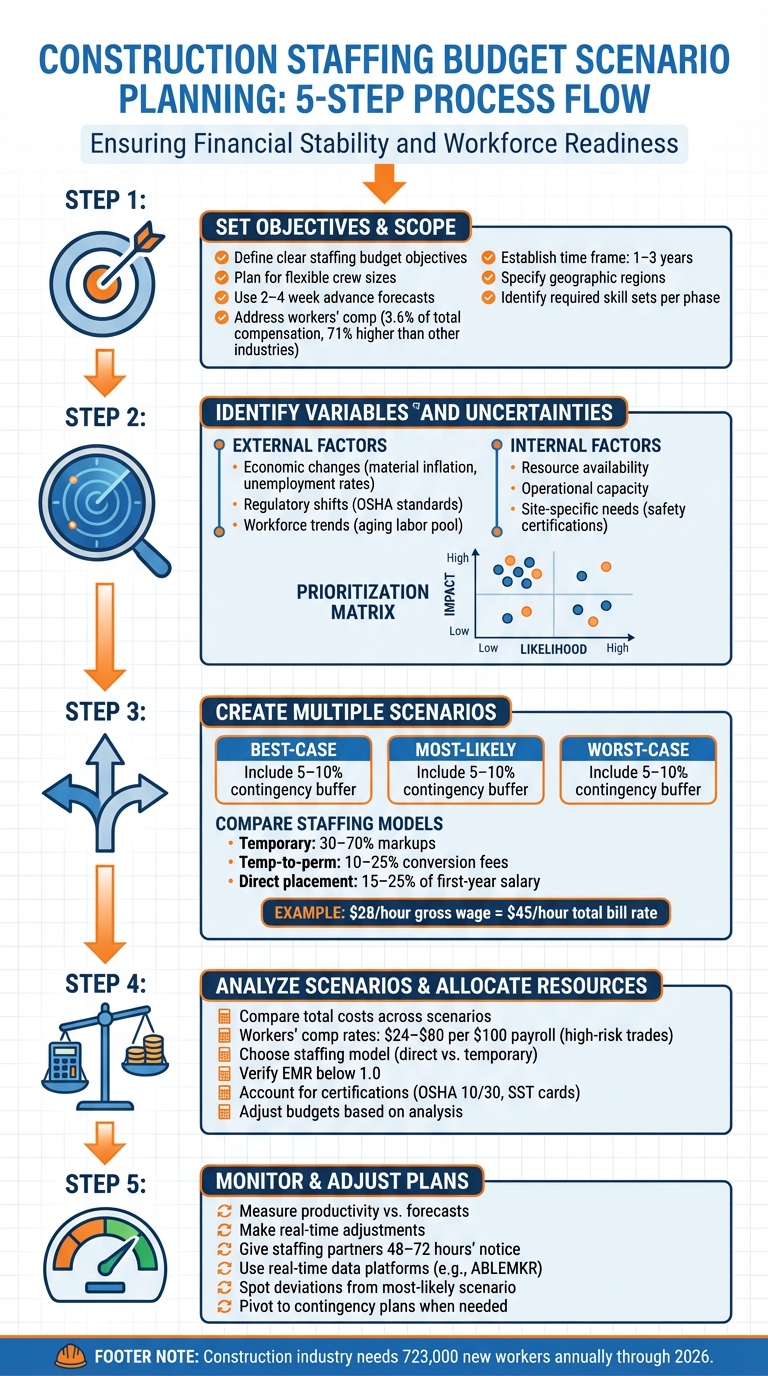
5-Step Construction Staffing Budget Scenario Planning Process
Step 1: Set Objectives and Scope
Start by defining clear objectives for your staffing budget. This includes planning for flexible crew sizes during different project phases and optimizing costs using 2–4 week advance forecasts. A key focus should be on reducing risks and ensuring compliance. For instance, transferring administrative tasks like workers’ compensation – which makes up 3.6% of total compensation costs in construction and is 71% higher than in other goods-producing industries – can help mitigate potential pitfalls. Address employment classification risks as part of this process.
Next, establish the scope of your planning. Specify the time frame (typically 1–3 years for flexibility) and the geographic regions you’ll cover. Your goals should include maintaining project momentum by addressing labor gaps caused by unpredictable factors like weather delays, material shortages, or staff turnover. Also, outline the specific skill sets you’ll need for each phase, such as balancing the number of journeyman electricians and general laborers. Once your objectives and scope are clear, identify the key variables and uncertainties that could impact these plans.
Step 2: Identify Variables and Uncertainties
Pinpoint external and internal factors that could disrupt your staffing budget. External variables might include economic changes like material inflation or fluctuations in local unemployment rates, regulatory shifts such as updated OSHA standards, and workforce trends like an aging labor pool. Internal factors could involve resource availability, operational capacity, or site-specific needs like safety certifications.
Use a prioritization matrix to evaluate these variables based on their potential impact and likelihood. For example, weather delays may be highly likely but have a moderate impact, while sudden regulatory requirements might be less likely but could have a significant effect. Align these insights with your forecasting approach to anticipate workforce needs and identify labor gaps. Collaborate with finance teams, operations managers, and site superintendents to factor in localized issues like permit delays or specific safety protocols.
Step 3: Create Multiple Scenarios
Develop at least three scenarios: best-case, most-likely, and worst-case. For each one, create a rolling look-ahead schedule that outlines when tasks like framing or mechanical, electrical, and plumbing rough-ins will occur. Assign crew sizes and skill levels based on productivity benchmarks.
Prepare for unexpected costs by including a 5–10% buffer in your staffing budgets to account for rework, changes, and weather-related delays. Compare staffing models across scenarios, such as:
- Temporary staffing, which often includes 30–70% markups on gross wages.
- Temp-to-perm arrangements, with conversion fees ranging from 10–25%.
- Direct placements, typically costing 15–25% of a worker’s first-year salary.
Calculate total bill rates, which include gross wages, payroll taxes, workers’ compensation, general liability insurance, and administrative fees. For example, a worker earning $28/hour in gross wages could have a total bill rate of $45/hour once you add $14 for insurance and taxes and a $3 administrative fee.
Step 4: Analyze Scenarios and Allocate Resources
Evaluate each scenario to determine how resources should be allocated and how budgets may need to be adjusted. Compare total costs, keeping in mind that workers’ compensation rates for high-risk trades like roofing can range from $24 to $80 per $100 of payroll.
Decide on a staffing model, whether it’s direct hiring for fixed costs or temporary staffing for more flexible, hour-based expenses. Ensure that staffing providers meet safety standards, such as having an Experience Modification Rate (EMR) below 1.0, which indicates strong safety performance. Also, account for necessary certifications, like OSHA 10/30 or SST cards, which could limit the pool of available workers. Once resources are allocated, monitor outcomes and adjust plans as conditions evolve.
Step 5: Monitor and Adjust Plans
Consistently measure productivity against your forecasts and make real-time adjustments to your resource allocation. For standard roles, give staffing partners 48–72 hours’ notice to access a wider pool of pre-vetted workers and secure better rates.
Use real-time data to spot deviations from your most-likely scenario and pivot to contingency plans if needed. Platforms like ABLEMKR (https://ablemkr.com) can provide real-time visibility into your workforce, helping you make quicker, more informed decisions as circumstances change. This level of agility ensures your staffing plans remain effective and responsive throughout the project lifecycle.
Tools and Methods for Scenario Planning
Budgeting and Forecasting Software
Once you’ve established solid planning scenarios, the next step is to use specialized software to bring your projections to life. Tools like Bridgit Bench are designed to help construction managers forecast staffing needs far into the future. For instance, Bridgit Bench’s "Scenario Planning" module allows contractors to assess how potential project wins could impact current staffing levels – even before contracts are signed. This feature lets you add potential opportunities to your workforce plan without skewing current utilization metrics, making it easier to spot allocation gaps before submitting bids.
These platforms also provide detailed utilization reports, breaking down metrics like "True Utilization" and "Average Utilization." This helps identify whether your team members are overextended or have unused capacity. Additionally, bench cost modules calculate the financial impact of underutilized staff, offering insights that can directly inform budget adjustments. As Todd Wynne, CIO at Rogers-O’Brien, aptly put it:
"There is a new dawn of workforce management, combining historical and situational data with experience. Bridgit Bench is your foundation to the future".
Using Real-Time Data
Real-time data is a game-changer for eliminating guesswork and reducing manual errors in staffing budgets. Modern platforms equipped with GPS-verified clock-ins and mobile app notifications give site supervisors instant visibility into worker attendance and locations. This level of precision not only supports accurate labor cost forecasting but also provides a complete view of all-in bill rates, including payroll taxes, workers’ compensation, and fees.
In 2024, construction employment reached over 8.3 million workers, with the industry projected to require about 723,000 new workers annually through 2026. Tools like ABLEMKR (https://ablemkr.com) meet this growing demand by automating time tracking and compliance monitoring. This approach helps prevent costly project delays while ensuring budgets remain aligned with real-world field conditions, making scenario planning more reliable and actionable.
Collaborative Planning Methods
Scenario planning works best when it’s a team effort. Input from general contractors, specialty contractors, HR teams, and site superintendents ensures project milestones are realistic and align with available labor. For example, creating rolling look-ahead schedules with site leads can help pinpoint upcoming tasks, required crew sizes, and specific trade skills – whether you need a journeyman electrician or an apprentice.
To secure the right workforce, engage staffing partners 48–72 hours in advance for standard roles and even earlier for specialized trades. This proactive approach increases your chances of accessing a broader talent pool while avoiding costly rush rates. Additionally, establish real-time feedback loops where site supervisors approve hours daily or weekly and provide performance ratings on factors like punctuality, skill, and safety. These ratings not only refine future workforce planning but also help identify top-performing talent for critical phases of your projects. By integrating these methods, you’ll be well-equipped to turn your scenario planning into actionable strategies.
How to Manage Construction Staffing Budgets
Maintain Workforce Flexibility
Scenario planning is a smart way to keep staffing costs under control. One effective strategy is to use temporary or "flex" workers during peak project phases – like site preparation, framing, or finishing. This way, you only pay for the hours worked instead of maintaining full-time salaries during slower periods. Another option is a temp-to-permanent model, where you can assess a worker’s skills and compatibility over 30–90 days before offering a permanent position. To further protect your budget, partner with W-2 staffing providers. This approach shifts administrative risks and can help manage costs in high-risk trades, where workers’ comp rates often range between $24 and $80 per $100 of payroll.
This kind of flexibility sets the stage for effective contingency planning.
Build Contingency Plans
Construction schedules are rarely set in stone – weather delays, material shortages, and unexpected turnover can throw things off track. To prepare for these challenges, include a 5–10% contingency buffer in your labor forecasts. This helps cover scope changes and disruptions while minimizing financial risks, such as penalties for worker misclassification or compliance issues. Keep a pool of pre-vetted workers ready, complete with verified identity checks, background screenings, and certifications (like OSHA 10/30 or trade licenses). This ensures you can quickly fill gaps when needed.
Also, work with site superintendents to create rolling 2–4 week look-ahead schedules. These schedules help identify upcoming tasks, crew sizes, and the trade skills required. When working with staffing partners, give them 48–72 hours’ notice for standard roles. This increases your access to a broader talent pool and avoids costly "rush" rates, which can inflate budgets by 30% to 70%.
Using modern technology can make these contingency strategies even more effective.
Use Technology for Workforce Management
Modern workforce platforms simplify staffing and reduce manual errors, making it easier to match labor to real-time demand. For instance, ABLEMKR uses mobile-first technology with GPS-verified clock-ins to ensure billing reflects actual on-site hours – critical in an industry that needs roughly 723,000 new workers annually through 2026. Its automated matching engine connects pre-vetted workers to job sites based on certifications, safety training, availability, and location. This allows for quick mobilization, even for last-minute needs.
The platform also integrates payroll workflows and compliance tracking, flagging expiring OSHA cards or trade licenses. This reduces regulatory risks while giving you clear visibility into labor costs across projects. By turning fixed labor costs into variable expenses, companies can better align staffing budgets with actual project demands.
Preparing for the Future of Construction Staffing
Key Takeaways
Relying on single-point forecasts can leave companies vulnerable when the market shifts. Instead, scenario planning offers a more adaptable approach by identifying critical uncertainties and creating multiple workforce models tied to specific triggers. To stay flexible, strategies like temp-to-perm models, rolling 2–4 week look-ahead schedules, and 5–10% contingency buffers in labor forecasts can help. These methods ensure companies avoid overstaffing during slow periods or scrambling for workers when demand spikes.
How Technology Shapes Workforce Planning
Technology has become a game-changer in workforce planning, making it easier to execute strategic models with agility. For example, AI-powered systems can achieve up to 97% accuracy in cost estimation and predict labor availability using real-time data. Tools like ABLEMKR’s mobile-first platform are designed to streamline operations by matching pre-vetted workers to job sites in just hours. Automated verification of certifications – such as OSHA cards and trade licenses – ensures compliance while speeding up deployment. Features like GPS-verified clock-ins and integrated payroll workflows provide real-time insights into labor costs, enabling companies to make quick adjustments, whether it’s mobilizing additional workers or scaling back to avoid unnecessary expenses.
Final Thoughts
By combining scenario planning with advanced digital tools and flexible staffing practices, construction firms can shift from reactive to proactive workforce management. Developing multiple workforce models and executing them efficiently with technology ensures a competitive edge. As one workforce planning expert aptly puts it:
"A scenario without a workforce model attached to it is not a workforce scenario plan".
Treating labor as a variable cost tied to actual project needs – and using digital tools to adapt quickly to market changes – positions companies to thrive, even in uncertain times.
FAQs
What triggers should prompt a switch in staffing scenarios?
When major shifts in project dynamics or external conditions arise, staffing plans often need reevaluation. Common triggers for these changes include sudden spikes in labor or material costs, supply chain hiccups, or fluctuations in the market. Additionally, exceeding budget limits, missing key milestones, or facing new regulatory requirements can all signal the need to reassess workforce strategies. Keeping an eye on these factors helps ensure staffing stays aligned with project objectives, schedules, and financial constraints, while also reducing potential risks.
How do we size a labor contingency without inflating bids?
To allocate a labor contingency without driving up bids, aim for 3%–10% of the project budget, depending on the project’s complexity and associated risks. Start by conducting a thorough risk assessment and reviewing historical data to establish a realistic reserve. Utilize tools that provide real-time expense tracking and variance analysis to keep a close eye on costs and make adjustments when necessary. This approach helps you submit competitive bids while still accounting for unexpected labor costs, such as overtime or workforce shortages, and avoids blowing the budget unnecessarily.
What field data should we track weekly to keep labor on budget?
To keep your construction project on budget, it’s crucial to monitor key field data every week. Focus on tracking labor hours worked, labor costs, workforce availability, safety training compliance, and worker certifications. These metrics help you stay on top of costs and ensure everything runs smoothly.


