
Managing worker verification for large construction projects is a challenge. With 723,000 new workers needed annually through 2026, ensuring compliance, safety, and efficiency is critical. Traditional methods like paper documents and spreadsheets are slow and prone to errors. Digital verification systems offer faster, more accurate solutions to manage credentials, reduce risks, and save costs.
Key takeaways:
- Compliance is costly if ignored: Fines can reach $25,000 per worker for misclassification or I-9 violations.
- Manual methods are inefficient: Paperwork and phone calls delay operations and increase errors.
- Digital platforms improve efficiency: Centralized credential tracking, automated alerts, and real-time worker data streamline processes.
- Cost savings and safety: Systems reduce rework, prevent time theft, and ensure only qualified workers are on-site.
Digital verification isn’t just about meeting legal requirements – it simplifies workforce management and protects budgets.
Common Problems When Scaling Worker Verification
Scattered Credential Records
Large construction projects often involve dozens of specialized trades – electricians, welders, plumbers, and heavy-equipment operators – each requiring specific licenses, safety certifications, and apprenticeship records. When workers come from various contractors and move between multiple job sites, their credentials can end up scattered across filing cabinets, email threads, and spreadsheets.
This fragmented system creates serious organizational headaches. Project managers frequently struggle to confirm whether a worker’s certification is still valid or if their professional license has expired. Kate Schroeder, CEO of Elevate Construction IST, puts it bluntly:
Without proper systems, scaling leads to chaos.
The problem becomes even more challenging on mega projects – those with budgets exceeding a billion dollars. These massive undertakings are often split into 4–10 smaller sub-projects to maintain oversight. This division only adds to the complexity, making manual verification a daunting task, as discussed below.
Manual Verification Methods and Their Drawbacks
Traditional methods of verification – phone calls, physical document reviews, and manual data entry – are time-consuming and inefficient. As worker numbers swell during peak construction periods, these processes become almost impossible to manage effectively.
The consequences go beyond wasted time. Manual checks delay operations and increase the risk of costly mistakes. For instance, unverified workers may cause significant errors, leading to expensive reworks. This is particularly dangerous in high-risk trades like electrical work, where unqualified labor can result in major safety hazards. As VerifyPass highlights:
Universal verification is particularly beneficial in large-scale construction projects, where coordinating a multitude of different specialties and ensuring compliance can be daunting.
Manual processes also fail to provide the real-time updates necessary to prevent such issues. And as the volume of data grows, security concerns become just as pressing.
Protecting Worker Data and Privacy
Scaling verification systems requires more than just speed – it demands strong data protection measures. Handling sensitive information for hundreds or thousands of workers – such as Social Security numbers, home addresses, certifications, and even biometric data – introduces serious privacy risks. Centralized databases, especially when accessed by multiple parties, increase the chances of data breaches.
Modern solutions address these concerns with privacy-enhancing technologies like zero-knowledge proofs. These methods allow systems to confirm credentials – such as verifying that a worker holds a valid OSHA certification – without exposing the actual certificate or personal details.
To ensure secure data handling, companies should partner with verification providers that meet SOC 2 Type II or ISO 27001 standards. Additionally, reusable digital identity wallets are emerging as a smart alternative. These wallets let workers maintain control over their verified credentials, reducing the need for companies to store large amounts of sensitive information.
sbb-itb-aa28329
Digital Systems for Worker Verification at Scale
Centralized Credential Tracking
Digital platforms tackle the issue of scattered records by offering a single source of truth for every worker’s credentials. Instead of juggling fragmented documents, project managers can access centralized digital profiles that consolidate all necessary credentials in one place.
ABLEMKR‘s platform streamlines the process with one-time onboarding. It verifies identity, conducts background checks, and audits certifications upfront, eliminating the need to repeat these steps for every new project. This approach minimizes administrative delays, allowing contractors to review a worker’s complete credential history before hiring. Gone are the days of relying on paper resumes or word-of-mouth recommendations – this system removes the guesswork entirely.
These verified profiles include key details like identity confirmation (via SSN match), background history (criminal and employment records), current license status, and compliance with I-9 work authorization. With this comprehensive view, scaling up quickly becomes far easier. Workers are fully vetted and ready to contribute from day one.
This centralized system also lays the groundwork for automated tools designed to simplify compliance further.
Automated Expiration Alerts
With centralized records in place, automated alerts help prevent compliance gaps. These platforms flag expired credentials automatically and send reminders before certifications expire, ensuring only compliant workers are assigned to projects.
This feature becomes even more critical for projects spanning multiple jurisdictions. The system adjusts for state-specific regulations and notifies both workers and employers when renewals are approaching. By avoiding lapses, businesses can sidestep costly compliance penalties and protect their financial health.
Real-Time Worker Status and Location Data
Beyond compliance and safety, the platform boosts operational efficiency with real-time worker tracking. ABLEMKR’s mobile-first technology uses GPS-verified clock-ins to confirm a worker’s physical presence on-site. This not only eliminates time theft but also simplifies payroll processing. Site supervisors can approve hours and manage crew assignments directly from their phones, reducing the need for constant office visits.
Real-time data also enables same-day or next-day worker placement when labor shortages arise due to weather delays or unexpected absences. The system matches pre-vetted workers to job sites based on certifications, location, and performance ratings, ensuring the right personnel are deployed quickly. With the construction industry projected to require about 723,000 new workers annually through 2026, having instant access to a verified workforce pool offers a critical edge in meeting demand.
Construction Workforce Data Collection | Devices & RTLS
Connecting Verification with Onboarding and Workforce Growth
Expanding centralized digital verification into onboarding processes can significantly boost workforce growth and improve operational efficiency.
Faster Onboarding with Verified Profiles
With one-time digital verification, identity checks, background screenings, and certification audits are completed during registration. This reduces onboarding time from weeks to as little as same-day or next-day placement.
Verified profiles come fully equipped with all necessary licenses and certifications, simplifying the digital onboarding process. For example, ABLEMKR’s platform automates these verifications in real-time. It cross-checks government-issued IDs with Social Security numbers and validates credentials like journeyman electrician licenses or EPA Section 608 certifications – no manual steps required. Workers can even complete all their paperwork digitally before starting their first shift, eliminating the need for bulky onboarding packets or in-office visits.
This pre-verification process doesn’t just save time; it also minimizes costly compliance errors. By streamlining onboarding, companies can avoid delays and create a system that supports rapid workforce expansion during periods of high demand.
Rapid Workforce Expansion During High-Demand Periods
Pre-verified profiles make it easier for contractors to scale their workforce quickly. When demand peaks, having a pool of pre-vetted talent can mean the difference between meeting deadlines and facing costly project delays. Digital platforms maintain databases of verified workers, which can be filtered by location, certifications, and availability. This allows contractors to instantly assemble the right team to handle unexpected surges in demand.
In industries where demand fluctuates, scalability is critical. Contractors who use look-ahead schedules – forecasting labor needs 2-4 weeks in advance – can communicate their requirements early. This ensures a larger pool of verified workers is ready to step in during peak periods. By planning ahead, contractors can avoid the high costs associated with last-minute staffing and keep projects on track without interruptions.
Evaluating Worker Verification System Performance
Digital Worker Verification ROI and Cost Savings in Construction
Performance Metrics for Verification Systems
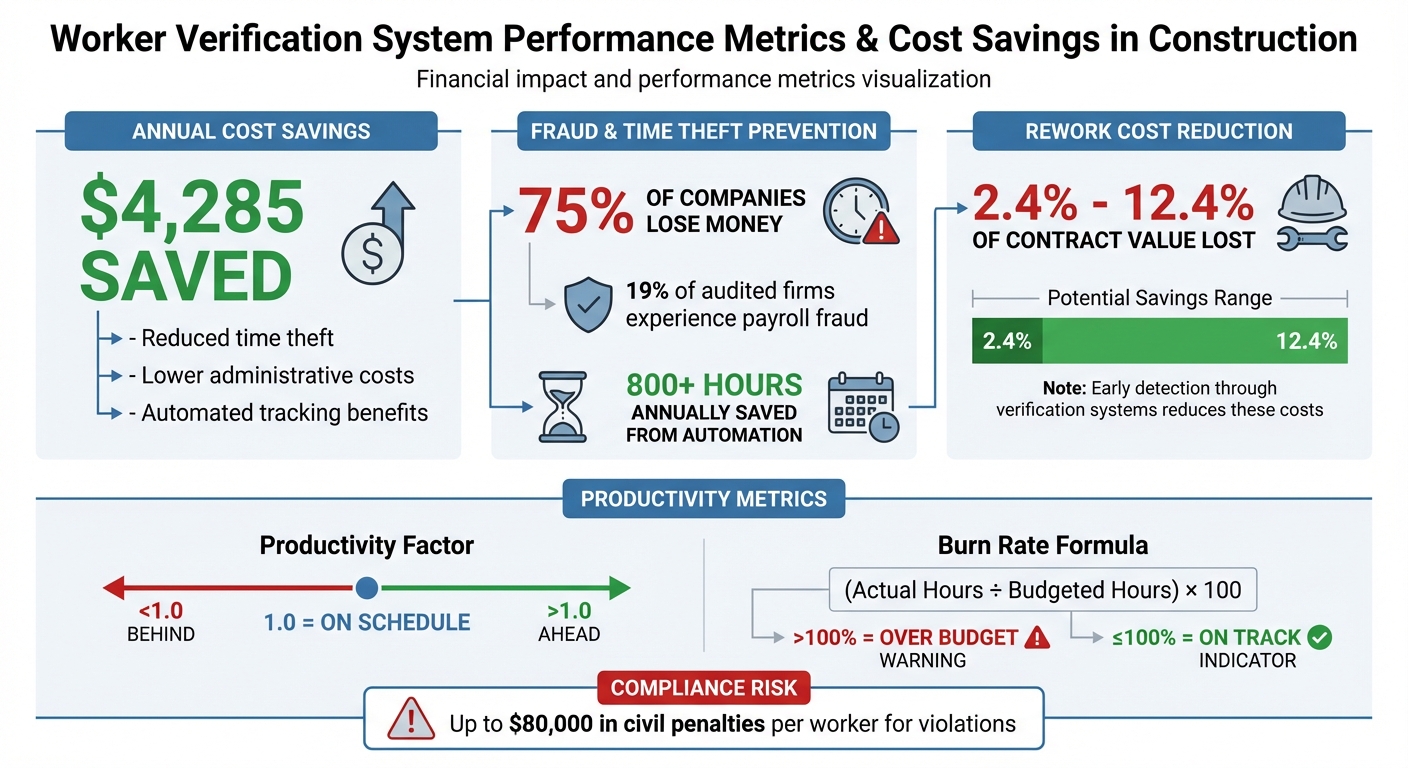
To gauge how well a worker verification system is performing, it’s essential to track metrics that highlight both productivity and compliance. Labor productivity – measured as the installed quantity per labor hour – shows how much work is completed by each worker. Another key metric is the productivity factor, calculated by dividing earned hours by actual hours. A factor of 1.0 means your project is right on schedule, while values above or below this indicate whether you’re outperforming or falling short of expectations.
The burn rate is another critical measure. It tracks how quickly you’re using up your labor budget. You find it by dividing actual hours by budgeted hours and multiplying by 100. If the result exceeds 100%, labor is being consumed faster than planned. Comparing this burn rate to production progress (actual quantities divided by budgeted quantities) helps identify if you’re at risk of overrunning your budget.
Additionally, keeping tabs on real-time certification statuses ensures that every worker has valid credentials. Efficient verification systems can save over 800 hours annually by automating tasks like timesheet entry, freeing supervisors to focus on managing their teams instead of administrative work. Together, these metrics provide the tools needed to adjust staffing and maintain compliance as projects evolve.
Practical Benefits of Scalable Verification
The advantages of these systems extend well beyond tracking numbers – they lead to measurable savings and fewer errors. For example, biometric verification and automated tracking can save over $4,285 per worker annually by reducing time theft and cutting down on administrative inefficiencies. This is particularly important when considering that about 75% of companies lose money due to "buddy punching", where one employee clocks in for another who isn’t actually present.
These systems also help lower the costs associated with rework, a common issue in construction. Rework often accounts for 2.4% to 12.4% of the total contract value and is frequently caused by misalignments that verification systems can identify early on. Additionally, with 19% of audited firms experiencing payroll-related fraud, accurate worker verification becomes a critical tool for safeguarding project budgets.
Platforms like ABLEMKR tackle these challenges head-on. By combining biometric verification with real-time credential tracking, they ensure that productivity metrics reflect actual hours worked by properly qualified personnel, giving project managers the confidence that their teams are operating efficiently and compliantly.
Conclusion
As construction projects grow in complexity, digital verification has become more than just a convenience – it’s a necessity. With expanding workforces, diverse subcontractor networks, and increasing compliance demands, traditional manual processes simply can’t keep up. They often lead to inefficiencies, expose firms to fraud, and open the door to hefty penalties. Sarah Croft, Sales & Marketing Director at TrustID, highlights the stakes:
If you want to protect your construction firm against the reputational loss, fraud risk, potential disruption to your site and significant fines that illegal documents can cause, digital identity and Right to Work checks are the foundation.
The financial risks are real. Civil penalties can climb to as much as $80,000 per worker. On the flip side, companies that adopt digital identity checks have already avoided substantial fines. Beyond compliance, scalable verification systems deliver tangible benefits – like reducing time theft and speeding up the onboarding process. These tools not only save money but also ensure that workforces are deployed quickly and in full compliance.
Solutions like ABLEMKR tackle these challenges head-on. With features like real-time credential tracking, biometric verification, and automated compliance workflows, they make it easier for project managers to keep track of worker certifications, mobilize teams faster, and maintain compliance across multiple job sites.
As regulations tighten and fraud tactics become more advanced, investing in digital verification systems isn’t just about staying compliant – it’s about staying competitive. Moving away from outdated spreadsheets to centralized, cloud-based platforms lays the groundwork for meeting the workforce demands of the future. This shift doesn’t just streamline operations; it strengthens a company’s ability to deliver on both compliance and efficiency.
FAQs
What’s the fastest way to verify thousands of workers across multiple job sites?
The quickest way to verify thousands of workers across multiple job sites is by leveraging a digital identity verification system designed for scalability and mobile-first use. These systems connect pre-approved workers to job sites by matching their certifications, training, and location, which speeds up crew deployment. Features like real-time worker status updates, built-in compliance tracking, and instant access to credentials simplify onboarding while ensuring safety requirements are upheld. This makes them a great fit for large, multi-site projects.
How can we confirm certifications are valid without storing sensitive personal data?
Cryptographic QR codes offer a way to validate certifications without needing to store sensitive personal information. These codes work by embedding verification URLs and cryptographic keys. When scanned, the system can instantly verify the individual’s identity by recomputing and comparing the data server-side. This approach removes the necessity for database lookups, keeping the process secure and efficient.
What KPIs show a worker verification system is saving money?
Key performance indicators (KPIs) to watch are the cost reduction percentage and error rate improvements. These metrics highlight how much expenses have been cut and how errors in payroll and compliance processes have decreased. Together, they offer a clear way to measure the system’s financial impact.


