
Robotic equipment is transforming industries like construction, energy, and manufacturing. To safely and effectively operate these machines, certifications are becoming essential. Here are the key certifications you should know about:
- AWS Certified Robotic Arc Welding (CRAW): Focuses on robotic welding, with Operator and Technician levels. Ideal for welding professionals looking to advance in automation-heavy sectors like construction and energy.
- IUOE Robotic Equipment Operator (REO): Prepares heavy equipment operators for autonomous construction machinery. Requires experience and OSHA-30 certification.
- FANUC Certified Robot Operator: Targets manufacturing workers and students, covering robot programming and operations. Accessible through technical schools.
- SACA Industry 4.0 Associate – Basic Operations: Entry-level certification for smart manufacturing and connected systems. Great for those starting in automation.
Each certification emphasizes safety, technical skills, and career advancement. They cater to different industries and experience levels, ensuring operators remain competitive in the growing robotics market.
Quick Comparison
| Certification | Focus Area | Prerequisites | Validity | Key Industries |
|---|---|---|---|---|
| AWS CRAW Operator/Technician | Robotic welding | Welding experience, CWI (Tech) | 3 years | Construction, energy |
| IUOE REO | Autonomous construction | 5 years heavy equipment, OSHA-30 | 5 years | Construction, energy |
| FANUC Certified Robot Operator | Manufacturing robotics | None, coursework recommended | Not specified | Aerospace, automotive |
| SACA Industry 4.0 Associate | Smart manufacturing | None, member registration | Not specified | Manufacturing, energy |
These certifications open doors to better pay, job security, and advanced roles in automation-driven industries. Choose one that aligns with your career goals and industry needs.
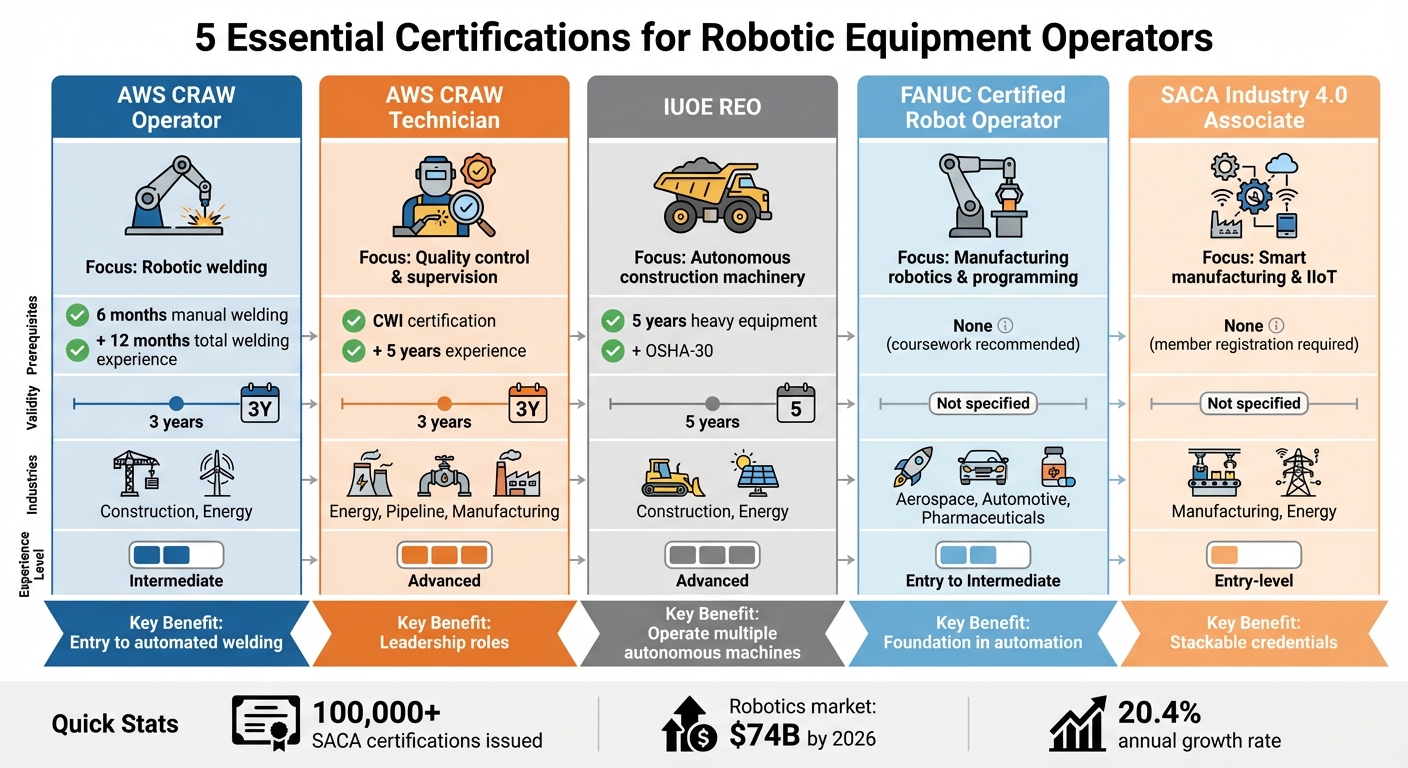
Robotic Equipment Operator Certifications Comparison Chart
FANUC Certified Robot Operator Certifications | MULTIPLE CHOICE
1. AWS Certified Robotic Arc Welding (CRAW) Operator
The AWS Certified Robotic Arc Welding (CRAW) Operator credential highlights expertise in programming and operating robotic welding systems. It certifies your ability to program, inspect, and maintain these systems effectively. This certification is ideal for welding professionals aiming to showcase their skills in automation across construction, repair, inspection, design, and production environments. Beyond technical validation, it reflects a strong commitment to safety and industry standards.
Prerequisites
To qualify, you’ll need a high school diploma or GED, six months of manual or semiautomatic arc welding experience, 12 months of total welding experience (including robotic operations), and three years of welding-related occupational experience. A post-secondary degree in welding, robotics, or engineering can substitute for up to two years of the occupational experience, but the six-month manual welding requirement remains mandatory.
Training and Certification Process
You must complete an OEM or equivalent Robotic Programming Course at an AWS Approved Testing Center (ATC). Certification involves a two-hour closed-book written exam covering 12 key topics (with Robot Programming and Logic accounting for 20%, Welding Processes for 15%, and Safety for 12%) and a hands-on performance test conducted by a certified AWS CRAW Technician. Training and exams are scheduled directly with an ATC, as AWS does not provide robotic programming courses. Applications must be submitted online through the Certification Application Portal to avoid a $125 non-refundable fee.
Recertification Requirements
The CRAW-O certification is valid for three years. Renewing requires proof of two years of welding-related activity or completion of 40 contact hours of relevant training. Every nine years, full recertification is mandatory, either by retaking the performance exam or providing evidence of two years of activity along with 80 professional contact hours. This ensures certified operators remain up-to-date with advancements in automation technology.
"By obtaining the CRAW certification, you not only demonstrate your ability to program a robot to deliver an acceptable weld, but also your commitment to staying current in the ever-evolving welding industry." – American Welding Society
Sector Relevance and Career Benefits
The CRAW-O certification is highly valued in sectors like construction, energy, and heavy industry, where robotic welding is rapidly becoming the norm. It enhances earning potential, expands career opportunities, and provides job security. This credential serves as portable proof of your expertise, recognized by employers in industries such as oil and gas, pipeline construction, and fabrication shops. It also demonstrates your ability to work across various codes, standards, and specifications, making you a versatile asset in the workforce.
2. AWS Certified Robotic Arc Welding (CRAW) Technician
The AWS Certified Robotic Arc Welding (CRAW) Technician certification is a step up from the Operator level, requiring a deeper understanding of quality control and supervisory skills. This certification is tailored for professionals specializing in inspection and quality assurance. A key distinction at this level is the prerequisite: candidates must already hold a AWS Certified Welding Inspector (CWI) credential, making it a more advanced and exclusive certification tier.
Prerequisites
To qualify for the Technician certification, candidates need five years of related work experience in welding or robotics, including 18 months specifically in welding (with at least six months dedicated to manual or semiautomatic arc welding). A two-year Associate Degree in welding, robotics, or engineering can count for up to two years of this requirement, but it cannot replace the mandatory six months of manual welding experience. Proficiency in quality measuring tools, weld cross-section analysis software, and basic computer skills is also essential. These requirements reflect the advanced nature of the certification, ensuring candidates are well-prepared for the challenges of quality assurance.
Training and Certification Process
The certification process mirrors the structure of the Operator level but places a stronger emphasis on quality control and supervisory responsibilities. Candidates must pass a two-hour closed-book written exam covering 12 subject areas, with a focus on inspection and quality assurance procedures. Additionally, a practical performance test evaluates the ability to oversee robotic welding operations and conduct quality assessments. Since AWS does not offer this training directly, candidates must coordinate with an AWS Approved Testing Center (ATC) to schedule their training seminar and performance test. For those with a two-year Associate Degree, an equivalent combination of education and experience may fulfill the certification’s educational requirements.
Recertification Requirements
Like the Operator credential, the Technician certification requires renewal every three years. Candidates must provide evidence of two years of active practice in quality control or complete 40 contact hours of relevant training. Full recertification is required every nine years, which can be achieved by retaking the performance test or by documenting 80 contact hours of professional development along with two years of active practice.
Sector Relevance and Career Benefits
This certification equips professionals for leadership roles in quality assurance and supervision across industries like energy, pipeline construction, and heavy manufacturing. With expertise in both robotic operations and welding inspection, CRAW-T holders play a critical role in maintaining safety standards and meeting project deadlines in large-scale automated fabrication environments. The credential also positions you for higher-paying roles, overseeing robotic welding systems and ensuring compliance with AWS D16.4 specifications for high-stakes infrastructure projects.
3. IUOE Robotic Equipment Operator (REO) Training
The IUOE Robotic Equipment Operator (REO) Training program is a collaborative effort between Built Robotics and the International Union of Operating Engineers (IUOE). It equips heavy equipment operators with the skills to manage autonomous construction machinery, placing them at the cutting edge of automation in the construction industry. As Built Robotics aptly notes, "Robotics are the biggest thing in construction since hydraulics".
Prerequisites
Given the advanced nature of the program, candidates must meet several prerequisites. Applicants need at least five years of experience operating heavy equipment and an OSHA-30 (or equivalent) certification. Familiarity with software like Excel, Trimble, and CAD is essential, alongside experience in maintaining equipment and electronics. A strong safety record and the ability to interpret construction drawings are also critical qualifications.
Training and Certification Process
The training focuses on three primary areas. First, participants learn safety protocols specific to autonomous operations. Next, they gain hands-on experience with the Exosystem™ hardware and Everest software platform, including tasks like system installation, safety perimeter setup, and defining autonomous tasks using GPS and construction plans. Currently, the program is being introduced to select partners, and interested operators must join a waitlist. IUOE/OECP certifications are valid for five years.
Recertification Requirements
Operators must renew their REO certification every five years. Recertification typically involves a 50-question written exam. However, operators who log at least 1,000 hours of "seat time" during the certification period may be exempt from practical testing. To prevent certification lapses, operators are encouraged to begin the renewal process at least six months before their certification expires.
Sector Relevance and Career Benefits
This certification directly addresses the increasing use of automation in construction and energy projects. Joe Warner, a seasoned operator with a decade of experience, shares, "In my ten years of operating, learning to become an REO is one of the single most important skills I’ve developed". REO-certified operators can oversee multiple autonomous machines at once, amplifying their efficiency on large-scale projects. As a result, employers actively seek these certified professionals and often offer higher pay to reflect their enhanced productivity and expertise. This program highlights the industry’s shift toward automation and the growing need for operators skilled in this area.
4. FANUC Certified Robot Operator
FANUC, in partnership with NOCTI, offers this certification to help both beginners and experienced workers demonstrate their robotics and manufacturing expertise. It’s made available through FANUC’s CERT program, which is offered at technical schools and community colleges.
Prerequisites
There aren’t any formal experience requirements for this certification. Typically, candidates access it through institutions that provide the CERT curriculum. However, taking preparatory courses like Electronics/Industrial Robotics Technology or Industrial Robotics Technology is highly encouraged to improve readiness for the exam. This certification is particularly suited for technical students and workers looking to advance their skills in manufacturing.
Training and Certification Process
Once candidates complete the recommended coursework, they take a 153-question exam (Test Code 8697) on ROBOGUIDE. The test lasts 180 minutes, requires a minimum score of 70.6% to pass, and costs $35. For those who need it, extended time and multi-session options are available. The exam evaluates key skills, including robot operations, frame setup, programming (writing and modifying), program offsets, and system backup and restoration. This targeted approach ensures the certification reflects practical, job-ready expertise in automated manufacturing.
Sector Relevance and Career Benefits
This certification serves as a stepping stone to better opportunities in industries like aerospace, automotive, pharmaceuticals, research, consumer goods, and alternative energy. As College of the Canyons highlights:
"Students who are certified to use FANUC robots have an advantage in finding a job, and are able to command better jobs".
Additionally, the CERT program is recognized as an Authorized Provider of Continuing Education Units (CEU) by the International Association for Continuing Education and Training (IACET). It complies with the national ANSI/IACET 1-2007 standard, giving it added credibility. For those entering or reentering the workforce, this certification offers a verified skill set that employers value in today’s automation-driven industries.
sbb-itb-aa28329
5. SACA Certified Industry 4.0 Associate – Basic Operations
The Smart Automation Certification Alliance (SACA) offers this certification as a starting point for individuals looking to work with equipment in today’s connected production environments. It’s designed for high school and college students, as well as current workers such as operators, maintenance technicians, and IT professionals. To date, SACA has issued 100,000 certifications across 500 member organizations.
Prerequisites
To qualify for the SACA certification, there are no strict educational or work experience requirements. Candidates with an associate degree or up to two years of experience are eligible. However, registration with a SACA member organization is mandatory. Before applying, ensure your school or employer is affiliated with SACA, as this is a key eligibility step.
Training and Certification Process
The certification is available at two levels:
- Silver Level: Requires passing an online written exam.
- Gold Level: Involves both the written exam and hands-on performance assessments on SACA-approved equipment.
Training covers eight key areas, including smart manufacturing principles, automated machine operation, basic robotics, and production monitoring using HMI and IIoT systems. The program requires 65–70 hours of training, and all exams are conducted at SACA Authorized Testing Centers.
This certification not only confirms your foundational skills but also prepares you for future career growth.
Sector Relevance and Career Benefits
This certification is stackable, meaning you can build on it as you advance in your career. It proves your ability to work with connected systems, a competency that is becoming increasingly important in sectors like construction and energy, in addition to manufacturing. Many institutions also accept these certifications for college credit. As an entry-level credential, it lays the groundwork for mastering automated systems while complementing more advanced certifications.
Certification Comparison: Advantages and Disadvantages
When comparing certifications, it’s clear that each offers unique benefits and challenges, making the choice highly dependent on your career goals and background.
The AWS Certified Robotic Arc Welding (CRAW) Operator certification is accessible to those with basic welding credentials and hands-on experience. However, this accessibility can be a double-edged sword – while it opens doors for many, it may limit career growth for individuals without significant hands-on expertise. For those aiming higher, the Technician level requires a Certified Welding Inspector (CWI) credential, which narrows eligibility but provides a pathway to senior supervisory positions.
The IUOE Robotic Equipment Operator (REO) Training stands out for its strong focus on OSHA compliance and practical safety evaluations. This program ensures operators are prepared for hazardous environments, such as confined spaces or unstable terrain. Its emphasis on safety protocols makes it distinct from certifications that focus solely on technical skills, like welding.
The FANUC Certified Robot Operator certification caters to advanced manufacturing industries. It provides a robust foundation in automation and industrial IoT, making it particularly appealing for careers in high-tech production. However, the program’s recertification requirements remain unclear, which could be a consideration for long-term planning.
The SACA Industry 4.0 Associate certification is designed with flexibility in mind. Its stackable credentials – Silver (written exam) and Gold (written plus hands-on) – allow workers to progress at their own pace. With no stringent prerequisites beyond registration with a member organization, it’s an accessible starting point for individuals at various experience levels.
How ABLEMKR Connects Certified Operators with Jobs

After certification, finding the right job is the next critical step. ABLEMKR’s mobile-first platform simplifies this process by directly matching certified robotic equipment operators with construction and energy projects across the U.S. Using automated matching technology, the platform evaluates factors like certifications, safety training, availability, and location to pair operators with jobs. Whether it’s a last-minute pipeline repair or a planned mine development, this system ensures operators are connected to opportunities that align with their skills and schedules.
The Worker Wallet takes the hassle out of managing certifications and training records. By digitizing these documents, it eliminates the need for physical paperwork and reduces the risk of credential lapses. Automated reminders for certification renewals help operators stay on top of their qualifications, ensuring they don’t miss out on work due to expired credentials. For employers, instant verification confirms that operators meet OSHA regulations and ASME standards before they even step onto a jobsite, cutting down on delays and boosting efficiency.
Compliance tracking goes a step further by ensuring operators meet various regulatory standards, whether it’s OSHA requirements for construction or international protocols like the EU Machinery Regulation. This real-time insight into worker compliance gives employers confidence that their crews are ready to go, while operators gain access to jobs that match their qualifications and pay well.
ABLEMKR also addresses a major concern for workers: payment reliability. By acting as an intermediary, the platform guarantees operators are paid for their completed hours, regardless of when contractors settle their invoices. Digital timesheets and automated invoicing reduce errors, while weekly direct deposits ensure consistent cash flow. Operators no longer have to worry about chasing payments or handling checks – the system takes care of it, allowing them to focus on their work.
Conclusion
Choosing the right certification hinges on your career goals and the specific requirements of operating robotic equipment.
For roles in welding and energy, AWS CRAW certifications are widely recognized. The CRAW-Operator level is perfect for transitioning from manual to robotic welding systems. On the other hand, the CRAW-Technician designation – requiring a Certified Welding Inspector credential – prepares you for advanced roles in areas like pipeline and structural energy projects. Keep in mind, AWS CRAW credentials need periodic renewal.
Different certifications align with varying experience levels and industry demands. For beginners, the FANUC Certified Robot Operator program focuses on foundational skills like programming and setup. Meanwhile, those looking to dive into smart automation and Industry 4.0 trends will appreciate the flexible, modular structure of SACA certifications.
Earning your first certification is just the beginning. Regular renewals and pursuing advanced credentials are key to staying competitive. Keeping your certifications up to date ensures you’re ready for immediate job opportunities while preparing for the rapid expansion of the robotics sector. Using digital tools to track certification expirations and connecting with professional groups like the International Union of Operating Engineers can help you access high-demand positions. With the robotics market projected to reach $74 billion by 2026 and grow 20.4% annually, operators who consistently upgrade their skills are well-positioned to meet the evolving safety and technical challenges in modern construction and energy industries.
FAQs
Which certification should I get first for my industry?
The best certification to start with depends heavily on the field you’re pursuing. For those venturing into robotics, the FANUC Certified Robot Operator – 1 is a great starting point. It focuses on the basics of robot operation and programming, making it perfect for beginners.
If you’re heading into construction or heavy equipment fields, certifications like the Heavy Equipment Operator Certification or the Crane Operator Certification from NCCER or NCCCO are widely acknowledged and respected. For anyone planning to handle high-risk crane operations, the Crane Operator Certification is a must-have, serving as a key credential across the United States.
How long does it take to earn each certification?
The duration required to obtain certifications can differ greatly. For instance, the robotics course at George Brown College spans approximately 28 weeks. On the other hand, the FANUC Certified Robot Operator program is much shorter, typically needing 45–50 hours of instruction. There are even quicker options available – some robotics operator training programs can be completed in just three 8-hour days.
What happens if my certification expires?
If your certification lapses, you’ll need to fulfill all recertification requirements before resuming equipment operation. This usually involves passing exams and meeting certain training or experience standards. Keep in mind, expired certifications don’t meet compliance or safety regulations, so it’s crucial to renew on time to stay eligible.


