
Retroactive application of California’s ABC Test has created serious financial risks for employers, especially in industries like construction and energy. This stricter worker classification standard, established in the 2018 Dynamex decision and applied retroactively by the 2021 Vazquez ruling, means businesses can face penalties for past decisions that were compliant under the older, more flexible Borello test. Employers must now ensure that independent contractors meet all three prongs of the ABC Test: freedom from control (Prong A), work outside the employer’s usual business (Prong B), and an independently established trade (Prong C).
Key takeaways:
- The ABC Test presumes workers are employees unless all three prongs are satisfied.
- Retroactive liabilities apply to cases unresolved as of April 30, 2018.
- Wage claims have a three-year statute of limitations; unfair competition claims extend to four years.
- Prong B poses the greatest challenge for industries relying on contractors for core business tasks.
To minimize risks, employers should:
- Audit worker classifications dating back at least four years.
- Reclassify noncompliant roles as W2 employees.
- Use workforce management tools to streamline compliance efforts.
These steps are critical to avoiding penalties, back pay, and legal expenses under California’s retroactive enforcement of the ABC Test.
Major Legal Decisions on Retroactive ABC Test Applications
Dynamex Operations West v. Superior Court
On April 30, 2018, the California Supreme Court issued a landmark decision in Dynamex Operations West, Inc. v. Superior Court, reshaping how workers are classified under California wage orders. This ruling replaced the older, more flexible Borello test with the stricter ABC Test.
The ABC Test shifts the burden entirely onto employers. Unlike the Borello test, which focused on whether a hiring entity had the "right to control" how a worker performed their job, the ABC Test presumes that all workers are employees unless the employer can satisfy all three prongs of the test. This decision specifically clarified the interpretation of the "suffer or permit to work" standard in Industrial Welfare Commission (IWC) wage orders, setting a much higher bar for classifying workers as independent contractors.
Although the court did not explicitly state whether the decision applied retroactively, it described the ruling as a clarification of existing law rather than a new legal standard. This framing paved the way for later rulings that applied the ABC Test retroactively.
Vazquez v. Jan-Pro and Retroactivity
In Vazquez v. Jan-Pro Franchising International, Inc., decided on January 14, 2021, the California Supreme Court addressed the retroactive application of the ABC Test. The court ruled that the test applies to all cases that were still pending as of April 30, 2018, the date of the Dynamex decision. This meant that claims filed years earlier could now be reevaluated under the stricter ABC standard.
The Vazquez case involved Gerardo Vazquez and other janitorial franchisees who had filed misclassification claims dating back to 2008. Even though their claims predated the ABC Test, the court allowed them to be reconsidered under the new standard. The Ninth Circuit, tasked with determining whether the franchisees should be classified as employees, supported this retroactive application. It emphasized that retroactivity ensured fairness across industries, stating:
retroactivity protects the [relevant] industry as a whole, putting [the employer] on equal footing with other industry participants who treated those providing services for them as employees… prior to Dynamex.
These rulings have profound consequences for industries like construction and energy, which have traditionally relied on subcontracting and staffing-heavy models under the more lenient Borello framework.
Statute of Limitations and Legal Exposure
With these rulings in place, employers now face a defined but significant window of legal exposure. Wage claims in California have a three-year statute of limitations, while unfair competition claims extend to four years. This means employers could face claims for actions going back as far as four years before a lawsuit is filed – even if those actions complied with the older Borello standard.
The risks are especially high for claims tied to IWC wage orders, which hinge on the "suffer or permit to work" standard clarified in Dynamex. Industries like construction and energy are particularly vulnerable. These sectors often rely on independent contractors for core tasks – such as freelance electricians, pipeline technicians, or equipment operators. Under Prong B of the ABC Test, employers must prove that these roles fall "outside the usual course" of their business. When the contracted work directly supports a company’s primary operations, meeting this requirement becomes extremely challenging.
For employers in staffing-heavy industries, these retroactive rulings demand immediate attention to ensure compliance and mitigate potential liabilities.
sbb-itb-aa28329
Compliance Challenges for Construction and Energy Employers
Prong B Challenges in Staffing-Intensive Models
Construction and energy companies face daunting hurdles when trying to comply with Prong B of the ABC Test. This prong requires employers to demonstrate that contracted workers perform tasks "outside the usual course of the hiring entity’s business." For industries like construction and energy – where the project work itself defines the core business – this standard is particularly difficult to meet.
Roles that are central to a company’s operations typically fail Prong B. For example, when a pipeline company hires welders to repair pipelines or a mining company contracts equipment operators for extraction, these tasks are directly tied to the company’s primary business. Under the ABC Test, all workers are presumed to be employees unless the employer can satisfy all three prongs. Anthony J. Oncidi, a Partner at Proskauer Rose LLP, explained that this test "makes it much harder for a hirer to classify a worker as an independent contractor." In staffing-heavy industries like construction and energy – where specialized subcontractors often handle core tasks – meeting Prong B becomes nearly impossible because these roles directly support the company’s main operations.
These challenges are even more pronounced in multi-tiered workforce arrangements, where compliance risks grow exponentially.
Compliance Risks in Multi-Level Workforces
The difficulty of meeting Prong B becomes even more complex in industries that rely on layered subcontracting structures. Construction and energy companies often operate through tiered arrangements: a general contractor hires a prime subcontractor, who then brings in specialized workers. Under the retroactive application of the ABC Test, the top-tier entity can be held accountable for worker misclassification several layers down the chain.
The Vazquez ruling highlights how liability can extend through these multi-level structures. In this case, Jan-Pro used a three-tier janitorial franchising model: the master owner sold rights to master franchisors, who then sold business plans to unit franchisees responsible for the actual cleaning work. Despite this complex structure, the California Supreme Court ruled that Jan-Pro could be held liable as the employer of the unit franchisees under the ABC Test, which was applied retroactively.
For companies that rely on staffing agencies, labor brokers, or multiple subcontracting tiers, failing Prong B becomes a significant risk if workers at the bottom of the chain perform tasks tied to the company’s core operations. Additionally, the statute of limitations for wage claims extends up to four years when Business & Professional Code violations are included. This means businesses could face liability for workforce decisions dating back to 2022 or earlier. As Samuel J. Stone and John H. Haney of Holland & Knight noted:
The ruling means that nearly all cases that were not final as of the date Dynamex issued will be governed under the ‘ABC’ standard instead of Borello.
California’s ABC Test Explained: 3 Steps to Classify Independent Contractors
How Employers Can Ensure Compliance
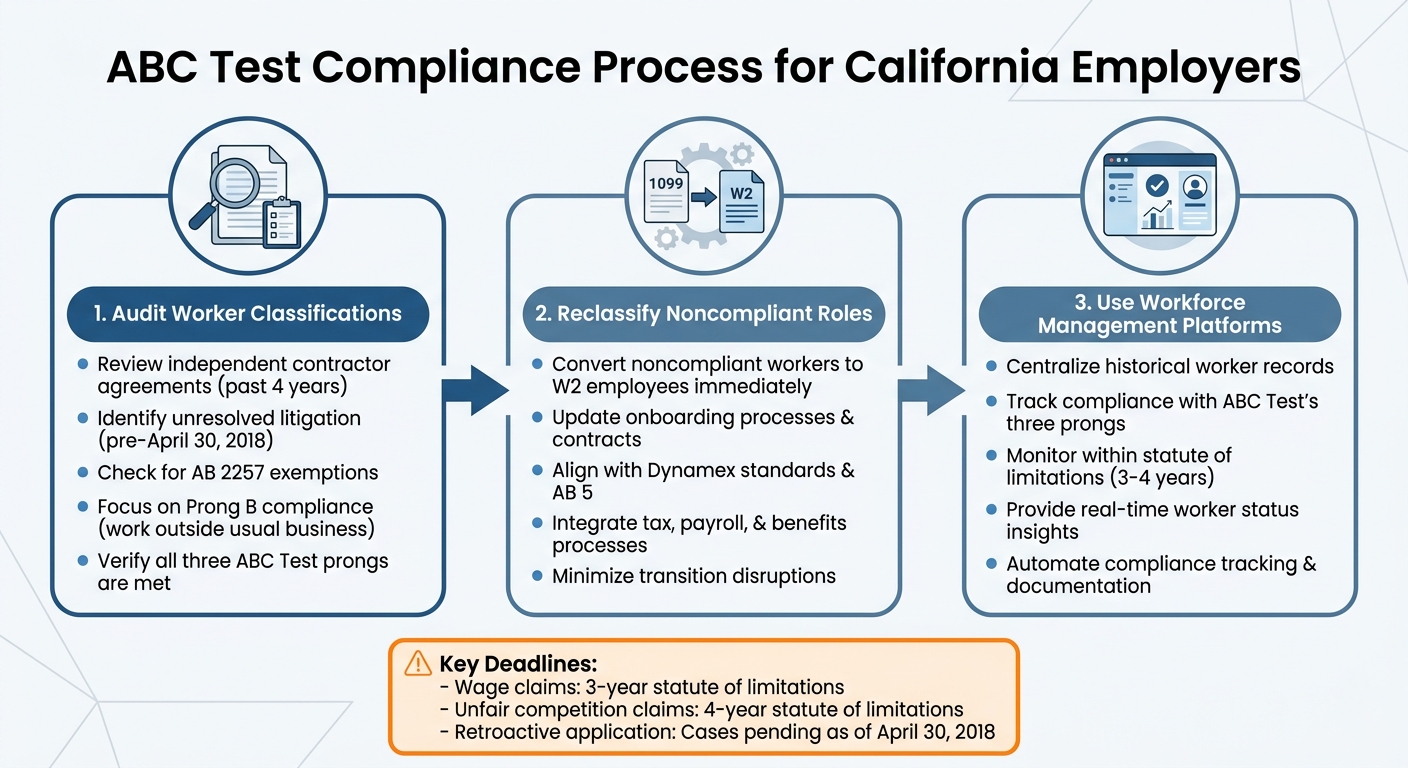
ABC Test Compliance: 3-Step Process for California Employers
Auditing Worker Classifications
Take a close look at all current and past independent contractor agreements – going back at least four years. This can help flag roles that might lead to retroactive claims, identify unresolved litigation prior to April 30, 2018, and determine if certain roles qualify for exemptions under AB 2257. Jonathan A. Siegel and David T. Wiley from Jackson Lewis P.C. stress the importance of this process:
California employers who routinely enter into independent contractor arrangements with individuals should promptly and carefully review the status of those workers.
Pay extra attention to Prong B, which requires contractors to perform tasks that are outside the usual course of the hiring entity’s business. For industries like construction and energy, meeting this standard can be particularly tough. Ensure compliance with all three prongs of the ABC test, and check if the older Borello multi-factor test might still apply under specific AB 2257 exemptions.
Spotting roles that don’t meet compliance requirements is the first step toward reclassification.
Reclassification Best Practices
If you identify noncompliant roles, reclassify those workers as W2 employees immediately to prevent further liability. Anthony J. Oncidi, a partner at Proskauer Rose LLP, highlights the importance of this step:
Employers should not only make sure that new workers are classified correctly according to Dynamex, but should revisit existing independent contractor agreements to verify they conform to the standards established by Dynamex.
Update your onboarding processes and contracts to align with the strict standards outlined by Dynamex and codified under AB 5. For workers moving from 1099 to W2 status, streamline the transition by integrating tax, payroll, and benefits processes to minimize disruptions. Heather M. Sager from Vedder Price advises:
Employers are urged to review their classification policies and consider making changes to avoid future liability.
These measures help address the retroactive liabilities highlighted by earlier rulings.
Using digital tools can make this reclassification process more efficient.
Using Workforce Management Platforms
Digital workforce management platforms can simplify the process of auditing and reclassifying workers. These tools centralize historical worker records, making it easier to document compliance with the ABC test’s three prongs: freedom from control (Prong A), work outside the usual course of business (Prong B), and independent trade establishment (Prong C).
For instance, ABLEMKR offers features tailored to construction and energy companies, helping them navigate compliance challenges. The platform provides real-time insights into worker status, ensuring employers can track data within California’s three-year statute of limitations for Labor Code violations and the four-year period for unfair competition claims. By offering W2 employment options and automated job matching based on certifications and safety training, ABLEMKR reduces classification uncertainties and minimizes the risk of retroactive misclassification claims. This proactive approach offers a clear path to reducing liabilities tied to past mistakes.
Conclusion
Retroactive rulings tied to the ABC Test have placed employers who classified workers as independent contractors before April 30, 2018, at considerable financial risk, all within the limits set by statute.
Key legal decisions continue to redefine employer responsibilities. For instance, Vazquez v. Jan-Pro solidified the retroactive application of the ABC Test, effectively invalidating defenses based on the older Borello standard. The court emphasized that "Dynamex was within the scope of what employers reasonably could have foreseen".
Among the test’s three prongs, Prong B poses the greatest challenge, especially for industries reliant on staffing. This prong requires that the work performed be outside the usual course of the employer’s business. Tasks that align closely with a company’s primary operations demand immediate attention. Employers should audit both current and past contractor classifications, particularly for roles filled within the past four years.
In addition to audits and reclassification efforts, technology offers practical tools for navigating compliance. Platforms that centralize worker data, track W2 employment status, and document certifications can simplify the process. For example, ABLEMKR’s workforce management platform provides real-time insights into worker status, integrates payroll functions, and incorporates compliance tracking. Such tools are invaluable for employers managing complex, multi-layered workforces across various job sites.
The ABC Test is here to stay. As Samuel J. Stone and John H. Haney of Holland & Knight aptly stated, "The ABC test is here to stay". Employers who act quickly to reclassify workers, revise contracts, and adopt robust tracking systems stand a better chance of minimizing retroactive liabilities. Taking proactive steps today not only reduces the risk of costly audits and litigation but also ensures long-term compliance in an evolving legal environment.
FAQs
Which past worker classifications can still trigger liability?
The classification of workers, like independent contractors, can still lead to legal issues. The California Supreme Court has decided that the ABC test, used to determine worker classification, applies retroactively. This means that past worker classifications could now face compliance reviews. Employers should take a close look at previous worker arrangements to ensure they meet the requirements of this retroactive application.
Why is Prong B so hard for construction and energy companies?
Prong B poses a tough hurdle for construction and energy companies. It demands proof that a worker’s role falls outside the scope of the employer’s usual business activities. The challenge? In these industries, subcontractors and independent contractors often handle essential tasks that are central to the company’s operations. This overlap between contractors’ work and the core functions of these businesses makes meeting the requirement especially tricky.
What should I gather before a California ABC Test audit?
Before facing a California ABC Test audit, it’s crucial to prepare documentation that clearly supports how a worker’s classification aligns with all three parts of the test. Specifically, focus on gathering evidence that shows:
- The worker performs tasks that are not part of your regular business activities.
- They operate independently and are established in their trade or profession.
- Their work is conducted with minimal oversight or control from your company.
Make sure these records are thorough, well-organized, and ready for review to ensure compliance.


