
The construction industry in the U.S. is facing a serious retention problem that’s affecting project timelines and profits. With over 246,000 unfilled jobs as of mid-2025 and a need for up to 454,000 additional workers, the challenge isn’t just hiring – it’s keeping workers on board. High turnover costs companies between $660,000 and $2.6 million annually, driven by factors like safety concerns, job instability, burnout, and limited career growth opportunities.
Key takeaways:
- Retention issues: Unsafe conditions, long hours, lack of recognition, and unclear career paths push workers to leave.
- Solutions: Focus on safety, recognition, career development, and better communication.
- Technology’s role: Tools like ABLEMKR streamline hiring, scheduling, and compliance, reducing stress for workers and improving retention.
- Metrics to track: Turnover rates, overtime hours, safety incidents, and training participation help measure progress.
Companies that prioritize worker well-being and use smart tools to address these issues can reduce turnover and stay competitive in a tightening labor market.
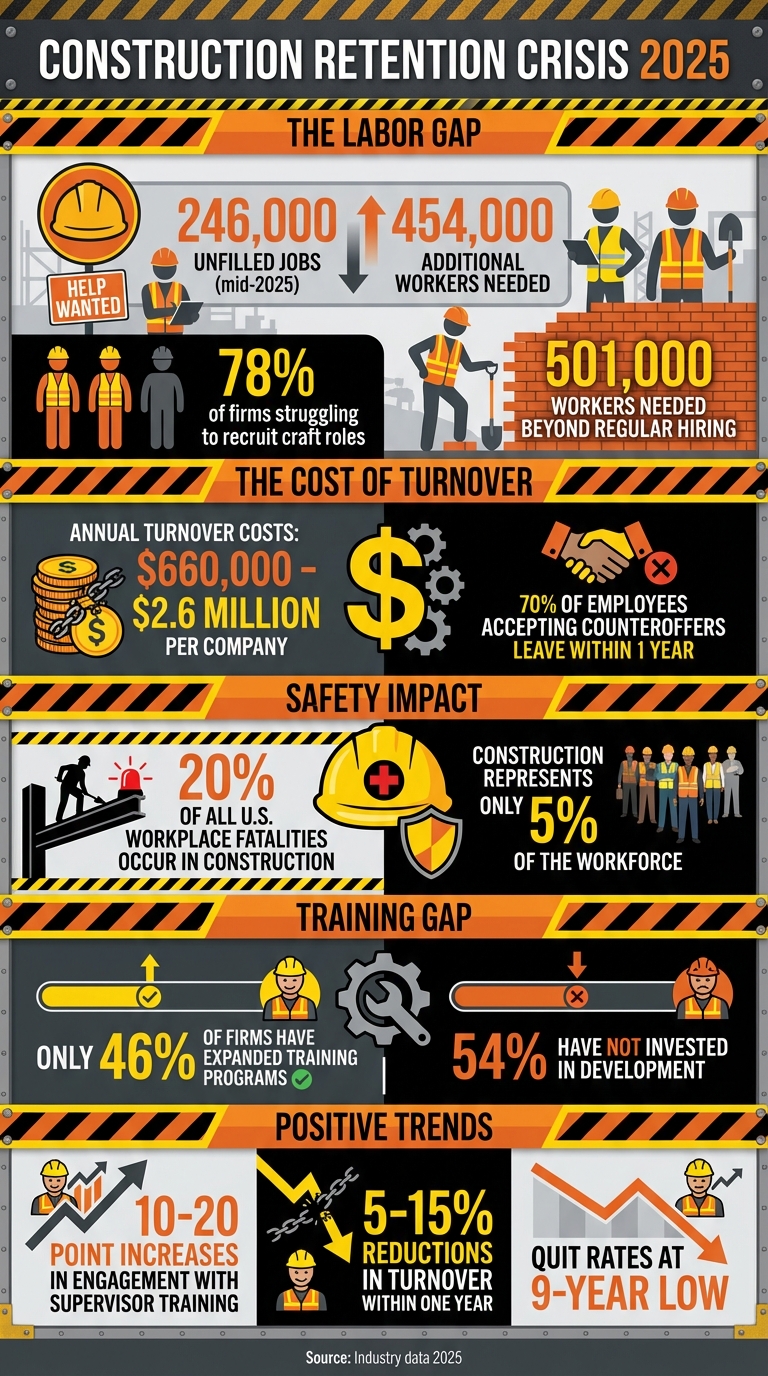
Construction Industry Retention Crisis: Key Statistics and Costs
Hire, Train, Retain: Proven Construction Hiring & Retention Strategies
Main Retention Problems in Construction
Retention challenges in construction largely stem from deep-rooted industry practices and cultural norms. The project-based nature of the work creates a chain reaction of issues, all tied to how companies manage their projects and treat their workforce.
Seasonal Work and Job Instability
The unpredictable, project-driven structure of construction often leaves workers feeling uncertain about their job security. Economic fluctuations and irregular project schedules make employment seem temporary rather than stable. For instance, the Associated Builders and Contractors estimated that the industry would require an additional 501,000 workers – beyond regular hiring needs – to meet demand. This uncertainty discourages workers from committing to long-term careers in the field. Poor communication about upcoming projects only adds to the instability, disrupting workers’ routines and increasing pressure, which can lead to burnout.
Work-Life Balance and Burnout
Construction work is physically demanding, and when combined with erratic schedules and excessive overtime, it creates a breeding ground for burnout. As of June 2025, there were 246,000 unfilled positions, with 78% of firms struggling to recruit for craft roles. This shortage forces existing crews to shoulder heavier workloads, leading to longer hours, weekend shifts, and growing exhaustion. While overall quit rates have hit a nine-year low due to retention efforts, the core problems of fatigue and overwork persist. These conditions not only strain workers’ personal lives but also compromise their safety and morale.
Safety Concerns and Physical Risks
Safety remains a major concern in construction. The industry accounts for 20% of all workplace fatalities in the U.S., even though it represents just 5% of the workforce. When companies neglect safety measures or fail to provide adequate health resources, workers notice – and many decide to leave. According to Marsh‘s 2025 industry risk review, hiring and retention risks were ranked as the top concern for construction firms, highlighting the importance of a strong safety culture. A reduced workforce often leads to overworked crews, increasing the likelihood of accidents – an unacceptable risk for many workers.
Lack of Recognition and Career Development
One of the key reasons workers leave isn’t low pay – it’s the lack of clear career advancement opportunities. While 46% of firms have expanded training and development programs, the remaining 54% have not, leaving many workers feeling stuck. Without recognition for their contributions – whether it’s quality work, safety milestones, or mentorship – employees often feel undervalued. Poor management and limited growth opportunities further drive workers to seek better prospects elsewhere. Even when companies offer counteroffers to retain employees, 70% of those who accept still leave within a year, revealing that financial incentives alone cannot address deeper cultural problems. Addressing these issues requires a shift toward creating a workplace where employees feel genuinely valued and supported.
How to Improve Retention Through Culture
With ongoing recruitment challenges and delays caused by workforce shortages, companies that emphasize recognition, safety, and development in their workplace culture gain a distinct advantage in retaining skilled employees. These principles need to be more than just buzzwords – they must be woven into the fabric of daily operations. Addressing these challenges requires a meaningful shift in how worker contributions are acknowledged, protected, and nurtured.
Building Recognition and Value
Employees are more likely to stay when they feel their work truly matters. Recognition programs that highlight achievements in safety, craftsmanship, punctuality, and mentorship during toolbox talks can create a culture of consistent appreciation. Peer-nomination systems are particularly effective for fostering trust among crews working in remote locations. Supervisors who provide frequent, specific feedback – not just corrections – help workers understand how their efforts contribute to a project’s success. Simple gestures like monthly crew highlight boards, end-of-project barbecues, and spot awards tied to specific behaviors make recognition more tangible. Addressing deeper issues around respect and value isn’t just a nice-to-have – it’s a must. Equally important is creating a safety-first culture that protects workers every day.
Improving Safety and Well-Being
Prioritizing safety not only minimizes on-site risks but also reduces turnover. A strong safety culture fosters loyalty, especially in high-risk environments. This starts with visible leadership commitment: executives and foremen modeling safe behavior, halting work to address hazards, and rewarding proactive safety actions rather than just penalizing mistakes. Offering mandatory, paid safety training in short, recurring sessions tailored to specific trades sends a clear message that worker well-being matters more than output. Regular discussions about fatigue, heat stress, and mental health during daily huddles further emphasize the importance of well-being. Predictable schedules, limits on consecutive overtime days, and advance notice for major changes help prevent burnout. When labor shortages stretch existing crews thin, platforms like ABLEMKR can quickly provide pre-vetted workers, reducing overwork while keeping projects on track.
Supporting Development and Community
Clear career pathways are a cornerstone of long-term retention. Apprenticeship programs that guide workers from helper to journeyman to foreman, paired with mentorship from experienced employees, accelerate skill-building and foster a sense of belonging. Organizations like Associated Builders and Contractors offer over 800 training programs covering craft, safety, and management skills, reflecting the industry’s commitment to structured development. Even smaller contractors can collaborate with trade associations or community colleges to provide classroom instruction alongside on-the-job training, with clear wage increases tied to skill milestones. Documenting these career paths, sharing success stories, and regularly discussing next steps during reviews help employees visualize a future within the company. Development programs not only equip workers with skills but also strengthen the sense of community that’s vital for retention. Team-building events, project-completion celebrations, and recognizing work anniversaries create a sense of camaraderie, even on dispersed job sites where crews frequently change.
sbb-itb-aa28329
Using Technology to Support Retention
Retention strategies rooted in workplace culture thrive when paired with tools that simplify daily tasks and create a sense of predictability. Workforce deployment technology plays a key role in reinforcing recognition, safety, and professional growth while managing shift coverage. By implementing systems that streamline hiring, scheduling, and compliance, companies build trust and show they value employees’ time and well-being. This digital approach strengthens workforce management practices.
Streamlining Workforce Management
The mobile-first platform from ABLEMKR connects pre-vetted, skilled workers to job sites based on their certifications, safety training, availability, and location. This reduces hiring delays and minimizes assignment gaps that often lead to turnover. Features like automated onboarding and compliance tracking eliminate paperwork bottlenecks, allowing workers to start earning sooner and reducing the stress of last-minute staffing. Integrated payroll with timely payments addresses a common frustration that can lead to employee dissatisfaction. This approach results in fewer missed shifts, less burnout caused by chaotic scheduling, and stronger loyalty to employers who prioritize keeping workers consistently employed and paid on time. By ensuring that only workers with current certifications and safety training are matched to relevant roles, the platform also fosters a culture of safety in everyday operations.
Improving Flexibility and Transparency
Technology enhances not just efficiency but also flexibility and openness. ABLEMKR allows workers to set their availability, preferred locations, and shift preferences, ensuring they’re matched with jobs that suit their needs. This eliminates the need for last-minute calls or rushed assignments. Real-time scheduling gives workers immediate clarity, making it easier to plan personal commitments – a crucial factor for improving retention in industries like construction and energy. Transparent job details and pay information further build trust, reducing misunderstandings about overtime or compensation. When workers have full visibility into job requirements and pay rates, they’re less likely to feel misled, addressing a key reason for turnover. For supervisors, real-time insights into staffing gaps allow for proactive planning rather than reactive fixes, which helps strengthen the company’s reputation and workplace culture in today’s competitive U.S. labor market.
Measuring Culture’s Impact on Retention
For culture initiatives to truly matter, they need to deliver measurable results. In industries like construction and energy, tracking specific metrics can directly connect workplace improvements to workforce stability. Four key indicators to monitor include: turnover rate (the percentage of employees leaving annually), overtime hours per employee (a potential sign of burnout), training completion rates (showing engagement in professional growth), and safety incident rates (a reflection of workplace safety). This approach ties cultural strategies to tangible outcomes, making it easier to assess their effectiveness.
Retention Metrics and KPIs
Start with 12–24 months of historical data to establish a baseline. For example, calculate annual turnover using the formula: (separations ÷ average headcount) × 100. Dig deeper by analyzing early-tenure turnover, such as employees leaving within their first 90 days or first year. High early exits often point to issues with onboarding or supervision rather than pay. Additionally, track absenteeism (unplanned absent hours ÷ scheduled hours) and the percentage of internal hires for open roles – these metrics can highlight morale and career development challenges. By examining these figures, companies can better understand how cultural changes contribute to long-term workforce stability.
Set clear, time-bound goals for each cultural initiative. For instance, after introducing foreman leadership training, aim to reduce annual turnover from 28% to 22% within a year. Or, try cutting average overtime from 18 to 12 hours per worker per week by implementing improved shift rotation rules. Document these baselines and targets in a one-page "Retention Scorecard" and review it quarterly with project leaders to stay on track.
Quantifying Improvements
To measure the success of culture initiatives, compare data before and after implementation. For example, pilot a program like mentorship or daily toolbox talks at select sites, then compare turnover and safety metrics against control sites. Companies that have provided supervisors with training on recognition and communication report 10–20 point increases in engagement and 5–15% reductions in turnover within a year. Standardized exit interview codes can also reveal the impact. If fewer employees cite reasons like "management/supervisor issues" or "no career path" after an initiative, it’s a clear sign of progress.
A simple table can help visualize the results, showing changes in turnover, overtime, safety incidents, and training completion rates before and after the initiative. Breaking the data down by site, crew, or supervisor can pinpoint where cultural improvements are driving better retention outcomes. For example, firms that embrace stronger safety practices – like no-blame near-miss reporting and peer safety observations – have seen fewer recordable incidents and higher retention among experienced tradespeople. This is especially true for workers who might otherwise leave over safety concerns. These measurable outcomes underscore the importance of blending technology with culture-focused retention strategies.
Conclusion
Retention in the construction and energy sectors is deeply tied to workplace culture. When companies create environments where employees feel safe, valued, and see opportunities for growth, turnover rates drop significantly. The firms that workers choose to stay with will be the ones thriving in 2025 and beyond.
Addressing the current challenges requires combining cultural improvements with smart technology. Initiatives like structured recognition, strong safety leadership, mentorship programs, and transparent scheduling aren’t just nice-to-haves – they’re essential strategies. These efforts stabilize teams, prevent burnout, and provide clear career paths, all while protecting profit margins, keeping projects on track, and reducing risks in an industry where skilled labor is hard to find.
Technology plays a key role in making these cultural changes actionable. Tools like ABLEMKR help bridge the gap by connecting certified workers to the right jobs, simplifying onboarding and compliance, streamlining scheduling, and ensuring timely payments. These solutions remove common frustrations, fostering trust and reducing turnover. Workers experience the transparency and respect that a strong workplace culture promises.
Tracking metrics like crew and site-specific turnover, overtime hours, safety incidents, training completion rates, and internal promotions is crucial. These indicators provide tangible proof of progress, showing whether cultural investments are paying off. Positive trends in these areas pave the way for long-term industry success.
With projections showing a need for 439,000–454,000 new workers by 2025, retention isn’t just a priority – it’s a matter of survival. By investing in safe, respectful, and growth-oriented workplace cultures, supported by tools like ABLEMKR, companies can turn retention challenges into a competitive advantage. This blend of culture and technology ensures the industry is ready to face a tightening labor market and secure its future.
FAQs
What are some effective ways construction companies can retain workers by improving company culture?
Construction companies can improve worker retention by building a strong foundation of trust, openness, and support. Creating a workplace that prioritizes safety, celebrates employee accomplishments, and provides flexible work options can significantly enhance morale and engagement.
On top of that, using workforce management platforms tailored for fast-paced industries can simplify tasks like hiring, onboarding, and ensuring compliance. These tools help workers feel appreciated, supported, and connected to rewarding opportunities, which can go a long way in boosting loyalty and minimizing turnover.
How can technology help solve retention challenges in the construction industry?
Technology has reshaped how the construction industry addresses retention challenges. It simplifies hiring, onboarding, and compliance by matching workers to projects based on their certifications, safety training, and availability. This not only accelerates crew mobilization but also cuts down on the administrative workload for employers.
Beyond efficiency, technology boosts job satisfaction by giving workers flexible access to well-paying jobs and ensuring they receive payments on time. Features like real-time updates on worker status and streamlined communication help build trust and loyalty, making it easier to keep skilled labor in a highly competitive field.
How does a strong safety culture help reduce turnover in construction?
A strong focus on safety in construction can significantly reduce employee turnover by fostering trust and demonstrating that worker well-being is a top priority. When employees feel secure and appreciated, they tend to remain more engaged and committed to their jobs.
Emphasizing safety also helps cut down on workplace accidents and stress – two factors that often lead to frustration and burnout. By creating an environment where safety is a core value, companies not only safeguard their teams but also enhance job satisfaction and boost long-term employee retention.


