
The renewable energy sector is growing fast, with 16.6 million jobs globally in early 2026 and a projected need for 38.2 million workers by 2030 to meet climate goals. Key areas like solar PV, wind energy, energy storage, and green hydrogen are driving demand, especially in countries like Germany, Denmark, Australia, and the U.S. Salaries range from $70,000 to $185,000+, depending on role and location.
To succeed internationally, focus on:
- Technical Skills: Solar PV, BESS integration, grid management, turbine repair.
- Certifications: PMP, GWO Basic Safety Training, NABCEP, FIDIC standards.
- Education: Specialized degrees in renewable technologies.
Countries like Germany (solar/wind), Denmark (wind), and Australia (solar/hydrogen) are hotspots. Platforms like ABLEMKR streamline job searches by matching certifications to roles. Whether you’re an engineer, project manager, or technician, renewable energy offers growing opportunities globally.
European Masters: Your Future in Renewable Energy Jobs #EUREC
sbb-itb-aa28329
Skills Required for Renewable Energy Careers
Building a successful career in renewable energy abroad requires a mix of technical expertise and workplace abilities. On the technical side, professionals need skills in areas like energy transformation, renewable fuels, Battery Energy Storage System (BESS) integration, and grid management. Beyond the basics, roles often call for specialized knowledge in cable systems engineering, grid connection design, civil and structural engineering for offshore projects, and turbine blade repair. With the growing overlap between sustainability and digital tools, proficiency in software like AutoCAD, as well as automation and informatics, is becoming just as important as traditional energy-related skills. Let’s take a closer look at the technical and interpersonal skills that are shaping careers in this field.
Technical Skills and Knowledge Areas
The technical demands of renewable energy careers span several key areas. Core competencies include alternative energy, renewable fuels, energy transformation, and energy supply management. For instance, in Germany, "energy transformation" appears in 20.93% of green job postings – a reflection of the country’s push for renewables, which made up 50% of its energy consumption in the first quarter of 2023. Similarly, in Australia and New Zealand, renewable energy skills are highlighted in 11.8% of green job postings, alongside environmental management (13.1%) and environmental science (12.9%).
For more specialized roles, expertise in offshore logistics, layout and piping engineering, and plant control systems is essential. BESS integration has become a cornerstone of modern energy grids, requiring professionals who can handle both the electrical and control system aspects.
Maintenance and technical trades are also critical. Internationally, there’s high demand for turbine blade repair technicians, solar maintenance experts, and coatings specialists certified under FROSIO or NACE standards. Additionally, familiarity with FIDIC standards for contract management gives candidates an edge in international roles.
While technical skills are vital, they must be paired with strong workplace capabilities to thrive in global markets.
Workplace and Interpersonal Skills
Technical know-how alone won’t guarantee success in renewable energy careers, especially for international roles. Employers are looking for professionals who excel in project coordination, cross-cultural communication, and navigating complex regulatory landscapes. In fact, management, planning, communication, and innovation rank among the most sought-after skills in European green job markets.
Global projects often involve multinational teams working across borders, making interpersonal skills indispensable. Industry leaders frequently emphasize the importance of well-rounded professionals:
"Their team has consistently provided highly skilled clean energy talent to job sites in every imaginable location."
Beyond teamwork, financial literacy and legal expertise in international energy regulations are increasingly valuable. For example, between 2019 and 2021, France saw a 55% rise in green job postings, creating opportunities for not only engineers but also sales experts, finance professionals, auditors, and lawyers familiar with the renewable energy sector. In Italy, where 78% of water supply industry jobs are tied to green skills, combining technical expertise with interpersonal abilities can set candidates apart.
Certifications and Qualifications for International Work
When it comes to working internationally in renewable energy, having the right credentials can make all the difference. Employers often prioritize internationally recognized certifications that show you can handle both the technical and regulatory complexities of the job. While a strong educational background is important, specific certifications often carry more weight, especially when navigating unfamiliar markets.
Industry Certifications in Renewable Energy
For managerial roles like Chief Renewable Energy Engineers or Wind Farm Project Managers, the Project Management Professional (PMP) certification is highly sought after. Contract managers working on global projects often need to be familiar with FIDIC standards (from the International Federation of Consulting Engineers), which are widely used in international contracts.
Technical specialists, on the other hand, require certifications tailored to their specific fields. For example, coatings specialists may need credentials such as FROSIO or NACE certifications to demonstrate expertise. Additionally, understanding regional energy certification systems is crucial for certain roles. In Europe, the European Energy Certificate System (EECS), managed by the Association of Issuing Bodies (AIB), is the standard for Guarantees of Origin. Globally, the I-REC (International Renewable Energy Certificate), overseen by the I-TRACK Foundation, is used in over 50 countries across Asia, Africa, and Latin America to track renewable energy attributes.
While certifications are critical, formal education also plays a significant role in preparing for international opportunities in renewable energy.
Degree Programs and Training Options
High-level international roles often require degrees in fields like electrical, mechanical, civil, or environmental engineering. However, many employers now favor specialized master’s programs that focus on specific renewable energy technologies. For instance, the University of Oldenburg in Germany offers a program in Wind Energy Engineering, while the University of Freiburg specializes in Solar Energy Engineering. In Australia, UNSW provides a degree in Photovoltaic and Renewable Energy Engineering, and Denmark’s Technical University (DTU) is renowned for its wind energy focus – unsurprising given that over half of Denmark’s electricity comes from wind power.
For more hands-on technical roles, certifications like the Certificate III in Electrotechnology are often required. Interdisciplinary programs that combine engineering with policy, business, or sustainability – such as the Sustainable Energy Futures program at Imperial College London – are excellent for those aiming for leadership or consultancy positions.
The cost of education varies widely based on location. Germany offers affordable public education, with annual expenses ranging from $11,000 to $16,500. In contrast, U.S. tuition costs can range from $65,000 to $95,000, though many PhD programs include stipends of $30,000 to $40,000. Australia falls in between, with annual costs of $37,000 to $49,000. Beyond tuition, students should consider post-study work opportunities. For example, the U.S. provides a 36-month Optional Practical Training (OPT) extension for STEM graduates, the UK offers a 2-year Graduate Route visa, and Canada grants a 3-year Post-Graduation Work Permit.
Countries with High Demand for Renewable Energy Workers
Leading Countries for Renewable Energy Jobs
Germany is at the forefront in Europe, with 20 renewable energy job listings across cities like Essen, Hamburg, Berlin, and Düsseldorf. The country’s "Energiewende" policy has fueled a growing need for professionals in solar PV and wind energy. Hamburg has become a hotspot for roles in fund management, business development, and consultancy, while Berlin is known for its focus on policy-making and managing large-scale projects.
Denmark has established itself as a leader in wind energy, home to major companies like Vestas and Ørsted. The country offers opportunities in niche areas such as biogas, carbon capture, and infrastructure investment. Cities like Copenhagen and Søborg are particularly active, with high demand for offshore wind engineers and R&D specialists.
The United Kingdom continues to be a major player in renewable energy, offering 12–13 job openings in fields like wind energy and offshore operations. Similarly, Switzerland provides international opportunities in renewable energy. Meanwhile, the Netherlands and Spain are also emerging as attractive markets for these roles.
In the United States, the renewable energy job market is spread across key regions: Texas (wind), California (solar and storage), Florida (solar), Iowa (wind farms), and North Dakota (wind and storage). This regional diversity highlights the country’s wide range of renewable energy projects and specialized needs.
These markets present opportunities not only in technical fields but also in project management and policy roles. However, navigating these opportunities requires a good understanding of local work permits and visa requirements.
Work Permits and Visa Requirements
Germany is simplifying its immigration process to address skill shortages in the renewable energy sector. In Denmark, visa and permit requirements depend on the role and the applicant’s qualifications, so reviewing the latest guidelines is essential. Foreign workers in the United Kingdom must secure the appropriate work visa, and it’s important to consult official resources to confirm eligibility. Similarly, in the United States, candidates should research visa options for specialized roles in renewable energy and plan for potential processing times.
Job Market and Career Development
High-Demand Job Roles
Once you’ve honed your skills and earned the necessary certifications, the next step is understanding which roles are driving demand globally. In renewable energy, technical and leadership positions are on the rise. For example, wind turbine technicians are experiencing explosive growth, with a projected 45% increase in demand through 2032. This makes it the fastest-growing job in the sector. Offshore wind turbine technicians, in particular, are highly sought after due to the advanced repair skills required, often earning 20–40% more than their onshore counterparts.
Another key area is solar energy. PV design engineers are crucial as countries continue to expand their solar infrastructure. These professionals handle the technical planning and system optimization for large-scale solar arrays. Similarly, solar installer roles are expected to grow by 22% through 2032.
Emerging fields like green hydrogen, energy storage, and agrivoltaics are also creating new leadership opportunities. Additionally, as energy systems become more digitized, the demand for grid modernization specialists – who can integrate renewable energy sources into smart grids – is on the rise.
Grasping the scope of these roles is essential. Next, let’s explore how you can strategically position yourself to land these high-demand opportunities.
Job Search Methods and Resources
Identifying the right roles is just the beginning – effective job search strategies are equally important. In today’s job market, verified certifications often carry more weight than traditional resumes. Platforms like ABLEMKR are changing the game by using mobile-first technology to connect pre-vetted workers with renewable energy projects. Their system matches candidates to jobs based on certifications, safety training, availability, and location, making the process faster and more efficient.
If you’re applying for international positions, ensure your certifications – such as GWO (Global Wind Organisation) Basic Safety Training for wind energy or NABCEP (North American Board of Certified Energy Practitioners) credentials for solar – are clearly documented and uploaded to your profile. These qualifications act as key filters for recruiters, significantly boosting your chances of being noticed by hiring managers. Additionally, being open to international relocation can be a game-changer. Specialized hubs like Texas, California, or Denmark are hotspots for renewable energy jobs and often require skilled professionals to relocate.
Salaries and Career Advancement
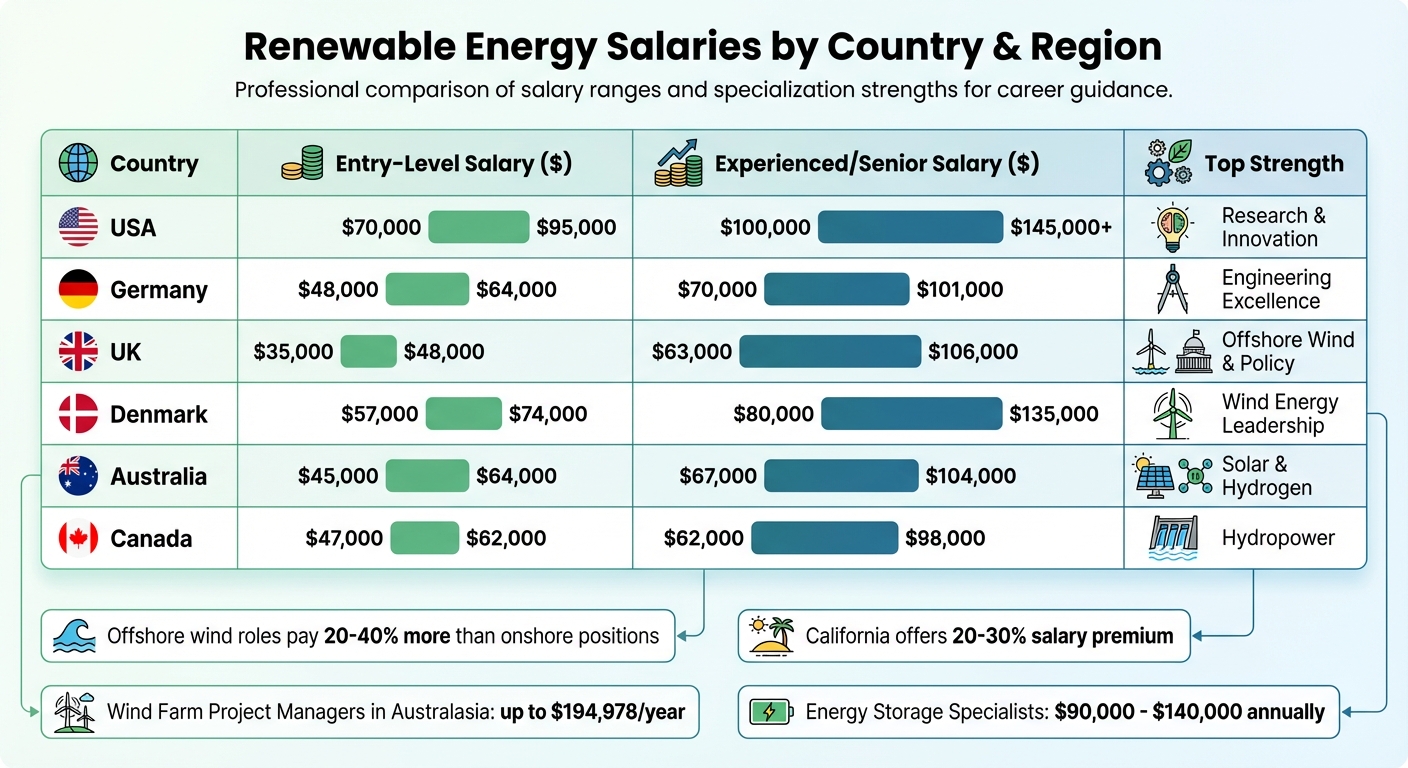
Renewable Energy Career Salaries by Country: Entry-Level to Senior Positions
Salary Ranges by Country and Region
When planning a career in renewable energy abroad, understanding both salary expectations and career growth opportunities is crucial. Compensation in this field varies significantly by region. For instance, in North America, specialized hubs like California offer a 20–30% salary premium due to high demand. Meanwhile, Australasia stands out, with Wind Farm Project Managers earning up to $194,978 annually.
Below is a breakdown of entry-level and experienced salaries across key markets:
| Country | Entry-Level Salary (USD) | Experienced/Senior Salary (USD) | Top Strength |
|---|---|---|---|
| USA | $70,000 – $95,000 | $100,000 – $145,000+ | Research & Innovation |
| Germany | $48,000 – $64,000 | $70,000 – $101,000 | Engineering Excellence |
| UK | $35,000 – $48,000 | $63,000 – $106,000 | Offshore Wind & Policy |
| Denmark | $57,000 – $74,000 | $80,000 – $135,000 | Wind Energy Leadership |
| Australia | $45,000 – $64,000 | $67,000 – $104,000 | Solar & Hydrogen |
| Canada | $47,000 – $62,000 | $62,000 – $98,000 | Hydropower |
Specialization also plays a major role in salary differences. For example, offshore wind roles typically pay 20–40% more than onshore positions due to their technical complexity and challenging work environments. Similarly, emerging areas like energy storage and green hydrogen are commanding higher salaries. Energy Storage Specialists, for instance, earn between $90,000 and $140,000 annually.
Understanding these regional and specialization-based salary trends can help you map out a rewarding career path in renewable energy.
Advancement Opportunities
Career progression in renewable energy often follows a clear trajectory as you gain experience and certifications. For example:
- Field Technicians: Start at entry-level roles, then move up to senior technician and supervisory positions.
- Engineers: Progress from junior roles to Senior Engineer, Principal Engineer, and eventually Engineering Manager.
- Project Managers: Advance from Assistant Project Manager to Program Manager or Director, with senior-level salaries exceeding $185,000 annually.
To accelerate your career, consider pursuing certifications like the Project Management Professional (PMP) credential, which is highly valued for leadership roles. Additionally, expertise in cutting-edge areas such as battery storage, green hydrogen, or smart grid integration not only increases earning potential but also shortens the timeline for promotions.
Experience in well-established markets like Germany or Denmark, known for their engineering expertise, can also open doors to international leadership roles.
These pathways highlight the dynamic opportunities for growth and advancement in the renewable energy sector worldwide.
Conclusion
Pursuing a renewable energy career abroad requires a mix of technical expertise, recognized certifications, and a strategic approach to location. This sector is booming, with projections showing over 3.3 million people employed in the U.S. clean energy industry by 2025. Even more impressive, job growth in this field is outpacing the national average by more than double. Opportunities in renewable energy continue to expand, reflecting the industry’s dynamic evolution.
To secure an international role, focus on three actionable steps. First, earn certifications that are widely respected in the industry. For example, NABCEP certification is essential for solar energy professionals, while GWO Basic Safety Training is a must for those in wind energy. These credentials demonstrate your expertise and increase your chances of landing global opportunities. Second, target countries that excel in your area of interest. Denmark leads in wind energy, Australia is emerging as a key player in solar and hydrogen, and Germany combines strong engineering programs with affordable education options. Finally, leverage job platforms tailored to renewable energy roles to connect with employers and projects.
If you’re based in the U.S., platforms like ABLEMKR can be a game-changer. This mobile-first tool links pre-vetted professionals with critical renewable energy projects. By matching workers to job sites based on certifications, safety training, and location, ABLEMKR simplifies the process while employers manage compliance and payroll seamlessly.
The renewable energy sector offers stable, high-paying careers with clear paths for advancement. Whether you’re transitioning from oil and gas, construction, or IT, your existing skills combined with the right certifications can open doors to roles earning between $70,000 and $185,000. Now is the time to take action and be part of the global clean energy movement.
FAQs
Which renewable energy jobs abroad are easiest to get first?
Entry-level jobs such as renewable energy technicians, solar installers, and wind turbine technicians are often the most accessible in the field. These roles usually demand basic technical skills, safety certifications, and some training, but they don’t typically require extensive experience or advanced degrees. Temporary positions in areas like construction, maintenance, or installation can also be excellent entryways, especially for individuals ready to pursue the necessary training and certifications.
What certifications should I get before applying overseas?
Before pursuing renewable energy jobs overseas, it’s worth looking into certifications like the Photovoltaic Installer – Level 1 (PVI1). This certification highlights your expertise in solar system installation and safety protocols. Additionally, international credentials such as I-REC can demonstrate verified renewable energy production, which helps establish compliance and trust. Having the right technical certifications and understanding international standards can make a big difference in standing out for global opportunities in the renewable energy field.
How do I handle visas and work permits for renewable energy roles?
When planning to work in renewable energy overseas, understanding the visa and work permit process is crucial. Each country has its own set of rules, so start by researching the specific requirements for your destination.
Typically, the process involves a few key steps:
- Job Offer or Sponsorship: Many countries require you to secure a job offer or sponsorship from an employer before applying for a visa or work permit.
- Gather Necessary Documents: Prepare essential paperwork like your passport, professional certifications, and any additional documents specified by the country’s immigration authorities.
- Submit Your Application: Apply through the correct channels, which could be a government portal, embassy, or consulate.
Once your visa or work permit is approved, it’s important to stay compliant with local regulations. Pay attention to visa conditions, such as work restrictions or residency requirements, and make sure to follow renewal procedures when necessary. Properly managing these steps will help ensure a smooth experience while working abroad.


