
Reducing workforce turnover in the energy sector requires addressing key challenges like high attrition rates, burnout, and limited career growth. Here’s a quick summary of actionable steps to retain employees:
- Understand Turnover Data: Separate retirement-related attrition from voluntary departures to identify trends.
- Career Development: Offer clear career paths, mentorship programs, and upskilling opportunities to keep employees engaged.
- Competitive Compensation: Regularly benchmark salaries and benefits to ensure they align with market standards.
- Work-Life Balance: Implement flexible scheduling, family-friendly policies, and better support for remote workers.
- Leverage Workforce Platforms: Use tools like ABLEMKR for efficient hiring, compliance tracking, and project planning.
High attrition affects operational efficiency and increases costs. By focusing on these strategies and tracking metrics like attrition rates, EVP scores, and absenteeism, energy companies can reduce turnover and build a stable workforce.
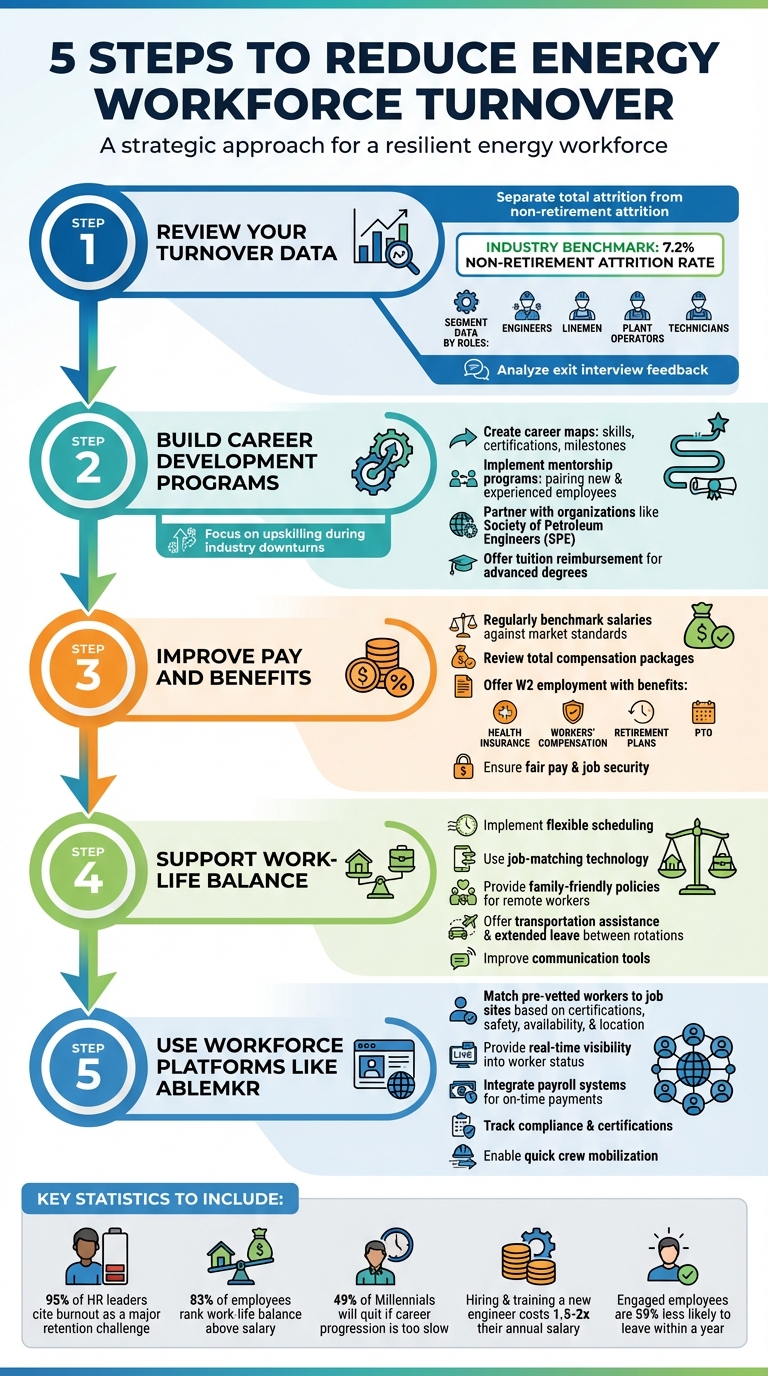
5 Steps to Reduce Energy Workforce Turnover
Workforce Strategies for the Next Energy Economy | Schneider Electric

sbb-itb-aa28329
Main Reasons Employees Leave
Grasping why employees decide to leave their jobs sheds light on challenges that disrupt workflows and increase costs.
Competition and Aging Workforce
The energy sector is feeling the pressure of a shrinking talent pool. Competing industries, especially tech companies, are actively recruiting skilled workers like engineers and developers from oil and gas. At the same time, retirements are draining institutional knowledge. Critical positions, such as plant operators and safety engineers, are left vacant as seasoned professionals exit the workforce. While only 17% of energy workers are 55 or older – lower than the national average of 24% – their departure creates significant gaps in specialized roles.
Replacing these experts isn’t cheap or quick. Hiring and training a new engineer can cost 1.5–2 times their annual salary, and it takes five to seven years for them to become fully autonomous. These hurdles are compounded by issues related to work-life balance and limited career growth.
Work-Life Balance and Growth Opportunities
Demanding schedules, constant on-call responsibilities, and isolation at remote sites are driving burnout. In fact, 95% of HR leaders identify these factors as major retention challenges. Today, 83% of employees rank work-life balance as more important than salary.
Career stagnation is another key reason employees leave. Younger workers, in particular, are quick to move on when they see limited opportunities for advancement. Nearly half (49%) of Millennials are willing to quit if career progression feels too slow. Roles requiring over a decade of experience before promotion only add to this frustration, making it harder to retain talent in the long run.
How to Reduce Turnover: 5 Steps
Reducing turnover takes a focused approach that digs into the reasons behind voluntary departures. Below is a practical guide for energy employers to keep skilled workers on board and maintain a stable workforce.
Step 1: Review Your Turnover Data
Start by breaking down your turnover numbers. Separate total attrition from non-retirement attrition to zero in on avoidable departures. Industry benchmarks, like the 7.2% non-retirement attrition rate from the Center for Energy Workforce Development, can help you identify if your rates are unusually high. If you’re above this average, it’s time to investigate further.
Segment your data by roles – engineers, linemen, plant operators, technicians – and cross-check it with feedback from exit interviews. Look for trends like employees leaving for better pay, limited career growth, or poor work-life balance. Once you’ve identified the root causes, you can focus on solutions like career development to address these issues.
Step 2: Build Career Development Programs
Lay out clear career paths for your employees. Create "career maps" that show the skills, certifications, and milestones needed for promotions. For younger workers especially, unclear career progression can lead to frustration.
"Stagnation is a primary driver of turnover. Ambitious professionals in the oil and gas sector want clear paths for growth." – Allianze HR
Pair newer employees with experienced mentors to transfer critical knowledge, especially as retirements increase. Partner with groups like the Society of Petroleum Engineers (SPE) to offer ongoing learning opportunities, and consider tuition reimbursement for advanced degrees. During industry downturns, focus on upskilling instead of layoffs. This shows employees you’re committed to their future and prepares them for when the market rebounds. Once growth opportunities are in place, make sure your pay and benefits align with retention goals.
Step 3: Improve Pay and Benefits
Competitive pay is essential in today’s labor market. Regularly benchmark salaries and review your total compensation packages, including benefits, to ensure they’re attractive. Offering W2 employment status can provide added stability, with perks like workers’ compensation, health insurance, retirement plans, and paid time off. Fair pay and a sense of security go a long way in keeping employees loyal. Once compensation is addressed, focus on improving work-life balance.
Step 4: Support Work-Life Balance
Demanding schedules and the isolation of remote job sites can lead to burnout, which directly impacts retention. Flexible scheduling and job-matching technology can help align projects with workers’ preferences. For employees on long rotations or in remote areas, family-friendly policies – like transportation assistance, extended leave between rotations, or better communication tools – show that you care about their well-being beyond just their work. Using modern workforce platforms can help manage these challenges more effectively.
Step 5: Use Workforce Platforms Like ABLEMKR
Modern workforce platforms can simplify hiring, compliance, and deployment, making it easier to retain employees. ABLEMKR, for instance, uses mobile-first technology to match pre-vetted workers to job sites based on their certifications, safety training, availability, and location. This reduces mismatches between workers and project needs.
The platform also provides real-time visibility into worker status, aids in project planning, and ensures on-time payments through integrated payroll systems. Its compliance tracking feature keeps certifications and safety standards up to date, allowing for quick crew mobilization. This is particularly useful for last-minute shutdowns or remote pipeline repairs. By implementing these tools, you can address retention challenges and measure the results to ensure your strategies are working effectively.
Tracking Your Results
Which Metrics to Track
To measure improvements in employee retention, focus on a few key metrics. Start with your non-retirement attrition rate. For context, the energy sector averages around 7.2%, while major oil and gas companies typically see rates between 9% and 11%. If your numbers are higher, it’s time to reassess your strategies.
Another critical metric is your EVP score, which is measured on a 1–5 scale and evaluates factors like work-life balance, company culture, career growth, compensation, and leadership. Most large energy companies maintain EVP scores between 3.3 and 4.1. Also, monitor training program participation rates to ensure employees are actively engaging in career development opportunities. Leadership plays a big role in retention, so keep an eye on your CEO approval rating and overall leadership effectiveness. Finally, calculate your absence rate using the formula: (Total Days Absent ÷ Total Available Workdays) × 100. High absenteeism often signals dissatisfaction among employees.
Consistently tracking these metrics over time will help you understand the impact of your retention efforts.
Before and After Comparisons
Comparing these metrics before and after implementing new strategies is essential to validate their effectiveness. Look at year-over-year data and benchmark against industry standards to determine if your changes are driving improvements or if external market factors are at play. For example, a European subsidiary of a major oil and gas company used baseline data from internal and external diagnostics to inform new career paths, diversity initiatives, and flexible work policies. Two years later, they achieved a top-quartile EVP score and a CEO approval rating exceeding 80%.
For deeper insights, conduct role-specific analyses. Focus on key positions like engineers, linemen, plant operators, and technicians – roles that often face high competition and turnover. Use charts or tables to track trends over 6- or 12-month intervals. Look for patterns, such as a rise in EVP scores coinciding with a drop in attrition rates. If your EVP score improves but attrition remains unchanged, it’s a sign that your strategies might need further adjustment.
These detailed comparisons help confirm whether your retention efforts are making a measurable difference.
Conclusion
Key Takeaways
Reducing turnover in the energy workforce starts with identifying the real reasons employees leave. Whether it’s stiff competition for talent, burnout from grueling schedules, or limited career growth opportunities, these challenges have a significant impact. Losing skilled workers doesn’t just hurt operations – it’s expensive, with costs climbing as high as 213% of an annual salary for specialized roles.
Building strong emotional ties with employees is essential. Research highlights that emotional commitment is the top predictor of retention in the energy sector. Fair pay, transparent processes, and clear communication from management play a major role in fostering this connection. Employees who feel that their organization operates fairly are far less likely to quit. At the same time, addressing burnout is critical, as 95% of HR leaders cite it as a leading cause of attrition.
Our five-step framework offers practical steps to tackle these issues: analyze turnover data, create career development programs, improve compensation and benefits, support work-life balance, and utilize tools like ABLEMKR to streamline hiring and retention efforts. Tracking metrics is key to ensuring these strategies make a measurable difference. Engaged employees are 59% less likely to leave their jobs within the next year, and organizations that optimize their staffing strategies can see productivity improve by up to 17%.
The energy sector’s rapid evolution calls for flexible workforce strategies. By using data to pinpoint retention challenges, applying targeted solutions, and monitoring results, companies can build a stable and high-performing team. Transparent policies, clear career paths, and a focus on employee well-being are investments that pay off in a competitive labor market. With these steps, energy employers can create a resilient workforce ready to meet the demands of the future.
FAQs
How do I distinguish retirement attrition from avoidable turnover?
Retirement attrition refers to the expected departures of employees due to age, often projected through models that consider factors like age and years of service. On the other hand, avoidable turnover happens when employees leave for reasons such as dissatisfaction with their job, limited career advancement, or poor work-life balance. Tools like employee surveys and exit interviews can help identify when voluntary resignations are linked to dissatisfaction. By examining both the timing and causes of employee departures, you can distinguish between natural retirements and turnover that might have been prevented.
What retention metrics should we track monthly?
Monitoring key retention metrics monthly is essential for understanding and improving employee retention. Metrics like turnover rate, average tenure, time-to-productivity, retention by job role, and attendance trends offer valuable insights into workforce dynamics.
- Turnover rate and average tenure help gauge overall workforce stability, showing how long employees stay and how frequently they leave.
- Time-to-productivity measures how quickly new hires become effective, reflecting the success of your onboarding process.
- Attendance trends can signal levels of employee engagement and satisfaction.
- Retention by job role pinpoints roles with higher turnover, enabling targeted strategies to address specific challenges.
These metrics highlight areas needing attention, such as excessive turnover in certain roles or inefficiencies in onboarding, allowing for more focused improvements.
How can ABLEMKR help reduce turnover fast?
ABLEMKR tackles workforce turnover by simplifying the entire hiring and onboarding process through its digital platform. It matches pre-vetted, qualified workers to energy projects by considering factors like certifications, training, availability, and location – making crew mobilization fast and efficient. Beyond staffing, the platform offers real-time worker tracking, streamlined payroll integration, and compliance monitoring. These features help companies hold onto skilled workers, avoid costly delays, and cut down on expenses linked to frequent turnover.


