
Real-time invoicing simplifies billing for construction projects by automating invoice creation and syncing live project data like labor hours and material costs. This approach eliminates delays, reduces errors, and improves cash flow by ensuring payments align with project progress. Key benefits include:
- Automated Invoice Generation: Pulls data directly from timesheets, work orders, and logs, reducing manual errors by up to 70%.
- Integration with Tools: Syncs with project management software for real-time updates on costs and changes.
- Compliance Management: Ensures invoices meet industry standards (e.g., AIA G702/G703) and tracks lien waivers and retainage.
- Faster Payments: Digital invoices and automated reminders speed up payment cycles, cutting delays.
Switching to real-time invoicing involves reviewing your current process, selecting construction-specific software, and training your team for a smooth transition. Platforms like ABLEMKR streamline billing by linking workforce data, automating payroll, and ensuring compliance, making payment cycles faster and more accurate.
Bottom Line: Real-time invoicing tackles payment delays and cash flow challenges, offering a smarter way to manage construction billing.
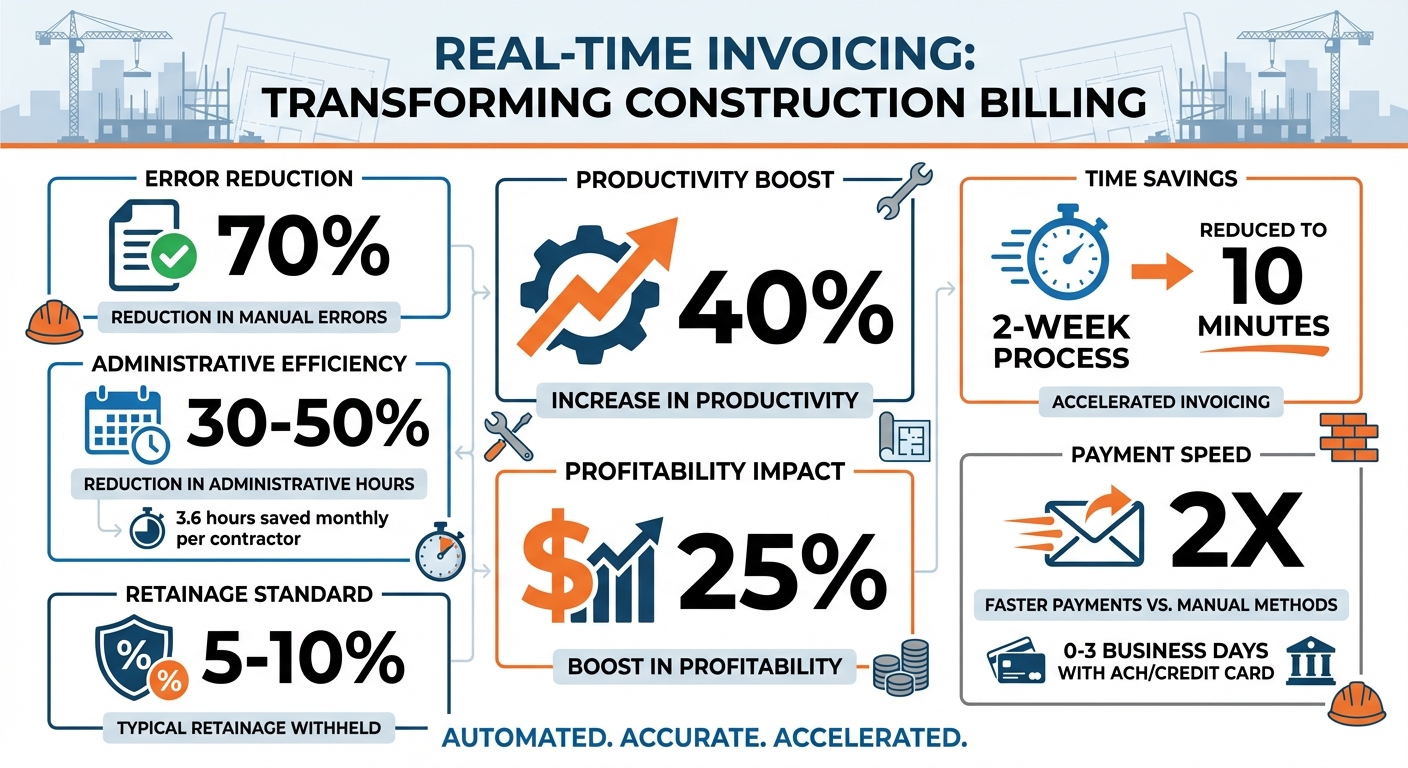
Real-Time Invoicing Benefits: Key Statistics for Construction Projects
Core Features of Real-Time Invoicing Systems
Automated Invoice Generation
Real-time invoicing systems take the hassle out of creating invoices by automatically pulling data from live sources like approved timesheets, work orders, and material logs. This eliminates the need for double entry and significantly reduces the chance of errors. Many of these systems also use OCR (optical character recognition) technology to extract details from receipts and other documents. Complex calculations, such as taxes, markups, and retainage (usually 5–10%), are handled automatically, ensuring accuracy without manual effort. Plus, with just one click, you can generate professional-grade documents like AIA G702 and G703 forms, saving time and maintaining a polished appearance.
Another key feature is the prevention of overbilling. The software ensures that invoiced amounts align with the actual percentage of work completed, which reduces disputes and protects both contractors and clients. This level of automation not only minimizes manual errors – by as much as 70% – but also boosts productivity by up to 40%. The result? Invoices that are accurate, professional, and sent out promptly, which helps keep payments on schedule.
The next step in streamlining invoicing is seamless integration with project management tools.
Integration with Project Management Tools
For real-time invoicing to work efficiently, it must integrate with your project management software. Without this connection, you’d have to manually move data between systems, which opens the door to delays and mistakes. When these platforms sync properly, everyone – from field teams to office staff – can access and work from the same up-to-date information.
One standout benefit of integration is real-time job costing. When a purchase order gets approved in the field, the data flows directly into the billing system, complete with the correct cost code. This makes it easier to organize expenses and monitor profitability. Additionally, when project scopes change (as they often do), integrated systems update billing records instantly, so all extra costs are captured and invoiced without delay. This streamlined process can speed up payments by as much as two times compared to manual invoicing methods.
Anna Ghazaryan from Buildern highlights the efficiency of this workflow:
"When a purchase order is approved, the data flows directly into the billing system. There is a corresponding cost code that makes it easier to group expenses."
Companies that adopt integrated financial systems report a 30–50% reduction in administrative hours and often see a 25% boost in profitability due to tighter control over margins.
Compliance and Documentation Management
Staying compliant is a non-negotiable for businesses, and real-time invoicing systems are built with this in mind. They automatically format invoices to meet industry standards like AIA G702/G703 and Schedule of Values (SOV), ensuring that all documentation aligns with contractual and regulatory requirements.
Another crucial feature is automated lien waiver tracking. These systems attach conditional and unconditional lien waivers to payments, reducing the risk of liens being filed after payments are made. They also manage retainage – typically 5–10% withheld until project completion – ensuring these amounts are correctly reflected on final invoices.
On top of that, the software allows you to attach supporting documents – such as timesheets, progress photos, material receipts, and signed change orders – directly to each invoice. This creates a clear audit trail that satisfies both internal reviews and external audits. Nick Overmann, Product Marketing Expert at GCPay, explains the complexity of construction invoicing:
"Construction invoicing often need to be reviewed by general contractors, construction project managers, and clients, which adds layers to the approval process."
To streamline this process, the system includes customizable approval workflows. These workflows route invoices to the appropriate stakeholders for review before payment is issued, ensuring that no payment is made without proper authorization while keeping the process efficient.
🚧 Using AI to Process Construction Invoices | LiveCosts.com
Benefits of Real-Time Invoicing for Construction Projects
Real-time invoicing, supported by automation and integration, brings noticeable improvements in accuracy, cash flow, and compliance for construction projects.
Better Accuracy and Fewer Errors
Manual invoicing often leads to costly mistakes – a wrong rate, a missed line item, or a simple math error can disrupt an entire project budget. Nick Overmann, Product Marketing Expert at GCPay, highlights this issue:
"A wrong rate, missing line item, or math error can throw off an entire construction budget. These mistakes can delay payment and strain client relationships."
Real-time invoicing systems address this by auto-filling invoices using contract terms, approved timesheets, and project progress data. This reduces the chance of errors from manual data re-entry and captures any changes to the project scope. Additionally, standardized templates like AIA G702/G703 forms ensure invoices include all necessary details before being sent.
Faster Payments and Better Cash Flow
Delayed payments are a persistent challenge in construction, but real-time invoicing significantly accelerates the payment process. Erik Feld, Project Manager and Director of Technical Operations at TruEdge Builds, shares his experience:
"Generating a bill in Procore, rather than in email and excel, automated a 2 week process to just 10 minutes."
With real-time invoicing, clients can pay directly through ACH or credit card, reducing the typical "check-in-the-mail" delays to just 0–3 business days. Automated reminders further ensure that invoices don’t get overlooked, and real-time tracking lets contractors know exactly when a client has opened and viewed an invoice. By billing based on milestones or percentage of completion, contractors can maintain a steady cash flow throughout the project rather than waiting until the end. Plus, all required documents – like lien waivers, photos, and receipts – are automatically bundled, minimizing delays caused by missing paperwork.
Easier Compliance and Audit Trails
Real-time invoicing systems simplify compliance by validating expenses against purchase orders and delivery slips, while attaching all supporting documents. This creates a complete digital audit trail, making it easier to resolve disputes and meet regulatory requirements. As Trimble explains:
"E-invoicing provides enhanced visibility into the invoicing cycle, allowing your company to track the status of invoices in real-time. These solutions often incorporate compliance features that ensure adherence to regulatory requirements and industry standards."
Some systems also integrate with safety management tools to notify managers when worker certifications or credentials are nearing expiration, helping to avoid costly compliance issues. Since invoices act as legal proof of financial agreements, maintaining a thorough digital record protects contractors in case of payment disputes or legal challenges. Additionally, automated workflows save contractors up to 3.6 hours of administrative work each month, freeing up valuable time to focus on core construction tasks. This combination of compliance support and efficiency ensures that projects run smoothly from start to finish.
sbb-itb-aa28329
How to Implement Real-Time Invoicing in Construction Projects
Switching from traditional methods like spreadsheets and emails to real-time invoicing can feel like a big leap, but it’s a change that delivers immediate results. The process involves three main steps: analyzing your current billing system, choosing the right tools, and preparing your team for the transition.
Review Your Current Billing Process
Start by pinpointing where your current billing system falls short. Look for inefficiencies like managing revisions across multiple spreadsheets, chasing down paper receipts, or manually calculating retainage percentages. These "Gray Work" tasks are time-consuming and often lead to delays in payments.
Next, determine the billing model your projects require. Are you using progress billing based on percentage completion, milestone billing tied to specific deliverables, or tracking time and materials (T&M)? This decision will guide which invoicing software features you’ll need. For example, most clients withhold 5–10% of each invoice as retainage until a project is complete. Your system should be able to handle this automatically.
Once you’ve identified the shortcomings and needs of your current process, it’s time to find a system that addresses these issues.
Choose the Right Invoicing System
Construction-specific software is a must. Unlike generic invoicing tools, these platforms are built to handle retainage, standardized forms, and lien waiver management.
Integration is critical. Your invoicing system should work seamlessly with your existing accounting tools (like QuickBooks or Xero) and project management platforms. This ensures all your data lives in one place, reducing errors and saving time. As Stripe points out:
"If integration is poor, the time you’ll spend manually cleaning up payment records will outweigh any benefit of switching providers".
Mobile accessibility is another key feature. Field teams need to document work and submit data directly from the job site, closing the gap between task completion and billing. This not only improves cash flow but also keeps your records accurate and up-to-date. Keep an eye on settlement timelines, as ACH transfers generally take 0–3 business days.
Here’s a quick look at some essential features to prioritize:
| Feature | Why It Matters |
|---|---|
| AIA G702/703 Formatting | Simplifies progress billing approval for architects and project owners. |
| Retainage Tracking | Automatically calculates holdbacks for smooth final releases. |
| Change Order Integration | Links scope changes directly to invoices. |
| Lien Waiver Management | Automates document collection to reduce legal and financial risks. |
Train Your Team and Test the System
After selecting the right software, the next step is to ensure a smooth rollout by training your team and testing workflows. Start small – pilot the system with a select group to identify any issues before expanding it to your entire operation.
Tailor training to each role. Project Managers should focus on reviewing billed quantities and progress, Contract Administrators need to match invoices against contracts, and Accounts Payable teams must handle tax details and payment terms.
Standardizing processes is essential. Use consistent naming conventions, cost codes, and invoice templates to minimize errors and speed up reviews. As Mastt advises:
"Standardize your validation checkpoints. Define clear steps and approval thresholds for each stage of billing… This creates accountability, shortens turnaround times, and builds consistency across every project".
Automated validation rules can also flag incomplete, duplicate, or noncompliant invoices before they reach the approval stage. This eliminates the back-and-forth that often delays payments. Collaborate with field teams early to verify quantities and progress logs before payment deadlines. Addressing discrepancies upfront avoids headaches later.
Most software vendors offer training and support resources – take full advantage of these to ensure both your office and field teams are confident in using the platform from day one.
How ABLEMKR Supports Real-Time Invoicing for Construction

For real-time invoicing to work smoothly, workforce data needs to flow seamlessly into your billing system. ABLEMKR’s platform makes this possible by linking labor deployment with automated payroll and compliance tracking. This reduces manual entry delays and creates a more efficient invoicing process.
Connecting Workforce Data with Invoicing
With ABLEMKR, workers log their hours directly through the app, allowing customers to view entries as they happen. This real-time visibility helps identify and address discrepancies before they make it to the invoice. Verified credentials and skill ratings for each worker ensure that hourly rates align with documented expertise. Geo-location tracking adds another layer of accuracy, confirming workers are on-site when they clock in and supporting progress tracking through in-app messaging. The platform’s mobile validation also creates a digital audit trail, reducing the risk of billing disputes.
On-Demand Staffing and Billing Efficiency
ABLEMKR’s automated matching system quickly assembles crews nationwide based on certifications, availability, and location, allowing for fast crew deployment. This eliminates the typical delays between getting a crew on-site and setting up billing. When you post a job with specific credential requirements, the platform matches workers accordingly, keeping invoicing aligned with actual labor costs. From finding and placing workers to managing payroll, ABLEMKR integrates everything into one streamlined workflow. On-time payments are guaranteed, reducing disputes and speeding up the billing process for temporary labor.
Built-In Compliance Tracking
To further simplify invoicing, ABLEMKR ensures every worker is fully insured, minimizing rejected payment applications. The platform’s W2 employment structure makes tax reporting easier and provides audit-ready billing records. Safety certifications and credentials are stored in each worker’s profile, so when compliance documentation is needed for progress billing, the system already has it covered. This eliminates unnecessary back-and-forth and helps keep payment cycles on track, a critical benefit for construction projects.
Conclusion
Real-time invoicing has the power to address two of the construction industry’s biggest headaches: payment delays and cash flow unpredictability. These delays cost the sector billions every year, draining productivity and straining professional relationships.
By automating the billing process, real-time invoicing tackles these inefficiencies head-on. The journey to adopting this system begins with evaluating your current billing workflow, selecting software that works seamlessly with your existing tools, and training your team to follow standardized procedures. Automation ensures invoices are generated promptly, reduces errors, and compiles the necessary documentation for faster approvals. With mobile access, field teams can input data instantly, creating an audit trail that simplifies compliance.
Take ABLEMKR, for example. Their platform combines workforce management with billing automation to streamline operations at every stage of a project. Workers clock in using geo-location verification, and their hours automatically sync with payroll. This cuts down the time between completing work and generating invoices. Plus, their W-2 employment structure, workers’ compensation coverage, and stored safety certifications mean compliance documentation is ready to go when payment applications are submitted. By reducing manual data entry, ABLEMKR eliminates delays and significantly lowers the risk of billing errors.
For construction companies juggling tight margins and unpredictable payment cycles, real-time invoicing isn’t just a tech upgrade – it’s a smarter way to manage billing. By aligning your invoicing system with field operations, you can stop wasting time chasing payments and focus on what really matters: getting the job done. Real-time invoicing transforms billing from a roadblock into a competitive edge for today’s construction projects.
FAQs
How can real-time invoicing help improve cash flow in construction projects?
Real-time invoicing plays a crucial role in improving cash flow within the construction industry by cutting down the time between completing work and getting paid. It empowers project teams to create and send precise invoices immediately after reaching key milestones, speeding up both billing and payment processes.
With automated tracking tools, you can keep tabs on invoices in real time – whether they’re pending, approved, or already paid. This makes it easier to follow up promptly and reduces the risk of overdue payments. Plus, electronic payment options streamline fund transfers, converting receivables into cash far more quickly than older, manual methods. By reducing mistakes and disputes, real-time invoicing ensures smoother transactions, helping businesses maintain the cash flow needed to cover essentials like payroll, materials, and payments to subcontractors.
What features should construction invoicing software have?
Construction invoicing software needs to address the specific billing challenges of the industry. Look for tools that support progress billing, milestone billing, and time-and-materials billing. These features let you invoice based on work completed, key project milestones, or detailed breakdowns of labor and material costs. Additionally, the ability to create standardized documents like AIA G702/G703 forms or a Schedule of Values (SOV) is crucial for meeting compliance standards.
Efficiency matters. Features like quick estimate-to-invoice conversion, customizable templates, and options to attach photos, files, or change-order details can save time and minimize mistakes. Integration with accounting platforms like QuickBooks or financial tools for tracking cash flow and measuring profitability helps keep your finances in check. Finally, a client portal or mobile-friendly design that simplifies invoice approvals and payments can enhance transparency and accelerate cash flow.
How do real-time invoicing systems help ensure compliance with construction industry standards?
Real-time invoicing systems streamline compliance by automatically pulling in critical data – like labor hours, materials used, and equipment details – into invoices as tasks are completed. This process ensures an accurate, time-stamped record that meets industry documentation and record-keeping standards. These systems also align billed amounts with contract terms, approved change orders, and certified payroll requirements, helping businesses adhere to construction accounting standards and federal regulations such as Davis-Bacon.
To minimize errors, built-in validation checks flag issues like missing certifications, incorrect tax codes, or unsupported payment terms before invoices are finalized. Plus, with a cloud-based platform, tax rules, revenue recognition, and compliance tracking are consistently applied. Project managers can easily generate audit-ready reports whenever needed, reducing manual mistakes, simplifying regulatory reporting, and providing a dependable record of all invoicing activities.


