
Energy jobs are growing faster than overall employment in the U.S., but many groups – like women, people of color, veterans, and LGBTQ+ individuals – remain underrepresented. To address this, various programs are creating pathways into the energy sector for these groups. These initiatives focus on training, job placement, and reducing barriers to entry. Here are 10 programs leading the way:
- ABLEMKR: A mobile platform that connects diverse workers to energy jobs using certifications and location data.
- IREC Workforce Diversity Initiatives: Provides solar training, certifications, and career maps for underserved communities.
- CEWD and Get Into Energy: Offers pre-apprenticeships, career coaching, and utility job opportunities, with a focus on veterans and urban communities.
- Exelon Infrastructure Academies: Prepares candidates for technical roles like linework and substation maintenance.
- Constellation Workforce Development: Partners with schools to provide scholarships, mentorship, and training for energy careers.
- GRID Alternatives: Hands-on solar training programs aimed at women, BIPOC, and justice-impacted individuals.
- Urban Energy Jobs Program: Recruits urban residents for pre-apprenticeship training in fields like solar and linework.
- Clean Power Institute: Runs campaigns and partnerships to connect disadvantaged youth with clean energy roles.
- Troops to Energy Jobs: Helps veterans transition into energy careers through career mapping and employer connections.
- Dominion Energy Careers in Energy Conference: Introduces students to energy careers through workshops and networking.
These programs use targeted outreach, pre-apprenticeships, and support services to create opportunities for underrepresented groups, ensuring the energy workforce reflects the communities it serves.
Equity in Focus: Building a Diverse, Inclusive Clean Energy Workforce
10 Programs Supporting Diversity in Energy Jobs
Across the United States, various programs are working to open doors for underrepresented groups in the energy sector. From tech platforms to collaborations with utilities and nonprofits, these initiatives aim to create pathways into energy trades. Each program has its own approach to making energy careers more accessible and inclusive.
1. ABLEMKR: Matching Workers to Energy Jobs
ABLEMKR is a mobile platform that connects pre-vetted workers with high-demand jobs in construction, energy, and extractive industries. Using factors like certifications, safety training, availability, and location, the platform simplifies hiring for both workers and employers. By guaranteeing payments and streamlining compliance, ABLEMKR helps smaller contractors and minority-owned businesses gain access to large-scale energy projects.
2. Interstate Renewable Energy Council (IREC) Workforce Diversity Initiatives
IREC is dedicated to creating opportunities in clean energy for underserved communities. The organization collaborates with partners like the Home Builders Institute to provide hands-on solar training and certifications, such as the Residential Rooftop Solar PV Technician Certification, for Job Corps students. IREC also offers clean energy career maps, showing clear pathways from entry-level jobs to advanced roles, and leads the National Clean Energy Workforce Alliance, which connects employers, training providers, and community groups.
3. Center for Energy Workforce Development and Get Into Energy
The Center for Energy Workforce Development (CEWD) brings together utilities, unions, contractors, and educators to build a diverse energy workforce. Its Get Into Energy platform serves as a resource where job seekers can explore utility trades like lineworking, gas technology, and plant operations. The platform also connects users with training programs and entry-level job opportunities. CEWD collaborates with labor unions and organizations like local Urban Leagues to offer pre-apprenticeship training, career coaching, and support services. Notably, veterans make up nearly 10% of the U.S. energy workforce, a sector that supports over 7 million jobs.
4. Exelon Infrastructure Academies and CONSTRUCT Program
Exelon’s Infrastructure Academies provide affordable training in technical areas like linework, cable splicing, and substation maintenance. These programs include safety training and job readiness support tailored to Exelon’s hiring standards. Meanwhile, the CONSTRUCT Program offers a pre-apprenticeship course that prepares diverse candidates for roles in construction and energy trades, often leading to apprenticeships or entry-level positions.
5. Constellation Workforce Development for Trades
Constellation focuses on expanding skilled trade opportunities by partnering with vocational schools, technical colleges, and Historically Black Colleges and Universities (HBCUs). The company funds lab equipment, offers scholarships for low-income and first-generation students, and helps create curricula that meet industry standards. Students also gain hands-on experience and mentorship, paving the way to careers in nuclear, renewable, and field service technology.
6. GRID Alternatives Workforce Development
GRID Alternatives is a nonprofit offering hands-on training in solar installation through programs like Installation Basics Training, SolarCorps Fellowships, and Tribal Energy Alternatives. These programs prioritize underrepresented groups in the energy sector. Participants earn certifications and receive support such as transportation assistance and stipends while connecting with solar industry employers.
7. Urban Energy Jobs Program (National Urban League & CEWD)
The Urban Energy Jobs Program, a collaboration between the National Urban League and CEWD, recruits candidates from urban neighborhoods for pre-apprenticeship training in fields like lineworking, gas technology, cybersecurity, and solar panel installation. Alongside technical training, participants receive career coaching, financial literacy education, and other support to help them succeed in energy careers.
8. Clean Power Institute‘s Recruiting Diverse Talent Initiative
The Clean Power Institute (CPI) partners with schools, the military, training institutions, and workforce councils to create a diverse pipeline for clean energy manufacturing and field roles. With clean energy manufacturing expanding quickly, CPI uses career fairs, digital campaigns, and community partnerships to connect candidates with training and job opportunities.
9. Troops to Energy Jobs
A collaboration between CEWD and the Edison Electric Institute (EEI), Troops to Energy Jobs helps veterans transition their military skills into energy careers. The program provides tools for translating military experience into civilian roles, career mapping, and direct connections to utility employers. With veterans making up nearly 10% of the energy workforce, this initiative supports both the industry’s need for skilled workers and veterans’ goals for stable, well-paying jobs.
10. Dominion Energy Careers in Energy Student Conference
Dominion Energy hosts the Careers in Energy Student Conference, aimed at introducing undergraduate students to the energy sector. The event features workshops, networking opportunities, and site visits, focusing on professional development and exploring diverse career paths in energy.
How These Programs Increase Diversity
These programs use a mix of strategies to open doors to energy careers for groups that have historically been underrepresented in the industry. Here’s how they’re making it happen:
Targeted outreach plays a big role. By partnering with community organizations, schools, military groups, and workforce councils, these programs connect with people of color, women, LGBTQ+ individuals, veterans, and those impacted by the justice system. A great example is IREC’s National Clean Energy Workforce Alliance, which, since January 2022, has brought together over 500 employers, training providers, and community organizations to share resources and create job opportunities for underserved communities.
Pre-apprenticeship pathways offer hands-on training that leads to recognized credentials and real job placements. For instance, IREC teamed up with the Home Builders Institute to provide solar training and the Residential Rooftop Solar PV Technician Certification to Job Corps students nationwide. Career maps are used to show students exactly how they can advance in the clean energy field.
Wraparound support services tackle the barriers that often hold diverse candidates back. These programs go beyond technical training by offering mentorship, scholarships, and other resources. Take the Urban Energy Jobs Program, for example – it works with local Urban Leagues to recruit diverse candidates for positions like line workers and solar panel technicians. By building on community relationships, they provide pre-apprenticeship training along with ongoing support.
Collaboration with industry stakeholders ensures that training programs meet the needs of employers and lead to meaningful job placements. Research backs this up, showing that diverse teams perform 35% better operationally and financially. These teams also bring fresh ideas, improve safety, and build stronger trust within communities.
sbb-itb-aa28329
Program Comparison Table
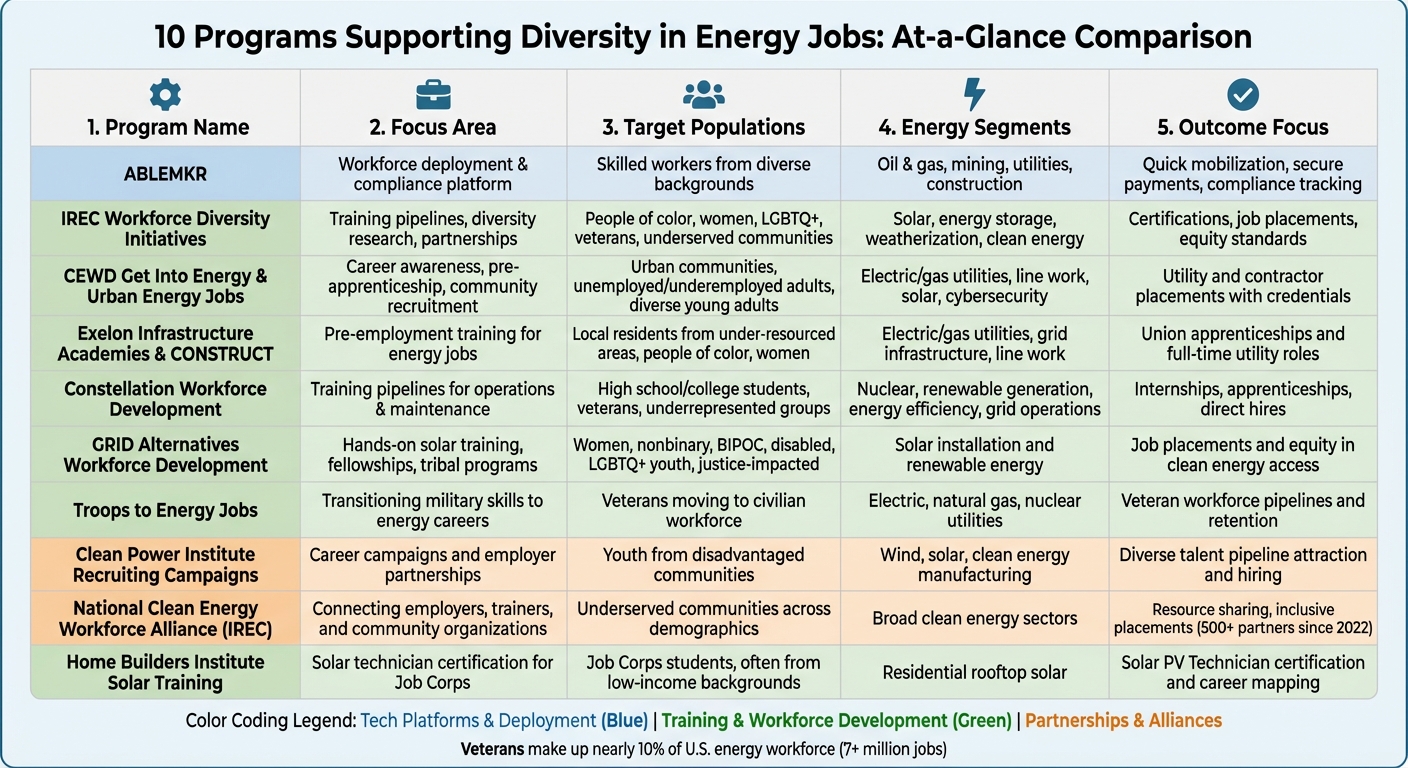
10 Energy Diversity Programs Comparison: Focus Areas, Target Groups, and Outcomes
Comparison Table
Here’s a detailed look at various programs, highlighting their focus, target populations, energy segments, and outcomes:
| Program Name | Focus Area | Target Populations | Energy Segments | Outcome Focus |
|---|---|---|---|---|
| ABLEMKR | Workforce deployment and compliance through a technology platform | Skilled workers from diverse backgrounds | Oil & gas, mining, utilities, heavy infrastructure, construction | Quick mobilization, secure payments, real-time compliance tracking |
| IREC Workforce Diversity Initiatives | Training pipelines, diversity research, and national partnerships | People of color, women, LGBTQ+, veterans, underserved communities | Solar, energy storage, weatherization, clean energy | Certifications, job placements, and equity standards for the industry |
| CEWD Get Into Energy & Urban Energy Jobs Program | Career awareness, pre-apprenticeship, and community recruitment | Urban communities, unemployed/underemployed adults, diverse young adults | Electric and gas utilities, line work, gas technicians, solar, cybersecurity | Placement into utility and contractor roles with credentialed training |
| Exelon Infrastructure Academies & CONSTRUCT | Pre-employment training connected to energy job opportunities | Local residents from under-resourced areas, people of color, women in trades | Electric and gas utilities, grid infrastructure, substation and line work | Graduates moving into union apprenticeships and full-time utility roles |
| Constellation Workforce Development | Training pipelines for energy operations and maintenance roles | High school and community college students, veterans, underrepresented groups | Nuclear, renewable generation, energy efficiency, grid operations | Internships, apprenticeships, and direct hires with a focus on diversity |
| GRID Alternatives Workforce Development | Hands-on solar training, fellowships, and tribal programs | Women, nonbinary individuals, BIPOC, disabled, LGBTQ+ youth, justice-impacted individuals | Solar installation and renewable energy | Job placements and promoting equity in clean energy access |
| Troops to Energy Jobs (CEWD/EEI) | Transitioning military skills into energy careers | Veterans moving into the civilian workforce | Electric, natural gas, nuclear utilities | Veteran workforce pipelines and retention in energy roles |
| Clean Power Institute Recruiting Campaigns | Career campaigns and employer partnerships | Youth from disadvantaged communities | Wind, solar, clean energy manufacturing | Attracting and hiring diverse talent pipelines |
| National Clean Energy Workforce Alliance (IREC) | Connecting employers, training providers, and community organizations | Underserved communities across various demographics | Broad clean energy sectors | Sharing resources and inclusive job placements (500+ partners since January 2022) |
| Home Builders Institute Solar Training (IREC Partnership) | Solar technician certification for Job Corps students | Job Corps students nationwide, often from low-income backgrounds | Residential rooftop solar | Certification as Residential Rooftop Solar PV Technicians and career mapping |
These programs showcase a range of approaches – from leveraging technology for efficient hiring to fostering community-based training and forming national partnerships – all aimed at increasing opportunities for historically underserved groups in the energy sector.
Conclusion
Creating a diverse workforce in energy skilled trades is a collective effort that involves jobseekers, employers, educators, and communities. As the U.S. undergoes an energy transition, millions of new opportunities are emerging. However, ensuring these opportunities are accessible to everyone requires deliberate action to include people of color, women, veterans, and other groups that have historically been excluded from these high-paying careers.
The programs mentioned here demonstrate what can happen when utilities, nonprofits, training providers, and technology platforms join forces. Initiatives like IREC’s hands-on solar certifications, CEWD’s utility training programs, and ABLEMKR’s mobile-first job matching platform tackle specific challenges that often block access to these fields. By building on these efforts, the energy sector can grow in a way that invites broad participation. A diverse workforce doesn’t just fill job openings – it enhances problem-solving, builds trust in projects within varied communities, and ensures the economic advantages of energy expansion reach those who need them most.
No matter your role, you can contribute. Jobseekers can explore resources like Get Into Energy or ABLEMKR to find training and employment opportunities. Employers can collaborate with organizations like IREC, CEWD, and workforce boards to tap into wider talent pools. Educators and community leaders can raise awareness about these careers and guide residents toward pre-apprenticeships. Even small steps – like mentoring, sharing resources, or supporting local programs – can make a big difference in ensuring the future energy workforce reflects the diversity of the communities it serves. The future of U.S. energy depends on these actions.
FAQs
How do these programs support diversity in the energy workforce?
These initiatives aim to open doors for underrepresented groups by focusing on tailored recruitment efforts, careful candidate evaluation, and simplified onboarding procedures. They bridge the gap between skilled workers and high-paying roles in the energy industry, while helping companies access and integrate diverse talent more effectively.
By addressing traditional hiring obstacles and encouraging a more inclusive workforce, these programs enable people from all walks of life to succeed in energy-related skilled trades.
What training and certifications are available through these programs for energy careers?
These programs offer focused training and certifications designed for careers in energy-related fields like construction, oil and gas, mining, electrical work, and restoration. The curriculum highlights safety practices, technical skills, and standards specific to the industry, equipping workers to handle the challenges of these demanding roles.
Participants benefit from hands-on learning opportunities and can earn credentials that align with the needs of thriving energy sectors. This not only boosts their qualifications but also enhances their career prospects in a competitive job market.
How can veterans use their skills to build careers in the energy sector?
Veterans have a great opportunity to transition into energy careers by leveraging the skills they’ve already honed in fields like construction, mining, or other skilled trades. Platforms such as ABLEMKR play a key role by connecting their certifications, safety training, and work experience with the specific demands of employers in the energy sector.
With flexible job options, simplified onboarding processes, and reliable on-time payments, veterans can step into high-demand roles with ease. These efforts not only help veterans build their careers but also ensure a seamless introduction to the energy industry.


