
Skill gaps in construction and energy industries can delay projects, increase costs, and create safety risks. Predictive analytics helps solve this by forecasting workforce needs before issues arise.
Here’s how it works:
- Skill Gaps Defined: The mismatch between current workforce skills and project demands leads to delays, budget overruns, and safety hazards.
- Predictive Analytics: Uses historical and real-time data to anticipate skill shortages weeks or months in advance.
- Key Benefits: Improves workforce planning accuracy by up to 70%, reduces budget and timeline deviations by 10–20%, and ensures the right skills are available when needed.
For example, companies like Johnson & Johnson have used AI-driven tools to identify future-ready skills, boosting workforce readiness and engagement. Tools like ABLEMKR further streamline this process by matching workers to projects in real time based on certifications, experience, and availability.
Predictive analytics transforms workforce management from reactive to proactive, ensuring projects stay on track and within budget.
How Predictive Analytics Works: A Step-by-Step Guide
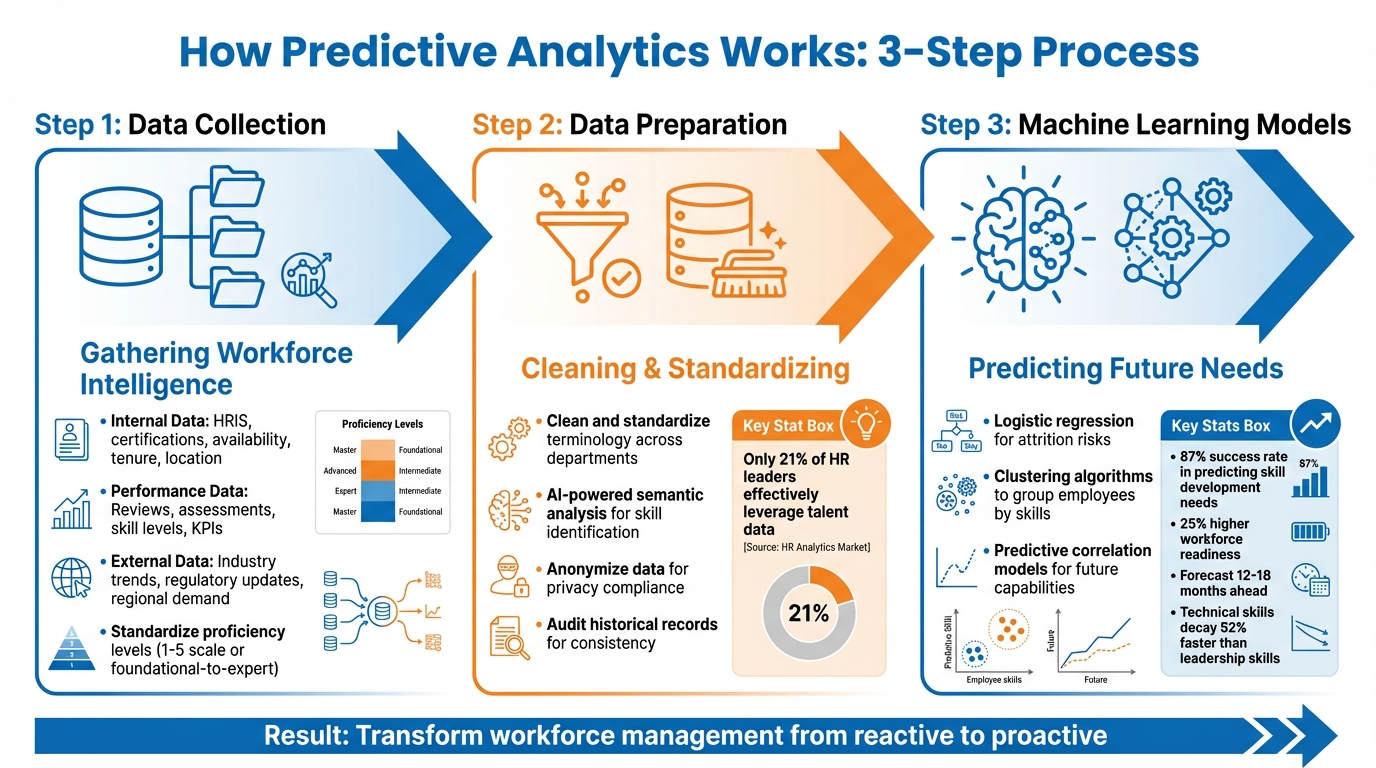
How Predictive Analytics Works: 3-Step Process for Workforce Planning
Predictive analytics takes raw workforce data and turns it into actionable forecasts, which are especially useful in industries like construction and energy. The process unfolds in three main stages: data collection, data preparation, and developing machine learning models. The first step? Gathering the right data.
Step 1: Collecting Historical and Real-Time Workforce Data
To build effective predictive models, you need a comprehensive view of your workforce – both current and historical. Start by pulling internal data from systems like HRIS, recruiting databases, LMS, and project management platforms. Gather details such as job roles, certifications (e.g., OSHA 30-hour cards or API welding credentials), worker availability, tenure, and geographic location. This foundational data creates a baseline for analysis.
Adding performance and assessment data enriches the picture by measuring skill levels. This could include past performance reviews, 360-degree feedback, behavioral assessments, job knowledge tests, and KPI contributions. For instance, if you’re managing pipeline crews, you’d want to know not just who holds welding certifications but also whether their skills are basic, intermediate, or advanced, based on outcomes from previous projects.
To refine your analysis further, layer in external market data, such as business goals, industry trends, regulatory updates, and regional workforce demand. For example, heat maps showing skill concentrations can highlight where certified electrical technicians are located compared to regions where solar installations are booming.
Standardizing proficiency levels – whether using scales like 1–5 or categories such as foundational-to-expert – helps quantify gaps between current skills and project requirements. This makes it easier to determine whether a crew needs a quick training session or months of upskilling.
Step 2: Preparing Data for Analysis
Raw data is rarely ready for analysis. Data preparation involves cleaning and standardizing information to ensure accuracy. For example, a "safety certification" should mean the same thing across all departments, whether it’s logged in Houston or Denver. Tools like AI-powered semantic analysis can help by interpreting resume details and identifying niche skills that might escape traditional keyword searches.
"Data is the cornerstone for the accuracy of a predictive analytics tool." – Aleksandr Ahramovich, Head of AI/ML Center of Excellence, Itransition
It’s also crucial to anonymize and standardize data to protect employee privacy and comply with regulations. Before building predictive models, audit historical records to ensure consistency. Interestingly, smaller datasets that consistently track trends over time often outperform massive but inconsistent datasets. While the HR analytics market is projected to hit $4.87 billion by 2025, only 21% of HR leaders currently leverage talent data effectively for recruitment or engagement strategies.
Step 3: Building Machine Learning Models
Once your data is structured, machine learning algorithms can identify workforce trends and predict future needs. Logistic regression can help assess attrition risks, clustering algorithms can group employees by skills, and predictive correlation models can link workforce capabilities to future business goals. For example, if a group of electricians needs updated arc flash training, the model can group them for a targeted training initiative. As the energy sector leans toward renewables, these models can also predict demand for roles like solar installation technicians or battery storage experts before projects even begin.
Machine learning has shown an 87% success rate in predicting skill development needs by analyzing training durations and sentiment signals. Companies using predictive analytics report 25% higher workforce readiness, and AI-driven forecasting can estimate workforce needs 12–18 months ahead. These models process millions of data points – like behavioral trends, project outcomes, and certification completions – to flag roles at risk of shortages. Additionally, since technical skills tend to decay 52% faster than leadership skills, the models can adjust training schedules to ensure certifications are renewed on time.
Next, see how these predictive insights seamlessly integrate with ABLEMKR for real-time workforce matching.
sbb-itb-aa28329
Forecasting Skill Shortages in Construction and Energy
Predictive models are transforming how industries anticipate skill shortages, especially in construction and energy. These tools help pinpoint which roles are likely to face shortages, where these gaps will occur, and when companies need to act. By turning raw data into clear hiring and training strategies, businesses can stay ahead of workforce challenges.
Identifying Regional Trends and Job-Specific Shortages
Predictive models combine workforce data with regional project plans to flag potential skill gaps before they become critical. For instance, if Gulf Coast refineries schedule major turnarounds for Q3 2026, the models might predict a high-severity shortage of certified welders experienced in oil and gas. Similarly, as renewable energy projects expand in the Northeast, the models could foresee a medium-severity gap in electricians skilled in solar and battery storage systems by Q4 2026.
These tools also highlight where skilled workers are concentrated geographically. For example, heat maps might reveal that the Southwest has sufficient crane operators, while the Midwest faces a severe shortage of concrete finishers. By factoring in external conditions, such as economic trends or regional infrastructure investments, these models refine their accuracy to better reflect actual conditions. This allows companies to adjust bidding strategies, implement targeted training programs, or reassign crews ahead of time. Visualizing these predictions ensures that contractors can translate forecasts into actionable steps.
Using Data Tables to Visualize Predicted Skill Gaps
Dashboards and data tables are essential for turning predictive insights into practical tools. Instead of wading through complex data, project managers can quickly interpret key metrics like severity, timelines, and recommended actions. For example, a table might suggest increasing subcontractor bids to address welder shortages in the Gulf Coast, while advising closer monitoring of equipment maintenance for crane operators in the Southwest.
| Job Role / Skill | Region | Predicted Severity | Forecasted Timeline | Recommended Action |
|---|---|---|---|---|
| Welder (Oil & Gas) | Gulf Coast | High | Q3 2026 | Increase subcontractor bidding |
| Electrician (Utilities) | Northeast | Medium | Q4 2026 | Initiate specialized training program |
| Crane Operator | Southwest | Low | Q2 2026 | Monitor equipment maintenance logs |
| Concrete Finisher | Midwest | Critical | Q3 2026 | Adjust shift patterns/crew sizes |
These dashboards also provide real-time alerts to site supervisors and project managers, enabling swift responses to potential disruptions. By integrating these insights into existing ERP and project management systems, companies eliminate data silos and ensure field teams can act immediately. Considering that 32% of construction cost overruns stem from estimating errors, accurate and visual forecasts are key to avoiding expensive last-minute labor issues.
Using Predictive Insights with ABLEMKR
ABLEMKR takes the concept of predictive analytics a step further by turning forecasts about skill gaps into actionable workforce solutions. This approach ensures that the right workers are matched with the right projects, precisely when they’re needed.
Connecting Predictive Analytics to Real-Time Workforce Matching
ABLEMKR transforms predictive data into immediate workforce deployment. Instead of relying on self-reported profiles, the platform uses skills inference to analyze worker data such as certifications, project outcomes, and validated behaviors. Its AI-powered tools then cross-reference this information with the specific requirements of each project – factors like certifications, safety training, availability, and location – to ensure an exact match.
For instance, imagine a refinery urgently needs certified welders. ABLEMKR doesn’t just search by job title. It identifies workers with the necessary certifications, recent relevant experience, and proximity to the job site. By quantifying worker proficiency through measurable scales, the platform ensures that the selected individuals meet the required standards of expertise.
The traditional, static hiring process is replaced by real-time dashboards and alerts. Managers are notified the moment pre-vetted candidates become available, enabling rapid crew mobilization for urgent needs like shutdowns or pipeline repairs. What used to take weeks can now happen in hours. ABLEMKR processes millions of data points in seconds, matching workers to projects based on detailed skill profiles and real-time availability. This technology delivers results: organizations using predictive intelligence see a 25% improvement in workforce readiness, which is critical given that 89% of enterprises report skills gaps that hinder growth.
This streamlined process not only speeds up staffing but also strengthens long-term workforce planning.
Benefits for Employers and Workers
Employers enjoy several advantages, including compliance tracking, real-time visibility into worker availability, and simplified payroll processes. Geo-location matching helps cut travel costs and avoid delays. For companies weighing whether to upskill their current staff or bring in external labor, ABLEMKR supports the "Rent" option within the Build, Buy, Borrow, or Rent framework, offering a flexible way to access skilled workers without committing to permanent hires.
Workers also reap the benefits. They gain flexible access to well-paid opportunities across various projects and regions. Payments are guaranteed and on time, providing financial stability. W2 employment and workers’ compensation coverage add another layer of security. Plus, the platform’s transparent matching process ensures workers are assigned to jobs that align with their verified skills and experience, avoiding mismatches that could compromise safety or job satisfaction.
Conclusion
The construction and energy sectors are grappling with a major workforce challenge. By 2030, the global worker shortfall is projected to surpass 85 million, with 62% of HR professionals predicting that current talent shortages will persist for the long haul. Relying on reactive hiring practices – waiting until projects are underway to secure workers – only leads to costly delays and operational setbacks.
Predictive analytics offers a smarter solution. By forecasting talent needs 12–18 months in advance, companies can identify critical roles at risk and proactively address skill gaps. This approach isn’t just theoretical; organizations leveraging predictive intelligence report a 25% improvement in workforce readiness. It’s a shift from scrambling to fill roles to strategically planning for future demands.
ABLEMKR takes these forecasts a step further by turning them into immediate action. By matching pre-vetted workers to key projects based on certifications, safety credentials, availability, and location, ABLEMKR ensures that the right talent is deployed when and where it’s needed. For example, if a refinery requires certified welders or a pipeline repair needs specialized technicians, ABLEMKR mobilizes the right crew quickly. This combination of forward-thinking analytics and real-time workforce deployment keeps critical industries running smoothly, even as labor markets tighten.
In a world where skill shortages are becoming the norm, data-driven workforce strategies are no longer optional – they’re essential for staying competitive and maintaining operational efficiency.
FAQs
What data do I need to predict skill shortages?
To foresee skill shortages, it’s essential to examine both internal and external data. Internally, focus on metrics like hiring patterns, employee skill sets, certifications, and training records. On the external side, consider factors such as industry trends, demographic shifts, and changing job requirements.
By using predictive analytics tools, which leverage AI and statistical models, organizations can merge these insights. This approach helps identify potential gaps and enables proactive strategies, such as targeted hiring, tailored training programs, or optimized workforce deployment, to address future needs effectively.
How far ahead can predictive analytics forecast labor needs?
Predictive analytics offers the ability to project labor needs 12 to 18 months ahead, giving industries like energy and construction a chance to tackle skill shortages before they become critical. By examining historical data and identifying patterns, these tools can pinpoint potential gaps in the workforce. This early insight allows companies to refine their recruitment efforts, improve training programs, and optimize how they allocate resources. In sectors where demand is high, such as energy and construction, having a well-prepared workforce is essential for keeping operations running smoothly and ensuring readiness for key projects.
How does ABLEMKR use predictions to staff jobs faster?
ABLEMKR leverages predictive analytics to assess both real-time and historical workforce data, allowing businesses to anticipate future skill requirements and labor availability. This forward-thinking method pinpoints skill gaps early, making it easier to plan recruitment and workforce deployment effectively. By aligning pre-vetted workers with job sites based on factors like certifications, training, availability, and location, ABLEMKR facilitates quick crew mobilization. This reduces downtime and simplifies staffing for essential energy and construction projects.


