
Portable retirement plans are essential for skilled workers who frequently change jobs or work in industries with high mobility like construction, energy, and trade. These plans allow workers to maintain and grow their retirement savings regardless of employer changes. Key options include:
- Taft-Hartley Trust Funds: Designed for unionized workers, these plans offer portability across employers in the same industry, service credit reciprocity, and tax-deferred growth.
- Individual Retirement Accounts (IRAs): Fully portable accounts with flexible contribution options for varying income levels. Options include Traditional, Roth, SEP, and SIMPLE IRAs.
- Portable 401(k) Plans (Solo 401(k)s): Ideal for self-employed workers, offering high contribution limits, Roth options, and loan features.
- Defined Contribution Cash Balance Plans: Combine pension-like stability with portability, allowing workers to roll over balances when changing jobs.
Each plan has unique advantages, such as tax benefits, contribution flexibility, and portability, making them suitable for different work styles and income levels.
Quick Comparison:
| Plan Type | Best For | Contribution Limits (2026) | Portability Features | Tax Benefits |
|---|---|---|---|---|
| Taft-Hartley Trust Funds | Unionized workers in mobile industries | Employer-determined | Service credit reciprocity within industries | Tax-deferred growth, employer contributions |
| Individual Retirement Accounts (IRAs) | Freelancers and self-employed workers | $7,500 ($8,600 if 50+) | Fully portable, consolidate old accounts | Tax-deductible (Traditional) or tax-free withdrawals (Roth) |
| Portable 401(k) Plans (Solo 401(k)s) | Self-employed individuals without employees | Up to $83,250 (with catch-up) | Rollovers to new plans or IRAs | Pre-tax (Traditional) or tax-free growth (Roth) |
| Defined Contribution Cash Balance Plans | Workers seeking pension-like stability | Up to $290,000+ | Lump-sum rollovers to IRAs or 401(k)s | Employer-funded, tax-deferred growth |
Choosing the right plan depends on your income, work style, and retirement goals. For example, Solo 401(k)s suit high-earning contractors, while IRAs work well for those just starting out. Platforms like ABLEMKR can help skilled workers maintain steady income streams, making it easier to contribute consistently to these plans.
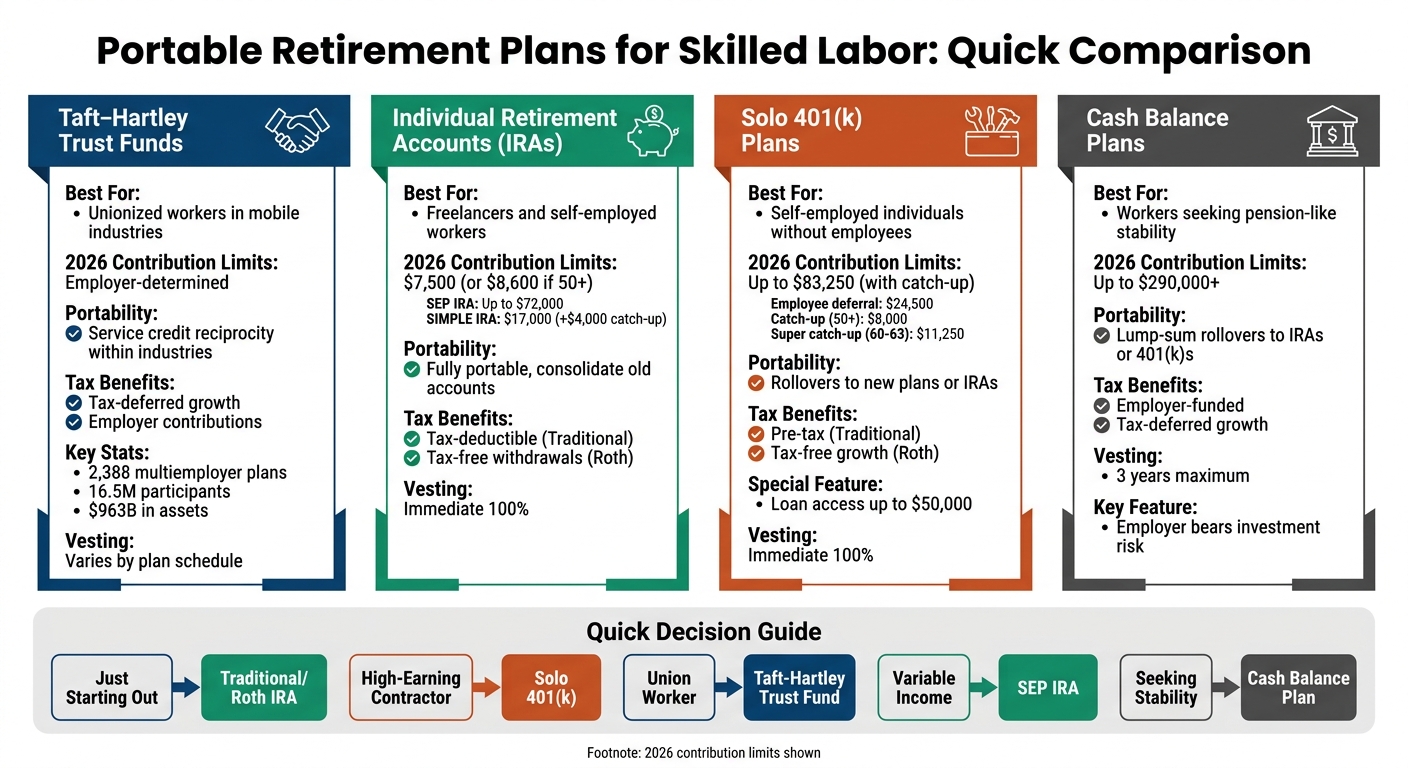
Portable Retirement Plans Comparison for Skilled Workers
1. Taft-Hartley Trust Funds
Taft-Hartley Trust Funds are designed for workers in industries where job changes and mobility are common. These multiemployer retirement plans are established through collective bargaining agreements between unions and employers. They are particularly prevalent in industries like construction, trucking, and trade unions – fields where workers frequently move between employers. As of 2023, the U.S. has around 2,388 multiemployer pension plans, covering over 16.5 million participants and managing roughly $963 billion in assets.
One of the standout features of these plans is their portability. If you switch jobs within the same plan, all your service credits and benefits carry over seamlessly, ensuring uninterrupted retirement savings. This is a key difference from traditional single-employer plans, where changing jobs often means starting over with new benefits. These plans cater perfectly to the needs of mobile workers, offering a practical solution for retirement savings.
"A defining characteristic of these multiemployer benefit funds is their ability to serve workers in industries marked by employment mobility, such as construction, trucking, and trade unions."
Portability
With Taft-Hartley plans, your retirement benefits move with you, requiring no additional paperwork. Reciprocity agreements even allow service credits to be merged across different regions. For instance, a construction worker relocating to another state can combine their service credits through these agreements.
"Reciprocity agreements negotiated between multiemployer plans in different geographic locations allow employees covered under their home plan to temporarily work in the jurisdiction of another multiemployer plan and still receive credit for that work."
Contribution Flexibility
Employer contributions to Taft-Hartley plans are determined through collective bargaining and are typically based on a fixed dollar amount per hour worked. This ensures steady growth in your retirement account, no matter which participating employer you work for.
By mid-2025, 44% of these plans are expected to include a 401(k) salary-deferral feature, up from 40% in 2024. Additionally, nearly 30% now offer Roth contributions, reflecting a 21% increase from the previous year. These options provide workers with more ways to save for retirement while maintaining flexibility.
Vesting Periods
Service time accumulates across all participating employers, making it easier for workers to achieve full vesting. Employee contributions are immediately vested, while employer contributions follow the plan’s vesting schedule. Once fully vested, your retirement benefit is calculated based on a fixed dollar amount per month multiplied by your total years of credited service.
Tax Implications
Taft-Hartley plans offer several tax advantages. Employer contributions are tax-deductible and grow tax-deferred until retirement. Salary-deferral contributions are made pre-tax, which helps lower your current taxable income. When it’s time to retire, benefits are either tax-free or tax-deferred. Additionally, you can roll over the defined contribution portion of your account into an IRA or another qualified plan to avoid immediate taxes or penalties.
"Taft-Hartley plans… offer tax-free benefits to those enrolled, as well as tax-deductible employer contributions."
- Rachel Cautero, Financial Writer, SmartAsset
These tax benefits make Taft-Hartley plans an essential resource for workers in industries with high mobility, helping them secure their financial future.
sbb-itb-aa28329
2. Individual Retirement Accounts (IRAs)
Individual Retirement Accounts (IRAs) are personal retirement savings plans that stay with you, no matter where life takes you. This makes them especially appealing for skilled workers who frequently change jobs, industries, or even states. Unlike employer-sponsored plans, IRAs are entirely portable, allowing you to consolidate multiple accounts from former employers into one IRA. This not only simplifies account management but can also help reduce fees. Their portability aligns well with other flexible retirement options, ensuring your savings remain on track despite career changes.
For self-employed individuals, SEP and SIMPLE IRAs provide the opportunity to make substantial contributions from varying income streams. Starting in 2026, the annual contribution limit for Traditional and Roth IRAs will be $7,500 – or $8,600 if you’re 50 or older. SEP IRAs allow contributions up to $72,000 or 25% of your compensation, while SIMPLE IRAs permit $17,000 in contributions, with an additional $4,000 catch-up for those aged 50 and above.
Portability
Like Taft-Hartley plans, IRAs remain yours regardless of employer changes, ensuring your retirement savings continue uninterrupted. When leaving a job, you can roll over funds from employer-sponsored accounts, such as a 401(k), into an IRA. A direct trustee-to-trustee transfer ensures the funds move between financial institutions without you ever having to handle the money yourself. By 2026, more financial institutions are expected to offer automated rollover tools and fee analyzers, making it easier and more cost-effective to transfer small balances from old employer plans into IRAs.
Contribution Flexibility
IRAs are well-suited to the unpredictable income patterns often experienced by skilled workers. You can contribute smaller amounts or adjust your contributions based on your earnings. Unlike some workplace retirement plans, Traditional and Roth IRAs don’t require a fixed contribution schedule, giving you the freedom to contribute at your own pace. For high-earning contractors, SEP IRAs stand out because they allow for larger contributions during profitable years and the option to skip contributions during slower periods.
"Consistency beats optimization. A slightly ‘less perfect’ account that you fund every month will outperform an ideal plan you never quite get around to using." – Renee Johnson, Editor-in-Chief, Self Employed
Vesting Periods
With IRAs, all contributions vest immediately. There are no waiting periods or service requirements. If you roll over funds from an employer-sponsored plan, your personal contributions are fully vested and portable right away.
Tax Implications
IRAs come with distinct tax advantages depending on the type:
- Traditional IRAs: Contributions are tax-deductible, reducing your taxable income for the year. However, distributions in retirement are taxed as ordinary income.
- Roth IRAs: Contributions are made with after-tax dollars, offering no immediate deduction, but qualified withdrawals during retirement are completely tax-free.
- SEP IRAs: These allow self-employed individuals to contribute up to 25% of their income with immediate tax deductions, which can help ease the tax burden during high-earning years.
Keep in mind that early withdrawals before age 59½ generally incur a 10% penalty in addition to income tax, though certain exceptions apply. With their tax benefits, immediate vesting, and unmatched flexibility, IRAs are a strong, portable choice for skilled workers looking to secure their financial future.
3. Portable 401(k) Plans
Portable 401(k) plans, especially Solo 401(k)s designed for independent contractors, offer a practical way for skilled workers to maintain and grow their retirement savings, even when they frequently switch employers or move into self-employment. Unlike traditional 401(k)s tied to a specific employer, portable 401(k)s are linked to your personal business, making them a great fit for 1099 workers in industries like construction and energy, where project-based work is common.
Portability
When leaving a job with a traditional 401(k), you have the option to transfer your balance directly to a new employer’s plan or consolidate it into a Solo 401(k) using a trustee-to-trustee transfer. This approach avoids the 20% mandatory tax withholding that applies if the funds are sent directly to you. Consolidating multiple small accounts into one portable 401(k) can reduce fees and simplify account management. Another advantage is that funds within a 401(k) structure benefit from strong federal ERISA-level creditor protection, which is often more robust than the protections offered by IRAs that depend on state laws.
Contribution Flexibility
Solo 401(k)s are highly adaptable, allowing contributions as both an employee and an employer. This setup enables you to maximize savings during high-earning years while scaling back contributions when income fluctuates. For 2026, employee deferrals can reach $24,500, with employer contributions adding up to 25% of compensation, for a combined total of up to $72,000. Additionally, those over 50 can make catch-up contributions of $8,000, and individuals aged 60–63 have access to a "super-catch-up" option of $11,250. Employer contributions can be made up until the tax filing deadline, typically April 15, giving you the flexibility to assess your annual income before deciding how much to contribute.
"A solo 401(k) lets you ramp up your contributions in profitable years and scale back if your income takes a dip." – Kyle McBrien, CFP®, Betterment
Vesting Periods
Solo 401(k) plans offer immediate 100% vesting for all contributions, eliminating the need for any waiting period.
Tax Implications
Portable 401(k)s provide tax advantages tailored to your financial situation. Traditional (pre-tax) contributions help lower taxable income during high-earning years, while Roth contributions – made with after-tax dollars – allow for tax-free growth and withdrawals in retirement. Starting in 2026, the SECURE 2.0 Act introduces the option to designate employer profit-sharing contributions as Roth contributions, enabling you to pay taxes upfront for tax-free growth later. Withdrawals without penalties can begin at age 59½, though early withdrawals typically incur a 10% penalty and ordinary income taxes. Unlike IRAs, many Solo 401(k) plans allow you to borrow up to 50% of your account value (up to $50,000) for immediate needs. This borrowing option sets portable 401(k)s apart from other retirement savings tools, paving the way for comparisons with Defined Contribution Cash Balance Plans.
4. Defined Contribution Cash Balance Plans
Defined contribution cash balance plans combine elements of traditional pensions with the flexibility modern workers often need. These plans are categorized as benefit plans but present retirement savings as a hypothetical account balance rather than a future monthly pension payout. This approach simplifies understanding and makes portability more accessible.
Portability
One of the standout features of cash balance plans is their portability. When you leave an employer, you can take your fully vested balance as a lump sum and roll it into an IRA or your new employer’s 401(k). This flexibility sets cash balance plans apart from traditional pensions, which typically require funds to stay in the plan until retirement. Federal law ensures that benefits in cash balance plans become fully vested after no more than three years of service. To preserve tax-deferred status and avoid a 10% early withdrawal penalty, it’s crucial to use a direct trustee-to-trustee rollover when moving your funds.
"Cash balance plans are better suited to a mobile workforce because employees accrue more substantial benefits earlier in their careers and can take their cash balance plan with them as they move from job to job." – U.S. Department of the Treasury
Contribution Flexibility
While cash balance plans offer many benefits, they come with strict annual funding requirements. Employers must contribute the full actuarially calculated amount each year, with no option to defer payments during tough financial periods. Typically, the contribution is a percentage of employee compensation – often ranging from 5% to 8% – plus an interest credit. Even if a company experiences a dip in revenue, the employer is still obligated to meet the funding requirement. This rigid structure makes cash balance plans more suitable for businesses with steady income streams rather than those with fluctuating revenue.
"The IRS requires that you make the full actuarially calculated contribution each year… You cannot skip contributions to conserve cash." – Kenneth Dennis, CEO, Uncle Kam
Tax Implications
Contributions to cash balance plans are entirely funded by employers and are tax-deductible for the business. For employees, the credited amounts grow tax-deferred until they take a distribution. When leaving a job or retiring, you can roll over your account balance into an IRA or a new employer’s 401(k) without triggering taxes, allowing the funds to retain their tax-deferred status. For 2026, the IRS maximum annual defined benefit limit is $290,000, which allows for much larger pre-tax contributions compared to traditional 401(k) plans. This is particularly advantageous for older workers aiming to boost their retirement savings. Additionally, since the employer assumes all investment risk, your account grows by the promised interest credit regardless of market conditions. This feature makes cash balance plans an attractive option for workers seeking reliable, tax-advantaged retirement savings while navigating career changes.
Advantages and Disadvantages
When evaluating retirement plan options, it’s essential to weigh their advantages and disadvantages. This comparison highlights the unique trade-offs of each portable retirement option, helping skilled, mobile workers make informed decisions – especially those frequently changing jobs.
Taft-Hartley Trust Funds
These funds are designed with portability in mind, making them ideal for mobile union workers. They pool resources across 1,400 multiemployer plans, covering about 10 million participants. This pooling helps reduce costs. However, they come with risks, particularly during industry downturns when retiree withdrawals may exceed contributions. While the Pension Benefit Guaranty Corporation (PBGC) offers a safety net, its coverage is capped and may not fully replace promised benefits.
Individual Retirement Accounts (IRAs)
IRAs offer complete control over investments and remain with you no matter where you work. You can open one at almost any financial institution and take it with you throughout your career. The downside? Contribution limits are lower compared to employer-sponsored plans, and there’s no employer match to boost your savings.
Portable 401(k) Plans (Solo 401(k)s)
Solo 401(k) plans are an excellent choice for self-employed workers, offering high contribution limits – up to $83,250 in 2026, including catch-up contributions. They also allow loans of up to $50,000 and provide Roth options for tax diversification. However, these plans are only available to business owners with no employees (except a spouse), and they come with moderate administrative tasks, such as filing IRS Form 5500 once assets exceed $250,000.
Defined Contribution Cash Balance Plans
Cash balance plans stand out for their stability, as they guarantee specific interest credits regardless of market conditions. Employers bear the investment risk, and contribution limits can go beyond $290,000 for older workers. On the flip side, employers must make annual contributions, even during tough times, and there’s a three-year vesting period for workers. Additionally, these plans come with high startup costs (around $2,000–$3,000) and ongoing expenses (approximately $3,000 annually).
Here’s a quick summary of the pros and cons:
| Plan Type | Advantages | Disadvantages |
|---|---|---|
| Taft-Hartley Trust Funds | – Portability across employers in the same industry – Pooled resources lower costs – PBGC safety net |
– Underfunding risks during industry downturns – Vesting periods required – PBGC caps may not cover full benefits |
| Individual IRAs | – Complete portability and investment control – No employer required – Simple setup |
– Lower contribution limits – No employer match – Entirely self-funded |
| Portable 401(k) Plans | – High contribution limits (up to $83,250 in 2026) – Loan access up to $50,000 – Roth options available |
– IRS Form 5500 filing required once assets exceed $250k – Only available to self-employed without employees – Moderate administrative requirements |
| Cash Balance Plans | – Employer bears the investment risk – Guaranteed interest credits – Very high contribution limits (up to $290k+) |
– Mandatory annual employer funding – Three-year vesting period – High startup (~$2,000–$3,000) and ongoing (~$3,000 annual) costs |
How ABLEMKR Supports Worker Financial Stability

ABLEMKR plays a key role in helping skilled workers maintain financial stability, especially when it comes to retirement planning. For workers frequently shifting between industries like construction, energy, oil & gas, mining, and utilities, income consistency is often a challenge. ABLEMKR addresses this by connecting pre-vetted workers to critical projects using its mobile-first platform. By matching workers based on certifications, availability, and location, the platform ensures steady job opportunities in major U.S. cities and energy hubs.
A reliable income stream is essential for building a solid retirement plan, and ABLEMKR enhances this stability with streamlined payroll processes. Integrated workflows ensure on-time payments, making it easier for workers to set up automatic contributions to retirement accounts like Solo 401(k)s or IRAs. With consistent paychecks, workers can align their contributions with each payment cycle, creating a "set-it-and-forget-it" system that keeps their retirement savings on track.
The platform also simplifies managing portable benefits, ensuring workers retain their retirement savings plans as they move between jobs. Features like real-time worker status updates and built-in compliance tracking reduce administrative headaches, such as meeting the "no employees" rule required for Solo 401(k) eligibility. This seamless approach allows workers to focus on maximizing their retirement savings without worrying about complex administrative requirements.
ABLEMKR’s support becomes even more valuable when considering the increased retirement contribution limits for 2026. Workers can defer up to $24,500 in salary into 401(k) plans, with a total combined contribution limit of $72,000. For those aged 50–59, an additional $8,000 in catch-up contributions is allowed, while workers aged 60–63 qualify for a super-catch-up contribution of $11,250. With stable income, workers can meet these higher limits and take full advantage of their retirement plans.
Beyond payroll, ABLEMKR strengthens financial stability through its workforce management tools. By offering access to flexible, well-paying jobs across various sectors, workers can navigate economic ups and downs more effectively. This steady employment not only supports immediate financial needs but also ensures long-term growth in retirement savings.
Conclusion
Selecting the best retirement plan depends heavily on your work style and your income level. For unionized workers in industries like construction and energy, Taft-Hartley Trust Funds provide a seamless solution with built-in portability across multiple employers within the same field. These plans cater to skilled, mobile workers and now often include salary-deferral features, giving members more control over their savings.
For high-earning independent contractors with no employees, Solo 401(k) plans offer a standout option. These plans allow you to contribute as both an employer and employee, maximizing tax-advantaged savings. Workers between 60 and 63 can also benefit from additional catch-up contributions to boost their retirement funds.
If your income fluctuates due to project-based work, SEP IRAs are a flexible choice, enabling larger contributions during high-earning years. On the other hand, Traditional and Roth IRAs are ideal for those just starting out with retirement planning, offering simplicity and manageable contribution limits.
Portability is key for workers in fields like construction, energy, oil & gas, mining, and utilities, where changing employers is common. Consolidating small 401(k) balances into a single IRA through trustee-to-trustee transfers can help minimize fees and avoid unnecessary taxes.
Regular contributions are more impactful than sporadic, optimized ones. As Renee Johnson, Editor-in-Chief at Self Employed, wisely points out:
"Consistency beats optimization. A slightly ‘less perfect’ account that you fund every month will outperform an ideal plan you never quite get around to using".
With steady income from platforms like ABLEMKR and the right portable retirement plan, skilled workers can build robust savings, no matter how often they switch jobs or industries.
FAQs
Which portable retirement plan fits my work setup?
For workers who often switch states or industries, portable retirement plans offer much-needed flexibility and consistency. Options such as solo 401(k)s or SEP IRAs work particularly well for self-employed individuals. These plans come with higher contribution limits and tax perks, making them attractive choices.
On top of that, newer platforms tailored for today’s flexible workforce make it easier to manage retirement savings across multiple jobs. This means mobile workers can grow and maintain their savings without dealing with complicated rollovers.
How do I roll over an old 401(k) without taxes?
When rolling over an old 401(k), the best way to avoid taxes is by opting for a direct rollover. This means the funds are transferred directly from your old account to a new qualified retirement account, such as an IRA or another 401(k). By keeping the transfer between providers, you can sidestep triggering a taxable event.
However, if you receive the funds yourself, the clock starts ticking. You’ll have just 60 days to complete the rollover into a qualified account. Miss that deadline, and you could face taxes and potential penalties.
To stay on the safe side, it’s always a good idea to consult with your plan administrator or a financial advisor. They can help ensure you’re following all IRS rules and making the best choices for your financial future.
What should I know about vesting if I change jobs a lot?
Understanding vesting is crucial if you tend to change jobs often – it can help safeguard your retirement savings. The money you contribute to your 401(k) is always yours, no strings attached. However, employer contributions may come with a vesting schedule. If you leave your job before you’re fully vested, you could lose part or all of those employer-contributed funds. To make the most of your retirement benefits when transitioning between jobs, check your current vesting status and familiarize yourself with the vesting rules of your new employer’s plan.


