
Energy sites pose serious respiratory risks, especially from hazards like hydrogen sulfide (H₂S), hydrocarbon vapors, and oxygen-deficient atmospheres. OSHA Standard 1910.134 mandates specific steps to protect workers. Here’s a quick rundown of what you need to know:
- Hazard Assessment: Identify and monitor respiratory risks like H₂S (limit: 20 ppm ceiling, 50 ppm max for 10 minutes) and oxygen levels below 19.5%.
- Written Program: Develop a site-specific respiratory protection plan. Include hazard analysis, respirator selection, and maintenance protocols.
- Medical Evaluations: Ensure employees are medically cleared before using respirators. Reevaluate when conditions change.
- Fit Testing: Perform annual fit tests and document results for each employee.
- Proper Use & Maintenance: Train workers to conduct seal checks and maintain respirators. Ensure proper cleaning and storage.
- Training & Recordkeeping: Provide annual training, update programs as needed, and keep detailed records to avoid costly fines.
Failure to comply can lead to penalties of up to $165,514 per violation. Use tools like ABLEMKR to streamline compliance and protect your team.
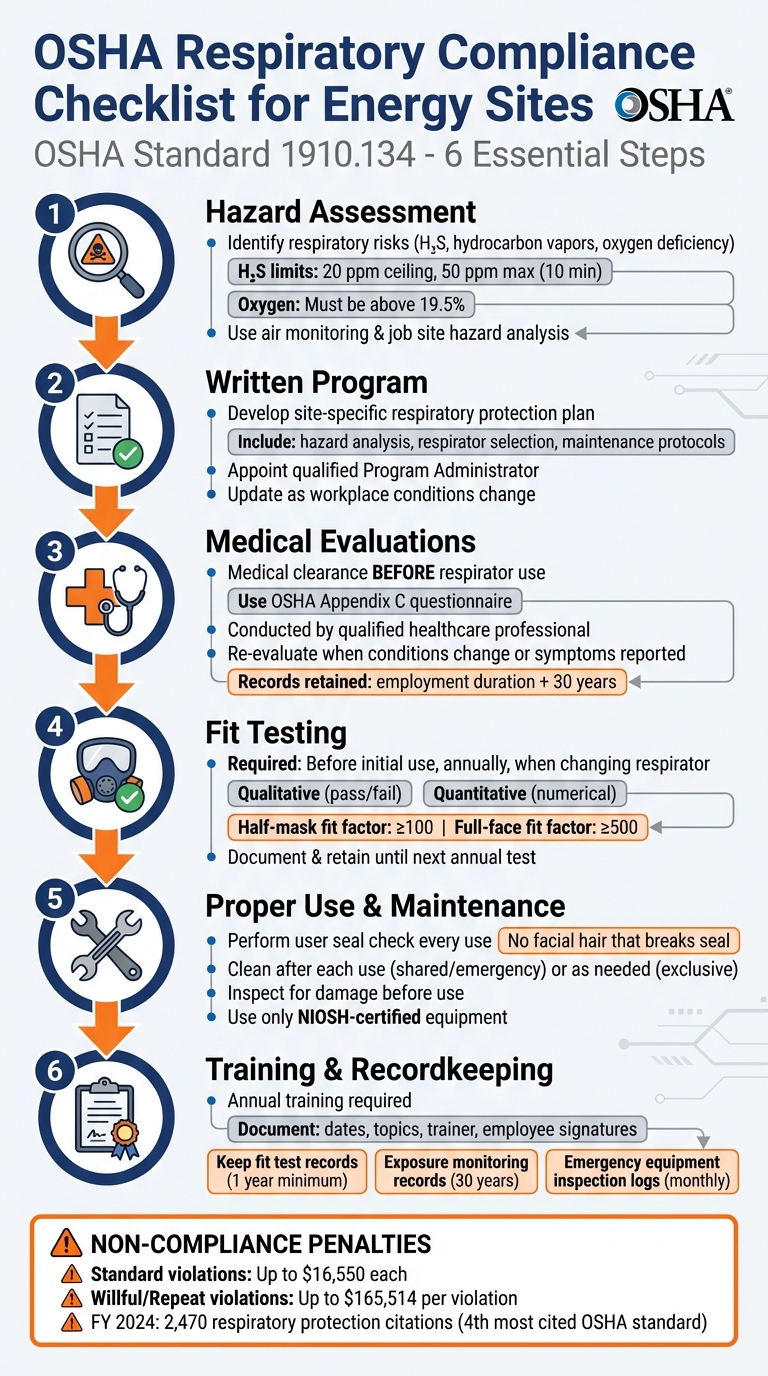
OSHA Respiratory Compliance 6-Step Checklist for Energy Sites
Hazard Assessment Checklist
Common Respiratory Hazards in Energy Sites
Energy sites are home to a variety of respiratory risks. One of the most dangerous threats is hydrogen sulfide (H₂S), particularly during activities like tank gauging or opening tank hatches on oil fields. From 2011 to 2020, the Bureau of Labor Statistics recorded 134 fatalities in the oil and gas extraction industry due to such hazards.
Another major concern is hydrocarbon gases and vapors (HGVs), which often arise during manual tank sampling. These vapors can displace oxygen in confined spaces, leading to oxygen-deficient environments. During hydraulic fracturing operations, crystalline silica becomes a notable risk, while diesel exhaust from heavy machinery can affect workers across various areas of energy sites.
"Half-mask, full-face, and powered air-purifying systems with organic vapor cartridges will NOT protect workers from exposure to HGVs and oxygen-deficient atmospheres." – Texas Department of Insurance
Identifying these hazards is a critical step before performing a detailed job site hazard analysis.
Conducting a Job Site Hazard Analysis
A thorough hazard analysis is crucial for meeting OSHA’s respiratory protection standards. Start by evaluating exposure levels for every task where respiratory hazards are present. Use periodic testing data to ensure accurate exposure assessments. For high-risk tasks, like gauging sour crude oil tanks, conduct air monitoring before each operation – unless H₂S concentrations are proven to stay below permissible exposure limits.
In the absence of air monitoring, assume the atmosphere is immediately dangerous to life or health (IDLH), and require the use of self-contained breathing apparatus (SCBA) or supplied-air respirators with escape capabilities. Document all findings using standardized tools such as the NIOSH "Rig Check" forms, which include 35 inspection points. Additionally, maintain Safety Data Sheets and perform walkthrough inspections to uncover potential hazards.
| Hazard Type | Common Source | Detection Method |
|---|---|---|
| Hydrogen Sulfide (H₂S) | Tank hatches, sour crude oil | Air monitoring, personal alarms |
| Hydrocarbon Vapors | Tank sampling | Exposure assessments, remote gauging |
| Oxygen Deficiency | Confined spaces, open hatches | Atmospheric testing, oxygen sensors |
| Crystalline Silica | Fracking sand, drilling | Job hazard analysis, dust monitoring |
| Diesel Exhaust | Rig engines, heavy machinery | Visual inspection, ventilation checks |
This analysis is the cornerstone for building effective respiratory protection strategies.
sbb-itb-aa28329
Respiratory Protection Safety Training
Written Respiratory Protection Program Requirements
After conducting thorough hazard assessments, creating a written, site-specific respiratory protection program is essential to address the unique risks of your worksite. OSHA standard 1910.134 mandates that energy site employers develop a program tailored to their specific conditions. A one-size-fits-all template won’t cut it. The program must detail procedures for selecting, using, and maintaining respirators based on hazards like H₂S exposure or silica dust from fracking operations.
"A compliant program comprises several elements and requires diligent recordkeeping and active oversight. It all starts with a written plan specific to your worksite." – Ready Response LLC
Employers are required to appoint a Program Administrator who has the necessary training or experience to handle the complexity of respiratory hazards at the site. This individual oversees the program, evaluates its effectiveness, and ensures that critical elements – such as fit testing and medical evaluations – are completed as required. These foundational steps set the stage for assigning clear responsibilities, discussed further below.
Roles and Responsibilities
Accountability is key, and it starts with clearly defining roles. The Program Administrator is responsible for developing, implementing, and periodically evaluating the respiratory protection program. Supervisors play their part by ensuring daily compliance – making sure employees wear respirators when needed and attend mandatory training sessions. Employees, on their end, must:
- Attend training sessions.
- Participate in fit testing.
- Perform seal checks before each use.
- Properly maintain their assigned respirators.
"The program shall be updated as necessary to reflect those changes in workplace conditions that affect respirator use." – Occupational Safety and Health Administration (OSHA)
Document these responsibilities in the written program. When roles are clearly outlined, compliance becomes a routine part of operations instead of an afterthought. Explicit documentation also ensures employees can easily access and understand their responsibilities.
Documentation and Accessibility
Keep the respiratory protection program accessible – whether it’s stored in a digital safety portal or as a physical binder in a central location – and update it promptly as worksite conditions change. While OSHA requires updates "as necessary", conducting a formal review at least once a year is a good practice and aligns with other safety program inspections. If there’s a change in the Physician or Other Licensed Health Care Professional overseeing the program, provide them with the most current version of the plan.
Making the program easily accessible and regularly updated ensures that everyone stays on the same page, reinforcing safety and compliance across the site.
Respirator Selection and NIOSH Certification
Following OSHA Standard 1910.134, selecting and certifying the right respirator is crucial for ensuring effective respiratory protection. The process starts by identifying workplace hazards and matching them with appropriate protection levels. For example, energy sites may expose workers to dust from drilling, welding fumes, or gases like hydrogen sulfide during oil and gas extraction.
"The employer shall select and provide an appropriate respirator based on the respiratory hazard(s) to which the worker is exposed and workplace and user factors that affect respirator performance and reliability." – Occupational Safety and Health Administration
In environments where oxygen levels drop below 19.5%, atmosphere-supplying respirators are mandatory, as air-purifying respirators won’t suffice. For Immediately Dangerous to Life or Health (IDLH) conditions, a full-facepiece pressure-demand SCBA with at least 30 minutes of service life is required. Respirator selection also depends on Assigned Protection Factors (APFs). For instance, a half-mask air-purifying respirator offers an APF of 10, while a full-facepiece SCBA provides an APF of up to 10,000. To ensure adequate protection, calculate the Maximum Use Concentration by multiplying the APF by the permissible exposure limit. This step confirms compliance with OSHA standards.
Selecting the Right Respirator
To select the correct respirator, match the type to the specific hazard – whether it’s dust, fumes, or gases – and account for workplace and user-specific factors. For example:
- Dust or metal fumes: Use an atmosphere-supplying or air-purifying respirator with a NIOSH-certified HEPA filter (N100, R100, or P100).
- Gases and vapors: Opt for an air-purifying respirator with a NIOSH-certified End-of-Service-Life Indicator (ESLI) or establish a cartridge change schedule based on reliable data.
Additionally, consider factors like physical exertion, temperature extremes, humidity, duration of use, and compatibility with other personal protective equipment. With an estimated 5.0 million workers in the U.S. relying on respirators either occasionally or regularly, proper selection is critical. Once you’ve chosen the appropriate respirator, confirm its compliance by ensuring it carries NIOSH certification.
Verifying NIOSH Certification
After selecting a respirator, verifying its NIOSH certification is essential. Every respirator must be NIOSH-certified and used according to the conditions outlined on its label. Check the respirator or its packaging to confirm it’s approved for the contaminants at your site. The NIOSH Trusted-Source Information Page is a helpful tool for identifying approved models, finding authorized sellers, and accessing a full list of certified respirators.
"Selection of the wrong equipment, one of the most frequent errors made in respiratory protection, can result in the employee being exposed to increased concentrations of the harmful contaminant." – OSHA Technical Manual
Regularly review updates on the NIOSH website and ensure only NIOSH-approved parts and accessories are used. Using non-approved components voids the certification and compromises worker safety. For instance, HEPA filters must achieve at least 99.97% efficiency in removing particles as small as 0.3 micrometers in diameter.
Medical Evaluations and Fit Testing
Before using a respirator, employees must complete both a medical evaluation and a fit test. These steps are mandatory and must occur in the correct order. In fiscal year 2024, skipping or reversing these steps was a frequent issue, leading to 508 citations for respiratory protection violations.
Medical Evaluation Checklist
The medical evaluation determines whether an employee can safely wear a respirator, as it increases breathing resistance and physiological stress. Employees with conditions such as heart disease, asthma, emphysema, or claustrophobia face higher risks.
"Wearing a respirator increases breathing resistance and physiological stress. Employees with certain medical conditions – such as heart disease, lung conditions, or claustrophobia – may experience serious health consequences when using respiratory protection." – RespiratorTest Team
This evaluation must be conducted by a qualified healthcare professional using OSHA’s mandatory questionnaire (Appendix C) or an equivalent exam. The questionnaire screens for cardiovascular and respiratory conditions, as well as claustrophobia. Employers are required to obtain a written recommendation that outlines any limitations on respirator use and confirms the employee has received a copy. These medical records must be kept for the duration of the employee’s time with the company, plus an additional 30 years.
Re-evaluations are also necessary under certain conditions, such as when employees report symptoms linked to respirator use, when supervisors notice significant physical changes (e.g., weight fluctuations of 20 pounds or more, or facial scarring), or when workplace stress increases. For example, in 2024, a construction company faced $127,000 in OSHA fines for failing to provide medical evaluations and fit testing for 14 employees over three months.
Once medical clearance is complete, the next step is fit testing to ensure the respirator provides an effective seal.
Fit Testing Procedures
After medical clearance, fit testing is required to confirm a proper seal between the respirator and the employee’s face. OSHA mandates fit testing under the following circumstances: before the initial use of a respirator, when switching to a different respirator (size, style, model, or make), and at least once per year. Importantly, employees must be tested with the same respirator they will use on the job.
There are two types of fit testing:
- Qualitative Fit Testing (QLFT): A pass/fail method that relies on the worker’s ability to detect a test agent (like a bitter or sweet aerosol). This method is only allowed for negative pressure air-purifying respirators with a fit factor requirement of 100 or less.
- Quantitative Fit Testing (QNFT): This method uses specialized equipment to measure leakage numerically. To pass, half facepieces must achieve a fit factor of 100 or higher, while full facepieces require a fit factor of at least 500.
Employers must document each fit test, including the employee’s name, the type of test (QLFT or QNFT), the date, respirator details, and the test results. These records must be retained until the next annual fit test. If a respirator fails to provide a proper fit, an alternative facepiece should be assigned, and the employee must be retested. Additionally, workers should perform a user seal check every time they wear the respirator to ensure the seal remains intact.
Respirator Use, Maintenance, and Storage
After employees complete medical evaluations and fit testing, the next step is ensuring respirators are used properly and kept in safe working condition. With millions of U.S. workers depending on respirators, maintaining their functionality is key to safety on energy sites. Below, we’ll cover the essential practices for proper use, maintenance, and storage to meet safety standards and protect workers.
Proper Use Guidelines for Energy Sites
Every time a respirator is worn, employees must perform a user seal check following OSHA or manufacturer guidelines. Workers with facial hair or anything else that disrupts the seal between the face and the respirator should avoid using such equipment. Additionally, make sure other personal protective gear doesn’t interfere with the respirator’s seal. Always use NIOSH-certified respirators and components on-site.
For environments immediately dangerous to life or health (IDLH) – like confined spaces with oxygen levels below 19.5% by volume – specific safety measures must be in place. These include protocols such as the "2-in/2-out" rule and having standby personnel equipped for rescue. When using air-purifying respirators for gases or vapors, employers should establish a cartridge or canister replacement schedule using objective data, especially if the equipment doesn’t have an end-of-service-life indicator (ESLI).
Cleaning and Maintenance Procedures
Proper use is just one piece of the puzzle; regular cleaning ensures respirators remain effective. Follow OSHA Appendix B-2 or manufacturer guidelines for cleaning and disinfecting respirators. The cleaning schedule depends on how the respirator is used:
- Exclusive Use: Clean as often as needed to maintain hygiene.
- Shared Use: Clean before being used by a different person.
- Emergency Use: Clean after every use.
- Fit Testing/Training: Clean after each session.
Before each use, inspect respirators for issues like cracks, worn-out straps, or missing valves. Disposable filtering facepiece respirators (dust masks) are an exception – they cannot be cleaned or reused once contaminated. Employers must also provide clear, written maintenance instructions so all employees handle the equipment consistently and correctly.
"Respirators that are not maintained and inspected can be less effective at reducing exposure to the harmful contaminants, and can place a greater burden on the respiratory system." – OSHA Technical Manual
Storage Requirements
Proper storage plays a critical role in keeping respirators functional over time. Store them in a way that protects against damage, contamination, and environmental hazards. Ensure all filters, cartridges, and canisters have legible, NIOSH-approved labels. Emergency respirators need extra care – they must be cleaned and inspected after every use before returning to storage. Written, step-by-step storage procedures should be in place to ensure consistency, and program administrators should routinely review these practices to confirm they remain effective.
Training and Communication Requirements
Proper respirator use and maintenance are just the beginning. To ensure full compliance, training and clear communication play a critical role. According to 29 CFR 1910.134, training is a required component of a compliant respiratory protection program. Respiratory protection violations ranked as the fourth most cited OSHA standard, with 2,470 citations issued. Among these, the top issue was failing to conduct medical evaluations before respirator use, which accounted for 508 citations. Thorough training helps prevent such costly mistakes and ensures workplace safety compliance.
Employee Training Essentials
Employees must follow a specific sequence: first, they need to complete a medical evaluation and fit testing before using a respirator. Training should also help workers recognize common respiratory hazards at energy sites – such as dust, fumes, vapors, gases, and oxygen-deficient atmospheres. It’s equally important to identify the Program Administrator and explain how to access the site-specific respiratory protection program.
Key training points include:
- Annual fit testing requirements.
- Retraining protocols for changes in respirator type or significant physical changes (e.g., weight fluctuations, dental work, or facial scarring).
- OSHA Appendix D safety guidelines for voluntary use of filtering facepieces (dust masks).
Documenting all training sessions is critical. Incomplete records are a frequent source of citations during OSHA inspections. Proper recordkeeping not only supports compliance but also reinforces workplace safety.
Communicating Program Updates
The Program Administrator is responsible for updating the respiratory protection program whenever workplace conditions shift. These updates may involve new equipment, changes in work processes, or environmental adjustments. Automated systems can simplify tracking annual fit tests and evaluations, ensuring nothing falls through the cracks.
"The program shall be updated as necessary to reflect those changes in workplace conditions that affect respirator use." – Occupational Safety and Health Administration
Digital tools also help centralize training records, making them easily accessible during inspections. If an employee experiences symptoms linked to respirator use or a supervisor identifies a concern, an immediate medical evaluation should be arranged. Proactive and timely communication ensures workers remain protected, keeps the workplace audit-ready, and upholds OSHA standards.
Program Evaluation and Recordkeeping
Evaluating Program Effectiveness
To ensure a respiratory protection program runs smoothly, the Program Administrator needs to regularly assess its effectiveness. This involves ongoing hazard assessments, reviewing the written program, and – most importantly – talking to employees. These conversations can uncover problems with respirator fit, equipment choices, or maintenance routines that might otherwise go unnoticed.
Annual reviews are a must, but re-evaluations should also happen whenever there are reports of symptoms or changes in workplace conditions. It’s critical to confirm that respirators are used as certified and that employees perform seal checks every time they wear one.
"Consult regularly with CSHOs [employees] required to use respirators to assess the CSHOs’ views on program effectiveness and to identify and correct any problems." – OSHA Instruction CPL 02-02-054
Maintaining Accurate Records
Sloppy recordkeeping isn’t just risky – it’s expensive. Violations can result in penalties of up to $165,514 for repeat or willful offenses. Employers are required to maintain detailed records, including:
- Medical clearance documentation: Keep these for every respirator user throughout their employment.
- Fit test records: Retain until the next annual test.
- Training logs: Include dates, topics covered, trainer names, and employee signatures.
For exposure monitoring, records must be kept for 30 years. Emergency equipment, like self-contained breathing apparatuses (SCBAs), also requires monthly inspection logs to document inspection dates and equipment status. Digital tracking tools can simplify this process, reducing compliance costs by as much as 70%. A centralized dashboard is particularly helpful for multi-site operations, ensuring consistent and audit-ready documentation.
| Record Type | Retention Requirement | Key Data to Include |
|---|---|---|
| Medical Clearance | Duration of employment | Written determination from PLHCP (no confidential medical details) |
| Fit Test Records | Until the next fit test (min. 1 year) | Employee name, test date, respirator make/model/size, and result |
| Training Records | Annual updates recommended | Date, topics, trainer name, and employee signature |
| Exposure Monitoring | 30 years (for specific substances) | Air sampling results and monitoring data |
| Emergency Equipment | Monthly inspection logs | Inspection date and condition of SCBAs or escape-only units |
Using ABLEMKR for Compliance Tracking

ABLEMKR offers digital tools designed to make OSHA respiratory compliance easier, covering everything from real-time monitoring to verifying worker credentials during onboarding.
Real-Time Compliance Monitoring
Keeping track of respiratory compliance across multiple energy sites can be overwhelming. ABLEMKR simplifies this with a centralized dashboard that provides employers with up-to-date information on worker certifications, such as medical evaluations and fit test results.
The platform sends real-time alerts when fit tests approach their 12-month expiration date. These notifications go out to both employers and workers, helping avoid the risks associated with expired certifications – risks that could lead to penalties or, worse, endanger worker safety.
For companies managing operations across several locations, ABLEMKR consolidates compliance data into one accessible hub. No more scrambling through paper records or spreadsheets from different sites. Safety managers can confirm that workers heading to a remote pipeline repair or scheduled shutdown have valid medical clearance and proper respirator training – all before they arrive on-site.
The tool also enhances the onboarding process, ensuring compliance is confirmed from the very beginning.
Simplified Onboarding and Documentation
Before deployment, ABLEMKR verifies key worker certifications, including medical evaluations and fit tests required under OSHA 1910.134(e). This prevents non-compliant assignments from happening in the first place.
The platform’s mobile-first design matches certified workers to job sites based on their training, availability, and location. For operators handling unexpected shutdowns or emergency repairs, this means compliant crews can be mobilized quickly without compromising on safety. Plus, all documentation is stored in one place, ready for audits and reducing administrative headaches.
Conclusion
Ensuring OSHA respiratory compliance on energy sites isn’t just about following the rules – it’s about protecting lives and avoiding hefty penalties. In fiscal year 2024, OSHA issued 2,470 citations for respiratory protection violations, making it the 4th most cited standard across all industries. For energy sector employers dealing with risks like hydrogen sulfide exposure during tank gauging or hazardous atmospheres in confined spaces, the stakes are even higher.
The financial consequences of non-compliance are steep. Serious violations can cost up to $16,550 each, while willful or repeated offenses can climb to $165,514 – and these fines multiply with every instance of non-compliance. For example, 20 incomplete medical evaluations could result in 20 separate violations. Beyond the fines, there’s the risk of workers’ compensation claims and potential wrongful death lawsuits, which can lead to even greater financial and legal exposure.
One of the most common compliance gaps lies in medical clearance protocols. Many employers fail to address this step before fit testing, leaving their programs vulnerable.
To tackle these challenges, digital compliance tools are proving invaluable. ABLEMKR’s platform simplifies the process by centralizing medical evaluations, fit test records, and training documentation. It also automates annual fit test reminders, ensuring compliance is maintained. For energy operators managing remote pipeline repairs or shutdowns across multiple sites, this means they can verify compliance before workers even step on-site – reducing paperwork and keeping safety front and center.
FAQs
When do we need SCBA instead of an air-purifying respirator?
SCBA is essential for environments classified as immediately dangerous to life and health (IDLH) or when working in such conditions for extended periods. Unlike air-purifying respirators, SCBA offers its own air supply, making it ideal for handling these high-risk scenarios.
What triggers a new medical evaluation or fit test before the annual date?
A new medical evaluation or fit test must be conducted if there’s a switch in the respirator model, a noticeable change in the employee’s physical condition, or at least once annually. These measures help ensure the respirator fits correctly and aligns with OSHA compliance requirements.
What records does OSHA ask for first during a respiratory program inspection?
OSHA usually begins by reviewing the medical evaluation to confirm that the employee is fit to use a respirator. After that, they examine the fit testing records to ensure the respirator creates an effective seal. These processes are key to ensuring adherence to OSHA’s respiratory protection standards.


