
Key Takeaways:
OSHA‘s 2025 updates introduce stricter safety regulations for construction workers, focusing on fall protection, heat hazard prevention, and properly fitting PPE. Employers must also address mental health and improve digital recordkeeping to avoid increased fines for non-compliance.
Highlights of the New Rules:
- Fall Protection: Stricter requirements for guardrails and tethering at lower heights (6-10 feet).
- PPE Fit Standards: Employers must ensure PPE fits all workers correctly, effective January 13, 2025.
- Heat Safety Plans: Mandatory hydration, shaded rest areas, and acclimatization protocols to prevent heat-related illnesses.
- Mental Health Focus: Suicide prevention and mental health awareness are now part of workplace safety standards.
- Digital Recordkeeping: Employers must maintain accurate, instant-access safety and compliance records.
Compliance Costs and Penalties:
- Fines: Serious violations exceed $16,500; willful or repeated violations can surpass $165,000.
- PPE Compliance Costs: Estimated $52 per worker for proper fit assessments.
Employers are encouraged to adopt digital tools like ABLEMKR to simplify compliance tracking, certification management, and incident reporting. These updates aim to improve worker safety while reducing workplace fatalities and injuries.
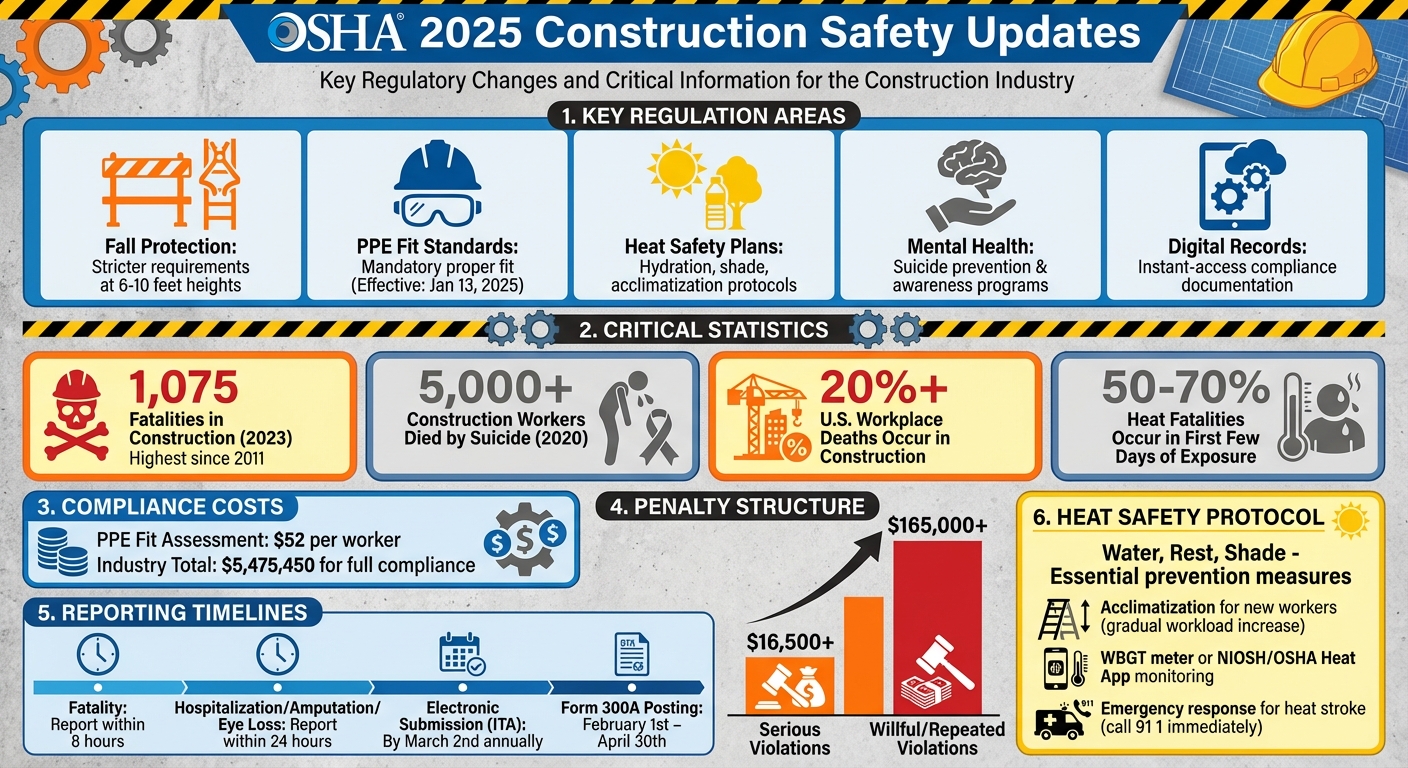
OSHA 2025 Construction Safety Updates: Key Requirements and Penalties
What Are the OSHA Construction Safety Standards for 2025? – Construction Jobs
Personal Protective Equipment (PPE) Updates
OSHA’s 2025 overhaul brings significant updates to PPE standards, aimed at closing safety gaps that have persisted for years. Starting January 13, 2025, the revised standard 29 CFR 1926.95(c) mandates that PPE must properly fit each worker. This marks a shift from the previously vague language to a clear, enforceable requirement. Notably, the construction industry, which recorded 1,075 fatalities in 2023 – the highest since 2011 – was the last major sector without this explicit rule.
Improperly fitting PPE poses serious risks. Doug Parker, Assistant Secretary for Occupational Safety and Health, emphasized the importance of proper fit, highlighting the support this update has received from both employers and unions. As a result, the new regulation calls for rigorous fit testing and careful PPE maintenance.
Required Fit Testing and Maintenance Protocols
Employers are now tasked with assessing their PPE inventory to ensure it includes a variety of sizes to suit all workers, particularly those with nonstandard body sizes. The average one-time cost per employee is estimated at $52, amounting to $5,475,450 for full compliance across the industry.
To ensure proper fit, employers should rely on manufacturer sizing charts, standards from organizations like the International Safety Equipment Association (ISEA), and OSHA’s enforcement guidelines. John Ho, Co-chair of the OSHA-Workplace Safety Practice at Cozen O’Connor, advises:
"Employers just need to review their practices for issuing PPE to make sure they document that the PPE is properly fitting, and potentially have employees sign off that the PPE is properly fitting".
Tracking and addressing worker complaints about fit is also crucial. Once the proper fit is confirmed, workers must be trained to maintain their PPE to ensure ongoing safety.
Updated Training Standards for PPE Use
Training now plays a critical role in ensuring PPE effectiveness. Workers must be taught how to identify poorly fitting gear and report issues promptly. This includes recognizing hazards like excess material that could snag on equipment or gaps that leave them unprotected. Matthew Cox, an attorney at Smith Currie Oles, explains:
"Loose gloves can get pulled by a machine, and hats with no chin straps can fall off".
Training should also cover regular PPE inspections and the importance of reporting damaged or ill-fitting equipment. Employers are responsible for making sure even employee-owned PPE meets safety standards and fits correctly. With penalties for serious violations reaching $16,131 per incident – and up to $161,323 for willful or repeated violations – maintaining thorough documentation and training records is not just recommended but essential.
Updated Reporting and Documentation Standards
OSHA’s 2025 updates bring stricter documentation rules, requiring immediate, digital record-keeping. This shift reflects OSHA’s transition from a reactive approach to a more proactive model that emphasizes real-time verification and continuous monitoring. Inspectors now expect instant digital access to training records, incident logs, and enforcement documents during site visits, eliminating the hassle of scrambling to compile weeks of paperwork.
Fines for serious violations now exceed $16,500, while willful or repeated violations can surpass $165,000. With construction accounting for over 20% of workplace deaths in the U.S., these enhanced documentation standards are vital – not just for avoiding penalties but for ensuring worker safety and business continuity. As the OSHA30Construction Group notes, "In today’s construction industry, compliance isn’t just about avoiding fines. It’s about building safer, more resilient businesses where documentation, prevention, and accountability are part of every job".
New Incident Reporting Processes
Employers must continue to report fatalities within 8 hours and hospitalizations, amputations, or eye losses within 24 hours. While these timelines haven’t changed, there’s now a stronger focus on conducting and documenting hazard analyses before beginning high-risk tasks. For example, before excavation or steel erection, crews must complete and document analyses to show risks have been identified and mitigated.
OSHA has also expanded the scope of reportable incidents. Beyond physical injuries, inspectors are now looking for evidence of mental health initiatives like suicide prevention talks and discussions about worker well-being. This change is driven by alarming statistics: in 2020, over 5,000 construction workers died by suicide, a number that surpasses traditional jobsite fatalities.
Additionally, establishments with 100 or more employees in high-hazard industries must electronically submit data from OSHA Form 300 (Log) and Form 301 (Incident Report) annually through the Injury Tracking Application (ITA) by March 2nd of the following year. OSHA states that "access to establishment-specific, case-specific injury and illness data will help the agency identify establishments with specific hazards… to address and abate the hazards and improve worker safety and health".
These changes emphasize the importance of robust digital record-keeping, which is further detailed below.
Record-Keeping Compliance for Employers
Alongside incident reporting updates, employers now face more stringent record-keeping requirements. Outdated systems won’t cut it anymore. Employers must retain OSHA Form 300 Logs, privacy case lists, Form 300A summaries, and Form 301 Incident Reports for five years. Additionally, Form 300A must be certified and posted in a visible location from February 1st to April 30th each year.
Digital documentation is no longer optional – it’s mandatory. In 2025, McInnis Construction avoided potential fines after a fall incident because their safety manager quickly provided comprehensive digital records, including the worker’s training history, toolbox talk attendance, and time-stamped meeting logs. The inspector credited the speed and completeness of their documentation for preventing a citation. As Heavy Construction Systems Specialists explains, "The 2025 regulatory climate leaves little room for outdated systems. OSHA expects employers to maintain organized, verifiable safety records and to demonstrate continuous improvement".
| Reporting Requirement | Timeline | Fine Amount |
|---|---|---|
| Work-related Fatality | Within 8 hours | Up to $16,500 (serious) |
| In-patient Hospitalization, Amputation, or Loss of an Eye | Within 24 hours | Up to $165,000 (willful/repeated) |
| Electronic Submission via ITA | By March 2nd annually | – |
| Posting Form 300A | February 1st – April 30th | – |
Digital records now serve as instant, verifiable evidence of ongoing safety compliance. This approach does more than meet regulatory requirements – it fosters a workplace culture where thorough documentation, proactive prevention, and accountability not only protect workers but also enhance your business’s reputation.
sbb-itb-aa28329
Heat Hazard Protections for Workers
OSHA’s "Heat Injury and Illness Prevention" rule is reshaping how construction employers protect workers from heat-related risks. This standard applies to all construction sites under OSHA’s jurisdiction, covering outdoor work like roofing and road construction, as well as indoor environments such as boiler rooms and areas near heat-producing machinery. The rule is currently progressing toward finalization.
Under the updated guidelines, employers must develop a formal written plan to assess and manage heat hazards specific to their workplace. Heat exposure risks aren’t limited to summer months – they can happen year-round, especially near heat-generating equipment or during physically demanding tasks. The standard considers both environmental heat (from weather) and metabolic heat (from physical exertion), acknowledging that construction work often amplifies the impact of external temperatures.
Prevention Plans for Heat-Related Risks
Each employer is now required to appoint a "responsible individual" – a foreman, supervisor, or safety director – to oversee site conditions and enforce the heat prevention plan throughout the workday. This individual must have the authority to adjust work schedules, increase rest breaks, or reduce physical demands when heat hazards are present.
Acclimatization plays a crucial role in preventing heat-related illnesses. OSHA data highlights that 50% to 70% of outdoor heat-related fatalities occur within the first few days of exposure to warm or hot environments, as the body hasn’t yet adapted. New workers or those returning after an extended absence (more than two weeks) must gradually increase their workload over the first week, with shorter shifts and frequent breaks to allow their bodies to adjust.
"Most outdoor fatalities, 50% to 70%, occur in the first few days of working in warm or hot environments because the body needs to build a tolerance to the heat gradually over time." – Occupational Safety and Health Administration
Prevention plans must also include "Water, Rest, Shade" protocols. This means ensuring workers have access to enough hydrating fluids (like water and sports drinks), regular breaks, and shaded or climate-controlled rest areas. To monitor environmental conditions accurately, employers are encouraged to use a WBGT (Wet Bulb Globe Temperature) meter, which factors in temperature, humidity, sunlight, and air movement. Alternatively, the NIOSH/OSHA Heat App can be used to calculate the heat index and provide workload recommendations. Employers also need to establish procedures for responding to National Weather Service heat advisories or warnings.
Incorporating these heat hazard protocols into a broader safety program is as essential as PPE or digital recordkeeping. Together, they form a comprehensive approach to worker safety.
Emergency Response Protocols for Heat Stress
While prevention is key, having clear emergency response protocols for heat-related illnesses is equally important. OSHA’s 2025 updates require employers to document detailed steps for getting medical help beyond basic first aid. Supervisors and workers must be trained to identify early signs of heat exhaustion and heat stroke and know how to act immediately.
Heat stroke is a medical emergency and can present symptoms like confusion, slurred speech, or unconsciousness. If a worker shows these signs, they should be moved to shade, cooled with water or ice, and 911 should be called immediately.
"Heat stroke is the most severe heat-related illness – cool the worker immediately and call 911!" – OSHA
For teams working in remote or distributed locations, the responsible individual must ensure there are clear methods for workers to report symptoms or unsafe conditions, enabling a swift emergency response. This is particularly critical for temporary or recently returned workers. Supervisors should also adjust work schedules as needed, such as scheduling physically demanding tasks during cooler morning hours or shortening shifts during extreme heat.
Managing Compliance with Workforce Platforms
Construction companies are under growing pressure to keep up with certifications, document safety protocols, and respond to OSHA inspections at a moment’s notice. Digital workforce platforms have stepped in to simplify this process, centralizing compliance data and automating tasks that used to be done manually.
Real-time verification is now a game-changer, ensuring that every worker meets OSHA standards before stepping foot on a jobsite. With penalties for noncompliance becoming stricter, this shift isn’t just about avoiding fines – it’s about saving lives. Construction accounts for over 20% of workplace deaths in the U.S., making precise compliance tracking both a legal requirement and a moral duty. These challenges highlight the growing need for digital tools that streamline compliance.
"Compliance is no longer just about avoiding penalties – it’s about protecting workers, maintaining productivity and building a reputation for safety that strengthens every aspect of the business." – Allyson Sherrier, Author, HCSS
Using ABLEMKR for Certification Tracking

Digital platforms like ABLEMKR offer a practical solution to these compliance challenges. With its certification tracking feature, safety managers can quickly verify worker credentials before deployment. The platform keeps detailed digital records, including OSHA training completions, PPE fit-test dates (a requirement under the updated 1926.95 standard effective January 13, 2025), and certifications for high-risk tasks like excavation or steel erection. When OSHA inspectors show up unannounced, employers can access comprehensive documentation in seconds, eliminating the hassle of digging through paper files.
In real-world scenarios, having instant access to time-stamped digital records has helped companies avoid fines by demonstrating full compliance.
ABLEMKR also tracks participation in mental health awareness programs, a growing focus for OSHA in 2025. In light of the alarming statistic that over 5,000 construction workers died by suicide in 2020, this feature is more critical than ever. Safety managers can log attendance at toolbox talks covering both emotional well-being and physical hazards, creating a complete safety record that aligns with OSHA’s broader definition of workplace safety.
Deploying Workers with ABLEMKR
ABLEMKR goes beyond compliance tracking by simplifying worker deployment. Its automated job matching system connects pre-vetted workers to job sites based on their certifications, training, availability, and location. For instance, if a project requires workers trained in heat hazard prevention, the platform ensures only those with the necessary training receive job notifications.
The platform’s mobile-first design provides real-time visibility into worker status, allowing project managers to confirm compliance before work begins. Field teams can use their devices to log inspections, document daily toolbox talks, and submit hazard analyses, creating time-stamped records that are securely stored and ready for audits. This eliminates documentation gaps that often lead to citations during surprise inspections.
For tasks with heightened risks – like working at heights between six and ten feet under OSHA’s updated fall protection thresholds – ABLEMKR allows supervisors to submit pre-work hazard analyses directly through the platform. These submissions include details on risk mitigation plans, reviewer approvals, and implemented safety measures. The system maintains a complete audit trail, reinforcing OSHA’s push for a proactive safety culture in 2025.
Conclusion and Key Takeaways
The 2025 OSHA updates mark a major turning point in how construction companies prioritize worker safety. From the January 13, 2025 PPE fit requirements to expanded protections against heat hazards and the integration of mental health considerations, these new regulations require immediate attention. With penalties for serious violations now exceeding $16,500 and willful violations topping $165,000, the financial and human costs of non-compliance are impossible to ignore. These updates build on earlier OSHA policies, emphasizing the need for quick and decisive action.
Action Steps for Employers
To stay ahead, employers should:
- Review PPE inventories to ensure proper fit for all workers.
- Transition from paper-based to digital systems for training records and hazard analyses.
- Develop written plans addressing heat prevention and mental health support.
- Incorporate mental health topics into toolbox talks to foster a more inclusive safety culture.
Digital compliance tools, like ABLEMKR, make these updates easier to manage. Platforms such as ABLEMKR simplify compliance by centralizing certification tracking, automating documentation, and connecting jobs with workers whose training is up-to-date. Having instant access to digital records can make the difference between a smooth audit and costly penalties.
Why Compliance Matters
Beyond avoiding fines, implementing these measures can bring real benefits to your business. Proactive safety strategies improve worker retention, boost productivity, and enhance your company’s reputation. For example, in October 2025, McInnis Construction avoided OSHA citations after a fall incident by immediately providing digital records of the worker’s complete training history – a process that could have taken weeks with paper-based systems.
"In today’s construction industry, compliance isn’t just about avoiding fines. It’s about building safer, more resilient businesses where documentation, prevention, and accountability are part of every job." – OSHA30Construction Group
With construction accounting for over 20% of workplace fatalities in the United States, these updates highlight the urgent need for a safety-first mindset. By adopting the 2025 OSHA guidelines now, you’re not just meeting regulatory requirements – you’re creating a culture of safety that protects lives and strengthens your business for the future.
FAQs
How will the updated 2025 PPE fit standards improve safety for construction workers?
The updated 2025 OSHA standards now mandate that personal protective equipment (PPE) must be tailored to fit each construction worker appropriately. This shift is designed to ensure that safety gear delivers its intended protection, reducing the chances of injuries caused by improper exposure.
By tackling long-standing fit challenges – particularly for smaller workers and women – these changes address key safety concerns. The result? Safer work environments and improved adherence to safety guidelines across job sites.
What does OSHA’s 2025 heat safety plan require for construction sites?
OSHA’s 2025 heat safety plan aims to safeguard workers from heat-related illnesses by mandating several critical safety practices for employers:
- Assess heat risks: Identify potential hazards and set specific temperature or heat index levels that require action.
- Monitor environmental conditions: Track factors like temperature or Wet Bulb Globe Temperature (WBGT) and implement measures such as shade, ventilation, and access to water stations.
- Develop work-rest schedules: Introduce structured breaks and acclimatization protocols to help workers adjust to heat exposure.
- Provide heat safety training: Educate employees on recognizing heat illness symptoms and responding to emergencies promptly.
- Ensure compliance and oversight: Keep detailed records and have supervisors actively enforce heat safety guidelines.
These measures are designed to create safer working environments, particularly in outdoor and physically demanding industries like construction, where heat exposure is a significant concern.
How does digital recordkeeping help construction workers comply with OSHA regulations?
Digital recordkeeping makes staying compliant much easier. It offers quick, organized access to critical safety documents like training records, hazard analyses, and incident logs. This means construction workers and contractors can easily show they’re meeting OSHA requirements during inspections, helping to avoid hefty fines.
With digital tools, contractors can keep records accurate and up-to-date, simplify reporting, and eliminate the hassle of dealing with piles of paperwork. This approach not only makes inspections less stressful but also boosts safety and efficiency across the job site.


