
The global energy workforce is changing fast. Renewable energy jobs are growing, but automation is slowing the pace of job creation despite record capacity additions. Meanwhile, oil and gas face job cuts due to falling prices, even as wages rise to retain skilled workers. Both sectors struggle with labor shortages, as over 60% of energy firms report hiring challenges. By 2035, two-thirds of new hires will replace retirees, with advanced economies hit hardest by aging workforces.
Key takeaways:
- Renewables: 16.6M jobs globally in 2024, led by solar PV (7.2M jobs). Growth slowed to 2.3% due to automation.
- Oil & Gas: Job cuts began in 2025, but wages rose 3.7% to retain talent. Employment remains volatile, tied to market shifts.
- Labor shortages: Aging workforce and skill gaps affect both sectors, with a growing need for younger, trained workers.
- Transition: 80% of oil and gas workers are interested in moving to renewables, with offshore wind and green hydrogen as top choices.
The energy transition is reshaping workforce dynamics, with reskilling, policy changes, and digital tools emerging as critical solutions.
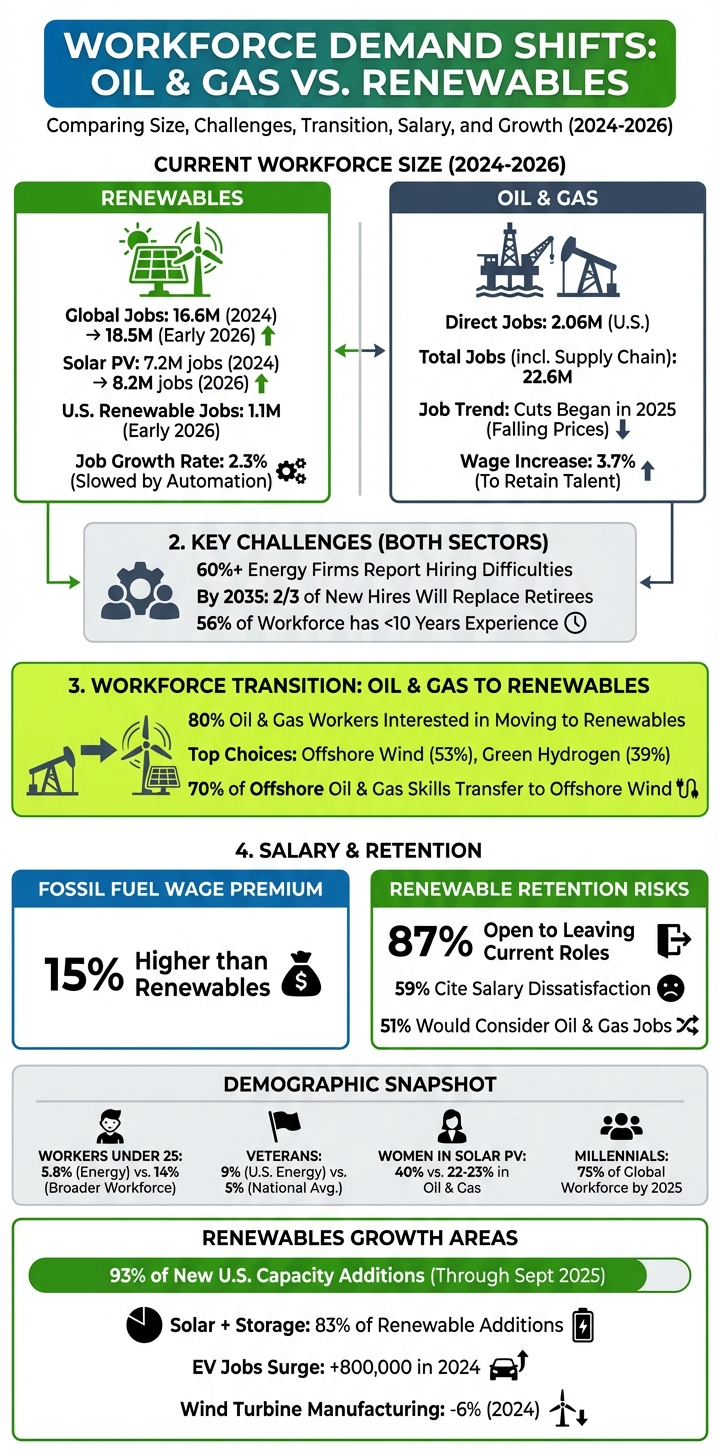
Oil & Gas vs Renewables: Workforce Statistics and Employment Trends Comparison
Employment Trends: Oil & Gas vs. Renewables
Current Workforce Sizes and Projections
As of 2024, renewable energy supports 16.6 million jobs globally, with solar PV leading the charge at 7.2 million positions. While the sector continues to grow, the pace of job creation lags behind the rapid expansion in capacity. In the United States alone, renewable energy employment reached around 1.1 million jobs by early 2026.
In contrast, the oil and gas industry, after recovering from the disruptions of 2020, began cutting jobs in 2025 due to falling prices and revenue declines. This shift highlights the inherent instability of traditional energy sector employment, which remains highly sensitive to market fluctuations.
Regionally, employment trends vary significantly. The Southwest, including Texas, New Mexico, and Arizona, has become a major hub for renewable energy jobs, thanks to large-scale solar-plus-storage projects and high energy demand from data centers. Texas (ERCOT) and the Southwest Power Pool regions lead in renewable employment due to their focus on low-carbon, reliable power sources. Meanwhile, traditional oil and gas jobs remain concentrated in established centers like Houston, Texas, though these areas face increasing pressure from changing market dynamics.
These regional differences provide a framework for examining patterns of job creation and decline.
Job Creation and Decline Patterns
Renewable energy has been a key driver of U.S. capacity growth, accounting for 93% of new capacity additions through September 2025, with solar and storage making up 83% of that total. However, global job growth in renewables has been modest, increasing by just 2.3%, partly due to advances in automation.
"Growing automation and economies of scale mean that comparatively less human labour is required for each new unit of capacity – although impacts vary across countries, technologies and segments of the renewable energy value chain."
- Francesco La Camera, Director-General, IRENA
Not all renewable sectors are expanding equally. Wind turbine manufacturing jobs, for instance, declined by 6% in 2024, largely due to challenges in the offshore market. On the other hand, jobs linked to electric vehicles (EVs) surged by nearly 800,000 in 2024, with China leading the way – close to 40% of its vehicle manufacturing workforce is now tied to EVs and batteries.
These shifts highlight how different market forces shape workforce needs across the energy spectrum.
Impact of Market Volatility
Market volatility adds another layer of complexity to workforce planning in both traditional and renewable energy sectors. In the oil and gas industry, falling prices in 2025 prompted companies to offer 3.7% wage increases to retain skilled employees and prevent talent loss during downturns.
Renewable energy faces its own set of challenges, including policy uncertainty, grid limitations, and geopolitical tensions, which temper job growth even as capacity installations hit record levels. For example, the "One Big Beautiful Bill Act" (OBBBA) of 2025 introduced tax credit changes that spurred developers to accelerate construction in certain regions, creating unpredictable hiring patterns.
Both sectors struggle with labor shortages, which impact project timelines. Over 60% of energy companies report difficulties in finding skilled workers to meet demand. Tools like ABLEMKR’s mobile-first platform are helping companies navigate these challenges by streamlining the hiring and deployment of skilled labor, allowing them to respond quickly to shifting market conditions.
sbb-itb-aa28329
Skills and Training: Bridging Workforce Gaps
Technical Skills and Certifications
The transition from oil and gas to renewable energy is smoother than many might think, as the core principles of physics remain the same across both industries. For instance, professionals skilled in subsea engineering, marine engineering, or handling high-voltage electrical equipment are finding their expertise in high demand for offshore wind projects. Similarly, experience in civil engineering, maintaining offshore structures, and managing complex logistics applies seamlessly to both sectors.
The primary difference lies in how these skills are applied. While oil and gas focus on resource extraction and refining, renewable energy prioritizes installing capacity and integrating with power grids. Areas like smart grid management, microgrid design, and distribution automation are emerging as key intersections between the two industries. Certifications such as the Certified Renewable Energy Professional (REP) from the Association of Energy Engineers are becoming essential for workers looking to establish their credentials across renewable technologies like solar, wind, and geothermal energy.
Moreover, the well-established safety protocols in oil and gas provide a solid foundation for renewable energy projects. As these projects scale up and face similar operational risks, the expertise gained in oil and gas safety is proving invaluable for developing robust safety frameworks in renewables. This overlap creates significant opportunities for reskilling efforts, making it easier for workers to transition between sectors.
Reskilling and Transitioning Workers
The interest in transitioning to renewable energy is widespread among oil and gas workers – around 80% express a desire to make the shift. Offshore wind is the top choice for 53% of these workers, while 39% are exploring opportunities in green hydrogen. To support this transition, initiatives like OPITO‘s Sustainability Training Standard (launched in November 2025) and EZOps’ partnership with Midland College (introduced in December 2025) are equipping workers with the skills needed for the evolving energy landscape. Accreditation from organizations like the North American Board of Certified Energy Practitioners (NABCEP) and the Interstate Renewable Energy Council (IREC) ensures these programs maintain high training standards.
Financial support plays a key role in making reskilling accessible. Workers can take advantage of up to $5,250 in tax-free educational assistance under federal tax law. Additionally, the $4,500 Powering Up Scholarship is available for those pursuing technical energy careers, while Solar Energy International offers scholarships covering 25% to 100% of course costs. These resources aim to ease the financial burden of gaining new qualifications and entering renewable energy fields.
Role of Technology in Workforce Evolution
Technology is playing a pivotal role in reshaping how the energy workforce operates. While automation has reduced the number of available jobs, it has also increased the demand for workers with advanced digital skills. This shift underscores the importance of specialized certifications and training.
Digital platforms are stepping in to address workforce challenges, particularly in matching skilled professionals to projects quickly and efficiently. For example, ABLEMKR’s mobile-first technology connects pre-vetted workers with job sites based on their certifications, safety training, availability, and location. This system ensures that experts in areas like high-voltage systems, offshore structures, or smart grid management are aligned with projects that need their specific expertise. By providing real-time visibility into worker credentials and compliance, operators can rapidly mobilize teams for tasks ranging from unexpected shutdowns to planned installations. This approach minimizes delays and simplifies workforce deployment across both traditional and renewable energy sectors.
Workforce Demographics and Retention
Generational Workforce Composition
The energy sector is grappling with a generational shift that’s hard to ignore. In Canada, workers under 25 make up just 5.8% of the energy workforce, compared to 14% in the broader labor force. Across the border in the U.S., while 84% of the energy workforce is under 55, attracting younger workers remains an uphill battle. Many younger employees prioritize environmental values, creating a disconnect with traditional energy sectors. This challenge is compounded by an experience gap: 56% of the energy workforce has fewer than 10 years of experience, leaving companies scrambling to replace retiring experts while building up the next generation of talent.
Different sectors within energy feel this generational divide in unique ways. By 2025, millennials are projected to make up 75% of the global workforce, bringing new expectations to hiring practices. For instance, one-third of workers aged 18–24 have rejected job offers from companies that didn’t align with their personal environmental and social values. This puts oil and gas firms under pressure to not only offer competitive salaries but also showcase credible environmental strategies. On the other hand, renewable energy companies naturally attract younger, mission-driven employees but often struggle to keep them due to less competitive pay.
Some demographics, however, show strong representation in the energy sector. In the U.S., veterans account for 9% of the energy workforce, nearly double the national average of 5%. In Canada, Indigenous peoples represent 7.3% of the energy labor force, compared to 3.5% in the overall labor market. Yet, gender diversity remains a hurdle. Women hold 40% of full-time roles in the solar PV sector, which is almost double the 22%–23% seen in oil and gas. Still, across the broader renewable energy industry, women make up just 32% of the workforce and only 19% of senior management positions.
These generational and demographic dynamics are creating major retention challenges as shifting worker expectations and wage disparities test the loyalty of the energy workforce.
Retention Challenges and Salary Trends
Retention has become a critical issue as the energy sector adapts to changing employment trends and evolving skill requirements. A 15% wage premium for fossil fuel jobs is driving many workers to leave renewables for better pay in oil and gas. The numbers speak volumes: 87% of renewable energy professionals are open to leaving their current roles, and 51% would consider moving to oil and gas jobs, up 14% from the previous year.
"Fossil fuel firms are becoming more popular among renewables workers by improving their ESG performance as well as pay." – Janette Marx, CEO, Airswift
Pay dissatisfaction is a key factor, with 59% of renewable energy workers citing salary issues and 50% pointing to inadequate benefits as reasons for frustration. Adding to the challenge, 78% of green energy workers received at least one job offer in the past year, underscoring both their high demand and high turnover rates.
For renewable energy companies, the path forward is clear but challenging. To compete with the salary advantages of fossil fuel firms, they need to emphasize non-monetary benefits like flexible work arrangements and the opportunity to make a meaningful societal impact. Meanwhile, fossil fuel companies are upping their game, combining competitive wages with improved environmental, social, and governance (ESG) metrics to attract even environmentally conscious talent.
Platforms like ABLEMKR aim to bridge these gaps by providing workers in both sectors with transparent access to well-paying opportunities and reliable, on-time payments. This reduces the friction that often pushes skilled professionals to leave the industry altogether.
Policy and Investment Influences on Workforce Demand
Tax Credits and Subsidies
In the face of market fluctuations impacting both oil and renewable energy sectors, government policies significantly influence workforce demand. Tax policies, in particular, play a direct role in hiring decisions. For over a century, fossil fuel subsidies have provided financial stability for long-term operations. For example, the 1916 intangible drilling cost deduction allows companies to write off 70% to 100% of non-equipment costs immediately. However, research shows that 75% to 96% of the value from these subsidies goes directly to company profits rather than generating new jobs.
Renewable energy tax credits, on the other hand, have been less consistent. Programs like the Investment Tax Credit (ITC) and Production Tax Credit (PTC) have faced repeated expirations and renewals, creating uncertainty for developers and their hiring plans. The Inflation Reduction Act was initially projected to support 9 million jobs over a decade. However, the 2025 One Big Beautiful Bill reversed many of these gains by cutting renewable tax credits short and introducing $39.7 billion in new subsidies for fossil fuels over a 10-year period.
This policy shift has had immediate effects on workforce demand. For instance, the expiration of the 30% residential solar credit in December 2025 impacted local jobs in solar installation and HVAC sectors. On the other hand, hydrogen production tax credits, expected to create 700,000 jobs by 2030, remain in place, though compressed deadlines are pushing developers to accelerate hiring. Energy Secretary Chris Wright justified this policy direction, stating:
"Subsidies are meant to drive prices down and boost supply. But subsidizing wind and solar has done exactly the opposite. … It’s time to stop subsidizing such insanity in perpetuity."
These fiscal decisions not only affect immediate hiring but also shape private infrastructure investments, which further influence workforce dynamics.
Infrastructure and Capital Investments
Beyond tax policies, market forces and capital investments are reshaping workforce demand, particularly in terms of grid integration and energy infrastructure. Government policies heavily influence private sector investments in clean energy. For instance, the Inflation Reduction Act was expected to spur over $3 trillion in private investment over the next decade. Meanwhile, the oil and gas sector supports approximately 2.06 million direct jobs, with the total – including supply chain and related positions – reaching 22.6 million. In Texas alone, the oil and natural gas industry contributed a record $27.3 billion in state and local taxes and royalties during fiscal year 2024.
However, infrastructure challenges are creating bottlenecks that affect job growth. Renewable energy projects are being developed faster than they can be integrated into the grid, with interconnection delays and grid constraints limiting employment opportunities in operations and maintenance. At the same time, the growing demand for AI data centers has led to increased infrastructure spending on reliable power sources, benefiting sectors like natural gas, nuclear, and solar-plus-storage projects that can bypass interconnection queues. This trend is driving demand for skilled trades such as line workers and electricians, especially as nearly 30% of electricians approach retirement age.
As the renewable energy sector evolves, it is becoming more automated and reliant on capital-intensive projects, narrowing its job creation advantage over the already automated fossil fuel industry. Platforms like ABLEMKR are stepping in to connect pre-vetted workers with critical projects, ensuring quick deployment across sectors. These shifts in infrastructure investment and market trends are transforming job opportunities and workforce dynamics, reflecting the broader transitions taking place across the energy landscape.
Emerging Opportunities and Workforce Transition Support
Growth Sectors in Renewables
By early 2026, renewable energy employment worldwide reached an impressive 18.5 million jobs. Solar PV alone accounted for 8.2 million of these, while job postings in grid modernization and energy storage saw a 15% year-over-year increase. The fastest-growing areas include solar installation, wind turbine maintenance, and advancements in grid modernization paired with energy storage.
Interestingly, about 70% of the technical skills used in offshore oil and gas operations can be applied directly to offshore wind roles. For example, solar installers need expertise in electrical wiring and DC/AC conversion, and wind turbine technicians depend on mechanical maintenance and hydraulics – skills already familiar to many oil and gas professionals. Additionally, traditional energy companies are starting to pivot towards decarbonization efforts, creating roles in areas like Carbon Capture, Utilization, and Storage (CCUS) and clean hydrogen production. These shifts allow workers to transition within their current organizations.
As renewable energy industries continue to expand, providing structured support for workers navigating these transitions becomes increasingly essential.
Supporting Workers Through Transition
Helping workers shift to emerging sectors requires accessible pathways and flexible opportunities. Programs like the Governor’s Climate Ready Workforce Initiative aim to address this need by committing to train 1 million new registered apprentices in climate and clean energy fields over the next decade. This initiative, supported by 24 U.S. governors, underscores the importance of preparing the workforce for the demands of a clean energy economy.
States like Michigan and New Jersey are leading collaborative efforts, while Georgia’s Quick Start Program offers customized job training at no cost to qualified clean energy companies. These programs are expanding opportunities in areas like clean fuels and battery technologies.
Digital tools are also playing a role. Platforms like ABLEMKR connect pre-vetted workers to critical projects based on their certifications, safety training, and location. This ensures teams can be quickly mobilized for tasks such as pipeline repairs or solar installations.
A shift toward a skills-first approach is further opening doors for workers. This framework prioritizes competencies over traditional degrees. For instance, Binghamton University‘s New Energy New York Battery Academy offers micro-credentials in battery storage and solar installation. As noted by IRENA:
"The transition is not just about changing energy sources; it is about evolving the workforce to meet the demands of a more complex, integrated, and digitalized energy landscape."
Workers who focus on certifications in areas like project management, high-voltage electrical work, and digital system monitoring are likely to find greater mobility across sectors. These efforts not only ease transitions but also address broader workforce challenges in an economy shaped by rapid changes.
Michael Love : Energy Transition Jobs: What Skills Still Matter and Where the Work Is Going | Ene…
Conclusion
The workforce trends in energy tell a striking story: while fossil fuel jobs are declining, clean energy employment is on a steady rise. From 2019 to 2022, fossil fuel jobs dropped by 4%, but clean energy jobs grew by an impressive 16%. By early 2026, global renewable energy employment hit record highs, signaling a major shift in the industry. This isn’t just a numbers game – it’s a transformation in how energy companies approach workforce strategies.
The need for a skilled workforce is more pressing than ever. The energy sector now demands 36% high-skilled workers, compared to 27% in the broader economy. At the same time, there’s a noticeable shortage of medium-skilled workers, including electricians and welders. These gaps highlight the natural pathways for reskilling and upskilling. As the IEA puts it:
"Retraining and upskilling initiatives can be an effective solution… to align academic curricula with the quickly evolving needs of the energy labour market".
Addressing these challenges requires modern solutions. Workforce volatility is a persistent issue, especially under least-cost electricity scenarios where employment needs can shift drastically. Technology-driven hiring platforms like ABLEMKR are stepping in to bridge this gap. By connecting pre-vetted workers to projects based on certifications, safety training, and location, these platforms offer flexibility for industries while ensuring workers have steady access to opportunities – whether it’s for an urgent pipeline repair or a planned solar installation.
The energy transition is happening now. Companies that invest in reskilling, embrace skills-focused hiring, and leverage digital tools will be better equipped to thrive in this rapidly evolving landscape.
FAQs
Why is renewable job growth slowing even as capacity rises?
The growth of jobs in the renewable energy sector is slowing, even as capacity continues to expand. This slowdown is tied to several factors, including geopolitical tensions, the rise of automation, and inconsistent investment and policy support. These issues have led to a gap between the rapid deployment of renewable energy projects and the slower growth of employment opportunities in the field.
Which oil and gas skills transfer best to renewables?
Skills from the oil and gas sector are highly applicable to the renewables industry. For example, offshore engineering, high-pressure systems, and complex fluid management translate seamlessly to projects like offshore wind farms and green hydrogen production.
Specialized knowledge in areas such as marine logistics, structural design, and subsea installation is particularly relevant for managing offshore wind turbines and laying subsea cables. Furthermore, expertise in project management, safety protocols, and design engineering plays a critical role in developing large-scale renewable energy infrastructure. These skills are increasingly sought after as the renewable energy sector continues to expand.
How do tax credit changes affect energy hiring in the U.S.?
Tax credit adjustments are reshaping the energy job market, boosting the need for skilled workers and steering investments into new projects. Policies such as the Inflation Reduction Act (IRA) of 2022 and the One Big Beautiful Bill Act (OBBBA) of 2026 have expanded clean energy tax credits. These incentives encourage renewable energy projects that adhere to wage and apprenticeship requirements. As a result, hiring has surged, with companies prioritizing workforce training and using technology platforms to deploy skilled teams efficiently.


